


 |
市場調查報告書
商品編碼
2117482
美國電子製造服務:市場佔有率分析、行業趨勢和統計數據、成長預測(2026-2031 年)United States Electronics Manufacturing Services - Market Share Analysis, Industry Trends & Statistics, Growth Forecasts (2026 - 2031) |
||||||

※ 本網頁內容可能與最新版本有所差異。詳細情況請與我們聯繫。
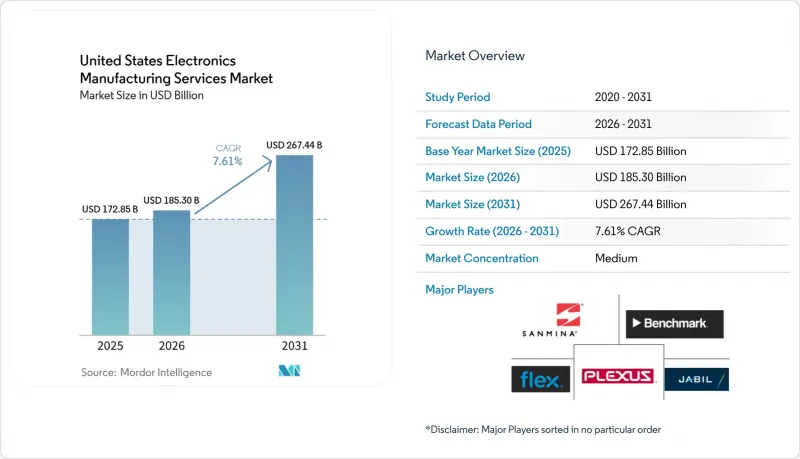
根據 Mordor Intelligence 預測,美國電子製造服務市場規模將從 2025 年的 1,728.5 億美元和 2026 年的 1,853 億美元成長到 2031 年的 2,674.4 億美元,2026 年至 2031 年的複合年成長率為 7.61%。
本報告依服務類型(電子設備製造服務、工程服務等)、經營模式(契約製造、ODM等)、製造流程(表面黏著技術、通孔技術等)及最終用戶(行動裝置、消費性電子產品等)分類。市場預測以美元計價。
美國電子製造服務市場的趨勢與洞察
根據《企業回流促進法案》採取的措施和加速津貼發放。
根據先進製造投資稅額扣抵,聯邦政府的獎勵已將新型SMT和光學檢測設備的稅後成本降低了25%,甚至使獲利能力盈利的項目也扭虧為盈。 390億美元的晶片製造津貼預算幾乎全部將在2025年底前分配完畢,其中台積電將獲得66億美元,英特爾將獲得78.6億美元,舉措將獲得47.4億美元。據報道,每家公司獲得的津貼都與其在當地擁有的先進封裝生產能力掛鉤,而這些能力又依賴國內的電子製造服務(EMS)合作夥伴。根據「回流計劃」的數據,2024年美國新增製造業就業機會將達到24.4萬個,其中電腦和電子產業將佔35%,這是自開始追蹤以來的最高比例。這些措施的結合將使組裝廠選址在晶圓生產廠一日車程範圍內成為可能,並縮短可製造性設計(DFM)週期。
醫療設備的小型化正在推動精密SMT技術的應用。
植入式心臟整流去顫器、胰島素幫浦和攜帶式超音波探頭目前均採用 01005 尺寸的被動元件和微封裝封裝 (µBGA),這些元件對安裝公差要求極高,小於 30µm,迫使電子製造服務 (EMS) 供應商升級其貼片機和 X光檢測線。 ISO 13485 審核日益要求追溯至單一捲筒批次單元,迫使工廠實施雷射打標和自動化資料採集系統,以即時輸入電子設備歷史記錄。擁有內部微雷射焊接和三防膠室的供應商贏得了更多契約,並將 OEM檢驗週期縮短了數週,因為他們可以交付完整的、可直接進行滅菌的成品組件。因此,小批量、高利潤的醫療設備專案源源不斷地湧入,進一步增加了美國製造工廠對精密表面貼裝技術 (SMT) 生產能力的需求。
美國電子組裝產業長期面臨技術純熟勞工短缺問題
2025年,美國勞工統計局報告稱,電子組裝產業的職缺率高達12%,凸顯了該產業面臨的嚴峻挑戰。人手不足導致IPC-A-610 3級職位的平均招募時間超過90天。受此影響,薪資溢價年增18%。工資上漲產生了顯著影響,使供應商的息稅前利潤下降了約120個基點。此外,人手不足加速了SMT生產線上協作機器人的應用,凸顯了該產業向自動化轉型的趨勢。社區大學認證計畫旨在解決這些人手不足,但預計其效果要到2027年才會顯現,這將導致短期成長預計下降0.7%。
細分市場分析
預計到2031年,電子機械組裝和整機銷售將以8.65%的複合年成長率成長,逐步縮小與PCB組裝(美國EMS市場最大的細分領域)在2025年48.29%的市佔率差距。這一成長反映出汽車製造商將電池管理系統和ADAS計算模組外包給能夠提供包括機殼製造、線束連接和最終功能測試在內的整合服務的國內合作夥伴。一級供應商透過大量採購鋁製外殼和大電流匯流排來利用規模經濟,這種模式是小規模的專用工廠無法複製的,而且模具成本還可以分攤到多個汽車平臺上。
儘管PCB組裝對於智慧型手機、路由器和工業控制器仍然至關重要,但隨著消費者更換週期的延長,其產量卻停滯不前。人工智慧硬體新創公司的原型訂單在一定程度上緩解了這種低迷,將小批量多層板的生產任務轉移到了價格更高的3級生產線上。與可製造性設計(DFM)相關的工程服務如今已成為一項必備條件,能夠在同一園區內開發線上測試(ICT)的供應商正在後續的大規模生產中佔據市場佔有率。物流服務透過免除OEM廠商的元件採購成本,完善了承包工程,從而在資金緊張的醫療和工業領域提供了決定性的優勢。
儘管到2025年,契約製造將占美國EMS市場收入的71.93%,但原始設計製造(ODM)領域正以9.97%的複合年成長率快速成長,因為OEM廠商正在尋求涵蓋材料、組裝和法規文件的「單一發票」解決方案。在承包合約模式下,EMS供應商承擔組件採購風險、維持緩衝庫存並管理供應商評估,這對於那些爭分奪秒趕上FDA申報截止日期的醫療設備新創公司來說極具吸引力。混合合約則透過允許客戶保留韌體和演算法的智慧財產權(IP),同時將PCB佈局和測試夾具設計外包給EMS供應商,從而在保護核心技術的同時加快了製造速度。
原始設計製造 (ODM) 仍然是一個小眾管道,主要專注於無差異化的白牌網路設備和 POS 終端。然而,混合模式已成為不願放棄主導的OEM 廠商的立足點,Plexus 報告稱,此類合約在 2025 年將帶來兩位數的利潤成長。在供應鏈持續不確定性的情況下,採用混合模式的公司,透過發票合併和加速設計變更 (ECO) 週期,正在美國電子製造服務 (EMS) 市場中確保持續的結構性優勢。
其他好處:
- Excel格式的市場預測(ME)表
- 3個月的分析師支持
目錄
第1章:引言
- 研究假設和市場定義
- 調查範圍
第2章:調查方法
第3章執行摘要
第4章 市場狀況
- 市場概覽
- 市場促進因素
- 基於「CHIPS 法案」的回流激勵措施和加速補貼
- 生成式人工智慧硬體的蓬勃發展正在推動對高速、多品種組裝的需求。
- 汽車電子產業正在將重點轉向電動車動力傳動系統和高級駕駛輔助系統 (ADAS)。
- 對安全且符合ITAR規定的國防生產的需求日益成長
- 醫療設備的小型化正在推動高精度SMT(表面貼裝技術)的應用。
- 二三級原始設備製造商 (OEM) 將新產品開發 (NPI) 外包,以縮短產品上市時間。
- 市場限制因素
- 美國電子組裝產業長期面臨技術純熟勞工短缺問題
- 產品零件價格波動給利潤率帶來了壓力。
- 先進基板的PCB供應鏈脆弱不堪
- 網路安全和智慧財產權外洩問題限制了基於雲端的協作。
- 產業價值鏈分析
- 監理情勢
- 技術展望
- 宏觀經濟因素對市場的影響
- 波特五力分析
第5章 市場規模與成長預測
- 按服務類型
- 電子製造服務
- 印刷基板(PCB)組裝
- 電子機械組裝/箱體製造
- 原型製作
- 其他電子製造服務
- 工程服務
- 測試和開發實施服務
- 物流服務
- 其他服務類型
- 電子製造服務
- 按經營模式
- 契約製造(CM)
- 原始設計製造(ODM)
- 混合/承包/其他經營模式
- 透過製造程序
- 表面黏著技術(SMT)
- 通孔技術(THT)
- 先進封裝/混合工藝
- 最終用戶
- 行動裝置(智慧型手機和平板電腦)
- 家用電子產品
- 電腦(桌上型電腦/筆記型電腦)
- 產業
- 車
- 溝通
- 照明
- 醫學領域
- 其他最終用戶
第6章 競爭情勢
- 市場集中度
- 策略趨勢
- 市佔率分析
- 公司簡介
- Jabil Inc.
- Flex Ltd.
- Sanmina Corporation
- Celestica Inc.
- Plexus Corp.
- Benchmark Electronics Inc.
- Kimball Electronics Inc.
- Key Tronic Corporation
- SigmaTron International Inc.
- Creation Technologies LP
- IEC Electronics Corp.
- TT Electronics plc
- Vexos Corporation
- Nortech Systems Inc.
- Sparton Corporation
- Zollner Elektronik AG
- Fabrinet USA
- OnCore Manufacturing Services LLC
- MC Assembly LLC
- Computrol Inc.
第7章 市場機會與未來展望
According to Mordor Intelligence, the United States electronics manufacturing services market size in 2026 is projected to expand from USD 172.85 billion in 2025 and USD 185.30 billion in 2026 to USD 267.44 billion by 2031, registering a CAGR of 7.61% between 2026 to 2031.
This report is Segmented by Service Type (Electronic Manufacturing Services, Engineering Services, and More), Business Model (Contract Manufacturing, Original Design Manufacturing, and More), Manufacturing Process (Surface Mount Technology, Through-Hole Technology, and More), End-User (Mobile, Consumer, and More). The Market Forecasts are Provided in Terms of Value (USD).
United States Electronics Manufacturing Services Market Trends and Insights
Accelerating Reshoring Incentives And CHIPS Act Subsidies
Federal incentives lowered the after-tax cost of new SMT and optical-inspection equipment by 25% under the Advanced Manufacturing Investment Credit, tipping marginal business cases into positive territory. Nearly all of the USD 39 billion CHIPS grant pool was committed by late 2025, including USD 6.6 billion to TSMC, USD 7.86 billion to Intel, and USD 4.74 billion to Samsung, each tied to co-located advanced-packaging capacity that depends on domestic EMS partners reported. Reshoring Initiative data confirm 244,000 U.S. manufacturing jobs announced in 2024, with computer and electronics accounting for 35%, the highest share since tracking began. Together, these levers shorten design-for-manufacturability loops by bringing assembly within a one-day truck haul of wafer output.
Medical-Device Miniaturization Driving Precision SMT Adoption
Implantable cardioverter defibrillators, insulin pumps, and portable ultrasound probes now rely on 01005 passives and µBGAs that demand placement tolerances tighter than 30 µm, prompting EMS providers to upgrade pick-and-place heads and x-ray inspection lines. ISO 13485 audits increasingly require traceability down to individual reel lots, pushing factories to deploy laser marking and automated data-capture systems that feed electronic device history records in real time. Providers with in-house micro-laser welding and conformal-coating booths win more contracts because they can ship fully finished assemblies ready for sterilization, trimming OEM validation cycles by several weeks. The net result is a steady inflow of low-volume, high-margin medical programs that reinforce demand for precision SMT capacity across U.S. campuses.
Persistent Skilled-Labor Shortage In U.S. Electronics Assembly
In 2025, the Bureau of Labor Statistics highlighted a significant challenge in the electronics assembly sector, reporting a 12% vacancy rate. This shortage extended the median time-to-fill for IPC-A-610 Class 3 roles beyond 90 days. As a result of these vacancies, wage premiums surged by 18% year over year. This wage spike had a tangible impact, trimming provider EBIT by approximately 120 basis points. Furthermore, the labor crunch has hastened the adoption of collaborative robots on SMT lines, underscoring the industry's push towards automation. While community-college certificate programs aim to address these shortages, their impact won't be felt until 2027, leading to a projected 0.7% dip in near-term growth.
Other drivers and restraints analyzed in the detailed report include:
- Tier-2 And Tier-3 OEMs Outsourcing NPI For Time-To-Market Gains
- Rising Demand For Secure ITAR-Compliant Defense Production
- Margin Compression From Commodity Component Price Swings
For complete list of drivers and restraints, kindly check the Table Of Contents.
Segment Analysis
Electromechanical assembly and box build revenue is expected to grow at a 8.65% CAGR to 2031, steadily narrowing the 48.29% 2025 lead held by PCB assembly as the laregets sub-segment of the United States EMS Market. This surge reflects automakers outsourcing battery-management systems and ADAS compute modules to domestic partners that can bundle enclosure fabrication, cable harnesses, and end-of-line functional tests. Tier-1 providers leverage scale purchasing for aluminum housings and high-current busbars, then amortize tooling across multiple vehicle platforms, a dynamic that smaller captive plants cannot replicate.
PCB assembly remains indispensable for smartphones, routers, and industrial controllers, yet its unit volume is flattening as consumer upgrade cycles lengthen. Prototyping orders from AI-hardware startups partially offset this softness, bringing short-run, high-layer-count work into premium-priced Class 3 lines. Engineering services linked to design-for-manufacturability have become table stakes, and providers capable of performing in-circuit test development inside the same campus win a larger share of follow-on production. Logistics services round out turnkey contracts by freeing OEMs from component financing, a decisive edge in capital-constrained medical and industrial niches.
Contract manufacturing accounted for 71.93% share of 2025 of the United States EMS Market's revenue, but Original Design Manufacturing (ODM) segment is advancing at a 9.97% CAGR as OEMs seek single-invoice solutions that cover materials, assembly, and regulatory documentation. Under turnkey deals, EMS providers shoulder component-sourcing risk, hold buffer stock, and manage supplier scorecards, features that appeal to medical-device start-ups scrambling to meet FDA submission deadlines. Hybrid contracts carve out firmware and algorithm IP for the customer while delegating PCB layout and test-fixture design to the EMS house, protecting core technology yet expediting builds.
Original design manufacturing remains a niche pathway centered on white-label networking gear and point-of-sale terminals where differentiation is thin. Nonetheless, hybrid models offer a stepping stone for OEMs wary of relinquishing control, and Plexus reported double-digit gains from such engagements in 2025. As supply-chain unpredictability persists, invoice consolidation and faster engineering change-order cycles give the hybrid cohort a durable structural advantage in the United States electronics manufacturing services (EMS) market.
Complete Report Scope:
- By Service Type
- Electronic Manufacturing Services
- PCB Assembly
- Electromechanical Assembly/Box Build
- Prototyping
- Other Electronic Manufacturing Services
- Engineering Services
- Test and Development Implementation Services
- Logistics Services
- Other Service Types
- Electronic Manufacturing Services
- By Business Model
- Contract Manufacturing (CM)
- Original Design Manufacturing (ODM)
- Hybrid / Turnkey / Other Business Models
- By Manufacturing Process
- Surface Mount Technology (SMT)
- Through-Hole Technology (THT)
- Advanced Packaging / Hybrid Processes
- By End-user
- Mobile Devices (Smartphones and Tablets)
- Consumer Electronics
- Computer (PCs/Desktop/Laptops)
- Industrial
- Automotive
- Communication
- Lighting
- Medical
- Other End-users
List of Companies Covered in this Report:
- Jabil Inc.
- Flex Ltd.
- Sanmina Corporation
- Celestica Inc.
- Plexus Corp.
- Benchmark Electronics Inc.
- Kimball Electronics Inc.
- Key Tronic Corporation
- SigmaTron International Inc.
- Creation Technologies LP
- IEC Electronics Corp.
- TT Electronics plc
- Vexos Corporation
- Nortech Systems Inc.
- Sparton Corporation
- Zollner Elektronik AG
- Fabrinet USA
- OnCore Manufacturing Services LLC
- MC Assembly LLC
- Computrol Inc.
Additional Benefits:
- The market estimate (ME) sheet in Excel format
- 3 months of analyst support
TABLE OF CONTENTS
1 INTRODUCTION
- 1.1 Study Assumptions and Market Definition
- 1.2 Scope of the Study
2 RESEARCH METHODOLOGY
3 EXECUTIVE SUMMARY
4 MARKET LANDSCAPE
- 4.1 Market Overview
- 4.2 Market Drivers
- 4.2.1 Accelerating Reshoring Incentives and CHIPS Act Subsidies
- 4.2.2 Generative-AI Hardware Boom Requiring High-Mix, High-Speed Assembly
- 4.2.3 Automotive Electronics Pivot to EV Powertrains and ADAS
- 4.2.4 Rising Demand for Secure, ITAR-Compliant Defense Production
- 4.2.5 Medical-Device Miniaturization Driving Precision SMT Adoption
- 4.2.6 Tier-2/3 OEMs Outsourcing NPI for Time-to-Market Gains
- 4.3 Market Restraints
- 4.3.1 Persistent Skilled-Labor Shortage in U.S. Electronics Assembly
- 4.3.2 Margin Compression from Commodity Component Price Swings
- 4.3.3 Fragile PCB Supply Chain for Advanced Substrates
- 4.3.4 Cyber-Security and IP Leakage Concerns Limiting Cloud-Based Collaboration
- 4.4 Industry Value-Chain Analysis
- 4.5 Regulatory Landscape
- 4.6 Technological Outlook
- 4.7 Impact of Macroeconomic Factors on the Market
- 4.8 Porter's Five Forces Analysis
- 4.8.1 Threat of New Entrants
- 4.8.2 Bargaining Power of Suppliers
- 4.8.3 Bargaining Power of Buyers
- 4.8.4 Threat of Substitutes
- 4.8.5 Intensity of Competitive Rivalry
5 MARKET SIZE AND GROWTH FORECASTS (VALUE)
- 5.1 By Service Type
- 5.1.1 Electronic Manufacturing Services
- 5.1.1.1 PCB Assembly
- 5.1.1.2 Electromechanical Assembly/Box Build
- 5.1.1.3 Prototyping
- 5.1.1.4 Other Electronic Manufacturing Services
- 5.1.2 Engineering Services
- 5.1.3 Test and Development Implementation Services
- 5.1.4 Logistics Services
- 5.1.5 Other Service Types
- 5.1.1 Electronic Manufacturing Services
- 5.2 By Business Model
- 5.2.1 Contract Manufacturing (CM)
- 5.2.2 Original Design Manufacturing (ODM)
- 5.2.3 Hybrid / Turnkey / Other Business Models
- 5.3 By Manufacturing Process
- 5.3.1 Surface Mount Technology (SMT)
- 5.3.2 Through-Hole Technology (THT)
- 5.3.3 Advanced Packaging / Hybrid Processes
- 5.4 By End-user
- 5.4.1 Mobile Devices (Smartphones and Tablets)
- 5.4.2 Consumer Electronics
- 5.4.3 Computer (PCs/Desktop/Laptops)
- 5.4.4 Industrial
- 5.4.5 Automotive
- 5.4.6 Communication
- 5.4.7 Lighting
- 5.4.8 Medical
- 5.4.9 Other End-users
6 COMPETITIVE LANDSCAPE
- 6.1 Market Concentration
- 6.2 Strategic Moves
- 6.3 Market Share Analysis
- 6.4 Company Profiles (includes Global Level Overview, Market Level Overview, Core Segments, Financials as available, Strategic Information, Market Rank/Share, Products and Services, Recent Developments)
- 6.4.1 Jabil Inc.
- 6.4.2 Flex Ltd.
- 6.4.3 Sanmina Corporation
- 6.4.4 Celestica Inc.
- 6.4.5 Plexus Corp.
- 6.4.6 Benchmark Electronics Inc.
- 6.4.7 Kimball Electronics Inc.
- 6.4.8 Key Tronic Corporation
- 6.4.9 SigmaTron International Inc.
- 6.4.10 Creation Technologies LP
- 6.4.11 IEC Electronics Corp.
- 6.4.12 TT Electronics plc
- 6.4.13 Vexos Corporation
- 6.4.14 Nortech Systems Inc.
- 6.4.15 Sparton Corporation
- 6.4.16 Zollner Elektronik AG
- 6.4.17 Fabrinet USA
- 6.4.18 OnCore Manufacturing Services LLC
- 6.4.19 MC Assembly LLC
- 6.4.20 Computrol Inc.
7 MARKET OPPORTUNITIES AND FUTURE OUTLOOK
- 7.1 White-space and Unmet-Need Assessment

 全球電子製造服務市場規模、佔有率、趨勢和成長分析報告(2026-2034)
 電子製造服務:市場佔有率分析、產業趨勢與統計、成長預測(2026-2031)北美電子製造服務:市場佔有率分析、產業趨勢與統計、成長預測(2026-2031 年)
 電子製造服務市場:2026-2032年全球市場預測(依服務類型、技術、組件類型、最終用戶產業及企業規模分類)電子設備電子製造服務:市場佔有率分析、產業趨勢與統計、成長預測(2026-2031)
 專業電子代工服務 (EMS) 市場:按服務、產品類型、經營模式、最終用途、國家和地區分類 - 全球產業分析、市場規模與佔有率及未來預測 (2026-2033)電子製造服務市場:依服務、經營模式、製造流程、最終用戶、國家及地區分類-全球產業分析、市場規模、市場佔有率及2026年至2033年預測
 電子受託製造服務市場預測至2034年-按服務類型、經營模式、製造形式、最終用戶產業和地區分類的全球分析
 全球電訊設備受託製造服務(EMS)市場。
 通訊電子製造服務市場:全球產業規模、佔有率、趨勢、機會和預測(按服務、應用和地區分類)、競爭格局(2021-2031 年)