


 |
市場調查報告書
商品編碼
2097394
電子設備電子製造服務:市場佔有率分析、產業趨勢與統計、成長預測(2026-2031)Electronics Manufacturing Services For Consumer Electronics - Market Share Analysis, Industry Trends & Statistics, Growth Forecasts (2026 - 2031) |
||||||

※ 本網頁內容可能與最新版本有所差異。詳細情況請與我們聯繫。
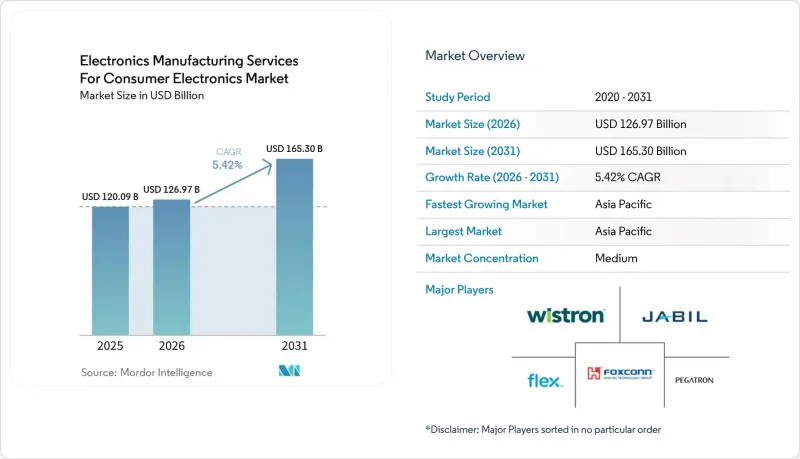
根據 Mordor Intelligence 預測,家用電子電器的電子製造服務 (EMS) 市場規模將從 2025 年的 1,200.9 億美元成長到 2026 年的 1,269.7 億美元,然後在 2031 年達到 1,653 億美元,2026 年至 2031 年的複合年成長率為 5.2%。
本報告按服務類型(電子製造服務,包括PCB組裝、電子機械組裝/整機組裝等)、經營模式(契約製造等)、製造流程(表面黏著技術等)和地區進行細分。市場預測以價值(美元)表示。
全球家用電子電器。
智慧型穿戴裝置的激增需要小型化和高密度EMS。
預計到2025年,穿戴式裝置的出貨量將達到5.23億台,而目前典型的智慧型手錶採用厚度小於10毫米的多層軟硬複合基板。為了滿足這項需求,EMS合作夥伴正在引入雷射直接曝光系統和微孔鑽孔技術,實現小於50微米的線寬,從而實現每平方公分超過120個元件的元件貼裝密度。由於這些設備缺乏主動散熱功能,溫度控管至關重要。供應商正在合作進行散熱片設計和晶片組選擇,以確保皮膚接觸溫度低於IEC 62368-1標準規定的41 度C限值(IEC.CH)。蘋果將Watch組裝轉移到立訊精密位於巴克讚的無塵室,凸顯了穿戴式產品生產地理分散化的趨勢。
智慧型手機產品生命週期的縮短正在推動外包。
預計2025年發布的旗艦機型的市場生命週期僅9.7個月,較2020年的14.2個月大幅下降。因此,OEM廠商紛紛將組裝組裝給EMS合作夥伴,以便分攤設備成本至多個品牌。富士康鄭州工廠只需72小時即可完成三個品牌之間的生產切換,只需重新調整47條SMT生產線、更換鋼網並重新編程貼片機即可。這種透過外包將固定成本轉化為變動成本的能力,在產品快速淘汰的高風險環境下,是至關重要的優勢。
產品價格波動導致利潤率承壓
2025年,銅價在每噸8,200美元至1,0400美元之間波動,環氧樹脂價格較去年同期增加14%。 PCB層壓板佔元件成本的22%,拖累了EMS企業的毛利率。儘管有成本轉嫁條款,Flex在2025會計年度第三季的毛利率仍下降了120個基點。規模較小的公司尤其舉步維艱,有時甚至會退出一些較簡單的製造項目。
細分市場分析
預計到2025年,PCB組裝將佔總銷售額的41.73%,成為家用電子電器市場電子製造服務(EMS)的基礎。然而,隨著品牌整合供應商,電子機械和整機組裝合約預計將成長5.81%,超過整體市場成長率。這種轉變反映出市場對承包機殼、散熱解決方案和最終測試的需求,這些服務均可在同一採購訂單內完成,從而降低協調成本並加快產品推出。
整機組裝定價通常包含佈線、韌體設計和封裝,這使得EMS合作夥伴能夠獲得專案價值的更大佔有率。雖然原型製作仍然是一個小眾領域,但它對於檢驗可製造性設計(DFM)至關重要,而Sanmina的原型製作週期已縮短至10天以內。測試服務的重要性日益凸顯,推動了人工智慧基板中神經網路精度檢查的需求,促使Benchmark計畫在2025年將其自動化測試能力提升18%。因此,預計到2031年,家用電子電器市場整機組裝的EMS市場佔有率將持續成長。
區域分析
預計到2025年,亞太地區將佔全球消費性電子EMS市場銷售額的60.88%,並保持在主導地位,到2031年將以6.55%的複合年成長率持續成長。亞太地區家用電子電器EMS市場佔有率的優勢主要歸功於廣東、江蘇和檳城密集的元裝置生態系統,以及印度的生產連結獎勵計畫計劃(PLI),該計劃可在五年內返還高達新增銷售額6%的補貼。越南在2025年吸引了89億美元的電子業外商直接投資(FDI),但海防港的擁塞導致貨櫃停留時間延長了4.3天,抵消了最初吸引中國OEM廠商帶來的成本節約效益。隨著馬來西亞Klim走廊持續加強其測試和封裝能力,以及泰國專注於中階智慧型手機組裝,以亞太地區多國供應鏈為核心的家用電子電器電子製造服務市場持續蓬勃發展。
隨著印度智慧型手機產量在2025年達到3.4億部,其中出口量佔58%,印度家用電子電器市場的電子製造服務(EMS)規模也隨之擴大。富士康、和碩和緯創已在泰米爾納德邦、北方邦和卡納塔克邦建立了整機生產線,利用保稅倉庫政策將清關流程縮短至12小時。在越南北寧省,三星擁有一個由六家工廠組成的綜合體,該綜合體構成了一個二級印刷電路基板和鏡頭供應商叢集,與從深圳出貨相比,前置作業時間縮短了27%。位於墨西哥瓜達拉哈拉和奇瓦瓦的工廠則作為筆記型電腦和網路設備的區域中心,利用了美墨加協定(USMCA)的規定,該規定對來自北美、增值率達到75%或以上的組裝免徵關稅。這些地點共同構成了「中國+1」策略的基礎,為OEM製造商提供替代路線,以防中國的供應鏈因出口限制或疫情相關限制而中斷。
儘管北美和歐洲合計在2025年僅佔全球銷售額的不到25%,但這些地區專注於高混合、低產量的生產,因此需要嚴格的智慧財產權保護和與設計團隊的接近性。位於加州和德克薩斯州的美國工廠專門從事先進封裝和用於國防應用的耐環境平板電腦的試點生產,而位於羅馬尼亞和波蘭的工廠則為歐洲電動車專案組組裝電池管理系統。巴西透過關稅壁壘和在地採購法規保護消費性電子產業基礎,這促使像Flex這樣的電子製造服務(EMS)公司為其巴西子公司申請ISO 14001認證,以確保獲得公共部門訂單。中東和非洲仍然是小眾市場,其中阿拉伯聯合大公國主要作為物流和轉口樞紐,向歐洲和非洲的分銷通路供應產品。在政策和勞工條件不斷變化的背景下,跨越三大洲的並行生產能力對於維持家用電子電器市場電子製造服務的供應連續性至關重要。
其他好處:
- Excel格式的市場預測(ME)表
- 3個月的分析師支持
目錄
第1章:引言
- 研究假設和市場定義
- 調查範圍
第2章:調查方法
第3章執行摘要
第4章 市場狀況
- 市場概覽
- 市場促進因素
- 智慧型穿戴裝置的普及需要小型、高密度EMS。
- 智慧型手機產品生命週期的縮短正在推動外包。
- 透過OEM模式促進本地化生產,“中國+1”
- 消費級SoC中先進構裝基板的採用
- 歐盟「維修權」政策推動環保電子產品需求成長
- 將人工智慧加速器整合到邊緣設備中,正在推動對複雜PCB的需求。
- 市場限制因素
- 產品價格波動導致利潤率承壓
- 對先進半導體技術的地緣政治出口限制
- 主要電子製造服務 (EMS) 地點面臨勞動力短缺和工資上漲的問題。
- 環境合規成本、RoHS3 和 PFAS 法規
- 產業價值鏈分析
- 監理情勢
- 技術展望
- 宏觀經濟因素對市場的影響
- 波特五力分析
第5章 市場規模與成長預測
- 按服務類型
- 電子製造服務
- PCB組裝
- 電子機械組裝/箱體製造
- 原型製作
- 其他電子製造服務
- 工程服務
- 測試和開發執行
- 物流服務
- 其他服務類型
- 電子製造服務
- 按經營模式
- 契約製造(CM)
- 原始設計製造(ODM)
- 混合/承包/其他經營模式
- 透過製造程序
- 表面黏著技術(SMT)
- 通孔技術(THT)
- 先進封裝/混合工藝
- 按地區
- 北美洲
- 美國
- 加拿大
- 墨西哥
- 歐洲
- 德國
- 英國
- 其他歐洲國家
- 亞太地區
- 中國
- 日本
- 韓國
- 印度
- 東南亞
- 其他亞太國家
- 南美洲
- 中東和非洲
- 北美洲
第6章 競爭情勢
- 市場集中度
- 策略趨勢
- 市佔率分析
- 公司簡介
- Foxconn Technology Group
- Pegatron Corporation
- Flex Ltd.
- Wistron Corporation
- Jabil Inc.
- Sanmina Corporation
- Celestica Inc.
- Compal Electronics Inc.
- Inventec Corporation
- Quanta Computer Inc.
- BYD Electronic(International)Company Limited
- Plexus Corporation
- Universal Scientific Industrial Co Ltd.(USI)
- New Kinpo Group(Cal-Comp Electronics)
- Luxshare-ICT Co Ltd.
- Venture Corporation Limited
- Kimball Electronics Inc.
- Benchmark Electronics Inc.
- Zollner Elektronik AG
- Asteelflash(USI Subsidiary)
第7章 市場機會與未來展望
According to Mordor Intelligence, the electronics manufacturing services for consumer electronics market size is expected to grow from USD 120.09 billion in 2025 to USD 126.97 billion in 2026 and is forecast to reach USD 165.30 billion by 2031 at 5.42% CAGR over 2026-2031.
This report is Segmented by Service Type (Electronic Manufacturing Services Including PCB Assembly, Electromechanical Assembly/Box Build, and More), Business Model (Contract Manufacturing, and More), Manufacturing Process (Surface Mount Technology, and More), and Geography. The Market Forecasts are Provided in Terms of Value (USD).
Global Electronics Manufacturing Services For Consumer Electronics Market Trends and Insights
Proliferation Of Smart Wearables Requiring Miniaturized High-Density EMS
Wearable shipments hit 523 million units in 2025, and the typical smartwatch now packs multilayer rigid-flex boards under 10 mm thick. EMS partners responded by installing laser direct imaging and micro-via drillers that achieve sub-50 µm line widths, enabling densities above 120 components per cm2. Thermal management is vital because devices lack active cooling; suppliers co-design spreaders and select chipsets to keep skin-contact temperature below 41 °C, the IEC 62368-1 limit IEC.CH. Apple's relocation of Watch assembly to a Luxshare cleanroom in Bac Giang underscores the trend toward regionalized wearable production.
Shortening Product Life Cycles In Smartphones Driving Outsourcing
Flagship devices launched in 2025 stayed on shelves for only 9.7 months, compared with 14.2 months in 2020. OEMs therefore offload assembly to EMS partners that spread equipment costs across several brands. Foxconn's Zhengzhou site can retune 47 SMT lines within 72 hours, swapping stencils and reprogramming pick-and-place heads to pivot among three brands. Outsourcing converts fixed overhead to variable cost, a decisive advantage when obsolescence risk is high.
Margin Pressure From Volatile Commodity Prices
Copper swung between USD 8,200 and USD 10,400 per ton in 2025, while epoxy resin climbed 14% year on year. PCB laminate, up to 22% of bill-of-materials, drove EMS gross-margin compression; Flex saw a 120 basis-point dip in fiscal Q3 2025 despite pass-through clauses. Smaller firms lacking scale struggle most, occasionally exiting low-complexity builds.
Other drivers and restraints analyzed in the detailed report include:
- OEM Push For Regionalized Manufacturing, China-Plus-One
- Adoption Of Advanced Packaging Substrates In Consumer SoCs
- Geopolitical Export Controls On Advanced Semiconductor Technology
For complete list of drivers and restraints, kindly check the Table Of Contents.
Segment Analysis
PCB assembly accounted for 41.73% of 2025 revenue, anchoring the electronics manufacturing services for consumer electronics market. However, electromechanical and box-build contracts are forecast to expand at 5.81%, surpassing overall growth as brands consolidate suppliers. This shift reflects demand for turnkey enclosures, thermal solutions, and final testing within a single purchase order, trimming coordination costs and boosting launch velocity.
Box-build fees often bundle cable routing, firmware flashing, and packaging, allowing EMS partners to capture a larger share of project value. Prototyping remained niche yet crucial for design-for-manufacturing validation, with Sanmina delivering sub-10-day cycles. Testing services gained profile as AI-centric boards require neural-network accuracy checks, prompting Benchmark to boost automated-test capacity by 18% in 2025. The EMS for consumer electronics market size for box-build is therefore positioned to widen its slice through 2031.
Complete Report Scope:
- By Service type
- Electronic Manufacturing Services
- PCB Assembly
- Electromechanical Assembly/Box Build
- Prototyping
- Other Electronic Manufacturing Services
- Engineering Services
- Test and Development Implementation
- Logistics Services
- Other Service Types
- Electronic Manufacturing Services
- By Business Model
- Contract Manufacturing (CM)
- Original Design Manufacturing (ODM)
- Hybrid / Turnkey / Other Business Models
- By Manufacturing Process
- Surface Mount Technology (SMT)
- Through-Hole Technology (THT)
- Advanced Packaging / Hybrid Processes
- By Region
- North America
- United States
- Canada
- Mexico
- Europe
- Germany
- United Kingdom
- Rest of Europe
- Asia-Pacific
- China
- Japan
- South Korea
- India
- South-east Asia
- Rest of Asia-Pacific
- South America
- Middle East and Africa
- North America
Geography Analysis
Asia Pacific generated 60.88% of global revenue for the EMS for consumer electronics market in 2025 and is projected to expand at a 6.55% CAGR through 2031, maintaining the region's leadership position. The electronics manufacturing services for consumer electronics market share advantage stems from dense component ecosystems in Guangdong, Jiangsu, and Penang, coupled with India's PLI incentives that reimburse up to 6% of incremental sales for five years. Vietnam attracted USD 8.9 billion in electronics foreign direct investment in 2025, yet port congestion at Hai Phong extended container dwell time by 4.3 days, eroding logistics savings that initially drew OEMs from China. Malaysia's Kulim corridor strengthened test and packaging depth, while Thailand concentrated on mid-tier smartphone assembly, ensuring that the electronics manufacturing services for consumer electronics market continue to pivot around a multi-country Asia Pacific supply base.
India's electronic manufacturing services for the consumer electronics market size accelerated as smartphone output hit 340 million units in 2025, with exports comprising 58% of shipments. Foxconn, Pegatron, and Wistron installed box-build lines in Tamil Nadu, Uttar Pradesh, and Karnataka, exploiting bonded-warehouse rules that reduce customs clearance to 12 hours. Vietnam's Bac Ninh province hosts Samsung's six-plant complex, anchoring a cluster of tier-2 printed circuit board and lens suppliers that shortens lead times by 27% relative to components shipped from Shenzhen. Mexico's Guadalajara and Chihuahua facilities serve as regional hubs for laptop and networking gear, leveraging USMCA rules that waive tariffs on assemblies with 75% North American value content. Collectively these locations form the backbone of the China-plus-one strategy, giving OEMs alternate routes when export controls or pandemic restrictions disrupt Chinese supply lines.
North America and Europe together commanded under 25% of 2025 revenue but focus on high-mix, low-volume builds that demand tight intellectual-property security and proximity to design teams. U.S. facilities in California and Texas specialize in advanced packaging pilots and ruggedized tablets for defense uses, while Romanian and Polish factories assemble battery-management systems for European electric-vehicle programs. Brazil protects its consumer-electronics base through tariff barriers and localized content rules, driving EMS firms such as Flex to certify Brazilian subsidiaries for ISO 14001 to win public-sector orders. The Middle East and Africa remain niche, with the United Arab Emirates serving primarily as a logistics re-export hub that feeds European and African channels. As policy and labor variables evolve, parallel capacity across three continents is now essential to preserve supply continuity in the electronics manufacturing services for consumer electronics market.
- Foxconn Technology Group
- Pegatron Corporation
- Flex Ltd.
- Wistron Corporation
- Jabil Inc.
- Sanmina Corporation
- Celestica Inc.
- Compal Electronics Inc.
- Inventec Corporation
- Quanta Computer Inc.
- BYD Electronic (International) Company Limited
- Plexus Corporation
- Universal Scientific Industrial Co Ltd. (USI)
- New Kinpo Group (Cal-Comp Electronics)
- Luxshare-ICT Co Ltd.
- Venture Corporation Limited
- Kimball Electronics Inc.
- Benchmark Electronics Inc.
- Zollner Elektronik AG
- Asteelflash (USI Subsidiary)
Additional Benefits:
- The market estimate (ME) sheet in Excel format
- 3 months of analyst support
TABLE OF CONTENTS
1 INTRODUCTION
- 1.1 Study Assumptions and Market Definition
- 1.2 Scope of the Study
2 RESEARCH METHODOLOGY
3 EXECUTIVE SUMMARY
4 MARKET LANDSCAPE
- 4.1 Market Overview
- 4.2 Market Drivers
- 4.2.1 Proliferation of Smart Wearables Requiring Miniaturized High-Density EMS
- 4.2.2 Shortening Product Life Cycles in Smartphones Driving Outsourcing
- 4.2.3 OEM Push for Regionalized Manufacturing, China Plus One
- 4.2.4 Adoption of Advanced Packaging Substrates in Consumer SoCs
- 4.2.5 Rising Demand for Eco-Designed Electronics Under EU Right-to-Repair
- 4.2.6 Integration of AI Accelerators in Edge Devices Boosting Complex PCB Demand
- 4.3 Market Restraints
- 4.3.1 Margin Pressure from Volatile Commodity Prices
- 4.3.2 Geopolitical Export Controls on Advanced Semiconductor Technology
- 4.3.3 Labor Shortages and Wage Inflation in Key EMS Hubs
- 4.3.4 Environmental Compliance Costs, RoHS3 and PFAS Bans
- 4.4 Industry Value Chain Analysis
- 4.5 Regulatory Landscape
- 4.6 Technological Outlook
- 4.7 Impact of Macroeconomic Factors on the Market
- 4.8 Porter's Five Forces Analysis
- 4.8.1 Threat of New Entrants
- 4.8.2 Bargaining Power of Buyers
- 4.8.3 Bargaining Power of Suppliers
- 4.8.4 Threat of Substitutes
- 4.8.5 Competitive Rivalry
5 MARKET SIZE AND GROWTH FORECASTS (VALUE)
- 5.1 By Service type
- 5.1.1 Electronic Manufacturing Services
- 5.1.1.1 PCB Assembly
- 5.1.1.2 Electromechanical Assembly/Box Build
- 5.1.1.3 Prototyping
- 5.1.1.4 Other Electronic Manufacturing Services
- 5.1.2 Engineering Services
- 5.1.3 Test and Development Implementation
- 5.1.4 Logistics Services
- 5.1.5 Other Service Types
- 5.1.1 Electronic Manufacturing Services
- 5.2 By Business Model
- 5.2.1 Contract Manufacturing (CM)
- 5.2.2 Original Design Manufacturing (ODM)
- 5.2.3 Hybrid / Turnkey / Other Business Models
- 5.3 By Manufacturing Process
- 5.3.1 Surface Mount Technology (SMT)
- 5.3.2 Through-Hole Technology (THT)
- 5.3.3 Advanced Packaging / Hybrid Processes
- 5.4 By Region
- 5.4.1 North America
- 5.4.1.1 United States
- 5.4.1.2 Canada
- 5.4.1.3 Mexico
- 5.4.2 Europe
- 5.4.2.1 Germany
- 5.4.2.2 United Kingdom
- 5.4.2.3 Rest of Europe
- 5.4.3 Asia-Pacific
- 5.4.3.1 China
- 5.4.3.2 Japan
- 5.4.3.3 South Korea
- 5.4.3.4 India
- 5.4.3.5 South-east Asia
- 5.4.3.6 Rest of Asia-Pacific
- 5.4.4 South America
- 5.4.5 Middle East and Africa
- 5.4.1 North America
6 COMPETITIVE LANDSCAPE
- 6.1 Market Concentration
- 6.2 Strategic Moves
- 6.3 Market Share Analysis
- 6.4 Company Profiles (includes Global Level Overview, Market Level Overview, Core Segments, Financials as available, Strategic Information, Market Rank/Share for key companies, Products and Services, and Recent Developments)
- 6.4.1 Foxconn Technology Group
- 6.4.2 Pegatron Corporation
- 6.4.3 Flex Ltd.
- 6.4.4 Wistron Corporation
- 6.4.5 Jabil Inc.
- 6.4.6 Sanmina Corporation
- 6.4.7 Celestica Inc.
- 6.4.8 Compal Electronics Inc.
- 6.4.9 Inventec Corporation
- 6.4.10 Quanta Computer Inc.
- 6.4.11 BYD Electronic (International) Company Limited
- 6.4.12 Plexus Corporation
- 6.4.13 Universal Scientific Industrial Co Ltd. (USI)
- 6.4.14 New Kinpo Group (Cal-Comp Electronics)
- 6.4.15 Luxshare-ICT Co Ltd.
- 6.4.16 Venture Corporation Limited
- 6.4.17 Kimball Electronics Inc.
- 6.4.18 Benchmark Electronics Inc.
- 6.4.19 Zollner Elektronik AG
- 6.4.20 Asteelflash (USI Subsidiary)
7 MARKET OPPORTUNITIES AND FUTURE OUTLOOK
- 7.1 White-space and Unmet-need Assessment

 全球電子製造服務市場規模、佔有率、趨勢和成長分析報告(2026-2034)
 電子製造服務:市場佔有率分析、產業趨勢與統計、成長預測(2026-2031)北美電子製造服務:市場佔有率分析、產業趨勢與統計、成長預測(2026-2031 年)美國電子製造服務:市場佔有率分析、行業趨勢和統計數據、成長預測(2026-2031 年)
 電子製造服務市場:2026-2032年全球市場預測(依服務類型、技術、組件類型、最終用戶產業及企業規模分類)
 專業電子代工服務 (EMS) 市場:按服務、產品類型、經營模式、最終用途、國家和地區分類 - 全球產業分析、市場規模與佔有率及未來預測 (2026-2033)電子製造服務市場:依服務、經營模式、製造流程、最終用戶、國家及地區分類-全球產業分析、市場規模、市場佔有率及2026年至2033年預測
 電子受託製造服務市場預測至2034年-按服務類型、經營模式、製造形式、最終用戶產業和地區分類的全球分析
 全球電訊設備受託製造服務(EMS)市場。
 通訊電子製造服務市場:全球產業規模、佔有率、趨勢、機會和預測(按服務、應用和地區分類)、競爭格局(2021-2031 年)