


 |
市場調查報告書
商品編碼
2124092
情緒分析:市場佔有率分析、產業趨勢與統計、成長預測(2026-2031)Emotion Analytics - Market Share Analysis, Industry Trends & Statistics, Growth Forecasts (2026 - 2031) |
||||||

※ 本網頁內容可能與最新版本有所差異。詳細情況請與我們聯繫。
根據 Mordor Intelligence 估計,2026 年情緒分析市值為 50.2 億美元,預計到 2031 年將達到 77 億美元,在預測期(2026-2031 年)內複合年成長率為 8.93%。
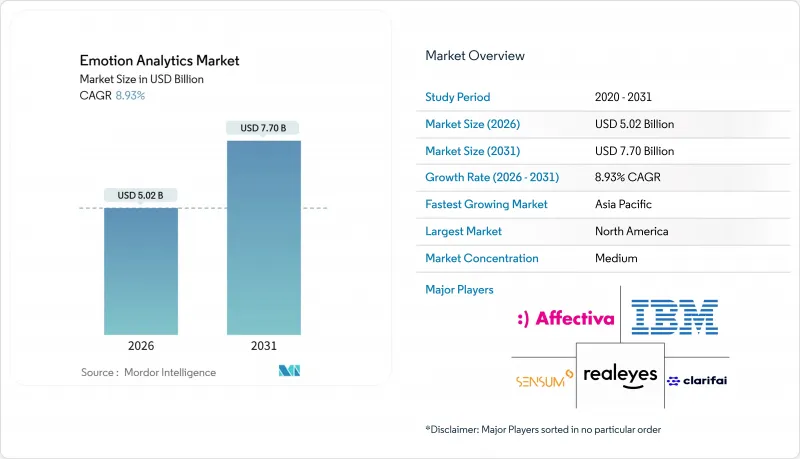
本報告按部署方式(本地部署、雲端部署等)、元件(軟體、硬體、服務)、分析方法(面部表情識別、基於影片的多模態分析等)、應用領域(客戶服務和客服中心、產品和市場研究等)以及地區進行細分。市場預測以美元計價。
全球情緒分析市場趨勢及洞察
物聯網穿戴裝置和智慧型裝置的激增
穿戴式情緒偵測硬體正從實驗室原型走向企業部署。一個典型的例子是售價 999 美元的 14 通道腦電圖 (EEG) 頭戴式裝置“Emotiv EPOC X”,目前可用於職場壓力評估和使用者體驗測試。 BIOPAC 研究戒指將來自皮膚電反應、光學容積描記法、心電圖、體溫和加速計的數據整合到單一的外形規格中,無需胸帶或臉部攝影機即可實現連續的情緒追蹤。 2025 年 12 月發表在《自然·科學資料》上的一篇論文介紹了 LLaMAC 資料集,該資料集融合了來自 Epoc-X 和 Empatica E4 的訊號以及同步的影像和音頻,用於訓練多模態情緒模型。心率變異性和皮膚電導率等生理訊號比臉部特徵具有更高的群體間一致性,從而減少了人口統計偏差。此外,設備端推理無需將原始生物訊號傳輸到雲端伺服器,進一步降低了延遲和資料外洩的風險。
基於深度學習的電腦視覺和自然語言處理的進展
變壓器架構和自監督預訓練減少了對標註數據的需求,使供應商能夠利用客服中心語音、臨床訪談或車載影像數據,以遠少於傳統卷積模型所需的標註量來微調基礎模型。谷歌雲端的對話洞察(Conversational Insights)可從即時音訊中提取情緒、意圖和升級徵兆,而微軟Azure AI則提供現成的情緒分析API,用於分析文字、語音和影片,從而降低了沒有專門機器學習人員的企業的准入門檻。基於情緒的即時路由可縮短客服中心的回應時間,提高處理能力,並將潛在的客戶流失轉化為更高的客戶忠誠度。文字分析還允許在幾分鐘內追蹤社交媒體、產品評論和調查中的品牌知名度。這些進步的結合正在將情感運算的應用範圍從孤立的先導計畫擴展到日常業務工作流程。
嚴格的資料隱私法規(GDPR、CPRA 等)
《一般資料保護規則》(GDPR) 第 9 條將生物識別資訊視為敏感數據,要求獲得明確同意、限制使用並嚴格遵守資料保留期限。 《加州隱私權法案》(CPRA) 對生物識別資訊也制定了類似的規則,並增加了刪除權和解釋演算法決策的義務。即將訂定的歐盟《人工智慧法案》將學校和職場的情感分析列為「高風險」技術,強制要求進行合規性評估和上市後監測。合規負擔增加了實施成本,並減緩了中小企業採用這些技術的速度。聯邦學習和同構密碼學等隱私保護工具可以降低資料外洩的風險,但其增加的延遲和運算成本正在減緩其在全球範圍內的推廣應用。
細分市場分析
為了滿足資料主權要求和毫秒延遲目標,企業正努力將推理處理部署在更靠近感測器的位置,預計從2026年到2031年,邊緣和設備端部署將以10.11%的複合年成長率成長。由於強大的運算能力和集中式模型更新,雲端架構在2025年仍佔據情感分析市場54.57%的佔有率。然而,由於往返延遲,對於需要亞秒回饋的安全關鍵型駕駛員監控和遠距心理健康諮詢而言,雲端部署並不實用。對於禁止生物識別資料外流的銀行和醫院而言,本地部署方案更具吸引力,但這需要對本地加速器和熟練的機器學習人員進行資本投資。
技術進步正在降低在邊緣運行模型的門檻。開放原始碼的BioGAP-Ultra 平台於 2025 年發布,它已證明可以在低功耗微控制器上處理腦電圖 (EEG)、肌電圖 (EMG)、心電圖 (ECG) 和光學容積描記法 (OPG) 資料流,即使沒有雲連接也能實現精準的情緒推斷。聯邦學習工具包允許數千台設備協作訓練共用模型,同時將原始資料保存在本地,從而降低頻寬成本,並幫助企業遵守《一般資料保護規則》(GDPR) 第 9 條的規定。隨著晶片製造商將神經處理單元 (NPU) 添加到標準系統晶片(SoC) 設計中,以及模型壓縮技術不斷縮小晶片尺寸,邊緣運算和雲端運算之間的經濟差距正在持續縮小。
硬體感測器,例如相機、腦電圖 (EEG) 頭戴式設備、懷孕皮膚反應 (GSR) 環和心電圖 (ECG) 模組,預計到 2031 年將以 9.43% 的複合年成長率成長,在所有組件類別中成長率最高。軟體層(軟體開發工具包、應用程式介面和託管儀表板)將在 2025 年佔據情緒分析市場規模的 45.72%,這反映了雲端 API 易於初始部署的特徵。同時,隨著買家對承包部署的需求不斷成長,包含整合和客製化模型訓練的服務產品也在不斷擴展。
硬體市場的蓬勃發展可歸因於監管法規和穿戴式裝置的普及。歐盟的駕駛員監控法規迫使汽車製造商為所有新車配備紅外線攝影機。在醫療和企業健康領域,Emotiv Epoc X 14通道腦電圖(EEG)頭戴裝置內建預訓練的壓力和參與度指標,即使是非專業團隊也能輕鬆上手。 BIOPAC 研究指環將來自皮膚電反應、體積描記法、心電圖、體溫和加速計的資料流整合到外形規格的裝置中,即使在隱私權政策限制影片的情況下,也能為研究人員提供多模態資料擷取選項。隨著感測器尺寸的縮小和產量的增加,硬體有望從實驗室走向消費級穿戴設備,並最終應用於支援環境智慧的吸頂式設備。
區域分析
到2025年,北美地區的收入佔比將達到36.64%,這主要得益於早期先導計畫、創業投資資金以及超大規模雲端服務供應商提供的雲端信用額度。亞太地區預計到2031年將維持11.61%的複合年成長率,成為成長速度最快的地區。中國正在智慧汽車專案和智慧城市監視錄影機中應用情緒分析技術,而日本則在投資研發能夠追蹤老年人情緒以提升其參與度的養老機器人。在印度,情緒分析儀錶板正被整合到業務流程外包(BPO)中心的品質保證工作流程中;韓國電子製造商則將情緒感知功能整合到智慧型手機和電視中。
在歐洲,成長速度較為緩慢,因為供應商必須證明其符合《一般資料保護規則》(GDPR 第 9 條)和即將生效的《人工智慧法案》。提供聯邦學習管道和同構加密解決方案的供應商在採購中享有優先權。
在南美洲、中東和非洲,零售、酒店和公共安全領域已開展了一些早期先導計畫,但由於頻寬和基礎設施方面的差異,短期貢獻有限。總體而言,隨著亞太地區在預測期內縮小與北美地區的差距,預計區域收入結構將趨於多元化。
其他好處:
- Excel格式的市場預測(ME)表
- 3個月的分析師支持
目錄
第1章:引言
- 研究假設和市場定義
- 調查範圍
第2章:調查方法
第3章執行摘要
第4章 市場狀況
- 市場概覽
- 市場促進因素
- 物聯網穿戴裝置和智慧型裝置的普及
- 基於深度學習的電腦視覺和自然語言處理(NLP)領域的進展
- 對高度個人化客戶參與工具的需求
- 駕駛人監控系統的監管要求(歐盟 GSR 2024)
- 共情人工智慧在遠距心理健康平台中的出現
- 用於保護隱私分析的邊緣運算框架
- 市場限制因素
- 嚴格的資料隱私法規(GDPR、CPRA 等)
- 面部表情資料集中的偏差和準確性問題
- 即時影片分析的高延遲和頻寬成本
- 對學校情緒監控的倫理抵制
- 產業價值鏈分析
- 監理情勢
- 技術展望
- 波特五力分析
第5章 市場規模與成長預測
- 不同的發展
- 現場
- 基於雲端的
- 邊緣/設備端
- 按組件
- 軟體(SDK/API)
- 硬體(感測器/攝影機)
- 服務(整合和管理)
- 透過分析方法
- 臉部表情辨識
- 基於影片的多模態
- 聲音和語調
- 文本和情感
- 生物訊號(腦電圖/心電圖/皮膚電反應)多模態
- 透過使用
- 客戶服務及客服中心
- 產品與市場研究
- 醫療保健和福祉
- 汽車和運輸業
- 教育和數位學習
- 遊戲與娛樂
- 安全和公共安全
- 按地區
- 北美洲
- 美國
- 加拿大
- 墨西哥
- 南美洲
- 巴西
- 阿根廷
- 其他南美國家
- 歐洲
- 德國
- 英國
- 法國
- 義大利
- 西班牙
- 其他歐洲國家
- 亞太地區
- 中國
- 日本
- 印度
- 韓國
- ASEAN
- 其他亞太國家
- 中東
- 沙烏地阿拉伯
- 阿拉伯聯合大公國
- 其他中東國家
- 非洲
- 南非
- 奈及利亞
- 其他非洲國家
- 北美洲
第6章 競爭情勢
- 市場集中度
- 策略趨勢
- 市佔率分析
- 公司簡介
- Affectiva Inc.
- Realeyes OU
- IBM Corporation
- Clarifai Inc.
- Sensum Ltd.
- Beyond Verbal Communication Ltd.
- Noldus Information Technology BV
- Sentiance NV
- Lexalytics Inc.
- Deloitte Touche Tohmatsu Ltd.
- Gorilla Technology Group Inc.
- Microsoft Corporation
- Google LLC
- Amazon Web Services Inc.
- Apple Inc.
- NEC Corporation
- Intel Corporation
- NVISO SA
- Sightcorp BV
- Kairos Inc.
- Entropik Technologies Pvt Ltd.
- iMotions A/S
- CrowdEmotion Ltd.
- Cogito Corporation
第7章 市場機會與未來展望
According to Mordor Intelligence, the emotion analytics market size is estimated at USD 5.02 billion in 2026, and is expected to reach USD 7.70 billion by 2031, at a CAGR of 8.93% during the forecast period (2026-2031).
This report is Segmented by Deployment (On-Premise, Cloud, and More), Component (Software, Hardware, and Services), Analytics Modality (Facial Emotion Recognition, Video-Based Multimodal, and More), Application (Customer Service and Contact Centers, Product and Market Research, and More), and Geography. The Market Forecasts are in Value (USD)
Global Emotion Analytics Market Trends and Insights
Proliferation of IoT Wearables and Smart Devices
Wearable emotion-sensing hardware has scaled from laboratory prototypes to enterprise rollouts, exemplified by the Emotiv EPOC X, a 14-channel electroencephalography headset priced at USD 999 that now ships for workplace stress audits and user experience trials. The BIOPAC Research Ring combines galvanic skin response, photoplethysmography, electrocardiogram, temperature, and accelerometer streams into a single form factor, delivering continuous affect tracking without chest straps or facial cameras. A December 2025 Nature Scientific Data paper introduced the LLaMAC dataset that fuses Epoc-X and Empatica E4 signals with synchronized video and audio to train multimodal emotion models. Physiological signals, such as heart rate variability and skin conductance, exhibit greater cross-population consistency than facial cues, thereby reducing demographic bias. On-device inference further limits latency and data-leak risk by removing the need to stream raw biosignals to cloud servers.
Advances in Deep-Learning-Based Computer Vision and Natural Language Processing
Transformer architectures and self-supervised pre-training have reduced the need for labeled data, allowing vendors to fine-tune foundation models on call-center audio, clinical interviews, or in-cabin driver videos with far fewer annotations than their convolutional predecessors. Google Cloud's Conversational Insights surfaces sentiment, intent, and escalation cues from live audio, while Microsoft Azure AI offers pre-built sentiment APIs that parse text, speech, and video, reducing barriers for firms lacking machine-learning staff. Real-time emotion routing lowers handle time and boosts throughput in contact centers, turning potential churn into loyalty gains. Text analysis also tracks brand perception across social media, product reviews, and surveys within minutes. Together, these advances extend affective computing from isolated pilots to routine business workflows.
Stringent Data-Privacy Regulations (GDPR, CPRA, etc.)
General Data Protection Regulation Article 9 treats biometric inference as sensitive data, demanding explicit consent, purpose limitation, and strict retention windows. The California Privacy Rights Act imposes similar rules on biometric identifiers, adding deletion rights and algorithmic-decision explanations. The forthcoming European Union Artificial Intelligence Act will categorize school and workplace emotion analytics as high risk, requiring conformity assessments and post-market monitoring. Compliance overhead raises deployment costs and delays procurement for small firms. Privacy-preserving tools such as federated learning and homomorphic encryption mitigate exposure but add latency and compute expense, slowing global rollouts.
Other drivers and restraints analyzed in the detailed report include:
- Demand for Hyper-Personalized Customer Engagement Tools
- Regulatory Mandate for Driver-Monitoring Systems (EU GSR 2024)
- Bias and Accuracy Issues in Facial-Emotion Data Sets
For complete list of drivers and restraints, kindly check the Table Of Contents.
Segment Analysis
Edge and on-device deployment is projected to advance at a 10.11% CAGR between 2026 and 2031 as enterprises push inference closer to sensors to satisfy data-sovereignty mandates and millisecond-level latency targets. Cloud architectures still held 54.57% of the emotion analytics market share in 2025 thanks to elastic compute and centralized model updates. However, round-trip delays make cloud impractical for safety-critical driver monitoring or tele-mental-health sessions that require sub-second feedback. On-premise stacks appeal to banks and hospitals that ban biometric data egress, yet they demand capital outlays for local accelerators and skilled machine-learning staff.
Technical progress is lowering the hurdles to run models at the edge. The open-source BioGAP-Ultra platform, published in 2025, processes electroencephalography, electromyography, electrocardiogram, and photoplethysmography streams on low-power microcontrollers, proving that accurate emotion inference can run without cloud connectivity. Federated-learning toolkits let thousands of devices co-train a shared model while keeping raw data local, cutting bandwidth cost and helping firms comply with General Data Protection Regulation Article 9. As chip makers add neural-processing units to standard system-on-chip designs and model-compression methods shrink footprints, the economic gap between edge and cloud continues to close.
Hardware sensors, including cameras, electroencephalography headsets, galvanic skin response rings, and electrocardiogram modules, are forecast to grow at a 9.43% CAGR through 2031, the fastest rate among all component groups. Software layers (software development kits, application programming interfaces, and managed dashboards) captured 45.72% of the emotion analytics market size in 2025, reflecting the early ease of spinning up cloud APIs. Service offerings that bundle integration and custom model training expand in parallel as buyers seek turnkey rollouts.
Regulation and wearable adoption explain hardware momentum. EU driver-monitoring rules push automakers to install infrared cameras in every new cabin. In healthcare and corporate wellness, the Emotiv Epoc X 14-channel electroencephalography headset ships with pre-trained stress and engagement metrics, lowering the entry bar for non-specialist teams. The BIOPAC Research Ring fuses galvanic skin response, photoplethysmography, electrocardiogram, temperature, and accelerometer streams in a finger-worn form factor, giving researchers a multimodal option when privacy policies restrict video capture. Ongoing sensor miniaturization and rising production volume are set to bring hardware from labs to consumer wearables and ambient-intelligence ceilings.
Complete Report Scope:
- By Deployment
- On-Premise
- Cloud-based
- Edge/On-Device
- By Component
- Software (SDK/API)
- Hardware (Sensors/Camera)
- Services (Integration and Managed)
- By Analytics Modality
- Facial Emotion Recognition
- Video-based Multimodal
- Speech and Voice Tone
- Text and Sentiment
- Bio-signal (EEG/ECG/GSR) Multimodal
- By Application
- Customer Service and Contact Centers
- Product and Market Research
- Healthcare and Well-being
- Automotive and Transportation
- Education and E-Learning
- Gaming and Entertainment
- Security and Public Safety
- By Geography
- North America
- United States
- Canada
- Mexico
- South America
- Brazil
- Argentina
- Rest of South America
- Europe
- Germany
- United Kingdom
- France
- Italy
- Spain
- Rest of Europe
- Asia-Pacific
- China
- Japan
- India
- South Korea
- ASEAN
- Rest of Asia-Pacific
- Middle East
- Saudi Arabia
- United Arab Emirates
- Rest of Middle East
- Africa
- South Africa
- Nigeria
- Rest of Africa
- North America
Geography Analysis
North America accounted for 36.64% of revenue in 2025, driven by early pilots, venture funding, and cloud credits from hyperscale providers. Asia-Pacific is projected to log an 11.61% CAGR through 2031, the steepest regional trajectory. China promotes emotion analytics within intelligent-vehicle programs and smart-city cameras, while Japan invests in eldercare robots that track affect to improve engagement. India's business-process-outsourcing hubs embed sentiment dashboards into quality-assurance workflows, and South Korean electronics firms integrate mood-sensing capabilities into smartphones and televisions.
Europe is growing more slowly because vendors must demonstrate compliance with both the General Data Protection Regulation (Article 9) and the forthcoming Artificial Intelligence Act. Suppliers that package federated-learning pipelines and homomorphic encryption gain procurement preference.
South America, the Middle East, and Africa report early pilots in retail, hospitality, and public safety, yet bandwidth and infrastructure gaps temper near-term contributions. Overall, the regional revenue mix is poised to diversify as the Asia-Pacific narrows the gap with North America over the forecast window.
- Affectiva Inc.
- Realeyes OU
- IBM Corporation
- Clarifai Inc.
- Sensum Ltd.
- Beyond Verbal Communication Ltd.
- Noldus Information Technology BV
- Sentiance NV
- Lexalytics Inc.
- Deloitte Touche Tohmatsu Ltd.
- Gorilla Technology Group Inc.
- Microsoft Corporation
- Google LLC
- Amazon Web Services Inc.
- Apple Inc.
- NEC Corporation
- Intel Corporation
- NVISO SA
- Sightcorp BV
- Kairos Inc.
- Entropik Technologies Pvt Ltd.
- iMotions A/S
- CrowdEmotion Ltd.
- Cogito Corporation
Additional Benefits:
- The market estimate (ME) sheet in Excel format
- 3 months of analyst support
TABLE OF CONTENTS
1 INTRODUCTION
- 1.1 Study Assumptions and Market Definition
- 1.2 Scope of the Study
2 RESEARCH METHODOLOGY
3 EXECUTIVE SUMMARY
4 MARKET LANDSCAPE
- 4.1 Market Overview
- 4.2 Market Drivers
- 4.2.1 Proliferation of IoT Wearables and Smart Devices
- 4.2.2 Advances in Deep-Learning-based Computer Vision and NLP
- 4.2.3 Demand for Hyper-personalised Customer Engagement Tools
- 4.2.4 Regulatory Mandate for Driver-monitoring Systems (EU GSR 2024)
- 4.2.5 Emergence of Empathetic AI in Tele-mental-health Platforms
- 4.2.6 Edge-compute Frameworks for Privacy-preserving Analytics
- 4.3 Market Restraints
- 4.3.1 Stringent Data-privacy Regulations (GDPR, CPRA, etc.)
- 4.3.2 Bias and Accuracy Issues in Facial-emotion Data Sets
- 4.3.3 High Latency/Bandwidth Cost in Real-time Video Analytics
- 4.3.4 Ethical Backlash Against Emotion Surveillance in Schools
- 4.4 Industry Value Chain Analysis
- 4.5 Regulatory Landscape
- 4.6 Technological Outlook
- 4.7 Porter's Five Forces Analysis
- 4.7.1 Bargaining Power of Suppliers
- 4.7.2 Bargaining Power of Buyers
- 4.7.3 Threat of New Entrants
- 4.7.4 Threat of Substitutes
- 4.7.5 Intensity of Competitive Rivalry
5 MARKET SIZE AND GROWTH FORECASTS (VALUE)
- 5.1 By Deployment
- 5.1.1 On-Premise
- 5.1.2 Cloud-based
- 5.1.3 Edge/On-Device
- 5.2 By Component
- 5.2.1 Software (SDK/API)
- 5.2.2 Hardware (Sensors/Camera)
- 5.2.3 Services (Integration and Managed)
- 5.3 By Analytics Modality
- 5.3.1 Facial Emotion Recognition
- 5.3.2 Video-based Multimodal
- 5.3.3 Speech and Voice Tone
- 5.3.4 Text and Sentiment
- 5.3.5 Bio-signal (EEG/ECG/GSR) Multimodal
- 5.4 By Application
- 5.4.1 Customer Service and Contact Centers
- 5.4.2 Product and Market Research
- 5.4.3 Healthcare and Well-being
- 5.4.4 Automotive and Transportation
- 5.4.5 Education and E-Learning
- 5.4.6 Gaming and Entertainment
- 5.4.7 Security and Public Safety
- 5.5 By Geography
- 5.5.1 North America
- 5.5.1.1 United States
- 5.5.1.2 Canada
- 5.5.1.3 Mexico
- 5.5.2 South America
- 5.5.2.1 Brazil
- 5.5.2.2 Argentina
- 5.5.2.3 Rest of South America
- 5.5.3 Europe
- 5.5.3.1 Germany
- 5.5.3.2 United Kingdom
- 5.5.3.3 France
- 5.5.3.4 Italy
- 5.5.3.5 Spain
- 5.5.3.6 Rest of Europe
- 5.5.4 Asia-Pacific
- 5.5.4.1 China
- 5.5.4.2 Japan
- 5.5.4.3 India
- 5.5.4.4 South Korea
- 5.5.4.5 ASEAN
- 5.5.4.6 Rest of Asia-Pacific
- 5.5.5 Middle East
- 5.5.5.1 Saudi Arabia
- 5.5.5.2 United Arab Emirates
- 5.5.5.3 Rest of Middle East
- 5.5.6 Africa
- 5.5.6.1 South Africa
- 5.5.6.2 Nigeria
- 5.5.6.3 Rest of Africa
- 5.5.1 North America
6 COMPETITIVE LANDSCAPE
- 6.1 Market Concentration
- 6.2 Strategic Moves
- 6.3 Market Share Analysis
- 6.4 Company Profiles (includes Global level Overview, Market Level Overview, Core Segments, Financials as Available, Strategic Information, Market Rank/Share for Key Companies, Products and Services, and Recent Developments)
- 6.4.1 Affectiva Inc.
- 6.4.2 Realeyes OU
- 6.4.3 IBM Corporation
- 6.4.4 Clarifai Inc.
- 6.4.5 Sensum Ltd.
- 6.4.6 Beyond Verbal Communication Ltd.
- 6.4.7 Noldus Information Technology BV
- 6.4.8 Sentiance NV
- 6.4.9 Lexalytics Inc.
- 6.4.10 Deloitte Touche Tohmatsu Ltd.
- 6.4.11 Gorilla Technology Group Inc.
- 6.4.12 Microsoft Corporation
- 6.4.13 Google LLC
- 6.4.14 Amazon Web Services Inc.
- 6.4.15 Apple Inc.
- 6.4.16 NEC Corporation
- 6.4.17 Intel Corporation
- 6.4.18 NVISO SA
- 6.4.19 Sightcorp BV
- 6.4.20 Kairos Inc.
- 6.4.21 Entropik Technologies Pvt Ltd.
- 6.4.22 iMotions A/S
- 6.4.23 CrowdEmotion Ltd.
- 6.4.24 Cogito Corporation
7 MARKET OPPORTUNITIES AND FUTURE OUTLOOK
- 7.1 White-space and Unmet-Need Assessment

 人工智慧驅動的薪資核算分析:市場佔有率分析、行業趨勢和統計數據、成長預測(2026-2031 年)
 情感市場規模、佔有率和成長分析:按解決方案類型、部署模式、應用、最終用戶和地區分類-2026-2033 年產業預測
 情緒分析市場:依技術、組件、部署模式和最終用戶分類-2026-2032年全球市場預測
 2026年全球情感人工智慧市場報告2026年全球情緒分析市場報告
 情感人工智慧市場:策略性洞察與預測(2026-2031)
 2025-2029年全球人工智慧情緒分析平台市場
 情感分析市場規模、佔有率和成長分析(按類型、部署類型、企業規模、應用、最終用戶和地區分類)-2026-2033年產業預測人工智慧情感分析平台市場規模、佔有率、成長及全球產業分析:依類型、應用和地區劃分的洞察,以及2024-2032年預測
 情緒分析:全球市場佔有率和排名、總收入和需求預測(2025-2031年)