


 |
市場調查報告書
商品編碼
2124049
美國塑膠瓶蓋:市場佔有率分析、產業趨勢與統計及成長預測(2026-2031)United States (US) Plastic Caps And Closures - Market Share Analysis, Industry Trends & Statistics, Growth Forecasts (2026 - 2031) |
||||||

※ 本網頁內容可能與最新版本有所差異。詳細情況請與我們聯繫。
根據 Mordor Intelligence 預測,美國塑膠瓶蓋和封蓋市場規模將從 2025 年的 120.9 億美元和 2026 年的 124.2 億美元成長到 2031 年的 140.4 億美元,2026 年至 2031 年的年複合成長率(CAGR)。
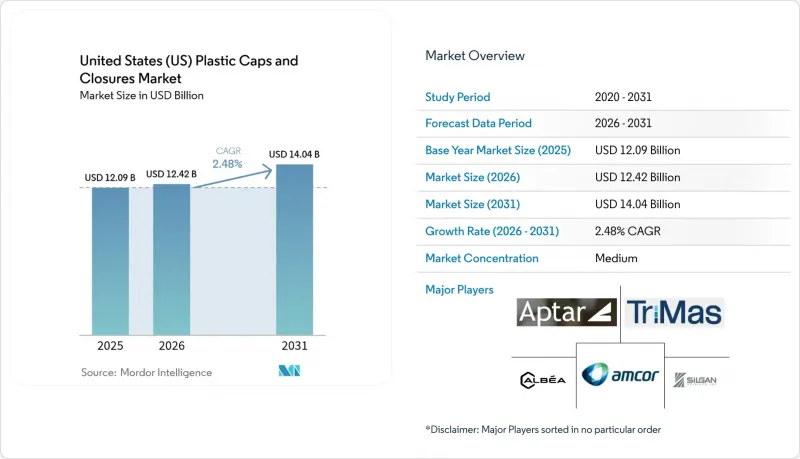
本報告按材料(例如,聚對苯二甲酸乙二醇酯 (PET)、聚丙烯 (PP))、終端用戶行業(例如,飲料、食品)、瓶蓋類型(例如,螺旋蓋、繫繩蓋)和製造過程(例如,射出成型、壓縮成型)進行分類。市場預測以美元 (USD) 為單位。
美國塑膠瓶蓋和封蓋市場的趨勢和洞察。
便利包裝飲料需求激增
受單杯咖啡、機能水和蛋白奶昔需求成長的推動,即飲飲料的出貨量預計在2025年將成長7.2%。便利商店(占美國飲料交易量的34%)中翻蓋式和按扣式運動蓋的展示空間也不斷擴大。據Keurig Dr Pepper公司稱,到2025年,可重複密封性將影響62%的消費者購買決策,比兩年前成長了8個百分點,凸顯了瓶蓋功能性作為品牌戰略關鍵要素的重要性。為此,瓶蓋供應商開發了帶有矽膠閥門的聚丙烯翻蓋,以防止電商運輸過程中發生洩漏。隨著飲料品牌加速開發與社群媒體趨勢相關的限量版口味,與模具製造商早期合作開發瓶蓋規格正在縮短產品上市時間。這些因素共同推動了對高通量成型單元和精密澆口設計的需求成長,以確保碳酸化品質。
電子商務的發展需要防篡改設計。
到2025年,線上食品雜貨銷售額將占美國食品飲料總銷售額的12.3%,而日益複雜的處理流程也增加了竄改的風險。聯邦法規已要求非處方藥必須有明顯的防篡改標記,而大型電商公司現在也要求對高檔食用油和營養補充劑粉末提出類似的要求。 Aptar集團於2025年3月推出的「SimpliSqueeze」閥門整合了一個斷裂環,無需感應密封,並將組裝的複雜性降低了20%。此外,履約中心也指定了能夠承受1.2公尺跌落測試的瓶蓋,這一高度是傳統貨架高度的兩倍。為此,模具製造商將壁厚增加了0.15毫米,並採用了一種即使在零下溫度下也能保持延展性的抗衝擊聚丙烯材料。這些性能的提升增加了每個瓶蓋的平均樹脂用量,部分抵消了包裝其他部分重量的減輕。
樹脂價格波動
2025年,聚丙烯現貨價格在每磅0.62美元至0.81美元之間波動。這與原油價格波動以及墨西哥灣沿岸地區裂解運作意外停產有關。除非ICIS.COM的價格上漲機制啟動,否則這些波動將使加工商的EBITDA下降200-300個基點。小規模的模塑企業缺乏對沖樹脂價格波動風險的能力,面臨營運資金緊張的困境,這促成了產業重組,例如Berry Global在2024年收購了三家區域性工廠。雖然期貨購買可以確保利潤率,但會佔用倉庫容量,並限制嘗試生物基樹脂的柔軟性,而生物基樹脂的交易價格通常比現貨價格高出20-30%。高密度聚乙烯(HDPE)也經歷了類似的價格波動,但隨著一座新的乙烷裂解裝置的運作,其供應在2025年下半年有所緩解。樹脂價格的持續波動已經使得為繫繩瓶蓋和支援 NFC 功能的智慧瓶蓋(需要高等級的化合物)的模具製定長期預算變得困難。
細分市場分析
得益於適用於高腔室射出成型的熔體流動速率,聚丙烯在2025年佔出貨量的43.21%。同時,隨著消費品公司(CPG)尋求檢驗的範圍3減排,生物基PET預計將以3.56%的複合年成長率(CAGR)實現最快成長。 Danimar Scientific的PHA瓶蓋於2025年4月在美國西岸以康普茶品牌推出,零售價溢價25%,同時證明了其海洋生物分解性。在可靠的原料供應合約的支撐下,美國生物基PET塑膠瓶蓋和封蓋市場預計將持續擴張,這些合約有助於抵禦化石燃料價格上漲的影響。塑膠回收再利用回收商協會報告稱,2025年天然HDPE瓶蓋的分類準確率達到92%,凸顯了HDPE在乳製品和家用化學品供應鏈中的重要作用。 Origin Materials 的碳負排放 PET 於 2025 年 9 月獲得了一份價值 1.5 億美元的飲料行業銷售合約。這表明到 2027 年,該產品將擴展到主流市場。如果基於銷售量的價格差異縮小了與傳統聚合物的價格差距,預計生物塑膠將在美國塑膠瓶蓋和封蓋市場獲得更大的佔有率。
加州立法機構第1200號法案規定,到2030年,飲料瓶蓋中必須使用15%的PCR(再生塑膠),間接促進了聚丙烯的閉合迴路回收。據模塑商稱,使用25%的PCR聚丙烯會導致拉伸強度下降6-8%,需要加厚瓶壁,部分抵消了減重帶來的好處。 Avantium公司的聚呋喃酸酯目前仍處於中試階段,但其優異的氣體阻隔性能預計在2028年前為碳酸飲料開闢一個利基市場。隨著樹脂選擇的增多,模具鋼材的選擇和澆口設計將決定加工商能否在傳統材料和生物級材料之間進行轉換,而無需進行成本高昂的熱流道改造。
飲料業仍是主要驅動力,預計2025年將佔出貨量的57.21%。然而,受高階護膚品對無氣泵的需求推動,化妝品和盥洗用品瓶蓋市場預計將以3.71%的複合年成長率成長至2031年。美國化妝品塑膠瓶蓋市場正在成長,因為無氣系統延長保存期限和減少防腐劑用量的優勢引起了對成分敏感型消費者的關注。預計到2025年,食材自煮包的普及將推動翻蓋式食品瓶蓋的出貨量成長9.3%。同時,漢高的「旋轉計量」瓶蓋透過減少12%的清潔劑浪費,凸顯了其功能價值。藥品瓶蓋僅佔出貨量的10%,但憑藉ISO認證文件維持了定價權。高階品牌與Loop合作,試行可重複填充的磁性螺旋蓋,在整個產品生命週期中減少了70%的一次性塑膠使用量。這些變化加在一起,導致需求不再局限於大規模生產的碳酸飲料和礦泉水產品線,並且對美國塑膠瓶蓋市場起到了緩衝作用,即使人均軟性飲料消費量保持平穩。
雖然補充裝系統會阻礙銷售量成長,但其複雜的機械結構和金屬外蓋卻能帶來更高的單價利潤率。帶有兒童安全蓋的藥品瓶蓋可使單價增加 0.08 至 0.12 美元,從而強化通用用途和特殊用途之間的細分。因此,美國塑膠瓶蓋和封蓋產業正走向兩條道路:一條是超快速旋蓋(幾美分的差價至關重要)成為主流,另一條則是高階化妝品和藥品封蓋帶來兩位數利潤率。
其他好處:
- Excel格式的市場預測(ME)表
- 3個月的分析師支持
目錄
第1章:引言
- 研究假設和市場定義
- 調查範圍
第2章:調查方法
第3章執行摘要
第4章 市場狀況
- 市場概覽
- 市場促進因素
- 便利包裝飲料需求激增
- 藥品包裝要求擴大
- 從金屬瓶蓋過渡到輕質塑膠瓶蓋
- 電子商務的發展需要防篡改設計。
- 頒布有關係繩帽的法律
- 利用高速壓縮成型能力進行回流
- 市場限制因素
- 樹脂價格波動
- 透過永續替代材料展開競爭
- 聯邦政府對一次性塑膠製品的監管趨勢
- 人們對微塑膠的日益關注正在推動無襯墊封裝的普及。
- 產業價值/價值鏈分析
- 監理情勢
- 技術展望
- 波特五力分析
- 宏觀經濟因素對市場的影響
第5章 市場規模與成長預測
- 材料
- 聚對苯二甲酸乙二醇酯(PET)
- 聚丙烯(PP)
- 低密度聚乙烯(LDPE)
- 高密度聚苯乙烯(HDPE)
- 其他材料
- 按最終用戶行業分類
- 飲料
- 食物
- 藥品和醫療保健
- 化妝品和盥洗用品
- 家用化學品
- 其他終端用戶產業
- 按帽子類型
- 螺帽
- 繫繩帽
- 翻蓋式瓶蓋與按扣式瓶蓋
- 兒童安全蓋
- 豪華/高級裝飾帽
- 分配蓋
- 透過製造技術
- 射出成型
- 壓縮成型
- 三件式直列組裝
- 採用數位印刷技術的智慧閉合裝置
第6章 競爭情勢
- 市場集中度
- 策略趨勢
- 市佔率分析
- 公司簡介
- Silgan Holdings Inc.
- AptarGroup, Inc.
- Amcor plc
- Albea SA
- TriMas Corporation
- Tetra Pak International SA
- Guala Closures SpA
- MJS Packaging, Inc.
- O. Berk Company, LLC
- Closure Systems International, Inc.
- BERICAP GmbH & Co. KG
- Crown Holdings, Inc.
- Evergreen Packaging LLC
- Phoenix Closures, Inc.
- Portola Packaging, Inc.
- Plastipak Packaging, Inc.
- Mold-Rite Plastics, LLC
- Smurfit WestRock
- SIG Combibloc Group AG
第7章 市場機會與未來展望
According to Mordor Intelligence, the United States plastic caps and closures market size is projected to expand from USD 12.09 billion in 2025 and USD 12.42 billion in 2026 to USD 14.04 billion by 2031, registering a CAGR of 2.48% between 2026 to 2031.
This report is Segmented by Material (Polyethylene Terephthalate (PET), Polypropylene (PP), and More), End-User Industry (Beverage, Food, and More), Cap Type (Screw Closures, Tethered Caps, and More), and Manufacturing Technology (Injection Molding, Compression Molding, and More). The Market Forecasts are Provided in Value (USD).
United States (US) Plastic Caps And Closures Market Trends and Insights
Surge in Demand for Convenient Packaged Beverages
Single-serve coffee, functional waters, and protein shakes lifted 2025 unit volumes for ready-to-drink beverages by 7.2%, expanding shelf space for flip-top and snap-on sports caps in convenience stores that account for 34% of national beverage transactions. Keurig Dr Pepper reported that resealability influenced 62% of consumer purchase decisions in 2025, up eight percentage points in two years, highlighting closure functionality as a brand lever. Closure suppliers responded with polypropylene flip-tops integrating silicone valves to avoid leaks during e-commerce parcel drops. As beverage brands accelerate limited-edition flavors tied to social-media trends, early co-development of closure specifications with molders trims commercialization timelines. These factors collectively reinforce demand for high-throughput molding cells and precise gating that maintain carbonation integrity.
Growth of E-Commerce Requiring Tamper-Evident Designs
Online grocery penetration reached 12.3% of total U.S. food and beverage sales in 2025, adding extra handling touchpoints that elevate tampering risk. Federal rules already oblige over-the-counter drugs to display visible evidence of entry, and large e-tailers now extend the same expectation to premium food oils and nutritional powders. AptarGroup's SimpliSqueeze valve, launched in March 2025, integrates a breakaway ring, eliminates induction seals, and cuts assembly-line complexity by 20%. Fulfillment centers also specify closures that survive 1.2-meter drop tests, twice the height of conventional store shelving, prompting molders to thicken walls by 0.15 millimeters and adopt impact-modified polypropylene grades that remain ductile at sub-zero temperatures. These performance upgrades enlarge the average resin requirement per closure, partially offsetting lightweighting gains elsewhere in the package.
Volatility in Resin Prices
Polypropylene spot quotes swung from USD 0.62 to 0.81 per pound during 2025, tracking crude volatility and unplanned cracker outages along the Gulf Coast, a shift that shaved 200-300 basis points off converter EBITDA unless price escalators kicked in ICIS.COM. Small molders lacking scale to hedge resin exposure faced working-capital strain, motivating consolidation such as Berry Global's 2024 purchase of three regional plants. Forward-buying locks in margins yet ties up warehouse capacity, limiting flexibility to trial biobased resins that trade at 20-30% premiums. HDPE displayed similar turbulence before new ethane-cracker capacity eased supply in late 2025. Persistent resin swings complicate long-term budgeting for tethered-cap tooling and NFC-enabled smart closures that already demand higher-grade compounds.
Other drivers and restraints analyzed in the detailed report include:
- Adoption of Tethered Cap Legislation
- Expanding Pharmaceutical Packaging Requirements
- Competition From Sustainable Alternative Materials
For complete list of drivers and restraints, kindly check the Table Of Contents.
Segment Analysis
Polypropylene captured 43.21% of 2025 shipments, underpinned by melt-flow rates that suit high-cavitation injection molds. Biobased PET, however, is positioned for the fastest climb at 3.56% CAGR, as CPG firms pursue verifiable scope-3 cuts. Danimer Scientific's PHA closures launched with a West Coast kombucha label in April 2025, commanding a 25% shelf premium and validating marine-biodegradation claims. The United States plastic caps and closures market size for biobased PET is projected to expand alongside secure feedstock contracts that shield against fossil-feedstock price spikes. The Association of Plastic Recyclers reported 92% sortation accuracy for natural HDPE caps in 2025, reinforcing HDPE's role in dairy and household-chemical supply chains. Origin Materials' carbon-negative PET secured a USD 150 million beverage offtake in September 2025, signaling mainstream scaling by 2027 and lifting the United States plastic caps and closures market share for bio-resins once volume pricing narrows the gap with conventional polymers.
California Assembly Bill 1200 requires 15% PCR in beverage closures by 2030, indirectly encouraging closed-loop polypropylene streams. Molders report tensile-strength losses of 6-8% when running 25% PCR PP, requiring thicker walls that partially offset weight-reduction gains. Avantium's polyethylene furanoate remains in pilot scale, but its superior gas barrier may create a niche for carbonated drinks by 2028. As resin options proliferate, tool-steel selection and gate design will dictate whether converters can switch between conventional and bio-grades without costly hot-runner rebuilds.
Beverages remained the anchor, controlling 57.21% of 2025 volume; yet airless pump demand from prestige skincare pushes cosmetics and toiletries closures toward a 3.71% CAGR through 2031. The United States plastic caps and closures market size for cosmetics is expanding as airless systems extend shelf life and reduce preservatives, a marketing claim resonating with ingredient-conscious consumers. Meal-kit adoption lifted flip-top food closures 9.3% in 2025, while Henkel's twist-and-measure cap cut detergent waste 12%, underscoring functional value. Pharmaceutical caps generated only 10% of units yet carried pricing power due to ISO-validated documentation. Luxury brands partnered with Loop to trial magnetic screw closures returned for refill, reducing single-use plastic by 70% over a product's life. Collectively, these shifts diversify demand beyond high-volume soda and water lines, buffering the United States plastic caps and closures market against flat per-capita soft-drink consumption.
Refill systems challenge volume growth but unlock higher unit margins through complex mechanisms and metallic overcaps. Child-resistant pharmaceutical closures added a revenue uplift of USD 0.08-0.12 per piece, reinforcing segmentation between commodity and specialty applications. The United States plastic caps and closures industry therefore navigates a dual-track future: one path dominated by ultra-high-speed screw caps where pennies matter, and another where premium cosmetics and drug closures command double-digit margins.
Complete Report Scope:
- By Material
- Polyethylene Terephthalate (PET)
- Polypropylene (PP)
- Low-Density Polyethylene (LDPE)
- High-Density Polyethylene (HDPE)
- Other Materials
- By End-User Industry
- Beverage
- Food
- Pharmaceutical and Healthcare
- Cosmetics and Toiletries
- Household Chemicals
- Other End-User Industries
- By Cap Type
- Screw Closures
- Tethered Caps
- Flip-Top and Snap-On Caps
- Child-Resistant Closures
- Luxury/Premium Decorative Closures
- Dispensing Caps
- By Manufacturing Technology
- Injection Molding
- Compression Molding
- 3-Piece and In-Line Assembly
- Digitally Printed Smart Closures
List of Companies Covered in this Report:
- Silgan Holdings Inc.
- AptarGroup, Inc.
- Amcor plc
- Albea S.A.
- TriMas Corporation
- Tetra Pak International S.A.
- Guala Closures S.p.A.
- MJS Packaging, Inc.
- O. Berk Company, LLC
- Closure Systems International, Inc.
- BERICAP GmbH & Co. KG
- Crown Holdings, Inc.
- Evergreen Packaging LLC
- Phoenix Closures, Inc.
- Portola Packaging, Inc.
- Plastipak Packaging, Inc.
- Mold-Rite Plastics, LLC
- Smurfit WestRock
- SIG Combibloc Group AG
Additional Benefits:
- The market estimate (ME) sheet in Excel format
- 3 months of analyst support
TABLE OF CONTENTS
1 INTRODUCTION
- 1.1 Study Assumptions and Market Definition
- 1.2 Scope of the Study
2 RESEARCH METHODOLOGY
3 EXECUTIVE SUMMARY
4 MARKET LANDSCAPE
- 4.1 Market Overview
- 4.2 Market Drivers
- 4.2.1 Surge in Demand for Convenient Packaged Beverages
- 4.2.2 Expanding Pharmaceutical Packaging Requirements
- 4.2.3 Shift Toward Lightweight Plastic Over Metal Closures
- 4.2.4 Growth of E-commerce Requiring Tamper-Evident Designs
- 4.2.5 Adoption of Tethered Cap Legislation
- 4.2.6 Reshoring via High-Speed Compression-Molding Capacity
- 4.3 Market Restraints
- 4.3.1 Volatility in Resin Prices
- 4.3.2 Competition From Sustainable Alternative Materials
- 4.3.3 Prospective Federal Single-Use-Plastic Restrictions
- 4.3.4 Micro-Plastic Scrutiny Driving Liner-Less Closures
- 4.4 Industry Value / Supply-Chain Analysis
- 4.5 Regulatory Landscape
- 4.6 Technological Outlook
- 4.7 Porter's Five Forces Analysis
- 4.7.1 Bargaining Power of Suppliers
- 4.7.2 Bargaining Power of Buyers
- 4.7.3 Threat of New Entrants
- 4.7.4 Threat of Substitute Products
- 4.7.5 Degree of Competition
- 4.8 Impact of Macroeconomic Factors on the Market
5 MARKET SIZE AND GROWTH FORECASTS (VALUE)
- 5.1 By Material
- 5.1.1 Polyethylene Terephthalate (PET)
- 5.1.2 Polypropylene (PP)
- 5.1.3 Low-Density Polyethylene (LDPE)
- 5.1.4 High-Density Polyethylene (HDPE)
- 5.1.5 Other Materials
- 5.2 By End-User Industry
- 5.2.1 Beverage
- 5.2.2 Food
- 5.2.3 Pharmaceutical and Healthcare
- 5.2.4 Cosmetics and Toiletries
- 5.2.5 Household Chemicals
- 5.2.6 Other End-User Industries
- 5.3 By Cap Type
- 5.3.1 Screw Closures
- 5.3.2 Tethered Caps
- 5.3.3 Flip-Top and Snap-On Caps
- 5.3.4 Child-Resistant Closures
- 5.3.5 Luxury/Premium Decorative Closures
- 5.3.6 Dispensing Caps
- 5.4 By Manufacturing Technology
- 5.4.1 Injection Molding
- 5.4.2 Compression Molding
- 5.4.3 3-Piece and In-Line Assembly
- 5.4.4 Digitally Printed Smart Closures
6 COMPETITIVE LANDSCAPE
- 6.1 Market Concentration
- 6.2 Strategic Moves
- 6.3 Market Share Analysis
- 6.4 Company Profiles (includes Global level Overview, Market level overview, Core Segments, Financials as available, Strategic Information, Market Rank/Share for key companies, Products and Services, and Recent Developments)
- 6.4.1 Silgan Holdings Inc.
- 6.4.2 AptarGroup, Inc.
- 6.4.3 Amcor plc
- 6.4.4 Albea S.A.
- 6.4.5 TriMas Corporation
- 6.4.6 Tetra Pak International S.A.
- 6.4.7 Guala Closures S.p.A.
- 6.4.8 MJS Packaging, Inc.
- 6.4.9 O. Berk Company, LLC
- 6.4.10 Closure Systems International, Inc.
- 6.4.11 BERICAP GmbH & Co. KG
- 6.4.12 Crown Holdings, Inc.
- 6.4.13 Evergreen Packaging LLC
- 6.4.14 Phoenix Closures, Inc.
- 6.4.15 Portola Packaging, Inc.
- 6.4.16 Plastipak Packaging, Inc.
- 6.4.17 Mold-Rite Plastics, LLC
- 6.4.18 Smurfit WestRock
- 6.4.19 SIG Combibloc Group AG
7 MARKET OPPORTUNITIES AND FUTURE OUTLOOK
- 7.1 White-Space and Unmet-Need Assessment

 歐洲塑膠瓶蓋和封蓋:市場佔有率分析、行業趨勢和統計數據以及成長預測(2026-2031 年)北美塑膠瓶蓋和封蓋市場:市場佔有率分析、行業趨勢和統計數據以及成長預測(2026-2031 年)塑膠蓋子與封口裝置:市場佔有率分析、行業趨勢和統計數據以及成長預測(2026-2031 年)
 2026年全球無內襯瓶蓋市場報告
 塑膠蓋子與封口裝置市場:2026-2032年全球市場預測(按產品類型、材料、製造流程、最終用途和分銷管道分類)
 塑膠瓶蓋及瓶蓋市場報告:按產品類型、原料、容器類型、技術、最終用途和地區分類(2026-2034 年)
 全球塑膠蓋子與封口裝置市場:市場規模、佔有率、成長和行業分析:按材料、產品類型、最終用途和地區分類的預測(至2034年)南美洲塑膠瓶蓋和封蓋:市場佔有率分析、行業趨勢和統計數據以及成長預測(2026-2031 年)
 全球塑膠瓶蓋和封蓋市場規模、佔有率、趨勢和成長分析報告(2026-2034年)2026年全球塑膠瓶蓋和封蓋市場報告