


 |
市場調查報告書
商品編碼
2120465
北美塑膠瓶蓋和封蓋市場:市場佔有率分析、行業趨勢和統計數據以及成長預測(2026-2031 年)North America Plastic Caps And Closures - Market Share Analysis, Industry Trends & Statistics, Growth Forecasts (2026 - 2031) |
||||||

※ 本網頁內容可能與最新版本有所差異。詳細情況請與我們聯繫。
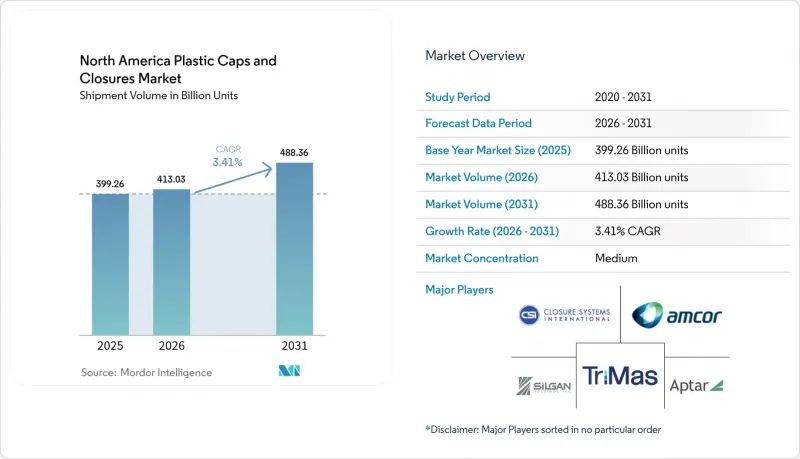
根據 Mordor Intelligence 預測,北美塑膠瓶蓋和封蓋市場預計將從 2025 年的 3992.6 億個和 2026 年的 4130.3 億個成長到 2031 年的 4883.6 億個,在 2026 年至 2031 年期間的複合年成長率為 3.41%。
本報告按材料(聚乙烯 (PE)、聚對苯二甲酸乙二醇酯 (PET) 及其他)、類型(螺桿式、分配式、非螺桿式及其他)、終端用戶行業(飲料、食品、醫藥及其他)、製造程序(射出成型、壓縮成型及其他)和地區進行細分。市場預測以數量(單位)為基礎。
北美塑膠瓶蓋和封蓋市場的趨勢和洞察
瓶裝飲料和功能性飲料的需求正在激增。
預計到2025年,功能性飲料新品上市數量將年增23%,這將加速對具備防篡改功能且密封強度達到15psi的28毫米和38毫米瓶蓋的需求。目前,單份瓶裝礦泉水佔該品類銷售額的62%,各大品牌正積極推廣輕質瓶蓋,以降低每個瓶蓋0.003美元的材料成本。運動營養品製造商正在將具有矽膠止回閥的翻蓋式飲水器標準化,以防止回流造成的污染。預計到2025年,美國人均功能性水攝取量將達到14.7加侖,比加拿大高出50%以上,凸顯了美國對瓶蓋出貨量的巨大影響。在便攜性和健康意識產品推出的推動下,飲料仍然是北美塑膠瓶蓋市場的核心。
線上藥品和營養補充劑市場的快速成長推動了對臨床研究協調員(CRC)的需求增加。
到2025年,美國線上藥局銷售額將達到920億美元,其中38%的處方箋藥瓶將透過郵購方式出貨。 《有毒包裝方法》強制要求使用兒童安全瓶蓋,營養補充品經銷商目前正採用符合ASTM D3475 E協議的「按壓旋轉式」成人瓶蓋設計。這種設計既能確保兒童安全,又能將成人開啟的成功率提高到85%。 AptarGroup的數據顯示,受GLP-1包裝需求激增的推動,2025年第三季藥品瓶蓋出貨量增加了22%。佛羅裡達州、亞利桑那州和加州人口老化程度高,寬頻普及率高,這些地區的成長也支撐了這個短期上升趨勢。這些趨勢進一步鞏固了兒童安全產品在北美塑膠瓶蓋和封蓋市場的高階地位。
原生樹脂的生產者延伸責任(EPR)費用
自2025年起,美國九個州和加拿大四個省將對每個原生塑膠瓶蓋徵收0.02至0.04美元的生產者延伸責任制(EPR)費用,用於資助其回收系統的擴建。緬因州的製度免除了100%再生材料製成的產品的費用,從而使每噸產品節省了80至120美元的成本,但北美食品級再生聚丙烯(PP)的供應量僅能滿足56%的需求。不列顛哥倫比亞省的製度則在每個瓶蓋上額外徵收0.015美元,以幫助改善上門回收服務。監管的分散使得加工商難以管理庫存單位(SKU)和庫存,從而增加了整個北美塑膠瓶蓋市場的營運成本。
細分市場分析
2025年,聚對苯二甲酸乙二醇酯(PET)瓶蓋的出貨量僅佔12%,但預計到2031年將以每年4.31%的速度成長,因為瓶裝水生產商正在轉向使用無內襯PET瓶蓋,以提高回收率。聚丙烯(PP)仍佔據市場主導地位,市佔率高達46.47%,這主要歸功於其優異的阻隔性,可將碳酸飲料中的氧氣滲透量限制在每天0.5毫升以下。根據加州AB 793法案(該法案將瓶蓋納入可回收材料含量目標),Silgan公司已將其位於德克薩斯州的三條生產線改造為可使用再生PET的生產線,使其年產能增加了6000萬個瓶蓋。
對於食品級再生PET,加工商已簽訂長期契約,每噸溢價200美元,從而確保了穩定的供應。相較之下,墨西哥由於回收基礎設施有限,目前仍使用78%的原生PP,儘管其2025年國家回收策略的目標是到2030年實現30%的再生材料含量。因此,北美塑膠瓶蓋和封蓋市場的材料轉型過程因地區而異,進展不平衡。
旋蓋仍然是主流類型,預計2025年將佔出貨量的48.83%,並且對於維持軟性飲料的壓力至關重要。受加拿大衛生署針對大麻食品的扭矩閾值規定以及美國線上藥局市場成長的推動,兒童安全蓋的出貨量增加了4.02%。 Aptar的「擠壓旋轉式」兒童安全蓋因其在不影響兒童安全功能的前提下,將成人開啟成功率提高到92%,而吸引了早期用戶的注意。
佔出貨量18%的瓶蓋,尤其是單手即可開啟的翻蓋式瓶蓋,在運動飲料領域越來越受歡迎。墨西哥一次性運動飲料的年增率高達14%。無螺紋的按扣式瓶蓋仍屬於小眾產品,因為電商運輸過程中可能發生的洩漏阻礙了其廣泛應用。這些趨勢凸顯了北美塑膠瓶蓋和封蓋市場中,不同產品對性能的具體要求,也正是這些要求維持了該市場的多元化。
其他福利
- Excel格式的市場預測(ME)表
- 3個月的分析師支持
目錄
第1章:引言
- 研究假設和市場定義
- 調查範圍
第2章:調查方法
第3章執行摘要
第4章 市場狀況
- 市場概覽
- 市場促進因素
- 瓶裝飲料和功能性飲料的需求正在激增。
- 促進品牌擁有者採用關聯式電子商務關閉機制。
- 過渡到使用單一材料PP瓶蓋,以便更輕鬆地回收。
- 線上藥品和營養補充劑市場的快速成長推動了對臨床研究協調員(CRC)的需求增加。
- 利用人工智慧驅動的線上視覺技術降低缺陷率和成本。
- 內建NFC和QR碼認證功能的智慧帽子。
- 市場限制因素
- 原生樹脂的生產者延伸責任(EPR)費用
- 帶接頭的立式袋的興起,取代了螺旋蓋。
- 美國和加拿大強制要求使用再生聚酯纖維(rPET),這給原生聚丙烯(PP)的需求帶來了壓力。
- 飲料品牌將開始測試鋁製皇冠蓋的再封功能。
- 價值鏈分析
- 監理情勢
- 技術展望
- 波特五力分析
第5章 市場規模與成長預測
- 材料
- 聚乙烯(PE)
- 聚對苯二甲酸乙二醇酯(PET)
- 聚丙烯(PP)
- 其他
- 按類型
- 螺絲式
- 分配類型
- 非螺紋型
- 兒童安全
- 按最終用戶行業分類
- 飲料
- 瓶裝水
- 軟性飲料
- 烈酒
- 其他飲料
- 食物
- 藥品和醫療保健
- 化妝品和盥洗用品
- 家用化學品
- 其他
- 飲料
- 透過製造程序
- 射出成型
- 壓縮成型
- 3D列印和快速原型製作
- 其他製造程序
- 國家
- 美國
- 加拿大
- 墨西哥
第6章 競爭情勢
- 市場集中度
- 策略趨勢
- 市佔率分析
- 公司簡介
- Silgan Holdings Inc.
- Amcor plc
- AptarGroup Inc.
- Closure Systems International Inc.
- TriMas Corporation
- Guala Closures SpA
- Tetra Pak Group
- O.Berk Company LLC
- BERICAP Holding GmbH
- Pano Cap Canada Ltd
- Erie Molded Plastics Inc.
- Crown Holdings Inc.
- Phoenix Closures Inc.
- Mold-Rite Plastics LLC
- Comar LLC
- Husky Technologies
- SACMI Imola SC
- Sonoco Products Company
- Plastipak Holdings Inc.
- Albea Group
第7章 市場機會與未來展望
According to Mordor Intelligence, the North America plastic caps and closures market size is projected to expand from 399.26 billion units in 2025 and 413.03 billion units in 2026 to 488.36 billion units by 2031, registering a CAGR of 3.41% between 2026 and 2031.
This report is Segmented by Material (Polyethylene, Polyethylene Terephthalate, and More), Type (Threaded, Dispensing, Unthreaded, and More), End-User Industry (Beverage, Food, Pharmaceutical and Healthcare, and More), Manufacturing Process (Injection Molding, Compression Molding, and More), and Geography. The Market Forecasts are Provided in Terms of Volume (Units).
North America Plastic Caps And Closures Market Trends and Insights
Demand Surge for Bottled and Functional Beverages
Functional beverage launches jumped 23% year-over-year in 2025, accelerating demand for tamper-evident 28- and 38-millimeter closures that hold 15 psi seal integrity. Single-serve bottled water now captures 62% of category sales, pushing brands to specify lighter closures that trim material costs by USD 0.003 each. Sports-nutrition players are standardizing flip-top dispensers with silicone check valves that prevent backflow contamination. In the United States, per-capita intake of enhanced water climbed to 14.7 gallons in 2025, more than 50% higher than Canada, highlighting the country's outsized pull on closure volumes. The convergence of portability preferences and health-centric product launches keeps beverages at the core of the North America plastic caps and closures market.
On-line Pharma and Nutraceutical Boom Fuels CRC Demand
U.S. online pharmacy revenue reached USD 92 billion in 2025, channeling 38% of prescription bottles through mail order fulfillment. The Poison Prevention Packaging Act requires child-resistant closures, and nutraceutical sellers now apply senior-friendly squeeze-and-turn designs that meet ASTM D3475 Protocol E, improving adult-opening success to 85% while retaining child safety. AptarGroup recorded a 22% lift in pharmaceutical closure shipments in Q3 2025 as GLP-1 drug packaging volumes surged. Growth clusters in Florida, Arizona, and California, where aging populations intersect with broadband penetration, underpin near-term upside. These dynamics reinforce the premium positioning of child-resistant offerings within the North America plastic caps and closures market.
Extended Producer Responsibility Fees on Virgin Resin
Since 2025, nine U.S. states and four Canadian provinces have levied EPR fees of USD 0.02-0.04 per virgin-resin closure to finance recycling upgrades. Maine's program waives fees for 100% recycled content, conferring a USD 80-120 per-ton cost edge, yet the North American supply of food-grade recycled PP meets just 56% of demand. British Columbia's scheme adds USD 0.015 per unit to fund improvements to curbside collection. Fragmented statutes compel converters to juggle SKUs and inventory, raising overhead across the North America plastic caps and closures market.
Other drivers and restraints analyzed in the detailed report include:
- Brand-Owner Push for Tethered and E-commerce-Ready Closures
- Shift Toward PP Mono-Material Caps for Easier Recycling
- Rise of Stand-Up Pouches with Fitments Replacing Screw Caps
For complete list of drivers and restraints, kindly check the Table Of Contents.
Segment Analysis
Polyethylene terephthalate closures, although only 12% of 2025 shipments, are growing at 4.31% through 2031 as bottled-water producers convert to liner-free PET caps that improve recycling yields. Polypropylene still dominates with 46.47% share because its barrier properties keep oxygen ingress below 0.5 cc/day for carbonated drinks. California's AB 793, which counts closures in recycled-content targets, has prompted Silgan to re-tool three Texas lines for recycled PET, adding 60 million units of annual capacity.
Converters that secure long-term contracts for food-grade recycled PET at USD 200-per-ton premiums are safeguarding supply. In contrast, Mexico remains 78% virgin PP, reflecting limited recycling infrastructure, although the 2025 National Recycling Strategy targets 30% recycled content by 2030. Material transitions therefore proceed unevenly across the North America plastic caps and closures market.
Threaded closures led with 48.83% of 2025 volume, vital for pressure retention in soft drinks. Child-resistant designs are advancing at 4.02%, aided by Health Canada's torque threshold rules for cannabis edibles and U.S. e-pharmacy growth. Aptar's squeeze-and-turn CRC raised adult-opening success to 92% without compromising child resistance, capturing early adopter interest.
Dispensing caps, 18% of shipments, are gaining popularity in sports beverages where flip-tops support one-hand use, particularly in Mexico, where single-serve sports drinks grow 14% annually. Unthreaded snap-on variants remain niche because leakage during e-commerce transit limits broader acceptance. These patterns underscore product-specific performance needs that sustain segment diversity within the North America plastic caps and closures market.
Complete Report Scope:
- By Material
- Polyethylene (PE)
- Polyethylene Terephthalate (PET)
- Polypropylene (PP)
- Other Materials
- By Type
- Threaded
- Dispensing
- Unthreaded
- Child-Resistant
- By End-user Industry
- Beverage
- Bottled Water
- Soft Drinks
- Spirits
- Other Beverages
- Food
- Pharmaceutical and Healthcare
- Cosmetics and Toiletries
- Household Chemicals
- Other Industries
- Beverage
- By Manufacturing Process
- Injection Molding
- Compression Molding
- 3-D Printing / Rapid Prototyping
- Other Manufacturing Process
- By Country
- United States
- Canada
- Mexico
List of Companies Covered in this Report:
- Silgan Holdings Inc.
- Amcor plc
- AptarGroup Inc.
- Closure Systems International Inc.
- TriMas Corporation
- Guala Closures SpA
- Tetra Pak Group
- O.Berk Company LLC
- BERICAP Holding GmbH
- Pano Cap Canada Ltd
- Erie Molded Plastics Inc.
- Crown Holdings Inc.
- Phoenix Closures Inc.
- Mold-Rite Plastics LLC
- Comar LLC
- Husky Technologies
- SACMI Imola S.C.
- Sonoco Products Company
- Plastipak Holdings Inc.
- Albea Group
Additional Benefits:
- The market estimate (ME) sheet in Excel format
- 3 months of analyst support
TABLE OF CONTENTS
1 INTRODUCTION
- 1.1 Study Assumptions and Market Definition
- 1.2 Scope of the Study
2 RESEARCH METHODOLOGY
3 EXECUTIVE SUMMARY
4 MARKET LANDSCAPE
- 4.1 Market Overview
- 4.2 Market Drivers
- 4.2.1 Demand Surge for Bottled and Functional Beverages
- 4.2.2 Brand-owner Push for Tethered / E-commerce-ready Closures
- 4.2.3 Shift Toward PP Mono-material Caps for Easier Recycling
- 4.2.4 On-line Pharma and Nutraceutical Boom Fuels CRC Demand
- 4.2.5 AI-enabled In-line Vision Lowers Defect Rates and Costs
- 4.2.6 Smart Caps with Embedded NFC/QR Authentication
- 4.3 Market Restraints
- 4.3.1 Extended Producer Responsibility (EPR) Fees on Virgin Resin
- 4.3.2 Rise of Stand-up Pouches with Fitments Replacing Screw Caps
- 4.3.3 U.S./Canada rPET Content Mandates Squeeze Virgin PP Demand
- 4.3.4 Beverage Brand Trials of Aluminium Crown Re-seals
- 4.4 Value Chain Analysis
- 4.5 Regulatory Landscape
- 4.6 Technological Outlook
- 4.7 Porter's Five Forces Analysis
- 4.7.1 Bargaining Power of Suppliers
- 4.7.2 Bargaining Power of Buyers
- 4.7.3 Threat of New Entrants
- 4.7.4 Threat of Substitutes
- 4.7.5 Intensity of Competitive Rivalry
5 MARKET SIZE AND GROWTH FORECASTS (VOLUME)
- 5.1 By Material
- 5.1.1 Polyethylene (PE)
- 5.1.2 Polyethylene Terephthalate (PET)
- 5.1.3 Polypropylene (PP)
- 5.1.4 Other Materials
- 5.2 By Type
- 5.2.1 Threaded
- 5.2.2 Dispensing
- 5.2.3 Unthreaded
- 5.2.4 Child-Resistant
- 5.3 By End-user Industry
- 5.3.1 Beverage
- 5.3.1.1 Bottled Water
- 5.3.1.2 Soft Drinks
- 5.3.1.3 Spirits
- 5.3.1.4 Other Beverages
- 5.3.2 Food
- 5.3.3 Pharmaceutical and Healthcare
- 5.3.4 Cosmetics and Toiletries
- 5.3.5 Household Chemicals
- 5.3.6 Other Industries
- 5.3.1 Beverage
- 5.4 By Manufacturing Process
- 5.4.1 Injection Molding
- 5.4.2 Compression Molding
- 5.4.3 3-D Printing / Rapid Prototyping
- 5.4.4 Other Manufacturing Process
- 5.5 By Country
- 5.5.1 United States
- 5.5.2 Canada
- 5.5.3 Mexico
6 COMPETITIVE LANDSCAPE
- 6.1 Market Concentration
- 6.2 Strategic Moves
- 6.3 Market Share Analysis
- 6.4 Company Profiles (includes Global level Overview, Market level overview, Core Segments, Financials as available, Strategic Information, Market Rank/Share, Products and Services, Recent Developments)
- 6.4.1 Silgan Holdings Inc.
- 6.4.2 Amcor plc
- 6.4.3 AptarGroup Inc.
- 6.4.4 Closure Systems International Inc.
- 6.4.5 TriMas Corporation
- 6.4.6 Guala Closures SpA
- 6.4.7 Tetra Pak Group
- 6.4.8 O.Berk Company LLC
- 6.4.9 BERICAP Holding GmbH
- 6.4.10 Pano Cap Canada Ltd
- 6.4.11 Erie Molded Plastics Inc.
- 6.4.12 Crown Holdings Inc.
- 6.4.13 Phoenix Closures Inc.
- 6.4.14 Mold-Rite Plastics LLC
- 6.4.15 Comar LLC
- 6.4.16 Husky Technologies
- 6.4.17 SACMI Imola S.C.
- 6.4.18 Sonoco Products Company
- 6.4.19 Plastipak Holdings Inc.
- 6.4.20 Albea Group
7 MARKET OPPORTUNITIES AND FUTURE OUTLOOK
- 7.1 White-space and Unmet-Need Assessment

 美國塑膠瓶蓋:市場佔有率分析、產業趨勢與統計及成長預測(2026-2031)歐洲塑膠瓶蓋和封蓋:市場佔有率分析、行業趨勢和統計數據以及成長預測(2026-2031 年)塑膠蓋子與封口裝置:市場佔有率分析、行業趨勢和統計數據以及成長預測(2026-2031 年)
 2026年全球無內襯瓶蓋市場報告
 塑膠蓋子與封口裝置市場:2026-2032年全球市場預測(按產品類型、材料、製造流程、最終用途和分銷管道分類)
 塑膠瓶蓋及瓶蓋市場報告:按產品類型、原料、容器類型、技術、最終用途和地區分類(2026-2034 年)
 全球塑膠蓋子與封口裝置市場:市場規模、佔有率、成長和行業分析:按材料、產品類型、最終用途和地區分類的預測(至2034年)南美洲塑膠瓶蓋和封蓋:市場佔有率分析、行業趨勢和統計數據以及成長預測(2026-2031 年)
 全球塑膠瓶蓋和封蓋市場規模、佔有率、趨勢和成長分析報告(2026-2034年)2026年全球塑膠瓶蓋和封蓋市場報告