


 |
市場調查報告書
商品編碼
2123987
摩擦材料:市場佔有率分析、產業趨勢與統計、成長預測(2026-2031)Friction Material - Market Share Analysis, Industry Trends & Statistics, Growth Forecasts (2026 - 2031) |
||||||

※ 本網頁內容可能與最新版本有所差異。詳細情況請與我們聯繫。
根據 Mordor Intelligence 預測,摩擦材料市場規模將從 2025 年的 8.3 億件和 2026 年的 8.6 億件成長到 2031 年的 10.7 億件,2026 年至 2031 年的年複合成長率(CAGR)為 4.36%。
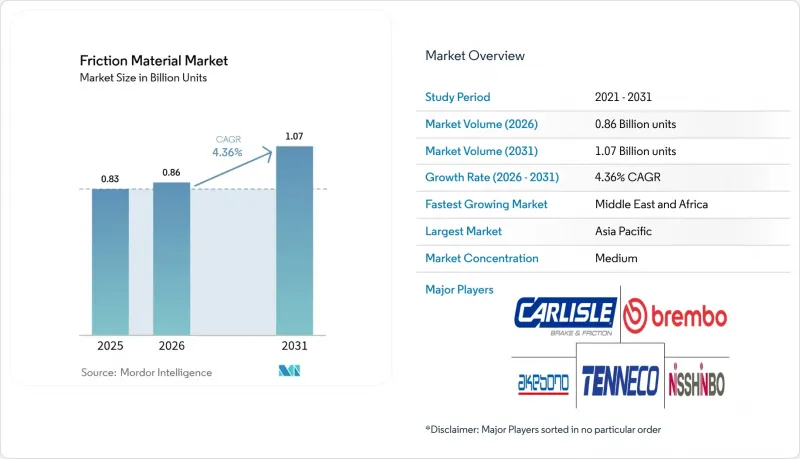
本報告按材料(半金屬、陶瓷等)、產品類型(煞車片、煞車盤、襯片及其他產品類型)、應用領域(離合器和煞車系統、齒輪系統及其他應用)、終端用戶產業(汽車、鐵路、航太等)以及地區(亞太地區、北美地區、歐洲等)進行細分。市場預測以銷售量(單位)為單位。
全球摩擦材料市場趨勢及洞察
全球汽車保有量的快速成長以及煞車皮更換週期
到2025年,亞太地區道路上的車輛數量將超過8.5億輛,每輛車根據使用情況,平均每行駛3萬至7萬公里就需要更換煞車皮。對於目前佔印度汽車保有量35%的老舊車輛而言,由於保養延遲會加速磨損,售後市場需求增加了一倍。這種情況正在推動摩擦材料市場的擴張,儘管原始設備製造商(OEM)在工廠使用陶瓷煞車片,但對成本最佳化的半金屬煞車片的需求仍然強勁。商用車業者目前仍容忍煞車片中含有銅,直到相關法規收緊,這給了傳統供應商時間來清理現有庫存。因此,儘管材料即將發生轉變,但車輛數量的激增正在支撐市場的基本成長。
更嚴格的“無銅”和“低噪音”標準正在加速材料提煉。
加州的SB 346法案和華盛頓州的「更佳煞車法案」將從2025年起限制煞車片中銅的含量不超過0.5%(重量比),迫使煞車片製造商改用LeafMark認證的芳香聚醯胺、陶瓷和燒結青銅混合物。配方的改變導致每套煞車片的原料成本增加了2-4美元,一級供應商正試圖透過年度價格談判來抵消這部分成本上漲。由於芳香聚醯胺的供應處於寡占狀態,任何供應中斷都會在60天內立即給複合材料工廠帶來壓力。歐洲74分貝的道路噪音限制法規也推動了類似的趨勢,該法規鼓勵使用低金屬含量和陶瓷配方,雖然這增加了配方的複雜性,但也為擁有內部材料實驗室的公司開闢了一個高階細分市場。
銅、芳香聚醯胺和陶瓷纖維的價格波動
預計2025年銅交易價格將在每噸9,250美元至9,800美元之間波動,而僅對所需數量的60%至70%進行避險的供應商的毛利率波動幅度將高達300個基點。醯胺纖維的價格為每公斤25至35美元,主要來自兩家生產商,這意味著任何供應中斷都將在幾週內波及整個摩擦材料市場。類似的集中化也影響到氧化鋁-二氧化矽陶瓷纖維,由於2024年紅海封鎖等物流中斷,該纖維的供應延遲了六週。中小企業正在將額外成本轉嫁給客戶,從而削弱了它們相對於擁有內部材料實驗室和採購能力的綜合性OEM製造商的競爭優勢。
細分市場分析
2025年,半金屬產品在摩擦材料市場維持37.97%的市場佔有率,主要得益於其在獨立售後市場通路的成本優勢。陶瓷基產品,包括碳陶瓷和碳碳複合材料,以每年6.02%的速度成長,每公斤價格最高,尤其是在航太和豪華汽車領域。
隨著北美對銅含量實施限制,歐洲收緊粉塵排放標準,市場需求日益兩極化。混料商爭相為富含芳香聚醯胺的混料申請認證,但兩家纖維製造商的供應集中有時會推高價格,擠壓利潤空間。因此,摩擦材料產業正投資建造內部實驗室,以快速開發無銅混料;同時,中小企業正與原料供應商合作,以確保原料供應穩定。
到2025年,煞車片仍將佔出貨量的40.88%,這反映出其在乘用車中的廣泛應用。但預計到2031年,煞車盤的出貨量將成長5.63%,因為風力發電機、礦業和非公路用機械等產業需要採用更大的表面積來散熱,以應對高達600 度C的熱負荷。主要用於鐵路和大型鼓式煞車的煞車塊和煞車襯片,隨著其更換週期的延長,市場佔有率正在逐步擴大,但隨著卡車逐漸過渡到碟式煞車,其市場佔有率正在下降。
摩擦盤用材料的市場預計將快速成長,尤其是在礦場等運作損失成本巨大的地區,因為營運商優先考慮的是減少摩擦衰減和便於模組化維護。卡萊爾的EL121乾濕兩用摩擦盤複合材料已成功應用於煤礦和銅礦,顯示安全法規和運作成本是推動摩擦盤應用普及的因素。
區域分析
預計到2025年,亞太地區將佔全球出貨量的45.97%,並持續維持摩擦材料市場的基石地位。東南亞國協龐大的內燃機摩托車保有量推動了對半金屬煞車片的強勁需求,而中國和印度電動車的激增則促使市場轉向無銅陶瓷材料。日本和韓國正利用其先進的材料技術優勢,向美國和歐洲出口軟性煞車片,從而獲得競爭優勢。
在北美,加州和華盛頓州的銅含量法規導致每套原料成本增加2-4美元,迫使製造商迅速調整配方。墨西哥的低成本生產設施根據美墨加協定(USMCA)的規定,向北美市場供應符合規定的產品。同時,加拿大的礦用卡車需要能夠承受零下環境條件的高溫襯片。密封變速器的日益普及降低了對離合器的需求,但同時,人們對離合器片壽命可靠性的期望卻有所提高。
在歐洲,最嚴格的歐7煞車粉塵排放法規已經實施,迫使汽車製造商採用超低磨損陶瓷材料。碳陶瓷解決方案正在德國研發現狀系統內共同開發,而Brembo正在投資7億歐元在波蘭建廠,建立一套向區域汽車製造商本地供應煞車盤的系統。中東和非洲地區的複合年成長率為4.68%,沙烏地阿拉伯和阿拉伯聯合大公國的在地化組裝工作正在穩步推進。同時,南美洲也受益於商用車產量和Fras Le的區域工廠網路。
其他好處:
- Excel格式的市場預測(ME)表
- 3個月的分析師支持
目錄
第1章:引言
- 研究假設和市場定義
- 調查範圍
第2章:調查方法
第3章執行摘要
第4章 市場狀況
- 市場概覽
- 市場促進因素
- 全球汽車保有量的快速成長以及煞車皮更換週期
- 更嚴格的無銅和低噪音標準正在加速材料的重新組合。
- 亞洲摩托車和微型交通工具車隊的快速電氣化
- 需要微型煞車模組的自主倉庫機器人的興起
- 風力發電機偏航變槳系統對高溫摩擦材料的需求正在激增。
- 市場限制因素
- 銅、醯胺纖維和陶瓷纖維的價格波動
- 隨著汽車製造商轉向使用密封、免維護的變速箱,對離合器的需求有所下降。
- 歐盟煞車顆粒物排放法規正在推動超低磨損解決方案的發展。
- 價值鏈分析
- 波特五力模型
第5章 市場規模與成長預測
- 材料
- 半金屬
- 陶瓷(包括碳陶瓷和碳碳複合材料)
- 石棉
- 燒結金屬
- 醯胺纖維
- 其他材料
- 依產品類型
- 軟墊
- 磁碟
- 堵塞
- 襯墊
- 其他產品類型
- 透過使用
- 離合器和煞車系統
- 齒輪系統
- 其他用途
- 按最終用戶行業分類
- 車
- 鐵路
- 航太(民用和國防)
- 礦業
- 其他終端用戶產業
- 按地區
- 亞太地區
- 中國
- 印度
- 日本
- 韓國
- 東南亞國協
- 其他亞太國家
- 北美洲
- 美國
- 加拿大
- 墨西哥
- 歐洲
- 德國
- 英國
- 法國
- 義大利
- 西班牙
- 俄羅斯
- 北歐國家
- 其他歐洲國家
- 南美洲
- 巴西
- 阿根廷
- 其他南美國家
- 中東和非洲
- 沙烏地阿拉伯
- 阿拉伯聯合大公國
- 南非
- 其他中東和非洲國家
- 亞太地區
第6章 競爭情勢
- 市場集中度
- 策略趨勢
- 市佔率和排名分析
- 公司簡介
- ABS Friction
- AKEBONO BRAKE INDUSTRY CO., LTD.
- ASK FRAS-LE FRICTION PVT LTD.
- Brembo NV
- Carlisle Brake & Friction(CentroMotion)
- ContiTech Deutschland GmbH
- DRiV Incorporated
- EBC Brakes
- Haldex
- Hindustan Composites Ltd.
- ITT Inc.
- Japan Brake Industrial Co., Ltd.
- Miba AG
- Nisshinbo Holdings Inc.
- SGL Carbon
- Tenneco Inc.
- Yantai Haina Brake Technology Co., Ltd.
第7章 市場機會與未來展望
According to Mordor Intelligence, the friction material market size is projected to expand from 0.83 Billion units in 2025 and 0.86 Billion units in 2026 to 1.07 Billion units by 2031, registering a CAGR of 4.36% between 2026 to 2031.
This report is Segmented by Material (Semi-Metallic, Ceramic, and More), Product Type (Pads, Discs, Linings, and Other Product Types), Application (Clutch and Brake Systems, Gear Tooth Systems, and Other Applications), End-User Industry (Automotive, Railway, Aerospace, and More), and Geography (Asia-Pacific, North America, Europe, and More). The Market Forecasts are Provided in Terms of Volume (Units).
Global Friction Material Market Trends and Insights
Surging Global Vehicle Parc and Brake-Pad Replacement Cycles
Asia-Pacific's on-road fleet exceeded 850 million vehicles in 2025, each requiring pad changes every 30,000-70,000 km depending on duty cycle. Older vehicles, now 35% of India's parc, double their aftermarket consumption rate as deferred maintenance accelerates wear. These conditions enlarge the friction material market by sustaining brisk volumes of cost-optimized semi-metallic pads even while OEMs adopt ceramics at factory install. Commercial operators still tolerate copper content until enforcement tightens, permitting traditional suppliers a window to exhaust existing inventories. This demographic bulge therefore underpins baseline market growth despite imminent material resets.
Stricter Copper-Free and Low-Noise Norms Accelerating Material Reformulation
California SB 346 and Washington's Better Brakes Law limited copper to 0.5 wt% from 2025, forcing pad makers to pivot to aramid, ceramic, and sintered-bronze blends that carry LeafMark certification. Reformulation lifts raw-material cost by USD 2-4 per set, which tier-one suppliers try to offset through annual price-down talks. Aramid supply is oligopolistic, so any outage quickly strains compounding plants within 60 days. European 74 dB road-noise caps reinforce the same direction by promoting low-metallic and ceramic recipes, multiplying formulation complexity but opening premium niches for firms with in-house materials labs.
Volatile Prices of Copper, Aramid and Ceramic Fibers
Copper traded between USD 9,250 and USD 9,800 per metric ton during 2025, swinging gross margins by up to 300 basis points for suppliers that hedge only 60-70% of needs. Aramid fiber at USD 25-35 kg is sourced mainly from two producers, so outages ripple across the friction material market within weeks. Similar concentration affects alumina-silica ceramic fibers, while logistical shocks such as the 2024 Red Sea blockage added six-week delays. Smaller firms pass surcharges to customers, eroding their edge over integrated OEMs that internalize materials labs and purchasing power.
Other drivers and restraints analyzed in the detailed report include:
- Rapid Electrification of Two-Wheelers and Micro-Mobility Fleets in Asia
- Rise of Autonomous Warehouse Robots Needing Micro-Brake Modules
- OEM Shift to Sealed, Maintenance-Free Transmissions Cutting Clutch Demand
For complete list of drivers and restraints, kindly check the Table Of Contents.
Segment Analysis
The semi-metallic retained 37.97% of the friction material market share in 2025, anchored by cost advantages in independent aftermarket channels. Ceramic formulations, spanning carbon-ceramic and carbon-carbon hybrids, are expanding at 6.02% annually and pull the highest price per kilogram, particularly in aerospace and premium automotive programs.
Demand divergence widens as North America enforces copper caps and Europe tightens dust limits; compounders scramble to qualify aramid-rich mixes, yet supply concentration among two fiber producers sends occasional price spikes that squeeze margins. The friction material industry therefore invests in in-house labs to prototype copper-free blends rapidly, while smaller firms ally with raw-material providers to secure feedstock continuity.
Pads still generated 40.88% of 2025 shipments, reflecting their ubiquity in passenger cars, but discs are forecast to grow 5.63% through 2031 as wind-turbine, mining, and off-highway equipment adopt larger surface areas to dissipate 600 °C heat loads. Blocks and linings, mainly used in rail and heavy-duty drums, inch forward on replacement cycles but lose share as trucks convert to discs.
The friction material market size for discs is projected to expand faster because operators value lower fade and easier modular servicing, especially in mines where runtime losses are costly. Carlisle's EL121 wet and dry disc compound already penetrates coal and copper pits, illustrating how safety regulations and uptime economics reinforce disc uptake.
Complete Report Scope:
- By Material
- Semi-metallic
- Ceramic (incl. carbon-ceramic and carbon-carbon)
- Asbestos
- Sintered Metals
- Aramid Fibers
- Other Materials
- By Product Type
- Pads
- Discs
- Blocks
- Linings
- Other Product Types
- By Application
- Clutch and Brake Systems
- Gear Tooth Systems
- Other Applications
- By End-user Industry
- Automotive
- Railway
- Aerospace (Commercial and Defense)
- Mining
- Other End-user Industries
- By Geography
- Asia-Pacific
- China
- India
- Japan
- South Korea
- ASEAN Countries
- Rest of Asia-Pacific
- North America
- United States
- Canada
- Mexico
- Europe
- Germany
- United Kingdom
- France
- Italy
- Spain
- Russia
- NORDIC Countries
- Rest of Europe
- South America
- Brazil
- Argentina
- Rest of South America
- Middle-East and Africa
- Saudi Arabia
- United Arab Emirates
- South Africa
- Rest of Middle-East and Africa
- Asia-Pacific
Geography Analysis
Asia-Pacific held 45.97% of global volume in 2025 and remains the anchor of the friction material market. Massive internal-combustion motorcycle fleets in ASEAN keep semi-metallic pad demand buoyant while China and India's EV surge sparks a shift toward copper-free ceramics. Japan and South Korea export compliant pads to the United States and Europe, using advanced materials know-how as a competitive wedge.
In North America, copper-content laws in California and Washington lifted raw-material costs by USD 2-4 per set and forced rapid reformulation. Mexico's low-cost production bases funnel compliant products northward under USMCA rules, while Canada's mining trucks require high-temperature linings that withstand sub-zero ambient conditions. The sealed-transmission trend trims clutch demand but simultaneously raises expectations for lifetime disc reliability.
Europe incubates the strictest brake-dust limits under Euro 7, which compel OEMs to adopt ultra-low-wear ceramics. Germany's R&D ecosystem co-develops carbon-ceramic solutions, and Brembo is erecting a EUR 700 million plant in Poland to near-source discs for regional OEMs. The Middle-East and Africa region is growing at 4.68% CAGR Saudi Arabia and the UAE localize assembly, while South America rides on commercial-vehicle output and Fras-le's regional plant network.
- ABS Friction
- AKEBONO BRAKE INDUSTRY CO., LTD.
- ASK FRAS-LE FRICTION PVT LTD.
- Brembo N.V.
- Carlisle Brake & Friction (CentroMotion)
- ContiTech Deutschland GmbH
- DRiV Incorporated
- EBC Brakes
- Haldex
- Hindustan Composites Ltd.
- ITT Inc.
- Japan Brake Industrial Co., Ltd.
- Miba AG
- Nisshinbo Holdings Inc.
- SGL Carbon
- Tenneco Inc.
- Yantai Haina Brake Technology Co., Ltd.
Additional Benefits:
- The market estimate (ME) sheet in Excel format
- 3 months of analyst support
TABLE OF CONTENTS
1 Introduction
- 1.1 Study Assumptions and Market Definition
- 1.2 Scope of the Study
2 Research Methodology
3 Executive Summary
4 Market Landscape
- 4.1 Market Overview
- 4.2 Market Drivers
- 4.2.1 Surging global vehicle parc and brake-pad replacement cycles
- 4.2.2 Stricter copper-free and low-noise norms accelerating material reformulation
- 4.2.3 Rapid electrification of two-wheelers and micro-mobility fleets in Asia
- 4.2.4 Rise of autonomous warehouse robots needing micro-brake modules
- 4.2.5 Demand surge for high-temp friction materials in wind-turbine yaw and pitch systems
- 4.3 Market Restraints
- 4.3.1 Volatile prices of copper, aramid and ceramic fibres
- 4.3.2 OEM shift to sealed, maintenance-free transmissions cutting clutch demand
- 4.3.3 EU brake-particulate limits favouring ultra-low-wear solutions
- 4.4 Value Chain Analysis
- 4.5 Porter's Five Forces
- 4.5.1 Bargaining Power of Suppliers
- 4.5.2 Bargaining Power of Buyers
- 4.5.3 Threat of New Entrants
- 4.5.4 Threat of Substitute Products and Services
- 4.5.5 Degree of Competition
5 Market Size and Growth Forecasts (Volume)
- 5.1 By Material
- 5.1.1 Semi-metallic
- 5.1.2 Ceramic (incl. carbon-ceramic and carbon-carbon)
- 5.1.3 Asbestos
- 5.1.4 Sintered Metals
- 5.1.5 Aramid Fibers
- 5.1.6 Other Materials
- 5.2 By Product Type
- 5.2.1 Pads
- 5.2.2 Discs
- 5.2.3 Blocks
- 5.2.4 Linings
- 5.2.5 Other Product Types
- 5.3 By Application
- 5.3.1 Clutch and Brake Systems
- 5.3.2 Gear Tooth Systems
- 5.3.3 Other Applications
- 5.4 By End-user Industry
- 5.4.1 Automotive
- 5.4.2 Railway
- 5.4.3 Aerospace (Commercial and Defense)
- 5.4.4 Mining
- 5.4.5 Other End-user Industries
- 5.5 By Geography
- 5.5.1 Asia-Pacific
- 5.5.1.1 China
- 5.5.1.2 India
- 5.5.1.3 Japan
- 5.5.1.4 South Korea
- 5.5.1.5 ASEAN Countries
- 5.5.1.6 Rest of Asia-Pacific
- 5.5.2 North America
- 5.5.2.1 United States
- 5.5.2.2 Canada
- 5.5.2.3 Mexico
- 5.5.3 Europe
- 5.5.3.1 Germany
- 5.5.3.2 United Kingdom
- 5.5.3.3 France
- 5.5.3.4 Italy
- 5.5.3.5 Spain
- 5.5.3.6 Russia
- 5.5.3.7 NORDIC Countries
- 5.5.3.8 Rest of Europe
- 5.5.4 South America
- 5.5.4.1 Brazil
- 5.5.4.2 Argentina
- 5.5.4.3 Rest of South America
- 5.5.5 Middle-East and Africa
- 5.5.5.1 Saudi Arabia
- 5.5.5.2 United Arab Emirates
- 5.5.5.3 South Africa
- 5.5.5.4 Rest of Middle-East and Africa
- 5.5.1 Asia-Pacific
6 Competitive Landscape
- 6.1 Market Concentration
- 6.2 Strategic Moves
- 6.3 Market Share(%)/Ranking Analysis
- 6.4 Company Profiles (includes Global level Overview, Market level overview, Core Segments, Financials as available, Strategic Information, Products and Services, and Recent Developments)
- 6.4.1 ABS Friction
- 6.4.2 AKEBONO BRAKE INDUSTRY CO., LTD.
- 6.4.3 ASK FRAS-LE FRICTION PVT LTD.
- 6.4.4 Brembo N.V.
- 6.4.5 Carlisle Brake & Friction (CentroMotion)
- 6.4.6 ContiTech Deutschland GmbH
- 6.4.7 DRiV Incorporated
- 6.4.8 EBC Brakes
- 6.4.9 Haldex
- 6.4.10 Hindustan Composites Ltd.
- 6.4.11 ITT Inc.
- 6.4.12 Japan Brake Industrial Co., Ltd.
- 6.4.13 Miba AG
- 6.4.14 Nisshinbo Holdings Inc.
- 6.4.15 SGL Carbon
- 6.4.16 Tenneco Inc.
- 6.4.17 Yantai Haina Brake Technology Co., Ltd.
7 Market Opportunities and Future Outlook
- 7.1 White-space and Unmet-Need Assessment

 摩擦產品市場-2026-2032年全球市場預測
 摩擦改進劑市場:按應用和地區分類
 有機摩擦改進劑:市場佔有率分析、行業趨勢和統計數據、成長預測(2026-2031 年)
 全球摩擦改進劑市場規模、佔有率、趨勢和成長分析報告(2026-2034年)摩擦改進劑市場:按類型、基礎油相容性、應用、終端用戶產業和銷售管道分類-2026-2032年全球市場預測摩擦材料市場:2026-2032年全球市場預測(依產品類型、材料類型、應用、終端用戶產業及銷售管道)全球摩擦材料市場規模、佔有率、趨勢和成長分析報告(2026-2034年)
 摩擦改質劑市場 - 全球產業規模、佔有率、趨勢、機會及預測(按類型、應用、地區和競爭格局分類,2021-2031年)
 2026-2030年全球摩擦產品市場摩擦改進劑市場-2026-2031年預測