


 |
市場調查報告書
商品編碼
2125435
泰國包裝產業:市場佔有率分析、產業趨勢與統計、成長預測(2026-2031)Thailand Packaging - Market Share Analysis, Industry Trends & Statistics, Growth Forecasts (2026 - 2031) |
||||||

※ 本網頁內容可能與最新版本有所差異。詳細情況請與我們聯繫。
據 Mordor Intelligence 稱,2025 年泰國包裝市場價值為 156.8 億美元,預計到 2031 年將達到 203.4 億美元,而 2026 年為 164 億美元,預測期(2026-2031 年)複合年成長率為 4.4%。
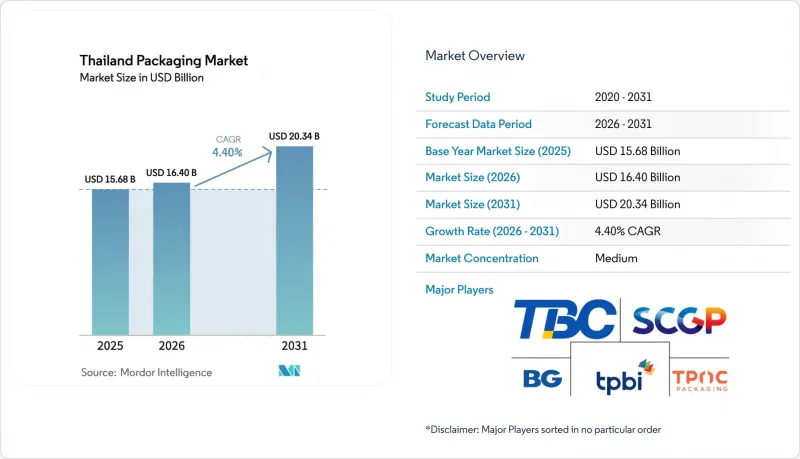
本報告按材料類型(紙和紙板、塑膠、金屬、玻璃容器)、產品類型(紙和紙板製品、塑膠製品、金屬製品、玻璃容器)、包裝類型(硬包裝、軟包裝)、終端用戶行業(食品、飲料、醫藥及其他)和地區進行細分。市場預測以美元計價。
泰國包裝市場的趨勢和洞察
食品和飲料產量增加
2024年,泰國食品出口額達328億美元。這一成長帶動了包裝需求,因為保存期限長的出口產品需要多層阻隔薄膜來保持長途運輸過程中的風味。 2025年,泰國國內食品廠的產能運轉率提升至78%,瓦楞紙箱、立式袋和無菌紙盒的訂單持續成長。隨著旅遊業的復甦,2025年飯店、餐廳和機構買家的支出達到354億美元,進一步推動了國內對使用微波爐適用托盤的即食食材自煮包的需求。在出口和國內市場雙雙成長的驅動下,加工商能夠將樹脂成本的波動轉嫁到產品價格上,而不會導致銷售量下降。因此,食品加工量的成長預計將使泰國包裝市場2026年至2031年的複合年成長率提高1.2個百分點。
電子商務和小包裹處理量的成長
宅配業的領導者嘉里快遞預計到2025年每日包裹處理量將達到700萬至800萬小包裹,自2022年以來實現了兩位數的成長。每個小包裹都將使用聚乙烯郵袋或瓦楞紙箱,預製輕便的解決方案因其能縮短從包裝到出貨的周期而備受青睞,尤其是在當日達服務興起之後。預計到2025年,泰國的商品交易總額將達到1,000億泰銖(約29億美元),其中時尚與健康美容產品的複購率最高。為了履行企業應對氣候變遷的承諾,小包裹承運商正積極尋求使用可回收或可生物分解的包裝材料,這導致紙質氣泡信封和可堆肥空氣枕的需求增加。隨著曼谷的末端配送網路趨於飽和並向區域樞紐擴展,預計到2028年,電子商務將繼續為市場成長貢獻約1個百分點。
禁止使用一次性塑膠製品和徵收環境稅
自2025年1月1日起,泰國將全國禁止使用Oxo分解塑膠袋、聚苯乙烯食品容器和塑膠吸管,違者將被處以最高10萬泰銖(約2,857美元)的罰款。零售商將被迫改用紙吸管和甘蔗渣容器,這些產品的成本將高出20%至40%,從而擠壓餐飲業的利潤空間。這項禁令將導致每年約5萬噸聚苯乙烯的需求量下降,迫使擠出生產商關閉生產線或轉而生產聚丙烯。此外,政府還計劃對每公斤原生樹脂徵收2至5泰銖(約0.06至0.14美元)的環境課稅,這可能會進一步加重成本負擔。預計這些因素綜合起來,短期內將使泰國包裝市場的複合年成長率下降0.6個百分點。
細分市場分析
儘管預計到2025年塑膠將佔市場價值的42.18%,但再生PET正以4.92%的複合年成長率快速成長,凸顯了全球品牌為實現25%至50%再生樹脂使用目標而向循環原料轉型的趨勢。在泰國包裝市場,僅再生PET瓶的市場規模預計將超過原生樹脂瓶,因為Indorama Ventures將於2025年底運作一條年產5萬噸的食品級生產線。聚丙烯和高密度聚苯乙烯的成長率在4%左右,但正面臨環境稅帶來的不利影響,而聚苯乙烯的需求在禁令實施後大幅下降。
預計到2025年,紙張和紙板將佔泰國包裝市場價值的約28%,這主要得益於國內造紙廠為滿足電商對瓦楞紙箱的激增需求而將產量提高5.2%。金屬包裝佔18%,其成長與泰國飲料罐公司(Thai Beverage Can)和波爾公司(Ball Corporation)對輕質鋁技術的投資密切相關。玻璃包裝緊隨其後,佔12%,BG Container Glass公司希望透過改進熔爐來提高效率,但卻因更輕的寶特瓶而失去了部分市場佔有率。總體而言,這些材料趨勢表明,永續性溢價和物流經濟正在重塑泰國的包裝市場。
2025年,塑膠袋佔總銷售額的28.24%,其中,受消費者對可重複密封和自主型包裝的偏好驅動,軟包裝袋的成長速度更快,達到5.01%。與通用包裝袋產品線相比,泰國包裝袋市場受益於更高的加工利潤率(12%至15%),這得益於其拉鍊和吸嘴等功能。薄膜和包裝膜的成長率為4.7%,主要受東部經濟走廊出口托盤化和溫室農業擴張的推動。
受飲料和個人保健產品需求的推動,硬質塑膠瓶、罐和瓶蓋的總合年成長率 (CAGR) 達到 4.2%。繫繩瓶蓋每單位成本增加 0.01 至 0.02 美元,但可防止亂丟垃圾,並符合即將實施的生產者責任召回 (EPR) 法規。瓦楞紙箱、折疊紙盒和模塑纖維外帶包裝正在蠶食紙製品市場,它們已成功與餐飲服務業簽訂契約,並利用了 2025 年 1 月發泡聚苯乙烯禁令的有利時機。這些產品趨勢表明,泰國包裝市場正持續向高附加價值產品轉型。
其他好處:
- Excel格式的市場預測(ME)表
- 3個月的分析師支持
目錄
第1章:引言
- 研究假設和市場定義
- 調查範圍
第2章:調查方法
第3章執行摘要
第4章 市場狀況
- 市場概覽
- 市場促進因素
- 食品和飲料產量增加
- 電子商務的成長和小包裹量的增加
- 對便利彈性包裝的需求
- 與永續性和循環經濟相關的舉措
- BOI對包裝自動化給予優惠待遇
- 含有大麻的食品和飲料需要使用兒童安全包裝。
- 市場限制因素
- 禁止使用一次性塑膠製品和徵收環境稅
- 石化樹脂價格波動
- 食品用rPET原料短缺
- 來自越南和中國的低價進口商品的競爭。
- 宏觀經濟因素對市場的影響
- 產業價值鏈分析
- 監理情勢
- 技術展望
- 波特五力分析
第5章 市場規模與成長預測
- 依材料類型
- 紙張和紙板
- 塑膠
- 聚丙烯(PP)
- 高密度聚乙烯和低密度聚乙烯
- PET
- PVC
- PS
- 其他塑膠
- 金屬
- 容器用玻璃器皿
- 依產品類型
- 紙和紙板製品
- 可折疊紙盒和硬紙盒
- 瓦楞紙箱和容器
- 免洗紙製品
- 其他類型的紙張和紙板
- 塑膠製品
- 硬質塑膠
- 瓶子和罐子
- 蓋子和封口
- 散裝產品
- 其他硬質塑膠
- 軟質塑膠
- 小袋
- 包包
- 薄膜和包裝
- 其他軟塑膠
- 硬質塑膠
- 金屬製品
- 坎
- 蓋子和閉合部件
- 氣霧劑容器
- 其他金屬製品
- 容器用玻璃器皿
- 瓶子
- 瓶子
- 紙和紙板製品
- 按包裝類型
- 硬質包裝形式
- 軟包裝
- 按最終用戶行業分類
- 食物
- 飲料
- 藥品和醫療保健
- 個人護理化妝品
- 工業和化學
- 農業
- 車
- 其他終端用戶產業
第6章 競爭情勢
- 市場集中度
- 策略趨勢
- 市佔率分析
- 公司簡介
- SCG Packaging Public Co. Ltd
- BG Container Glass Public Co. Ltd
- TPAC Packaging Public Co. Ltd
- Thai Beverage Can Co. Ltd
- TBPI Public Co. Ltd
- Eastern Polypack Co. Ltd
- Huhtamaki Oyj
- Amcor plc
- Sealed Air Corporation
- TOPPAN Inc.
- Thai Packaging Industry PCL
- Berli Jucker Public Company Limited
- Ball Corporation
- Crown Holdings, Inc.
- Alpla Werke Alwin Lehner GmbH & Co KG
- Oji Packaging(Thailand)Ltd
- Siam Toppan Packaging Co. Ltd
- Thai Cane Paper Public Co. Ltd
- DNP Asia Co. Ltd
- Printpack Asia Ltd
第7章 市場機會與未來展望
According to Mordor Intelligence, the Thailand packaging market size was valued at USD 15.68 billion in 2025 and is estimated to grow from USD 16.4 billion in 2026 to reach USD 20.34 billion by 2031, at a CAGR of 4.4% during the forecast period (2026-2031).
This report is Segmented by Material Type (Paper and Paperboard, Plastic, Metal, and Container Glass), Product Type (Paper and Paperboard Product, Plastic Product, Metal Product, and Container Glass Product), Packaging Format (Rigid, and Flexible), End-User Industry (Food, Beverage, Pharmaceutical and Medical, and More), and Geography. The Market Forecasts are Provided in Terms of Value (USD).
Thailand Packaging Market Trends and Insights
Rising Food and Beverage Output
Thailand shipped USD 32.8 billion worth of food products in 2024, a performance that lifts packaging demand because shelf-stable exports need multilayer barrier films that preserve flavour during long transit. Capacity-utilization in domestic food factories climbed to 78% in 2025, sustaining orders for corrugated shippers, stand-up pouches, and aseptic cartons. Hotels, restaurants, and institutional buyers spent USD 35.4 billion in 2025 as tourism rebounded, strengthening local pull for ready-to-eat meal kits that rely on microwaveable trays. The dual export-domestic engine allows converters to transfer resin cost swings into pricing without volume loss. Consequently, rising food throughput is expected to add 1.2 percentage points to the Thailand packaging market CAGR between 2026 and 2031.
Growth Of E-Commerce and Parcel Volumes
Courier leader Kerry Express handled 7 million-8 million parcels daily during 2025, reflecting a double-digit volume climb since 2022. Each parcel uses a polyethylene mailer or corrugated box, and the shift toward same-day service favours pre-formed, lightweight solutions that shorten pack-to-ship cycles. National gross-merchandise value touched THB 100 billion (USD 2.9 billion) in 2025, with fashion and health-and-beauty goods recording the highest reorder rates. Parcel carriers now request recyclable or biodegradable mailers to meet corporate climate pledges, spurring demand for paper-based bubble mailers and compostable air pillows. As the last-mile network saturates Bangkok and expands to provincial hubs, e-commerce will continue to contribute about 1 percentage point to market growth through 2028.
Single-Use-Plastic Bans and Eco Taxes
A nationwide prohibition on oxo-degradable bags, polystyrene food boxes, and plastic straws took effect on 1 January 2025, with fines up to THB 100,000 (USD 2,857) per infraction. Retailers pivoted to paper straws and bagasse containers that cost 20%-40% more, squeezing food-service margins. The ban removed roughly 50,000 metric tons of annual polystyrene demand, forcing extruders to idle lines or retool toward polypropylene. Planned eco-tax surcharges of THB 2-THB 5 per kilogram (USD 0.06-USD 0.14) on virgin resin could deepen the cost burden. Combined, these factors shave 0.6 percentage points from the Thailand packaging market CAGR in the near term.
Other drivers and restraints analyzed in the detailed report include:
- Demand For Convenient and Flexible Packs
- Sustainability And Circular-Economy Mandates
- Volatile Petrochemical Resin Prices
For complete list of drivers and restraints, kindly check the Table Of Contents.
Segment Analysis
Plastic captured 42.18% of value in 2025, yet recycled PET is racing ahead at a 4.92% CAGR, underlining the pivot to circular feedstock as global brands chase 25%-50% post-consumer-resin targets. The Thailand packaging market size for rPET bottles alone is projected to grow faster than virgin equivalents because Indorama Ventures commissioned a 50,000 metric-ton food-grade line in late 2025. Polypropylene and high-density polyethylene grow in the low-4% range but face eco-tax headwinds, while polystyrene demand collapsed post-ban.
Paper and paperboard represented about 28% of 2025 value, buoyed by 5.2% output growth at domestic mills that meet surging e-commerce box orders. Metal held 18%, its advance tied to Thai Beverage Can and Ball Corporation investments in lightweight aluminium technology. Glass followed at 12%, with BG Container Glass banking on furnace-upgrade efficiencies but conceding share to lighter PET bottles. Altogether, material dynamics demonstrate how sustainability premiums and logistics economics reshape the Thailand packaging market.
Bags accounted for 28.24% of 2025 revenue, yet pouches grow quicker at 5.01% as consumers favour resealable, shelf-standing formats. The Thailand packaging market share for pouches benefits from 12%-15% converter margins, higher than commodity bag lines, because of zipper and spout features. Films and wraps rise 4.7% thanks to export palletization and greenhouse farming in the Eastern Economic Corridor.
Rigid plastics bottles, jars, and caps collectively post a 4.2% CAGR, aided by beverage and personal-care demand. Tethered caps add USD 0.01-USD 0.02 each yet prevent littering and meet forthcoming EPR rules. Corrugated boxes, folding cartons, and molded-fiber takeaway packs round out paper products, leveraging the January 2025 foam ban to win food-service contracts. The product landscape signals a continuing tilt toward value-added formats within the Thailand packaging market.
Complete Report Scope:
- By Material Type
- Paper and Paperboard
- Plastic
- Polypropylene (PP)
- HDPE and LDPE
- PET
- PVC
- PS
- Other Plastics
- Metal
- Container Glass
- By Product Type
- Paper and Paperboard Product
- Folding Carton and Rigid Boxes
- Corrugated Boxes and Containers
- Single-Use Paper Products
- Other Paper and Paperboard Types
- Plastic Product
- Rigid Plastics
- Bottles and Jars
- Caps and Closures
- Bulk-Grade Products
- Other Rigid Plastics
- Flexible Plastics
- Pouches
- Bags
- Films and Wraps
- Other Flexible Plastics
- Rigid Plastics
- Metal Product
- Cans
- Caps and Closures
- Aerosol Containers
- Other Metal Products
- Container Glass Product
- Bottles
- Jars
- Paper and Paperboard Product
- By Packaging Format
- Rigid Packaging Format
- Flexible Packaging Format
- By End-User Industry
- Food
- Beverage
- Pharmaceutical and Medical
- Personal Care and Cosmetics
- Industrial and Chemical
- Agriculture
- Automotive
- Other End-User Industries
List of Companies Covered in this Report:
- SCG Packaging Public Co. Ltd
- BG Container Glass Public Co. Ltd
- TPAC Packaging Public Co. Ltd
- Thai Beverage Can Co. Ltd
- TBPI Public Co. Ltd
- Eastern Polypack Co. Ltd
- Huhtamaki Oyj
- Amcor plc
- Sealed Air Corporation
- TOPPAN Inc.
- Thai Packaging Industry PCL
- Berli Jucker Public Company Limited
- Ball Corporation
- Crown Holdings, Inc.
- Alpla Werke Alwin Lehner GmbH & Co KG
- Oji Packaging (Thailand) Ltd
- Siam Toppan Packaging Co. Ltd
- Thai Cane Paper Public Co. Ltd
- DNP Asia Co. Ltd
- Printpack Asia Ltd
Additional Benefits:
- The market estimate (ME) sheet in Excel format
- 3 months of analyst support
TABLE OF CONTENTS
1 INTRODUCTION
- 1.1 Study Assumptions and Market Definition
- 1.2 Scope of the Study
2 RESEARCH METHODOLOGY
3 EXECUTIVE SUMMARY
4 MARKET LANDSCAPE
- 4.1 Market Overview
- 4.2 Market Drivers
- 4.2.1 Rising Food and Beverage Output
- 4.2.2 Growth of E-commerce and Parcel Volumes
- 4.2.3 Demand for Convenient and Flexible Packs
- 4.2.4 Sustainability and Circular-Economy Mandates
- 4.2.5 BOI Incentives for Packaging Automation
- 4.2.6 Cannabis-Infused Food and Beverage Requires Child-Safe Packs
- 4.3 Market Restraints
- 4.3.1 Single-Use-Plastic Bans and Eco Taxes
- 4.3.2 Volatile Petrochemical Resin Prices
- 4.3.3 Shortage of Food-Grade rPET Feedstock
- 4.3.4 Low-Cost Import Competition From Vietnam and China
- 4.4 Impact of Macroeconomic Factors on the Market
- 4.5 Industry Value-Chain Analysis
- 4.6 Regulatory Landscape
- 4.7 Technological Outlook
- 4.8 Porter's Five Forces Analysis
- 4.8.1 Bargaining Power of Suppliers
- 4.8.2 Bargaining Power of Buyers
- 4.8.3 Threat of New Entrants
- 4.8.4 Threat of Substitutes
- 4.8.5 Competitive Rivalry
5 MARKET SIZE AND GROWTH FORECASTS (VALUE)
- 5.1 By Material Type
- 5.1.1 Paper and Paperboard
- 5.1.2 Plastic
- 5.1.2.1 Polypropylene (PP)
- 5.1.2.2 HDPE and LDPE
- 5.1.2.3 PET
- 5.1.2.4 PVC
- 5.1.2.5 PS
- 5.1.2.6 Other Plastics
- 5.1.3 Metal
- 5.1.4 Container Glass
- 5.2 By Product Type
- 5.2.1 Paper and Paperboard Product
- 5.2.1.1 Folding Carton and Rigid Boxes
- 5.2.1.2 Corrugated Boxes and Containers
- 5.2.1.3 Single-Use Paper Products
- 5.2.1.4 Other Paper and Paperboard Types
- 5.2.2 Plastic Product
- 5.2.2.1 Rigid Plastics
- 5.2.2.1.1 Bottles and Jars
- 5.2.2.1.2 Caps and Closures
- 5.2.2.1.3 Bulk-Grade Products
- 5.2.2.1.4 Other Rigid Plastics
- 5.2.2.2 Flexible Plastics
- 5.2.2.2.1 Pouches
- 5.2.2.2.2 Bags
- 5.2.2.2.3 Films and Wraps
- 5.2.2.2.4 Other Flexible Plastics
- 5.2.2.1 Rigid Plastics
- 5.2.3 Metal Product
- 5.2.3.1 Cans
- 5.2.3.2 Caps and Closures
- 5.2.3.3 Aerosol Containers
- 5.2.3.4 Other Metal Products
- 5.2.4 Container Glass Product
- 5.2.4.1 Bottles
- 5.2.4.2 Jars
- 5.2.1 Paper and Paperboard Product
- 5.3 By Packaging Format
- 5.3.1 Rigid Packaging Format
- 5.3.2 Flexible Packaging Format
- 5.4 By End-User Industry
- 5.4.1 Food
- 5.4.2 Beverage
- 5.4.3 Pharmaceutical and Medical
- 5.4.4 Personal Care and Cosmetics
- 5.4.5 Industrial and Chemical
- 5.4.6 Agriculture
- 5.4.7 Automotive
- 5.4.8 Other End-User Industries
6 COMPETITIVE LANDSCAPE
- 6.1 Market Concentration
- 6.2 Strategic Moves
- 6.3 Market Share Analysis
- 6.4 Company Profiles (includes Global Level Overview, Market Level Overview, Core Segments, Financials as available, Strategic Information, Market Rank/Share, Products and Services, Recent Developments)
- 6.4.1 SCG Packaging Public Co. Ltd
- 6.4.2 BG Container Glass Public Co. Ltd
- 6.4.3 TPAC Packaging Public Co. Ltd
- 6.4.4 Thai Beverage Can Co. Ltd
- 6.4.5 TBPI Public Co. Ltd
- 6.4.6 Eastern Polypack Co. Ltd
- 6.4.7 Huhtamaki Oyj
- 6.4.8 Amcor plc
- 6.4.9 Sealed Air Corporation
- 6.4.10 TOPPAN Inc.
- 6.4.11 Thai Packaging Industry PCL
- 6.4.12 Berli Jucker Public Company Limited
- 6.4.13 Ball Corporation
- 6.4.14 Crown Holdings, Inc.
- 6.4.15 Alpla Werke Alwin Lehner GmbH & Co KG
- 6.4.16 Oji Packaging (Thailand) Ltd
- 6.4.17 Siam Toppan Packaging Co. Ltd
- 6.4.18 Thai Cane Paper Public Co. Ltd
- 6.4.19 DNP Asia Co. Ltd
- 6.4.20 Printpack Asia Ltd
7 MARKET OPPORTUNITIES AND FUTURE OUTLOOK
- 7.1 White-Space and Unmet-Need Assessment

 折疊扇市場 - 全球市場預測 2026-2032
 電子順磁共振(ESR)波譜儀市場規模、佔有率和成長分析:按波譜儀類型、頻段、應用、最終用戶、配置和地區分類-2026-2033年產業預測
 木質合板包裝市場:策略性洞察與預測(2026-2031年)
 西班牙包裝產業:市場佔有率分析、產業趨勢與統計、成長預測(2026-2031)包裝泵和分配器:市場佔有率分析、行業趨勢和統計數據、成長預測(2026-2031 年)非洲包裝市場:市場佔有率分析、產業趨勢與統計及成長預測(2026-2031 年)
 微波爐適用包裝市場分析及至2035年預測:類型、技術、應用、形狀、材料類型、製程、最終用戶、功能、設備
 2034年纖維基阻隔性包裝市場預測-全球分析(依纖維材料、阻隔塗層、包裝形式、阻隔技術、最終用戶和地區分類)復古包裝市場規模、佔有率、成長、全球產業分析、區域趨勢及2026-2034年預測行動包裝市場規模、佔有率、成長率、全球產業分析、區域分析及未來預測(2026-2034)