

 |
市場調查報告書
商品編碼
2122695
施工機械租賃:市場佔有率分析、產業趨勢與統計、成長預測(2026-2031)Construction Equipment Rental - Market Share Analysis, Industry Trends & Statistics, Growth Forecasts (2026 - 2031) |
||||||

※ 本網頁內容可能與最新版本有所差異。詳細情況請與我們聯繫。
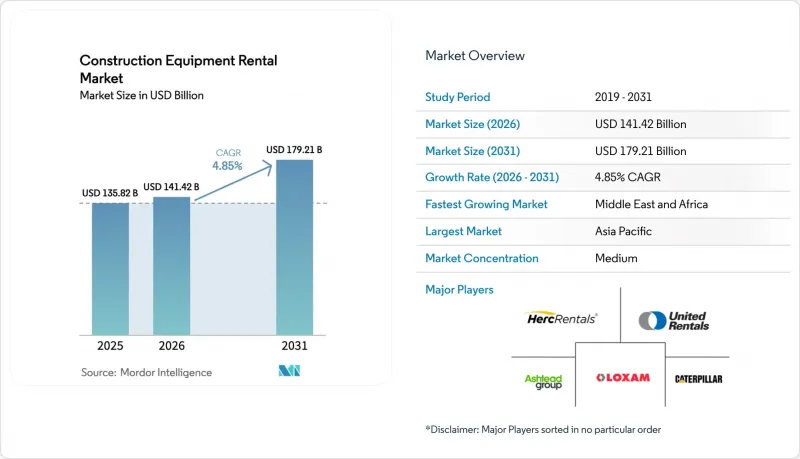
根據 Mordor Intelligence 預測,施工機械租賃市場規模預計將在 2025 年達到 1,358.2 億美元,2026 年達到 1,414.2 億美元,2031 年達到 1,792.1 億美元,2026 年至 2031 年的複合年成長率為 4.85%。
本報告按設備類型(土木工程機具、物料輸送機械等)、驅動系統(內燃機、混合動力等)、應用領域(住宅建築、商業建築等)、租賃管道(線下和線上)、服務類型(短期租賃、中期租賃等)以及地區進行細分。市場預測以美元計價。
全球施工機械租賃市場趨勢及洞察
一系列由基礎設施獎勵策略資助的大型企劃正在籌備中。
大規模公共支出計畫正在將投機性需求轉化為穩定的多年租賃協議。美國已根據《基礎設施投資與就業法案》承諾對超過6萬個基礎建設項目進行大量投資。 2024年,中國大幅增加了地方政府債券的發行量,主要集中在交通走廊和都市更新項目。印度在2024-2025會計年度為基礎建設發展預算了111.1兆盧比(約1330億美元)。沙烏地阿拉伯的「2030願景」包含多個超級項目(例如NEOM和吉迪亞),這些項目正在支撐建築需求和施工機械的使用。土耳其的初步損失累計表明,需要超過1000億美元來支持持續的災後重建工作。這些項目與中期租賃直接相關,並且已經產生了可觀的回報。
建築業從資本支出轉向營運支出
為了確保流動性,建設公司越來越依賴租賃而非自有設備。聯合租賃公司(United Rentals)在2024年維持了大規模的年度資本支出計劃,重點為租賃專用設備和電動資產提供少數股權資金籌措。陽光地帶租賃公司(Sunbelt Rentals)在2025會計年度投入大量資源擴大其設備規模,同時在美國各地開設了多家新店。哈克租賃公司(Hark Rentals)透過專注於專業細分市場,在2024年顯著提升了其設備價值。在北美和歐洲信貸市場趨緊的背景下,企業明顯傾向選擇經營租賃而非資本購買。這種融資策略目前正在亞太地區的建築公司中推廣。
熟練操作人員短缺會增加停機風險。
當需求激增時,往往難以找到熟練的操作人員,導致租賃設備閒置。美國勞工統計局預測,從2026年開始,未來十年施工機械操作人員的需求將持續成長,主要促進因素是設備更新換代。在施工旺季,由於退休人員數量超過新入職的合格人員數量,這種短缺問題會更加突出。德國和日本也面臨類似的短缺問題,勞動力老化推高了薪資溢價,延長了招聘週期,導致專案成本增加和工期延長。租賃公司正透過將操作人員培訓納入合約或與職業學校合作來降低風險,但培訓等候名單的積壓意味著建築公司需要等待數週才能獲得合格的操作人員。運作的設備降低了運轉率,迫使租賃公司維持大規模的車隊規模以滿足服務水準保證,從而佔用了原本可以用於電氣化和數位化投資的資金。除非大幅擴大培訓計劃,否則操作員短缺問題將繼續減少合適設備的供應,至少在中期內如此,並繼續對租賃利潤率造成下行壓力。
細分市場分析
到2025年,土木工程和施工機械將佔施工機械租賃市場佔有率的41.05%,其到2031年的複合年成長率將達到7.61%,超過整體市場成長率。挖土機、裝載機和推土機在公路、鐵路和採礦項目中仍然至關重要。後鏟式裝載機在公共產業和住宅建築工地發揮關鍵作用,因為這些工地對多功能性要求極高。挖土機,尤其是履帶式挖土機,正在推動大規模土方作業的需求,而輪式挖土機在都市區,機動性至關重要。
起重機和加長型堆高機等物料輸送設備在高層建築和物流設施建設中佔據第二大市場。由於高速公路投資的增加,混凝土和道路施工機械的需求也在成長,而發電機和壓縮機等動力設備則滿足了現場的間歇性需求。配備遠端資訊處理功能的土木工程機具正在以其卓越的正常運行時間而非價格運轉率,在租賃設備市場中脫穎而出,進一步鞏固了其在施工機械租賃市場的核心地位。
截至2025年,由於柴油加氣網路的持續普及,內燃機(IC)機械仍佔據86.13%的市場。柴油與電力結合的混合模式可在低排放氣體區作業。電池驅動的施工機械發展勢頭強勁,加州大量零排放車型的註冊進一步推動了這一趨勢。
氫燃料電池汽車,例如現代汽車在2025年寶馬展上發布的HW155H挖掘機,預計到2031年將以15.88%的複合年成長率成長,吸引那些既需要零排放又不受電池續航里程限制的項目。 JCB的氫燃料電池引擎可直接取代柴油引擎。雖然內燃機預計在未來十年仍將佔據主導地位,但監管壓力和總擁有成本(TCO)的下降可能會在長期內推動市場轉型為電動和氫燃料電池技術。
區域分析
預計到2025年,亞太地區將佔據40.11%的市場佔有率,並在2031年之前保持顯著的複合年成長率。需求主要來自中國的地方基礎設施債券、印度的大型專案規劃以及日本的建設預算。韓國的大規模產業計畫以及澳洲的礦業和可再生能源綜合計畫也同樣推動了租賃需求。該地區都市化和大型企劃的協同效應正在支撐施工機械租賃市場的發展。
中東和非洲地區以6.72%的複合年成長率領先,主要得益於沙烏地阿拉伯價值1.3兆美元的「2030願景」計畫群,涵蓋新城(NEOM)、紅海和吉迪亞等地區。阿拉伯聯合大公國阿提哈德鐵路二期等項目需持續更換設備。土耳其耗資1000億美元的重建項目和南非的可再生能源計畫也為市場注入了新的活力。
北美和歐洲正經歷著穩定成長。美國持續透過大量投資推動基礎建設。加拿大優先發展公共交通和電力線路,德國則致力於在都市區推廣電動車,以符合低排放氣體法規。英國建設產業也注重租賃專用設備,以確保符合相關法規。
其他好處:
- Excel格式的市場預測(ME)表
- 3個月的分析師支持
目錄
第1章:引言
- 研究假設和市場定義
- 調查範圍
第2章:調查方法
第3章執行摘要
第4章 市場狀況
- 市場概覽
- 市場促進因素
- 規劃與基礎設施和經濟獎勵策略相關的大型企劃。
- 承包商從資本支出向營運支出的過渡
- 嚴格的ESG目標正在加速電動車的租賃。
- 新興市場數位租賃平台的爆炸性成長
- 計量收費和基於績效的合約模式
- 數據驅動的車輛營運最佳化可提高客戶的投資報酬率。
- 市場限制因素
- 熟練操作人員短缺增加了停機風險。
- 由於採用多品牌系統,因此需要較高的維護水準。
- OEM廠商提供的直接面對消費者的租賃服務導致銷售蠶食。
- 鋰電池資產殘值波動性
- 價值供應鏈分析
- 監理情勢
- 技術展望
- 波特五力模型
第5章 市場規模與成長預測
- 依設備類型
- 土木工程施工機械
- 後鏟式裝載機
- 裝載機
- 鏟
- 推土機
- 滑移裝載機
- 其他土木工程和施工機械
- 物料輸送設備
- 起重機
- 堆高機
- 自動卸貨卡車
- 加長型堆高機
- 其他物料輸送
- 混凝土及道路施工機械
- 電力和能源設備
- 其他設備
- 土木工程施工機械
- 透過驅動系統
- 內燃機
- 混合
- 電的
- 氫燃料電池
- 透過使用
- 住宅
- 商業建築
- 工業/製造業
- 基礎建設(道路、橋樑、港口)
- 採礦和採石
- 石油和天然氣
- 租賃頻道
- 線下(實體店)
- 線上平台
- 按服務類型
- 短期租賃(少於1個月)
- 中期租賃(1-12個月)
- 長期出租(1年或以上)
- 按地區
- 北美洲
- 美國
- 加拿大
- 其他北美國家
- 歐洲
- 德國
- 英國
- 法國
- 義大利
- 西班牙
- 俄羅斯
- 其他歐洲國家
- 亞太地區
- 中國
- 日本
- 印度
- 韓國
- 澳洲
- 其他亞太國家
- 南美洲
- 巴西
- 阿根廷
- 智利
- 其他南美國家
- 中東和非洲
- 沙烏地阿拉伯
- 阿拉伯聯合大公國
- 土耳其
- 南非
- 奈及利亞
- 其他中東和非洲國家
- 北美洲
第6章 競爭情勢
- 市場集中度
- 策略趨勢
- 市佔率分析
- 公司簡介
- United Rentals Inc.
- Ashtead Group plc(Sunbelt Rentals)
- Herc Rentals Inc.
- Loxam Group
- Caterpillar Inc.
- Sumitomo Corporation
- Hitachi Construction Machinery Co., Ltd.
- Liebherr-International AG
- Kanamoto Co., Ltd.
- CNH Industrial NV
- Boels Rental
- Cramo Oyj
- Ahern Rentals
- Maxim Crane Works
- Coates Hire Operations Pty Ltd.
- Sarens nv/sa
第7章 市場機會與未來展望
According to Mordor Intelligence, the construction equipment rental market size is projected to be USD 135.82 billion in 2025, USD 141.42 billion in 2026, and reach USD 179.21 billion by 2031, growing at a CAGR of 4.85% from 2026 to 2031.
This report is Segmented by Equipment Type (Earthmoving Equipment, Material Handling Equipment, and More), Drive Type (IC Engine, Hybrid, and More), Application (Residential Construction, Commercial Construction, and More), Rental Channel (Offline and Online), Service Type (Short-Term Rental, Medium-Term Rental, and More), and Geography. The Market Forecasts are Provided in Terms of Value (USD).
Global Construction Equipment Rental Market Trends and Insights
Infrastructure-Stimulus Megaproject Pipeline
Large public spending programs turn speculative demand into firm, multi-year rental contracts. The United States has already committed significant investment to over 60,000 infrastructure projects under the Infrastructure Investment and Jobs Act. In 2024, China significantly increased its deployment of provincial bonds, focusing primarily on transport corridors and urban renewal projects. India budgeted INR 11.11 lakh crore (USD 133 billion) for infrastructure in fiscal 2024-25 . Saudi Arabia's Vision 2030 includes multiple giga-projects (e.g., NEOM, Qiddiya) that are sustaining construction demand and equipment utilization. Preliminary damage assessments for Turkiye indicate needs above USD 100 billion, supporting sustained reconstruction activity. These pipelines feed directly into medium-term rentals, already generating notable revenue.
Shift from CAPEX-to-OPEX Among Contractors
In a bid to preserve liquidity, construction firms are increasingly turning to rentals instead of relying on owned fleets. United Rentals maintained a significant annual capex program in 2024, with a focus on minority-financing specialty and electric assets for rental purposes. Sunbelt Rentals committed substantial resources in fiscal 2025 for fleet expansion, simultaneously inaugurating numerous new outlets across the United States. Herc Rentals, in 2024, enhanced its fleet value significantly, honing in on specialty niches. As tighter credit markets emerge in North America and Europe, there's a noticeable shift towards operating leases over capital purchases. This financial strategy is now being rolled out to contractors in the Asia-Pacific region.
Skilled-Operator Scarcity Elevates Downtime Risk
Rental equipment often sits idle because trained operators are unavailable when demand surges. In 2026, the U.S. Bureau of Labor Statistics projects continued annual openings for construction equipment operators over the next decade, driven mainly by replacement needs. This gap becomes more pronounced during peak construction months, as retirements outpace new certifications. Similar shortages are also evident in Germany and Japan, where aging workforces drive up wage premiums and lengthen recruitment cycles, thereby inflating project costs and extending schedules. Rental firms attempt to mitigate the risk by bundling operator training into contracts and partnering with vocational schools; however, class backlogs still mean contractors wait weeks for certified personnel. Idle machinery erodes utilization metrics, forcing rental companies to maintain larger fleets to meet service-level guarantees, thereby tying up capital that could be used to fund electrification or digital upgrades. Unless training pipelines expand materially, operator scarcity will continue to depress adequate fleet availability and place downward pressure on rental margins through at least the medium term.
Other drivers and restraints analyzed in the detailed report include:
- Stringent ESG Targets Accelerating Electric Rentals
- Digital Rental-Platform Explosion in Emerging Markets
- High Multi-Brand Maintenance Complexity
For complete list of drivers and restraints, kindly check the Table Of Contents.
Segment Analysis
Earthmoving equipment secured 41.05% of the construction equipment rental market share in 2025, and its 7.61% CAGR through 2031 exceeds the overall market pace. Excavators, loaders, and bulldozers remain indispensable for road, rail, and mining projects. Backhoe loaders serve utilities and residential work where versatility matters. Excavators, especially tracked units, lead demand for heavy soil removal, while wheeled variants gain ground in urban sites where mobility is prized.
Material-handling gear forms the next-largest slice, driven by cranes and telehandlers used in high-rise and logistics developments. Concrete and road machinery rise with highway spending, and power equipment-such as generators and compressors-meets intermittent site needs. Telematics-enabled earthmovers differentiate rental fleets on uptime rather than price, reinforcing their central role in the construction equipment rental market.
Internal Combustion (IC) engine machines accounted for 86.13% of the mix in 2025, as diesel refueling networks remain ubiquitous. Hybrid models blend diesel and electric to navigate low-emission zones. Battery electric equipment gains momentum, helped by a significant number of zero-emission models listed in California.
Hydrogen fuel-cell units, such as Hyundai's HW155H excavator unveiled at Bauma 2025, are growing at a 15.88% CAGR by 2031 and attract projects that need zero emissions without battery-range limits. JCB's hydrogen-combustion engines offer a drop-in diesel alternative. IC dominance will persist this decade; however, regulatory pressure and falling total cost of ownership will tilt the longer-term curve toward electric and hydrogen technologies.
Complete Report Scope:
- By Equipment Type
- Earthmoving Equipment
- Backhoe Loaders
- Loaders
- Excavators
- Bulldozers
- Skid-Steer Loaders
- Other Earthmoving
- Material Handling Equipment
- Cranes
- Forklifts
- Dump Trucks
- Telehandlers
- Other Material Handling
- Concrete and Road Construction Equipment
- Power and Energy Equipment
- Other Equipment
- Earthmoving Equipment
- By Drive Type
- IC Engine
- Hybrid
- Electric
- Hydrogen Fuel Cell
- By Application
- Residential Construction
- Commercial Construction
- Industrial / Manufacturing
- Infrastructure (Roads, Bridges, Ports)
- Mining and Quarrying
- Oil and Gas
- By Rental Channel
- Offline (Branch-based)
- Online Platforms
- By Service Type
- Short-Term Rental (less than 1 Month)
- Medium-Term Rental (1 - 12 Months)
- Long-Term Rental (Over 1 Year)
- By Geography
- North America
- United States
- Canada
- Rest of North America
- Europe
- Germany
- United Kingdom
- France
- Italy
- Spain
- Russia
- Rest of Europe
- Asia-Pacific
- China
- Japan
- India
- South Korea
- Australia
- Rest of Asia-Pacific
- South America
- Brazil
- Argentina
- Chile
- Rest of South America
- Middle East and Africa
- Saudi Arabia
- United Arab Emirates
- Turkey
- South Africa
- Nigeria
- Rest of Middle East and Africa
- North America
Geography Analysis
Asia-Pacific captured a 40.11% share in 2025 and is tracking a notable CAGR to 2031. China's local infrastructure bonds, India's significant pipeline, and Japan's construction budget anchor demand. South Korea's considerable program and Australia's mining-plus-renewables mix likewise favor rentals. The region's mix of urbanization and mega-projects sustains the construction equipment rental market.
The Middle East and Africa log the fastest CAGR of 6.72%, led by Saudi Vision 2030's USD 1.3 trillion slate spanning NEOM, the Red Sea, and Qiddiya. Projects in the United Arab Emirates, such as Etihad Rail Phase 2, require continuous rotations . Turkey's USD 100 billion reconstruction and South Africa's renewable-energy program add depth.
North America and Europe experience a steady, albeit slow, growth. The United States continues its strong infrastructure push with significant investments. While Canada prioritizes transit and power lines, Germany channels its construction efforts towards electric fleets, aligning with urban low-emission mandates. The United Kingdom construction sector also leans into specialty rentals to ensure compliance.
- United Rentals Inc.
- Ashtead Group plc (Sunbelt Rentals)
- Herc Rentals Inc.
- Loxam Group
- Caterpillar Inc.
- Sumitomo Corporation
- Hitachi Construction Machinery Co., Ltd.
- Liebherr-International AG
- Kanamoto Co., Ltd.
- CNH Industrial N.V.
- Boels Rental
- Cramo Oyj
- Ahern Rentals
- Maxim Crane Works
- Coates Hire Operations Pty Ltd.
- Sarens n.v./s.a.
Additional Benefits:
- The market estimate (ME) sheet in Excel format
- 3 months of analyst support
TABLE OF CONTENTS
1 Introduction
- 1.1 Study Assumptions & Market Definition
- 1.2 Scope of the Study
2 Research Methodology
3 Executive Summary
4 Market Landscape
- 4.1 Market Overview
- 4.2 Market Drivers
- 4.2.1 Infrastructure-Stimulus Megaproject Pipeline
- 4.2.2 Shift from CAPEX-to-OPEX Among Contractors
- 4.2.3 Stringent ESG Targets Accelerating Electric Rentals
- 4.2.4 Digital Rental-Platform Explosion in Emerging Markets
- 4.2.5 Pay-Per-Use and Outcome-Based Contracting Models
- 4.2.6 Data-Driven Fleet Optimization Boosts Customer ROI
- 4.3 Market Restraints
- 4.3.1 Skilled-Operator Scarcity Elevates Downtime Risk
- 4.3.2 High Multi-Brand Maintenance Complexity
- 4.3.3 OEMs' Direct-to-Customer Rental Cannibalization
- 4.3.4 Residual-Value Volatility for Lithium-Battery Assets
- 4.4 Value / Supply-Chain Analysis
- 4.5 Regulatory Landscape
- 4.6 Technological Outlook
- 4.7 Porter's Five Forces
- 4.7.1 Threat of New Entrants
- 4.7.2 Bargaining Power of Buyers
- 4.7.3 Bargaining Power of Suppliers
- 4.7.4 Threat of Substitutes
- 4.7.5 Intensity of Competitive Rivalry
5 Market Size & Growth Forecasts (Value, USD)
- 5.1 By Equipment Type
- 5.1.1 Earthmoving Equipment
- 5.1.1.1 Backhoe Loaders
- 5.1.1.2 Loaders
- 5.1.1.3 Excavators
- 5.1.1.4 Bulldozers
- 5.1.1.5 Skid-Steer Loaders
- 5.1.1.6 Other Earthmoving
- 5.1.2 Material Handling Equipment
- 5.1.2.1 Cranes
- 5.1.2.2 Forklifts
- 5.1.2.3 Dump Trucks
- 5.1.2.4 Telehandlers
- 5.1.2.5 Other Material Handling
- 5.1.3 Concrete and Road Construction Equipment
- 5.1.4 Power and Energy Equipment
- 5.1.5 Other Equipment
- 5.1.1 Earthmoving Equipment
- 5.2 By Drive Type
- 5.2.1 IC Engine
- 5.2.2 Hybrid
- 5.2.3 Electric
- 5.2.4 Hydrogen Fuel Cell
- 5.3 By Application
- 5.3.1 Residential Construction
- 5.3.2 Commercial Construction
- 5.3.3 Industrial / Manufacturing
- 5.3.4 Infrastructure (Roads, Bridges, Ports)
- 5.3.5 Mining and Quarrying
- 5.3.6 Oil and Gas
- 5.4 By Rental Channel
- 5.4.1 Offline (Branch-based)
- 5.4.2 Online Platforms
- 5.5 By Service Type
- 5.5.1 Short-Term Rental (less than 1 Month)
- 5.5.2 Medium-Term Rental (1 - 12 Months)
- 5.5.3 Long-Term Rental (Over 1 Year)
- 5.6 By Geography
- 5.6.1 North America
- 5.6.1.1 United States
- 5.6.1.2 Canada
- 5.6.1.3 Rest of North America
- 5.6.2 Europe
- 5.6.2.1 Germany
- 5.6.2.2 United Kingdom
- 5.6.2.3 France
- 5.6.2.4 Italy
- 5.6.2.5 Spain
- 5.6.2.6 Russia
- 5.6.2.7 Rest of Europe
- 5.6.3 Asia-Pacific
- 5.6.3.1 China
- 5.6.3.2 Japan
- 5.6.3.3 India
- 5.6.3.4 South Korea
- 5.6.3.5 Australia
- 5.6.3.6 Rest of Asia-Pacific
- 5.6.4 South America
- 5.6.4.1 Brazil
- 5.6.4.2 Argentina
- 5.6.4.3 Chile
- 5.6.4.4 Rest of South America
- 5.6.5 Middle East and Africa
- 5.6.5.1 Saudi Arabia
- 5.6.5.2 United Arab Emirates
- 5.6.5.3 Turkey
- 5.6.5.4 South Africa
- 5.6.5.5 Nigeria
- 5.6.5.6 Rest of Middle East and Africa
- 5.6.1 North America
6 Competitive Landscape
- 6.1 Market Concentration
- 6.2 Strategic Moves
- 6.3 Market Share Analysis
- 6.4 Company Profiles (Includes Global Level Overview, Market Level Overview, Core Segments, Financials as Available, Strategic Information, Market Rank/Share for Key Companies, Products and Services, SWOT Analysis, and Recent Developments)
- 6.4.1 United Rentals Inc.
- 6.4.2 Ashtead Group plc (Sunbelt Rentals)
- 6.4.3 Herc Rentals Inc.
- 6.4.4 Loxam Group
- 6.4.5 Caterpillar Inc.
- 6.4.6 Sumitomo Corporation
- 6.4.7 Hitachi Construction Machinery Co., Ltd.
- 6.4.8 Liebherr-International AG
- 6.4.9 Kanamoto Co., Ltd.
- 6.4.10 CNH Industrial N.V.
- 6.4.11 Boels Rental
- 6.4.12 Cramo Oyj
- 6.4.13 Ahern Rentals
- 6.4.14 Maxim Crane Works
- 6.4.15 Coates Hire Operations Pty Ltd.
- 6.4.16 Sarens n.v./s.a.
7 Market Opportunities & Future Outlook

 東協施工機械租賃:市場佔有率分析、產業趨勢與統計及成長預測(2026-2031)印度施工機械租賃:市場佔有率分析、產業趨勢與統計及成長預測(2026-2031)
 2026-2030年全球施工機械租賃市場
 施工機械租賃市場:2026-2032年全球市場預測(依設備類型、租賃期限、動力來源、營運方式、租賃模式及應用領域分類)
 施工機械租賃市場-全球產業規模、佔有率、趨勢、機會和預測:按設備類型、產品類型、應用類型、驅動類型、地區和競爭格局分類,2021-2031年
 施工機械租賃市場報告:按型號、驅動系統、應用和地區分類(2026-2034 年)
 施工機械租賃市場:按機器類型和地區分類
 2026年全球施工機械租賃市場報告2026年全球重型建築設備租賃市場報告
 施工機械及工具租賃平台市場預測至2034年-全球分析(依設備類型、租賃模式、定價模式、客戶類型、最終用戶及地區分類)