


 |
市場調查報告書
商品編碼
2114333
印度施工機械租賃:市場佔有率分析、產業趨勢與統計及成長預測(2026-2031)India Construction Equipment Rental - Market Share Analysis, Industry Trends & Statistics, Growth Forecasts (2026 - 2031) |
||||||

※ 本網頁內容可能與最新版本有所差異。詳細情況請與我們聯繫。
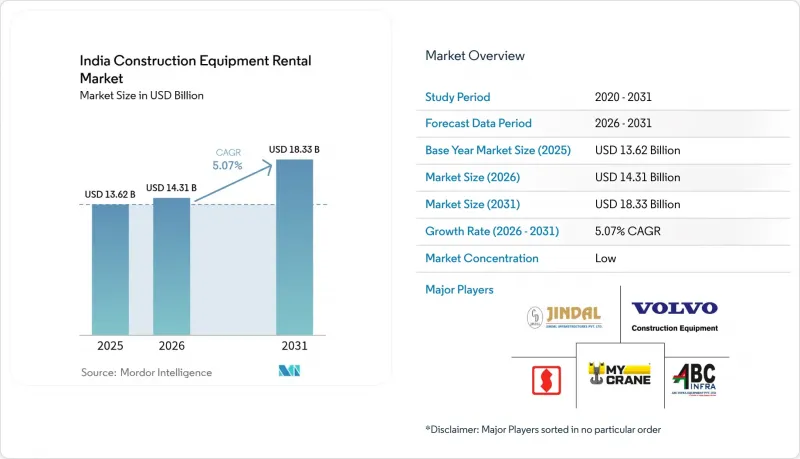
據 Mordor Intelligence 稱,印度施工機械租賃市場預計到 2026 年價值 143.1 億美元,高於 2025 年的 136.2 億美元,預計到 2031 年將達到 183.3 億美元。
預計從 2026 年到 2031 年,其複合年成長率將達到 5.07%。
本報告按車輛類型(土木工程機具和物料輸送機械)、驅動系統(內燃機和電動/混合動力)、租賃期限(短期和長期)、最終用戶(基礎設施、住宅和商業地產、工業和能源、採礦和採石)以及地區進行細分。市場預測以價值(美元)表示。
印度施工機械租賃市場的趨勢與洞察
政府基礎設施發展計劃(NIP 和 PM Gati Shakti)
在印度,國家基礎建設正在加速推進,這得益於一個提升專案透明度並整合大規模開發專案的數位化規劃平台。鐵路網的擴張和流程的精簡使得專案執行的可預測性日益增強。這種新的穩定性有利於施工機械租賃公司,能夠穩定設備運轉率並鼓勵大規模的資本投資。這些趨勢凸顯了基礎設施規劃向長期化方向的重大轉變、執行效率的提升以及對專業施工機械需求的激增。印度鐵道部2024-2031會計年度的資本支出(CAPEX)達到26.5億盧比(約320億美元),進一步鞏固了對專用夯實機、攤舖機和隧道掘進機的需求。
智慧城市和經濟適用住宅專案正在加速需求成長。
隨著100個城市智慧城市專案獲得巨額預算批准,其中五分之三的專案已進入實施階段,城市施工機械的需求週期已然穩固。泰米爾納德邦批准建造五個租賃住宅叢集,總計數千套住房,這清晰地展現了該邦層面的這一發展勢頭。承包商越來越依賴租賃方式來獲取那些直接購買成本過高的專用範本和高空作業平台。
建築業的周期性特徵以及選舉年的停滯不前
印度施工機械產業正受到該國大選週期的影響。儘管租賃銷售依然強勁,但機械銷售卻遭受重創,主要原因是與「模範行為準則」相關的政策批准延遲。選舉期間,專案啟動速度通常會放緩,導致機械運轉率下降,租賃價格也趨於下跌。此外,北方邦、馬哈拉斯特拉邦和特倫甘納邦等關鍵地區的接連邦選舉也造成了需求的顯著波動,為租賃公司的設備部署和規劃帶來了挑戰。
細分市場分析
預計到2025年,土木工程機具將佔印度施工機械租賃市場63.02%的佔有率,複合年成長率(CAGR)為5.12%。後鏟式裝載機仍然是農村道路建設的主力設備,而20-35噸的挖土機在煤礦開採區的使用量正在增加,目標是到2025年煤炭開採量超過10億噸。物料輸送設備(移動式起重機、塔式起重機和加長型堆高機)受益於智慧城市高層建築建築的建設。自動卸貨卡車受益於國家基礎設施計劃(NIP)道路開發項目,這些項目增加了骨材運輸量。推土機和平平土機雖然數量較少,但對於印度公路路基養護的施工機械租賃市場規模至關重要,並將受益於「印度公路網擴建計畫」(Bharatmala Highway Network Expansion Program)。
推土機上安裝的自動調平控制系統使返工率降低了四分之一,促使建築公司選擇租賃技術先進的設備,而不是購買過時的機械。 JCB印度公司於2025年1月推出的符合第五階段排放標準的系列產品,燃油效率提高了十倍,這能立即為租賃方節省成本。遠端資訊處理資料收集有助於預測性維護計劃的製定,使租賃公司能夠提供可靠的正常運轉率保證,從而在印度施工機械租賃市場中實現更高的租賃價格。
2025年,內燃機佔總銷量的86.55%,但預計到2031年,電動和混合動力車型將以5.18%的複合年成長率快速成長。到2028年,電池價格將降至75美元/度左右,從而縮小總擁有成本(TCO)的差距。由JCB主導,與印度「國家氫能計畫」合作開發的氫燃料燃燒原型機,為重型鑽探作業帶來零碳排放的可能性。儘管續航里程問題依然存在,但租賃公司在安裝集中式充電或加氫站方面具有獨特的優勢,可以與整個車隊分攤加氫站的成本。在大都會圈的隧道鑽探作業中,動力系統的電氣化可以降低通風成本,從而抵消高昂的租賃費用,使其成為人口密集、排放法規最為嚴格的城市中一個極具吸引力的選擇。
雖然混合動力解決方案目前在競爭力上不如純電動車,但對於需要連續運作的長途採石場作業而言,它們極具吸引力。柴油-電動混合動力汽車可降低五分之一的油耗,滿足第五階段二氧化碳排放標準,並減輕柴油價格上漲對租賃用戶的負擔。在監管壓力和企業脫碳努力的推動下,預計印度施工機械租賃市場將逐步擺脫試點階段,全面採用混合動力汽車。
其他好處:
- Excel格式的市場預測(ME)表
- 3個月的分析師支持
目錄
第1章:引言
- 研究假設和市場定義
- 調查範圍
第2章:調查方法
第3章執行摘要
第4章 市場狀況
- 市場概覽
- 市場促進因素
- 政府基礎設施發展計劃(NIP 和 PM Gati Shakti)
- 智慧城市和經濟適用住宅專案正在加速需求成長。
- 對輕資產和計量收費模式的需求日益成長。
- 數位租賃市場正在擴大設備獲取管道。
- 更嚴格的排放標準正在推動對電動車和低排放氣體汽車租賃的需求。
- 與租賃服務一同提供的OEM服務合約可提高運轉率。
- 市場限制因素
- 建築業的周期性特徵以及選舉年的停滯不前
- 供應基礎的嚴重分散限制了全國車輛總擁有量的成長。
- 低殘值預期阻礙了資本資金籌措。
- 熟練操作人員短缺,無法操作先進機械
- 價值供應鏈分析
- 監理情勢
- 技術展望
- 波特五力模型
第5章 市場規模與成長預測
- 車輛類型
- 土木工程施工機械
- 後鏟式裝載機
- 裝載機(輪式和滑移式)
- 履帶式和輪式挖土機
- 其他(推土機、平土機)
- 物料輸送設備
- 移動式起重機和塔式起重機
- 自動卸貨卡車和翻斗車
- 其他(加長型堆高機、堆高機)
- 土木工程施工機械
- 透過驅動系統
- 內燃機
- 電動/混合動力
- 租賃期
- 短期
- 長期
- 最終用戶
- 基礎建設(公路、鐵路、地鐵)
- 住宅及商業地產
- 工業和能源
- 採礦和採石
第6章 競爭情勢
- 市場集中度
- 策略趨勢
- 市佔率分析
- 公司簡介
- Sanghvi Movers Ltd.
- Quippo Construction Equipment Ltd.
- Indiabulls Store One Rentals
- Essar Equipment Bank
- ABC Infra Equipment Pvt Ltd.
- Volvo Construction Equipment India
- JCB India Ltd.
- Tata Hitachi Construction Machinery
- Larsen & Toubro-L&T Rentals
- Mtandt Rentals
- Jainex Group
- All India Crane Hiring Co.
- ACE Cranes(Action Construction Equip.)
- CASE India
- Kobelco India
- Srei Equipment Finance(fleet outsourcing)
- Gulf Oil Rental Solutions
- Bull Machines Rentals
- Gmmco Rental(Cat)
- Schwing Stetter India Rentals
第7章 市場機會與未來展望
According to Mordor Intelligence, India construction equipment rental market size in 2026 is estimated at USD 14.31 billion, growing from 2025 value of USD 13.62 billion with 2031 projections showing USD 18.33 billion, growing at 5.07% CAGR over 2026-2031.
This report is Segmented by Vehicle (Earth-Moving Equipment and Material Handling Equipment), Drive Type (Internal-Combustion Engine and Electric/Hybrid), Rental Duration (Short-Term and Long-Term), End-User (Infrastructure, Residential & Commercial Real-Estate, Industrial & Energy, and Mining & Quarrying) and Geography. The Market Forecasts are Provided in Terms of Value (USD).
India Construction Equipment Rental Market Trends and Insights
Government Infrastructure Pipeline (NIP & PM Gati Shakti)
India is ramping up its national infrastructure initiatives, bolstered by digital planning platforms that enhance project transparency and integrate large-scale developments. With the expansion of rail networks and a more streamlined process, project execution has become increasingly predictable. This newfound stability is proving advantageous for equipment rental companies, leading to consistent fleet utilization and prompting them to make larger capital investments. These developments underscore a significant shift towards long-term infrastructure planning, heightened execution efficiency, and a surging demand for specialized construction machinery. The rail ministry's CAPEX is Rs 2.65 lakh crore (USD 32 Billion) for FY 2024-31 pipeline further anchors demand for specialized tampers, pavers, and tunnel-boring units.
Smart-City & Affordable-Housing Projects Accelerate Demand
Smart-city programs have sanctioned a huge amount across 100 cities, with three-fifth of projects in execution, locking-in urban equipment demand cycles. Tamil Nadu's approval of five rental-housing clusters totaling thousands of units exemplifies state-level momentum. Contractors increasingly rely on rentals for specialized formwork and high-reach platforms not justified for outright purchase.
Construction Sector Cyclicality & Election-Year Pauses
India's construction equipment sector is feeling the pinch from the country's general election cycle. Although rental turnover has held steady, equipment sales have taken a hit, largely due to policy approval delays tied to the Model Code of Conduct. It's common for project initiations to decelerate during election seasons, leading to decreased equipment utilization and a subsequent dip in rental prices. Furthermore, with staggered state elections in pivotal regions such as Uttar Pradesh, Maharashtra, and Telangana, demand patterns have become erratic, posing challenges for rental companies in fleet deployment and planning.
Other drivers and restraints analyzed in the detailed report include:
- Rising Preference for Asset-Light, Pay-Per-Use Models
- Digital Rental Marketplaces Expanding Equipment Access
- Highly Fragmented Supply Base Limits Nationwide Fleet Depth
For complete list of drivers and restraints, kindly check the Table Of Contents.
Segment Analysis
Earth-moving machines captured 63.02% India construction equipment rental market share in 2025 and will expand at a 5.12% CAGR. Backhoe loaders remain the workhorse in rural road layouts, while 20-35 ton excavators see rising dispatches to coal blocks targeting more than billion tons of extraction by 2025. Material handling hardware-mobile cranes, tower cranes, telehandlers-gains from smart-city high-rise shells. Dump trucks profit from NIP road packages that lifted aggregate haulage. Dozers and graders, though smaller in volume, are critical to the India construction equipment rental market size for highway sub-grade preparation and will benefit from the Bharatmala highway densification program.
Automated grade-control systems installed on dozers have cut re-work by a quarter, persuading contractors to lease technologically richer gear rather than buy dated units. JCB India's Stage V lineup, released January 2025, offers one-tenth better fuel economy-an immediate cost lever for renters. Telematics downloads inform predictive-maintenance schedules, enabling rental companies to offer iron-clad uptime commitments that justify premium tariffs within the India construction equipment rental market.
Internal-combustion engines represented 86.55% of 2025 revenue, but electric and hybrid units will rise fastest at 5.18% CAGR through 2031. Battery prices, falling toward USD 75/kWh by 2028, narrow total-cost-of-ownership gaps. Hydrogen combustion prototypes under JCB's banner sync with India's National Hydrogen Mission, bringing zero-carbon possibilities to heavy digging. Range concerns remain; nevertheless, rental depots are uniquely positioned to house centralized charging or hydrogen refueling bays and amortize station costs across fleets. For metro tunneling, drivetrain electrification offers ventilation savings that offset higher lease fees, making it compelling inside densely populated cities where emission caps are strictest.
Rental companies marketing hybrid solutions trail pure electrics yet appeal to long-haul quarry tasks requiring continuous duty cycles. Diesel-electric hybrids post one-fifth fuel savings, meeting Stage V CO2 thresholds and cushioning renters from diesel price shocks. Regulatory nudges and corporate decarbonization pledges should nudge adoption beyond pilot stage within the India construction equipment rental market.
Complete Report Scope:
- By Vehicle
- Earth-Moving Equipment
- Backhoe Loaders
- Loaders (Wheeled & Skid-Steer)
- Crawler & Wheeled Excavators
- Others (Dozers, Graders)
- Material Handling Equipment
- Mobile & Tower Cranes
- Dump Trucks & Tippers
- Others (Telehandlers, Forklifts)
- Earth-Moving Equipment
- By Drive Type
- Internal-Combustion Engine
- Electric / Hybrid
- By Rental Duration
- Short-Term
- Long-Term
- By End-User
- Infrastructure (Roads, Rail, Metro)
- Residential & Commercial Real-Estate
- Industrial & Energy
- Mining & Quarrying
List of Companies Covered in this Report:
- Sanghvi Movers Ltd.
- Quippo Construction Equipment Ltd.
- Indiabulls Store One Rentals
- Essar Equipment Bank
- ABC Infra Equipment Pvt Ltd.
- Volvo Construction Equipment India
- JCB India Ltd.
- Tata Hitachi Construction Machinery
- Larsen & Toubro - L&T Rentals
- Mtandt Rentals
- Jainex Group
- All India Crane Hiring Co.
- ACE Cranes (Action Construction Equip.)
- CASE India
- Kobelco India
- Srei Equipment Finance (fleet outsourcing)
- Gulf Oil Rental Solutions
- Bull Machines Rentals
- Gmmco Rental (Cat)
- Schwing Stetter India Rentals
Additional Benefits:
- The market estimate (ME) sheet in Excel format
- 3 months of analyst support
TABLE OF CONTENTS
1 Introduction
- 1.1 Study Assumptions & Market Definition
- 1.2 Scope of the Study
2 Research Methodology
3 Executive Summary
4 Market Landscape
- 4.1 Market Overview
- 4.2 Market Drivers
- 4.2.1 Government Infrastructure Pipeline (NIP & PM Gati Shakti)
- 4.2.2 Smart-City & Affordable-Housing Projects Accelerate Demand
- 4.2.3 Rising Preference For Asset-Light, Pay-Per-Use Models
- 4.2.4 Digital Rental Marketplaces Expanding Equipment Access
- 4.2.5 Tightening Emission Norms Spurring Electric/Low-Emission Rentals
- 4.2.6 OEM Service Contracts Bundled With Rentals Boost Uptime
- 4.3 Market Restraints
- 4.3.1 Construction Sector Cyclicality & Election-Year Pauses
- 4.3.2 Highly Fragmented Supply Base Limits Nationwide Fleet Depth
- 4.3.3 Low Residual-Value Perception Hampers Equipment Financing
- 4.3.4 Scarcity Of Skilled Operators For Advanced Machines
- 4.4 Value / Supply-Chain Analysis
- 4.5 Regulatory Landscape
- 4.6 Technological Outlook
- 4.7 Porter's Five Forces
- 4.7.1 Threat of New Entrants
- 4.7.2 Bargaining Power of Buyers
- 4.7.3 Bargaining Power of Suppliers
- 4.7.4 Threat of Substitutes
- 4.7.5 Intensity of Competitive Rivalry
5 Market Size & Growth Forecasts (Value (USD))
- 5.1 By Vehicle
- 5.1.1 Earth-Moving Equipment
- 5.1.1.1 Backhoe Loaders
- 5.1.1.2 Loaders (Wheeled & Skid-Steer)
- 5.1.1.3 Crawler & Wheeled Excavators
- 5.1.1.4 Others (Dozers, Graders)
- 5.1.2 Material Handling Equipment
- 5.1.2.1 Mobile & Tower Cranes
- 5.1.2.2 Dump Trucks & Tippers
- 5.1.2.3 Others (Telehandlers, Forklifts)
- 5.1.1 Earth-Moving Equipment
- 5.2 By Drive Type
- 5.2.1 Internal-Combustion Engine
- 5.2.2 Electric / Hybrid
- 5.3 By Rental Duration
- 5.3.1 Short-Term
- 5.3.2 Long-Term
- 5.4 By End-User
- 5.4.1 Infrastructure (Roads, Rail, Metro)
- 5.4.2 Residential & Commercial Real-Estate
- 5.4.3 Industrial & Energy
- 5.4.4 Mining & Quarrying
6 Competitive Landscape
- 6.1 Market Concentration
- 6.2 Strategic Moves
- 6.3 Market Share Analysis
- 6.4 Company Profiles (includes Global Level Overview, Market Level Overview, Core Segments, Financials as Available, Strategic Information, Market Rank/Share for Key Companies, Products and Services, SWOT Analysis, and Recent Developments)
- 6.4.1 Sanghvi Movers Ltd.
- 6.4.2 Quippo Construction Equipment Ltd.
- 6.4.3 Indiabulls Store One Rentals
- 6.4.4 Essar Equipment Bank
- 6.4.5 ABC Infra Equipment Pvt Ltd.
- 6.4.6 Volvo Construction Equipment India
- 6.4.7 JCB India Ltd.
- 6.4.8 Tata Hitachi Construction Machinery
- 6.4.9 Larsen & Toubro - L&T Rentals
- 6.4.10 Mtandt Rentals
- 6.4.11 Jainex Group
- 6.4.12 All India Crane Hiring Co.
- 6.4.13 ACE Cranes (Action Construction Equip.)
- 6.4.14 CASE India
- 6.4.15 Kobelco India
- 6.4.16 Srei Equipment Finance (fleet outsourcing)
- 6.4.17 Gulf Oil Rental Solutions
- 6.4.18 Bull Machines Rentals
- 6.4.19 Gmmco Rental (Cat)
- 6.4.20 Schwing Stetter India Rentals
7 Market Opportunities & Future Outlook
- 7.1 White-space & Unmet-Need Assessment

 東協施工機械租賃:市場佔有率分析、產業趨勢與統計及成長預測(2026-2031)施工機械租賃:市場佔有率分析、產業趨勢與統計、成長預測(2026-2031)
 2026-2030年全球施工機械租賃市場
 施工機械租賃市場:2026-2032年全球市場預測(依設備類型、租賃期限、動力來源、營運方式、租賃模式及應用領域分類)
 施工機械租賃市場-全球產業規模、佔有率、趨勢、機會和預測:按設備類型、產品類型、應用類型、驅動類型、地區和競爭格局分類,2021-2031年
 施工機械租賃市場報告:按型號、驅動系統、應用和地區分類(2026-2034 年)
 施工機械租賃市場:按機器類型和地區分類
 2026年全球施工機械租賃市場報告2026年全球重型建築設備租賃市場報告
 施工機械及工具租賃平台市場預測至2034年-全球分析(依設備類型、租賃模式、定價模式、客戶類型、最終用戶及地區分類)