


 |
市場調查報告書
商品編碼
2122633
室內農業:市場佔有率分析、產業趨勢與統計、成長預測(2026-2031)Indoor Farming - Market Share Analysis, Industry Trends & Statistics, Growth Forecasts (2026 - 2031) |
||||||

※ 本網頁內容可能與最新版本有所差異。詳細情況請與我們聯繫。
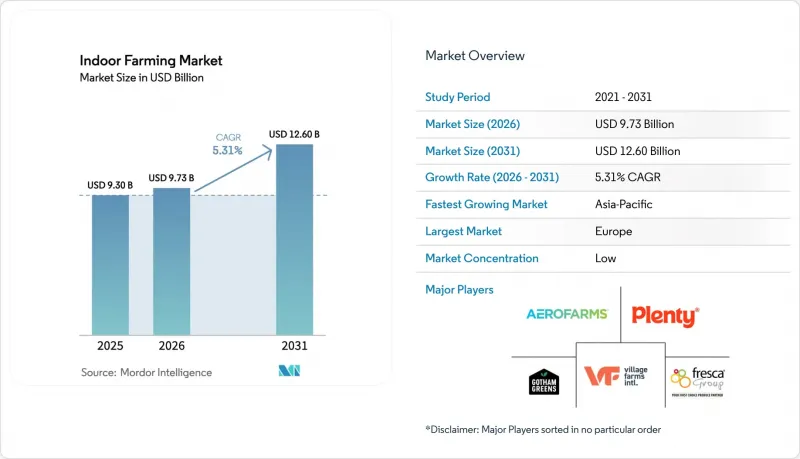
根據 Mordor Intelligence 估計,室內農業市場在 2025 年的價值為 93 億美元,到 2026 年將達到 97.3 億美元。
此外,預計到 2031 年,該產業規模將成長至 126 億美元,在預測期(2026-2031 年)內,年複合成長率將達到 5.31%。
本報告按栽培系統(氣耕、水耕、魚菜共生等)、設施類型(玻璃或聚碳酸酯溫室、室內垂直農場、貨櫃農場等)、作物類型(水果和蔬菜、香草和微型菜苗等)以及地區(北美、歐洲、南美、亞太地區等)進行細分。市場預測以美元計價。
全球室內農業市場趨勢與洞察
都市區對新鮮、無農藥農產品的需求
大都會圈注重健康的消費者願意為本地種植的有機綠葉蔬菜支付20-30%的溢價。這為室內農場創造了價格優勢,使其能夠抵消更高的生產成本。像Whole Foods和Kroger這樣的零售商正在透過與Gotham Greens和Bright Farms在2024年簽署多年供應合約來緩解需求的不確定性,從而確保貨架空間和供應。此前,因露天種植的生菜受到大腸桿菌和李斯特菌污染而引發的食品安全召回事件進一步加速了這一趨勢,削弱了消費者對傳統供應鏈的信心。接近性都市區可將最後一公里物流成本降低40-50%,從而實現HelloFresh和Blue Apron等食材自煮包服務所需的當日送達模式。此外,美國農業部(USDA)的區域食品推廣計畫在2025年撥款5,000萬美元,用於支持城市農業基礎設施建設,包括為符合良好農業規範(GAP)認證標準的環保設施提供津貼。
提高發光二極體(LED) 的效率,降低暖氣、冷氣和通風 (HVAC) 的成本。
到2025年,LED照明燈具的光通量效率將超過3.0微莫耳/焦耳,比2020年增加25%,每公斤生菜的電力消耗量將降低約18%。像昕諾飛(Signify)和歐司朗(Osram)這樣的製造商在2024年推出了頻譜可調系統,以最佳化不同生長階段的光合效率,並最大限度地減少營養生長和開花期間的能源浪費。暖氣、通風和空調(HVAC)領域的技術創新,例如乾燥劑和熱回收通風系統,到2025年將使氣候控制成本降低15%至20%。這些進步將使全年生產在經濟上可行,即使在阿拉伯聯合大公國和沙烏地阿拉伯等炎熱氣候地區也是如此。國際能源總署(IEA)預測,到2027年,固體照明的效率將達到3.5微莫耳/焦耳,進一步縮小室內農業和露天農業之間的能源強度差距。
高資本投資和能源強度
建造一座佔地一英畝的垂直農場,初始資本投資在1000萬美元到2500萬美元之間,具體金額取決於自動化程度和氣候控制要求。如此高昂的成本構成了一大進入門檻,使得只有資金雄厚的公司或能夠獲得補貼貸款的公司才能參與其中。能源成本佔營運成本的25%到35%,而在加州和德國等電力成本高昂的地區,相關設施可能需要七年以上的時間才能達到收支平衡,這進一步阻礙了投資。 AppHarvest公司在2023年因成本超支和收益下降而倒閉,這進一步加劇了貸款機構和股權投資者的擔憂,導致2024年和2025年新計畫的貸款條件更加嚴格。 2025年,美國能源局的「更佳建築計畫」 (舉措 )津貼3000萬美元,用於一項旨在將電力消耗轉移到非高峰時段並降低20%至30%需求電價的能源儲存系統系統試點計畫。這項計畫的實施僅限於擁有足夠屋頂空間或相鄰土地用於安裝電池的設施。
細分市場分析
到2025年,水耕技術將佔室內農業市場規模的59.0%。這得歸功於數十年的農藝研究以及成熟的泵、儲罐和營養液供應商網路。根據AeroFarms公司2024年的永續發展揭露報告,氣耕系統比土壤種植節水95%,比水耕節水40%,這在中東等海水淡化水成本高達每立方公尺1.50至2美元的地區尤為顯著。作物的經濟效益正日益成為影響栽培系統選擇的主要因素,而非技術偏好。例如,需要淺根系和快速水交換的綠葉蔬菜非常適合營養膜系統。另一方面,對於漿果等高利潤作物而言,氣氣耕的複雜性是合理的,因為改善的氣流可以提高果實的硬度和色澤,從而實現更高的售價。
預計到2031年,氣耕將以15.0%的複合年成長率成長,成為室內農業系統中成長最快的技術。這主要得益於乾旱地區節水需求以及透過霧化方式直接向根系輸送養分以加速作物生長週期的需求。結合養魚和蔬菜種植的魚菜共生技術,由於水產養殖許可證相關的監管挑戰以及對園藝和水生生物學專業知識的需求,目前仍屬於小眾技術。有機認證企業由於無法使用合成營養液,更傾向於使用土壤的室內種植系統。這類系統需要更深的種植床和更長的生長週期,因此產量較低。
區域分析
預計2025年,歐洲將引領室內農業市場,佔33.9%的市場。這得益於荷蘭先進的高科技溫室叢集、熟練的氣候控制人才隊伍以及促進低排放量農業發展的碳排放稅優惠政策。德國和西班牙的零售商正在擴大採購合約範圍,將中型垂直農場納入其中,從而縮短運輸距離,確保全年庫存穩定。儘管能源價格波動仍然是一個挑戰,但廣泛的區域供熱網路和可再生能源購電協議(PPA)的日益普及正在降低成本風險。
預計到2031年,亞太地區將以9.0%的複合年成長率實現最高成長,主要受土地稀缺和日益壯大的都市區對安全、可追溯農產品的需求驅動。在新加坡,政府津貼和占地面積獎勵政策支持屋頂農業項目,但如何平衡資本投資與當地需求仍面臨挑戰,一些知名項目的關閉便是明證。在中國,沿海省份正在新建的「農業技術園區」內打造環境可控型農業中心,透過促進大學與創業投資人的合作,加速先進技術的應用。在日本,地方政府公共產業津貼使用發光二極體(LED)照明以穩定夜間電網負荷,間接降低了生產成本。
北美市場已趨於成熟,但溫室種植面積仍持續擴張。例如,位於德克薩斯州的BrightFarms公司佔地150萬平方英尺的溫室採用蒸發冷卻技術,將夏季葉片溫度維持在華氏77度以下,從而能夠與當地雜貨店簽訂全年供貨合約。在墨西哥,遮蔭溫室的蔬菜生產正在蓬勃發展,充分利用當地良好的日照條件和低廉的人事費用,旨在出口到鄰國。在中東,主權財富基金正對垂直農業計畫進行大規模投資,以加強糧食安全並減少對海水淡化的需求。在非洲,室內農業仍處於起步階段,但在肯亞和南非,利用太陽能的貨櫃農場正因其能夠應對電力供應不穩定的問題而備受關注。這些趨勢凸顯了該地區室內農業市場的巨大成長潛力。
其他好處:
- Excel格式的市場預測(ME)表
- 三個月的分析師支持
目錄
第1章:引言
- 研究假設和市場定義
- 調查範圍
第2章:調查方法
第3章執行摘要
第4章 市場狀況
- 市場概覽
- 市場促進因素
- 都市區對新鮮、無農藥農產品的需求
- 提高了 LED 的效率,降低了 HVAC(暖氣、通風和空調)成本。
- 耕地減少和極端天氣事件加劇
- 全年生產確保了穩健的供應鏈。
- 將閒置的零售和倉儲物業用途轉換
- 將低碳農產品的排碳權貨幣化
- 市場限制因素
- 高資本投資和能源強度
- 熟練園藝勞動力短缺
- 備受矚目的破產事件導致創業投資資金籌措。
- 都市區電網擁塞和供電供給能力限制
- 監理情勢
- 技術展望
- 波特五力分析
第5章 市場規模與成長預測
- 培訓系統
- 氣耕
- 水耕法
- 水耕法
- 土壤耕作
- 混合
- 依設施類型
- 玻璃或聚碳酸酯溫室
- 室內垂直農場
- 貨櫃農場
- 室內深水養殖系統
- 其他設施類型
- 按作物類型
- 水果和蔬菜
- 綠葉蔬菜
- 番茄
- 草莓
- 茄子
- 其他水果和蔬菜
- 香草和微型菜苗
- 羅勒
- 香艾菊
- 小麥草
- 其他香草和微型菜苗
- 花卉和觀賞植物
- 多年生植物
- 一年生草
- 觀賞植物
- 其他花卉和觀賞植物
- 其他作物類型
- 水果和蔬菜
- 按地區
- 北美洲
- 美國
- 加拿大
- 墨西哥
- 其他北美國家
- 歐洲
- 德國
- 英國
- 法國
- 西班牙
- 義大利
- 俄羅斯
- 其他歐洲國家
- 亞太地區
- 中國
- 日本
- 印度
- 澳洲
- 新加坡
- 韓國
- 其他亞太國家
- 中東
- 沙烏地阿拉伯
- 阿拉伯聯合大公國
- 土耳其
- 其他中東國家
- 非洲
- 南非
- 肯亞
- 奈及利亞
- 其他非洲國家
- 北美洲
第6章 競爭情勢
- 市場集中度
- 策略趨勢
- 市佔率分析
- 公司簡介
- AeroFarms, Inc.
- Plenty Unlimited Inc.
- Gotham Greens Holdings LLC
- Village Farms International Inc.
- Fresca Group(Thanet Earth)
- BrightFarms Inc.(Cox Enterprises Inc.)
- Pure Harvest Smart Farms Ltd.
- Fresca Group Limited
- Revol Greens LLC
- Windset Farms Inc.
- Sky Urban Solutions Holdings Pte Ltd.
- 80 Acres Urban Agriculture Inc.
- Spread Co., Ltd.
- Local Bounti Corporation
- Intelligent Growth Solutions Ltd.
第7章 市場機會與未來展望
According to Mordor Intelligence, the indoor farming market size was valued at USD 9.30 billion in 2025 and is estimated to reach USD 9.73 billion in 2026, further projected to grow to USD 12.60 billion by 2031, advancing at a CAGR of 5.31% during the forecast period (2026-2031).
This report is Segmented by Growing System (Aeroponics, Hydroponics, Aquaponics, and More), by Facility Type (Glass or Poly Greenhouses, Indoor Vertical Farms, Container Farms, and More), by Crop Type (Fruits and Vegetables, Herbs and Microgreens, and More), and by Geography (North America, Europe, South America, Asia-Pacific, and More). The Market Forecasts are Provided in Terms of Value (USD).
Global Indoor Farming Market Trends and Insights
Urban Demand for Fresh, Pesticide-Free Produce
Health-conscious consumers in metropolitan areas are willing to pay 20% to 30% premiums for locally grown, pesticide-free greens. This creates a price advantage that indoor farms leverage to offset higher production costs. Retailers such as Whole Foods and Kroger secured multi-year supply agreements with Gotham Greens and BrightFarms in 2024, ensuring shelf space and volume commitments, which help reduce demand uncertainty. This trend is further driven by food-safety recalls linked to field-grown lettuce contaminated with E. coli and Listeria, eroding consumer confidence in conventional supply chains. Urban proximity reduces last-mile logistics costs by 40% to 50%, enabling same-day delivery models required by meal-kit services like HelloFresh and Blue Apron. Additionally, the USDA's Local Food Promotion Program allocated USD 50 million in 2025 to support urban agriculture infrastructure, including grants for controlled-environment facilities adhering to Good Agricultural Practices certification standards.
Light-Emitting Diode (LED) Efficiency and Heating, Ventilation, and Air Conditioning (HVAC) Cost Declines
LED fixture efficacy surpassed 3.0 micromoles per joule in 2025, marking a 25% improvement over 2020 levels and reducing electricity consumption per kilogram of lettuce by approximately 18%. Manufacturers such as Signify and Osram introduced tunable spectrum systems in 2024, optimizing photosynthetic efficiency across various growth stages and minimizing energy waste during vegetative and flowering phases. Innovations in Heating, Ventilation, and Air Conditioning (HVAC), including desiccant dehumidifiers and heat-recovery ventilation, reduced climate-control costs by 15% to 20% in 2025. These advancements have made year-round production economically viable in hot climates such as the UAE and Saudi Arabia. The International Energy Agency projects that solid-state lighting efficiency will reach 3.5 micromoles per joule by 2027, further narrowing the energy-intensity gap between indoor and field agriculture.
High CAPEX and Energy Intensity
The initial capital investment for a 1-acre vertical farm ranges between USD 10 million and USD 25 million, depending on the level of automation and climate-control requirements. This high cost creates a significant entry barrier, restricting participation to well-funded entities or those with access to subsidized financing. Energy expenses constitute 25% to 35% of operating costs, with facilities in regions such as California and Germany, where electricity costs are high, facing break-even periods exceeding seven years, which discourages investment. The bankruptcy of AppHarvest in 2023, caused by cost overruns and lower yields, further alarmed lenders and equity investors, leading to tighter credit availability for new projects in 2024 and 2025. In 2025, the United States Department of Energy's Better Buildings Initiative allocated USD 30 million in grants to pilot energy-storage systems aimed at shifting power consumption to off-peak hours, reducing demand charges by 20% to 30%. Adoption has been limited to facilities with adequate roof space or adjacent land for battery installations.
Other drivers and restraints analyzed in the detailed report include:
- Shrinking Arable Land and Extreme Weather Volatility
- Year-Round Production Ensuring Resilient Supply Chains
- Scarcity of Skilled Horticultural Workforce
For complete list of drivers and restraints, kindly check the Table Of Contents.
Segment Analysis
Hydroponics commanded a 59.0% share of the indoor farming market size in 2025, supported by decades of agronomic research and a well-established supplier network for pumps, reservoirs, and nutrient solutions. According to AeroFarms' 2024 sustainability disclosure, aeroponic systems use 95% less water than soil-based methods and 40% less than hydroponics, a significant advantage in regions like the Middle East, where desalinated water costs range from USD 1.50 to USD 2.00 per cubic meter. Crop economics rather than technical preferences increasingly influence the selection of growing systems. For instance, leafy greens, which require shallow root zones and rapid turnover, are well-suited to nutrient-film techniques. Conversely, high-margin crops like berries justify the complexity of aeroponics, as enhanced airflow improves fruit firmness and color, enabling premium pricing.
Aeroponics is forecast to accelerate at a 15.0% CAGR to 2031, the highest growth rate among indoor farming systems, driven by the need to conserve water in drought-prone areas and to accelerate crop cycles by delivering nutrients directly to root zones in mist form. Aquaponics, which combines fish farming with vegetable cultivation, remains a niche approach due to regulatory challenges related to aquaculture permits and the requirement for expertise in both horticulture and aquatic biology. Soil-based indoor systems are preferred by organic-certified operations that cannot use synthetic nutrients. These systems require deeper grow beds and longer crop cycles, which reduce throughput.
Complete Report Scope:
- By Growing System
- Aeroponics
- Hydroponics
- Aquaponics
- Soil-based
- Hybrid
- By Facility Type
- Glass or Poly Greenhouses
- Indoor Vertical Farms
- Container Farms
- Indoor Deep-Water Culture Systems
- Other Facility Types
- By Crop Type
- Fruits and Vegetables
- Leafy Vegetables
- Tomato
- Strawberry
- Eggplant
- Other Fruits and Vegetables
- Herbs and Microgreens
- Basil
- Tarragon
- Wheatgrass
- Other Herbs and Microgreens
- Flowers and Ornamentals
- Perennials
- Annuals
- Ornamentals
- Other Flowers and Ornamentals
- Other Crop Types
- Fruits and Vegetables
- By Geography
- North America
- United States
- Canada
- Mexico
- Rest of North America
- Europe
- Germany
- United Kingdom
- France
- Spain
- Italy
- Russia
- Rest of Europe
- Asia-Pacific
- China
- Japan
- India
- Australia
- Singapore
- South Korea
- Rest of Asia-Pacific
- Middle East
- Saudi Arabia
- United Arab Emirates
- Turkey
- Rest of Middle East
- Africa
- South Africa
- Kenya
- Nigeria
- Rest of Africa
- North America
Geography Analysis
Europe led the indoor farming market with a 33.9% share in 2025, supported by the Netherlands' advanced cluster of high-tech greenhouses, a skilled workforce in climate control, and carbon-tax incentives that promote low-emission agriculture. German and Spanish retailers are expanding their sourcing contracts to include mid-sized vertical farms, which reduce transportation distances and ensure consistent year-round inventory. While energy price volatility poses a challenge, the presence of widespread district heating networks and the increasing availability of renewable power purchase agreements help mitigate cost risks.
The Asia-Pacific region is projected to post the highest CAGR of 9.0% through 2031, driven by land scarcity and a growing urban middle class demanding safe and traceable produce. In Singapore, government grants and floor-area concessions support rooftop farming initiatives, though challenges remain in balancing capital investment with local demand, as evidenced by several high-profile closures. In China, coastal provinces are developing controlled-environment hubs within new "agri-tech parks," which foster collaboration between universities and venture investors, accelerating the adoption of advanced practices. In Japan, municipal utilities subsidize the use of Light-Emitting Diode (LED) lights to stabilize nighttime grid loads, indirectly reducing production costs.
North America, while a mature market, continues to expand its greenhouse acreage. For instance, BrightFarms' 1.5 million square foot complex in Texas utilizes evaporative cooling to maintain summer leaf temperatures below 77 degrees Fahrenheit, enabling year-round supply contracts with regional grocers. In Mexico, shade-house vegetable production is being scaled for export to border states, leveraging favorable sunlight and lower labor costs. The Middle East is heavily investing in vertical farming projects through sovereign funds, aiming to enhance food security and reduce desalination demands. In Africa, indoor farming is in its early stages, with notable adoption in Kenya and South Africa, where solar-powered container farms address unreliable grid supply. These developments highlight the region's potential for growth in the indoor farming market.
- AeroFarms, Inc.
- Plenty Unlimited Inc.
- Gotham Greens Holdings LLC
- Village Farms International Inc.
- Fresca Group (Thanet Earth)
- BrightFarms Inc. (Cox Enterprises Inc.)
- Pure Harvest Smart Farms Ltd.
- Fresca Group Limited
- Revol Greens LLC
- Windset Farms Inc.
- Sky Urban Solutions Holdings Pte Ltd.
- 80 Acres Urban Agriculture Inc.
- Spread Co., Ltd.
- Local Bounti Corporation
- Intelligent Growth Solutions Ltd.
Additional Benefits:
- The market estimate (ME) sheet in Excel format
- 3 months of analyst support
TABLE OF CONTENTS
1 Introduction
- 1.1 Study Assumptions and Market Definition
- 1.2 Scope of the Study
2 Research Methodology
3 Executive Summary
4 Market Landscape
- 4.1 Market Overview
- 4.2 Market Drivers
- 4.2.1 Urban demand for fresh, pesticide-free produce
- 4.2.2 LED efficiency and HVAC (Heating, Ventilation, and Air Conditioning) cost declines
- 4.2.3 Shrinking arable land and extreme weather volatility
- 4.2.4 Year-round production ensuring resilient supply chains
- 4.2.5 Surplus vacant retail/warehouse real estate repurposed
- 4.2.6 Carbon-credit monetization for low-footprint produce
- 4.3 Market Restraints
- 4.3.1 High CAPEX and energy intensity
- 4.3.2 Scarcity of skilled horticultural workforce
- 4.3.3 Venture Capital funding pull-back after high-profile bankruptcies
- 4.3.4 Urban grid-congestion and power-availability limits
- 4.4 Regulatory Landscape
- 4.5 Technological Outlook
- 4.6 Porter's Five Forces Analysis
- 4.6.1 Threat of New Entrants
- 4.6.2 Bargaining Power of Buyers/Consumers
- 4.6.3 Bargaining Power of Suppliers
- 4.6.4 Threat of Substitute Products
- 4.6.5 Intensity of Competitive Rivalry
5 Market Size and Growth Forecasts (Value)
- 5.1 By Growing System
- 5.1.1 Aeroponics
- 5.1.2 Hydroponics
- 5.1.3 Aquaponics
- 5.1.4 Soil-based
- 5.1.5 Hybrid
- 5.2 By Facility Type
- 5.2.1 Glass or Poly Greenhouses
- 5.2.2 Indoor Vertical Farms
- 5.2.3 Container Farms
- 5.2.4 Indoor Deep-Water Culture Systems
- 5.2.5 Other Facility Types
- 5.3 By Crop Type
- 5.3.1 Fruits and Vegetables
- 5.3.1.1 Leafy Vegetables
- 5.3.1.2 Tomato
- 5.3.1.3 Strawberry
- 5.3.1.4 Eggplant
- 5.3.1.5 Other Fruits and Vegetables
- 5.3.2 Herbs and Microgreens
- 5.3.2.1 Basil
- 5.3.2.2 Tarragon
- 5.3.2.3 Wheatgrass
- 5.3.2.4 Other Herbs and Microgreens
- 5.3.3 Flowers and Ornamentals
- 5.3.3.1 Perennials
- 5.3.3.2 Annuals
- 5.3.3.3 Ornamentals
- 5.3.3.4 Other Flowers and Ornamentals
- 5.3.4 Other Crop Types
- 5.3.1 Fruits and Vegetables
- 5.4 By Geography
- 5.4.1 North America
- 5.4.1.1 United States
- 5.4.1.2 Canada
- 5.4.1.3 Mexico
- 5.4.1.4 Rest of North America
- 5.4.2 Europe
- 5.4.2.1 Germany
- 5.4.2.2 United Kingdom
- 5.4.2.3 France
- 5.4.2.4 Spain
- 5.4.2.5 Italy
- 5.4.2.6 Russia
- 5.4.2.7 Rest of Europe
- 5.4.3 Asia-Pacific
- 5.4.3.1 China
- 5.4.3.2 Japan
- 5.4.3.3 India
- 5.4.3.4 Australia
- 5.4.3.5 Singapore
- 5.4.3.6 South Korea
- 5.4.3.7 Rest of Asia-Pacific
- 5.4.4 Middle East
- 5.4.4.1 Saudi Arabia
- 5.4.4.2 United Arab Emirates
- 5.4.4.3 Turkey
- 5.4.4.4 Rest of Middle East
- 5.4.5 Africa
- 5.4.5.1 South Africa
- 5.4.5.2 Kenya
- 5.4.5.3 Nigeria
- 5.4.5.4 Rest of Africa
- 5.4.1 North America
6 Competitive Landscape
- 6.1 Market Concentration
- 6.2 Strategic Moves
- 6.3 Market Share Analysis
- 6.4 Company Profiles (Includes Global Level Overview, Market Level Overview, Core Segments, Financials as Available, Strategic Information, Market Rank/Share, Products and Services, Recent Developments)
- 6.4.1 AeroFarms, Inc.
- 6.4.2 Plenty Unlimited Inc.
- 6.4.3 Gotham Greens Holdings LLC
- 6.4.4 Village Farms International Inc.
- 6.4.5 Fresca Group (Thanet Earth)
- 6.4.6 BrightFarms Inc. (Cox Enterprises Inc.)
- 6.4.7 Pure Harvest Smart Farms Ltd.
- 6.4.8 Fresca Group Limited
- 6.4.9 Revol Greens LLC
- 6.4.10 Windset Farms Inc.
- 6.4.11 Sky Urban Solutions Holdings Pte Ltd.
- 6.4.12 80 Acres Urban Agriculture Inc.
- 6.4.13 Spread Co., Ltd.
- 6.4.14 Local Bounti Corporation
- 6.4.15 Intelligent Growth Solutions Ltd.
7 Market Opportunities and Future Outlook

 創新室內農業系統市場分析與至2035年的預測:按類型、產品、服務、技術、組件、應用、最終用戶、安裝類型、設備和解決方案
 室內貨櫃農場市場規模、佔有率和成長分析:按作物類型、栽培技術、貨櫃尺寸、最終用戶、應用和地區分類-2026-2033年產業預測
 德國室內農業:市場佔有率分析、產業趨勢與統計及成長預測(2026-2031)
 室內農場技術市場:2026-2032年全球市場預測(依產品、作物類型、耕作方式、自動化程度及最終用戶分類)南美洲室內農業:市場佔有率分析、產業趨勢與統計及成長預測(2026-2031 年)美國室內農業:市場佔有率分析、產業趨勢與統計及成長預測(2026-2031 年)
 室內農業市場規模、佔有率、趨勢和預測:按設施類型、作物類型、組件、種植系統和地區分類,2026-2034 年中東和非洲室內農業:市場佔有率分析、行業趨勢和統計數據以及成長預測(2026-2031 年)
 室內農業市場-全球產業規模、佔有率、趨勢、機會、預測:種植技術、設施類型、組成部分、作物類型、地區及競爭格局,2021-2031年
 2026年全球室內農業市場報告