


 |
市場調查報告書
商品編碼
2122489
可再生能源領域複合材料:市場佔有率分析、產業趨勢與統計及成長預測(2026-2031)Composite Materials In Renewable Energy - Market Share Analysis, Industry Trends & Statistics, Growth Forecasts (2026 - 2031) |
||||||

※ 本網頁內容可能與最新版本有所差異。詳細情況請與我們聯繫。
據 Mordor Intelligence 稱,2025 年可再生能源領域複合材料的市場規模為 101.6 億美元,預計到 2031 年將從 2026 年的 109.7 億美元成長至 161.2 億美元,預測期(2026-2031 年)的複合成長率為 7.9%。
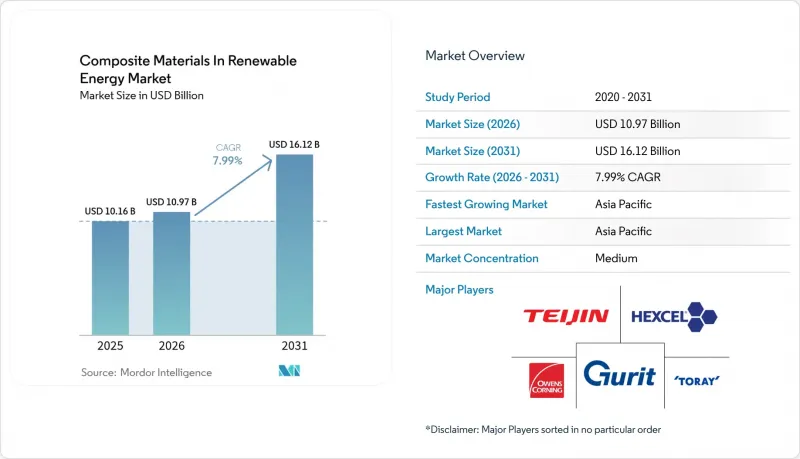
本報告按纖維類型(玻璃纖維增強塑膠 (GFRP) 及其他)、樹脂基體(環氧樹脂、聚酯樹脂及其他)、製造流程(真空灌注、預浸料/高壓釜及其他)、應用領域(風能、太陽能及其他)和地區(亞太地區、北美地區及其他)對產業進行細分。市場預測以美元 (USD) 為單位。
全球可再生能源領域複合材料市場趨勢與洞察。
與金屬結構相比,重量更輕
在離岸風力發電、氫氣槽和潮汐發電站中,以複合材料取代現有結構可以減輕其重量,提高裝載效率並減輕運輸的物流負擔。潮汐發電站葉片重量減輕13.76%,與鋼製葉片相比,功率輸出提高了46.1%。在航太領域,無內襯V型碳複合材料儲槽的開發正在推動向液氫推進的過渡,並間接增加了對可再生能源級纖維的需求。三菱化學的C/SiC陶瓷基質複合材料可承受高達1500 度C的溫度,為定日鏡接收器和核融合反應器硬體的應用鋪平了道路。這些進展清楚地表明,在可再生能源市場的高溫和腐蝕性環境中,為何複合材料能持續取代鋁和鋼。
風力發電機葉片加長導致需求增加
西門子能源公司21兆瓦原型機轉子直徑達276米,顯示當葉片長度接近150米時,必須使用碳纖維葉片帽才能達到所需的剛度重量比目標,而僅靠玻璃纖維無法實現。採用高韌性環氧樹脂黏合的分段式葉片結構,既便於運輸,又能保持氣動彈性完整性。 ZEBRA聯盟已完成全球最大全可回收熱塑性樹脂葉片的研發,該葉片採用阿科瑪公司的「Elium」樹脂,顯示已準備好在閉合迴路平台上進行工業實用化。這種混合層壓結構由天然纖維和合成纖維混合而成,提高了抗衝擊性,同時減少了碳含量。這與歐盟到2050年離岸風力發電達到150吉瓦的目標相符,該目標可能會使全球碳纖維需求增加一倍。
研發成本和模具製造成本的高額資本投入。
自動化纖維鋪放線的單價在500萬至1000萬美元之間,而用於長度超過100米的葉片的模具,每套成本超過200萬美元,這意味著在收回投資之前,資金會被佔用數年之久。認證課程通常需要5到7年,這延長了中型創新企業的營運資金需求。 Hexel公司計劃在2025年發行3億美元債券,這充分展現了其維持製程技術領先地位所需的雄厚財力。熱塑性樹脂的採用進一步增加了成本,因為其烘箱、壓平機和焊接設備與熱固性樹脂生產線所使用的設備不同,需要並行安裝設備,這削弱了中小型製造商的競爭力。
細分市場分析
到2025年,該細分市場將成為最大的收入貢獻者,其中玻璃纖維增強複合材料(GFRP)在可再生能源市場複合材料佔有率中佔比高達54.70%。碳纖維的複合年成長率(CAGR)為8.39%,這主要反映了轉子直徑超過120公尺的情況,在這些情況下,碳纖維的剛度和疲勞性能足以支撐5-10倍的成本溢價。 SGL Carbon公司簽訂的80公尺以上葉片的供應合約表明,垂直整合的趨勢正從航太領域轉向能源領域。纖維混合層壓板(玄武岩纖維和天然纖維的混合物)透過減少碳纖維含量並保持必要的彈性模量,為中型渦輪機提供了更多選擇。德國對生物基木質素纖維的研究可能成為未來降低成本的一種途徑,儘管目前商業規模的生產仍然有限。再生碳纖維在二次結構材料領域正穩步發展,因為機械回收可以保留其60-70%的原始抗張強度。這有助於原料的多樣化,並緩解原料價格的波動。
環氧樹脂憑藉其成熟的供應鏈和優異的抗疲勞性能,在2025年仍維持45.20%的市佔率。然而,隨著原始設備製造商(OEM)競相滿足循環經濟的要求,生物基樹脂和再生樹脂的市場佔有率正以7.88%的複合年成長率快速成長。陶氏化學和維斯塔斯公司已獲得一種用於聚氨酯錐帽的化學成分認證,該成分可實現快速的鈽加工,同時提高層間韌性。西科明公司的SGi 128生物基環氧樹脂膠衣含有35%的可再生原料,並提供了高度耐火的解決方案。像Elium這樣的公司提供的熱塑性基體材料具有可修復性和熔融回收性等額外優勢,將可再生能源市場的複合材料轉變為閉合迴路經濟。
區域分析
預計到2025年,亞太地區將佔可再生能源領域複合材料市場規模的44.30%,並在2031年之前以8.03%的複合年成長率成長。中國憑藉其端到端的供應鏈,是該地區的核心參與者,但由於2024年回收標準的實施,合規成本不斷增加,這使得本土的大型綜合企業更具優勢。印度24億美元的「氫能計畫」以及碳纖維在國防領域的應用,正在增強國內生產的獎勵。日本的鈣鈦礦藍圖旨在利用軟性複合材料基板,在2040年實現38.3吉瓦的裝置容量,這項轉型可望重塑全球光學模組的格局。韓國正利用其造船技術離岸風力發電複合材料市場,而澳洲正在內陸水庫上進行浮體式太陽能發電示範實驗,展現了不同地區應用案例的多樣性。
北美地區受益於《通膨削減法案》提供的3,690億美元資金,其中對國內採購比例的優惠政策推動了德克薩斯州、紐約州和安大略省的工廠擴張。通用電氣Vernova公司投資6億美元的製造地擴張項目象徵著旨在降低跨太平洋物流風險的製造業回流趨勢。加拿大的航太複合材料產業叢集正在支持將高壓高壓釜外成型技術應用於潮汐渦輪機船體,而墨西哥則憑藉其具有成本競爭力的勞動力,吸引用於太陽能支架出口的牽引成型企業。該地區面臨的挑戰是擴大紡織品生產,以避免過度依賴進口,目前已有多家合資企業正在籌備中,目標是在2027年前彌補這一缺口。
歐洲在可回收性和碳中和方面擁有強大的監管影響力,並主導全球標準。 ZEBRA專案中熱塑性樹脂葉片的成功應用,使歐洲在技術領域佔據了先鋒地位。德國的木質素纖維試驗生產線象徵其在研發領域的領先地位,而法國則正利用其在航太領域的專業知識來改進高模量預浸料。英國國家複合材料中心的SusWIND專案展示了多種回收管道的有效性,為原始設備製造商(OEM)提供了設計柔軟性。北海和波羅的海離岸風力發電的擴張正在推動纖維需求的持續成長,但飆升的能源成本使得自動化成為維持獲利能力的關鍵。
其他好處
- Excel格式的市場預測(ME)表
- 3個月的分析師支持
目錄
第1章:引言
- 研究假設和市場定義
- 調查範圍
第2章:調查方法
第3章執行摘要
第4章 市場狀況
- 市場概覽
- 市場促進因素
- 與金屬結構相比,重量更輕
- 風力發電機葉片加長導致需求增加
- 政府對引進可再生能源的立場
- 熱塑性可回收刀片平台的商業化
- 擴大3D列印複合材料零件在浮體式太陽能發電設施和潮汐發電設施的應用。
- 市場限制因素
- 研發成本和模具製造成本的高額資本投入。
- 遵守回收和掩埋禁令的相關成本。
- 人們對某些複合材料的耐久性和耐火性表示擔憂
- 價值鏈分析
- 波特五力模型
第5章 市場規模與成長預測
- 依纖維類型
- 玻璃纖維增強塑膠(GFRP)
- 碳纖維增強塑膠(CFRP)
- 纖維強化塑膠(FRP)
- 其他纖維類型(混紡織物等)
- 不同的樹脂基體類型
- 環氧樹脂
- 聚酯纖維
- 聚氨酯
- 熱塑性樹脂
- 生物樹脂和再生樹脂
- 透過製造程序
- 真空輸液
- 預浸料/高壓釜
- 拉擠成型
- 自動化纖維鋪放和3D列印
- 壓縮成型(SMC、BMC)
- 透過使用
- 風力
- 太陽能
- 水力發電
- 其他應用(綠色氫氣和儲能容器)
- 按地區
- 亞太地區
- 中國
- 印度
- 日本
- 韓國
- 其他亞太國家
- 北美洲
- 美國
- 加拿大
- 墨西哥
- 歐洲
- 德國
- 英國
- 法國
- 義大利
- 其他歐洲國家
- 南美洲
- 巴西
- 阿根廷
- 其他南美國家
- 中東和非洲
- 沙烏地阿拉伯
- 南非
- 其他中東和非洲國家
- 亞太地區
第6章 競爭情勢
- 市場集中度
- 策略趨勢
- 市佔率和排名分析
- 公司簡介
- Changzhou Tiansheng New Materials Co. Ltd
- EPSILON Composite SAS
- EURO-COMPOSITES
- Evonik Industries AG
- Exel Composites
- GE Vernova
- Gurit Services AG
- Jiangsu Hengshen Co.,Ltd
- Hexcel Corporation
- HS HYOSUNG ADVANCED MATERIALS
- LM WIND POWER
- Mitsubishi Chemical Group Corporation
- Norco Composites & GRP
- Owens Corning
- Plastic Reinforcement Fabrics Ltd
- SGL Carbon
- Siemens Gamesa Renewable Energy, SAU
- Solvay
- TEIJIN LIMITED
- TORAY INDUSTRIES, INC.
第7章 市場機會與未來展望
According to Mordor Intelligence, the composite materials in the renewable energy market size was valued at USD 10.16 billion in 2025 and estimated to grow from USD 10.97 billion in 2026 to reach USD 16.12 billion by 2031, at a CAGR of 7.99% during the forecast period (2026-2031).
This report Segments the Industry by Fibre Type (Glass-Fibre-Reinforced Plastics (GFRP), and More), Resin Matrix (Epoxy, Polyester, and More), Manufacturing Process (Vacuum Infusion, Prepreg/Autoclave, and More), Application (Wind Power, Solar Power, and More), and Geography (Asia-Pacific, North America, and More). The Market Forecasts are Provided in Terms of Value (USD).
Global Composite Materials In Renewable Energy Market Trends and Insights
Reduced Weight Versus Metallic Structures
Composite substitution cuts structural mass in offshore wind, hydrogen tanks, and tidal devices, boosting payload efficiency and easing transport logistics. Weight savings of 13.76% on tidal blades have lifted power output by 46.1% versus steel alternatives. In aerospace, the development of liner-less Type V carbon-composite tanks supports the transition to liquid-hydrogen propulsion, indirectly increasing demand for renewable-grade fibres. Mitsubishi Chemical's C/SiC ceramic matrix composite endures 1,500 °C, opening paths for heliostat receivers and fusion-reactor hardware. These advances underline why the composite materials in the renewable energy market continue to displace aluminum and steel in high-temperature, corrosive environments.
Growing Demand for Longer Wind-Turbine Blades
Siemens Energy's 21 MW prototype with a 276 m rotor diameter illustrates how blade lengths nearing 150 m require carbon-fibre spar caps for stiffness-to-weight targets unattainable with glass fibre alone. Segmented blade architectures, enabled by high-toughness epoxy joints, ease transport while maintaining aeroelastic integrity. The ZEBRA consortium completed the world's largest fully recyclable thermoplastic blade using Arkema's Elium resin, signalling industrial readiness for closed-loop platforms. Hybrid lay-ups that mix natural and synthetic fibres improve impact resistance and lower embodied carbon, aligning with EU offshore wind targets of 150 GW by 2050 that could double global carbon-fibre demand.
High Research and Development and Tooling CAPEX
Automated fibre-placement lines cost USD 5-10 million each, while molds for >100 m blades exceed USD 2 million per set, tying up capital for years before payback. Certification programs often run 5-7 years, stretching working-capital needs for mid-tier innovators. Hexcel's USD 300 million bond issue in 2025 exemplifies the financial firepower required to retain process-technology leadership. Thermoplastic adoption compounds costs, since ovens, presses, and welding equipment differ from thermoset lines, creating parallel asset footprints that hamper small manufacturers' competitiveness.
Other drivers and restraints analyzed in the detailed report include:
- Government Inclination Towards Adoption of Renewable Energy
- Commercialization of Thermoplastic Recyclable Blade Platforms
- Recycling & Landfill-Ban Compliance Costs
For complete list of drivers and restraints, kindly check the Table Of Contents.
Segment Analysis
The segment generated the largest revenue contribution in 2025, when GFRP held 54.70% of composite materials in the renewable energy market share. Carbon fibre's 8.39% CAGR reflects rotor diameters that eclipse 120 m, where stiffness and fatigue performance justify its 5-10X cost premium. SGL Carbon's supply agreements for 80 m-plus blades illustrate vertical moves into energy from aerospace. Fibre-hybrid lay-ups blending basalt and natural fibre reduce embodied carbon yet maintain required modulus, expanding options for mid-range turbine classes. Bio-based lignin fibre research in Germany offers a future cost-reduction lever, although commercial volumes remain limited. Recycled carbon fibre is steadily integrating into secondary structures as mechanical recycling preserves 60-70% original tensile strength, further diversifying feedstocks and tempering raw material price swings.
Epoxy maintained a 45.20% revenue share in 2025 thanks to mature supply chains and high fatigue resistance. Yet bio-resins and recycled resins are expanding at an 7.88% CAGR as OEMs race to satisfy circular-economy mandates. Dow and Vestas have qualified polyurethane spar-cap chemistries that enable rapid pultrusion while elevating interlaminar toughness. Sicomin's SGi 128 bio-epoxy gel coat demonstrates fire-safe solutions with 35% renewable content. Thermoplastic matrices such as Elium offer the added benefit of repairability and melt recycling, pivoting the composite materials in the renewable energy market toward closed-loop economics.
Complete Report Scope:
- By Fibre Type
- Glass-Fibre-Reinforced Plastics (GFRP)
- Carbon-Fibre-Reinforced Plastics (CFRP)
- Fibre-Reinforced Polymers (FRP)
- Other Fibre Types (Hybrid and Other Fibres, etc.)
- By Resin Matrix
- Epoxy
- Polyester
- Polyurethane
- Thermoplastic
- Bio-resins and Recycled Resins
- By Manufacturing Process
- Vacuum Infusion
- Prepreg/Autoclave
- Pultrusion
- Automated Fibre Placement / 3-D Printing
- Compression Moulding (SMC, BMC)
- By Application
- Wind Power
- Solar Power
- Hydroelectricity
- Other Applications (Green-Hydrogen & Energy-Storage Vessels)
- By Geography
- Asia-Pacific
- China
- India
- Japan
- South Korea
- Rest of Asia-Pacific
- North America
- United States
- Canada
- Mexico
- Europe
- Germany
- United Kingdom
- France
- Italy
- Rest of Europe
- South America
- Brazil
- Argentina
- Rest of South America
- Middle East and Africa
- Saudi Arabia
- South Africa
- Rest of Middle East and Africa
- Asia-Pacific
Geography Analysis
Asia-Pacific commanded 44.30% of the composite materials in the renewable energy market size in 2025 and is on track for an 8.03% CAGR through 2031. China anchors the region with end-to-end supply chains, yet its 2024 recycling standards raise compliance costs that favor integrated local champions. India's USD 2.4 billion Hydrogen Mission and defense-sector carbon-fibre push reinforce domestic production incentives. Japan's perovskite roadmap aims for 38.3 GW by 2040 via flexible composite substrates, a pivot that may recalibrate global solar module architectures. South Korea leverages shipbuilding know-how to enter offshore wind composites, while Australia tests floating solar on inland reservoirs, showcasing regional diversity in end-use cases.
North America benefits from USD 369 billion of Inflation Reduction Act funding, with domestic-content bonuses catalyzing plant expansion in Texas, New York, and Ontario. GE Vernova's USD 600 million manufacturing buildout exemplifies reshoring moves that cut trans-Pacific logistics risk. Canada's aerospace-composite cluster supports the transfer of out-of-autoclave methods to tidal-turbine shells, while Mexico's cost-competitive labor pool draws pultruders for solar-rack exports. The region's challenge is scaling fibre production to prevent over-dependence on imports, a gap several joint ventures aim to close by 2027.
Europe wields regulatory clout, steering global norms on recyclability and embodied carbon. The ZEBRA project's thermoplastic blade success positions the continent as a technology frontrunner. Germany's lignin-fibre pilot lines symbolize R&D leadership, whereas France leverages aerospace heritage to refine high-modulus prepregs. The UK National Composites Centre's SusWIND program validates multiple recycling routes, giving OEMs design flexibility. Offshore wind buildout in the North Sea and Baltic drives sustained fibre demand, though high energy costs compel automation to defend margins.
- Changzhou Tiansheng New Materials Co. Ltd
- EPSILON Composite SAS
- EURO-COMPOSITES
- Evonik Industries AG
- Exel Composites
- GE Vernova
- Gurit Services AG
- Jiangsu Hengshen Co.,Ltd
- Hexcel Corporation
- HS HYOSUNG ADVANCED MATERIALS
- LM WIND POWER
- Mitsubishi Chemical Group Corporation
- Norco Composites & GRP
- Owens Corning
- Plastic Reinforcement Fabrics Ltd
- SGL Carbon
- Siemens Gamesa Renewable Energy, S.A.U
- Solvay
- TEIJIN LIMITED
- TORAY INDUSTRIES, INC.
Additional Benefits:
- The market estimate (ME) sheet in Excel format
- 3 months of analyst support
TABLE OF CONTENTS
1 Introduction
- 1.1 Study Assumptions & Market Definition
- 1.2 Scope of the Study
2 Research Methodology
3 Executive Summary
4 Market Landscape
- 4.1 Market Overview
- 4.2 Market Drivers
- 4.2.1 Reduced weight versus metallic structures
- 4.2.2 Growing demand for longer wind-turbine blades
- 4.2.3 Government inclination towards the adoption of renwable energy
- 4.2.4 Commercialisation of thermoplastic recyclable blade platforms
- 4.2.5 Rising adoption of 3-D printed composite parts in floating solar & tidal devices
- 4.3 Market Restraints
- 4.3.1 High research and development and tooling CAPEX
- 4.3.2 Recycling & landfill-ban compliance costs
- 4.3.3 Concerns regarding the durability and fire resistance of some composite materials
- 4.4 Value Chain Analysis
- 4.5 Porter's Five Forces
- 4.5.1 Bargaining Power of Suppliers
- 4.5.2 Bargaining Power of Buyers
- 4.5.3 Threat of New Entrants
- 4.5.4 Threat of Substitutes
- 4.5.5 Degree of Competition
5 Market Size & Growth Forecasts (Value)
- 5.1 By Fibre Type
- 5.1.1 Glass-Fibre-Reinforced Plastics (GFRP)
- 5.1.2 Carbon-Fibre-Reinforced Plastics (CFRP)
- 5.1.3 Fibre-Reinforced Polymers (FRP)
- 5.1.4 Other Fibre Types (Hybrid and Other Fibres, etc.)
- 5.2 By Resin Matrix
- 5.2.1 Epoxy
- 5.2.2 Polyester
- 5.2.3 Polyurethane
- 5.2.4 Thermoplastic
- 5.2.5 Bio-resins and Recycled Resins
- 5.3 By Manufacturing Process
- 5.3.1 Vacuum Infusion
- 5.3.2 Prepreg/Autoclave
- 5.3.3 Pultrusion
- 5.3.4 Automated Fibre Placement / 3-D Printing
- 5.3.5 Compression Moulding (SMC, BMC)
- 5.4 By Application
- 5.4.1 Wind Power
- 5.4.2 Solar Power
- 5.4.3 Hydroelectricity
- 5.4.4 Other Applications (Green-Hydrogen & Energy-Storage Vessels)
- 5.5 By Geography
- 5.5.1 Asia-Pacific
- 5.5.1.1 China
- 5.5.1.2 India
- 5.5.1.3 Japan
- 5.5.1.4 South Korea
- 5.5.1.5 Rest of Asia-Pacific
- 5.5.2 North America
- 5.5.2.1 United States
- 5.5.2.2 Canada
- 5.5.2.3 Mexico
- 5.5.3 Europe
- 5.5.3.1 Germany
- 5.5.3.2 United Kingdom
- 5.5.3.3 France
- 5.5.3.4 Italy
- 5.5.3.5 Rest of Europe
- 5.5.4 South America
- 5.5.4.1 Brazil
- 5.5.4.2 Argentina
- 5.5.4.3 Rest of South America
- 5.5.5 Middle East and Africa
- 5.5.5.1 Saudi Arabia
- 5.5.5.2 South Africa
- 5.5.5.3 Rest of Middle East and Africa
- 5.5.1 Asia-Pacific
6 Competitive Landscape
- 6.1 Market Concentration
- 6.2 Strategic Moves
- 6.3 Market Share(%)/Ranking Analysis
- 6.4 Company Profiles (includes Global-level Overview, Market-level Overview, Core Segments, Financials, Strategic Information, Market Rank/Share, Products & Services, Recent Developments)
- 6.4.1 Changzhou Tiansheng New Materials Co. Ltd
- 6.4.2 EPSILON Composite SAS
- 6.4.3 EURO-COMPOSITES
- 6.4.4 Evonik Industries AG
- 6.4.5 Exel Composites
- 6.4.6 GE Vernova
- 6.4.7 Gurit Services AG
- 6.4.8 Jiangsu Hengshen Co.,Ltd
- 6.4.9 Hexcel Corporation
- 6.4.10 HS HYOSUNG ADVANCED MATERIALS
- 6.4.11 LM WIND POWER
- 6.4.12 Mitsubishi Chemical Group Corporation
- 6.4.13 Norco Composites & GRP
- 6.4.14 Owens Corning
- 6.4.15 Plastic Reinforcement Fabrics Ltd
- 6.4.16 SGL Carbon
- 6.4.17 Siemens Gamesa Renewable Energy, S.A.U
- 6.4.18 Solvay
- 6.4.19 TEIJIN LIMITED
- 6.4.20 TORAY INDUSTRIES, INC.
7 Market Opportunities & Future Outlook
- 7.1 White-space & Unmet-need Assessment

 環保複合地板材料市場:全球市場預測(2026-2032)礦山複合襯砌市場:全球市場預測,2026-2032年
 軟磁複合材料市場:按材料、應用、最終用戶、分銷管道和地區分類
 2026年全球精準發酵衍生生醫材料市場報告
 全球永續複合材料市場(2027-2037 年)
 運輸容器市場規模、佔有率和成長分析:按產品類型、材料、應用、最終用戶、分銷管道和地區分類 - 產業預測,2026-2033年
 電動車電池外殼複合材料市場分析與預測(至2035年):類型、產品、技術、組件、應用、形狀、材料類型、最終用戶、功能
 2034年風力渦輪機葉片複合材料市場預測-全球分析(依樹脂類型、材料類型、製造流程、葉片長度、應用和地區分類)
 複合材料:市場佔有率分析、產業趨勢與統計、成長預測(2026-2031)
 起重機墊板市場機會、成長要素、產業趨勢分析及2026-2035年預測