


 |
市場調查報告書
商品編碼
2109304
起重機墊板市場機會、成長要素、產業趨勢分析及2026-2035年預測Crane Mats Market Opportunity, Growth Drivers, Industry Trend Analysis, and Forecast 2026 - 2035 |
||||||

全球起重機墊板市場預計到 2025 年將達到 7.451 億美元,年複合成長率為 4.5%,到 2035 年將達到 11.6 億美元。
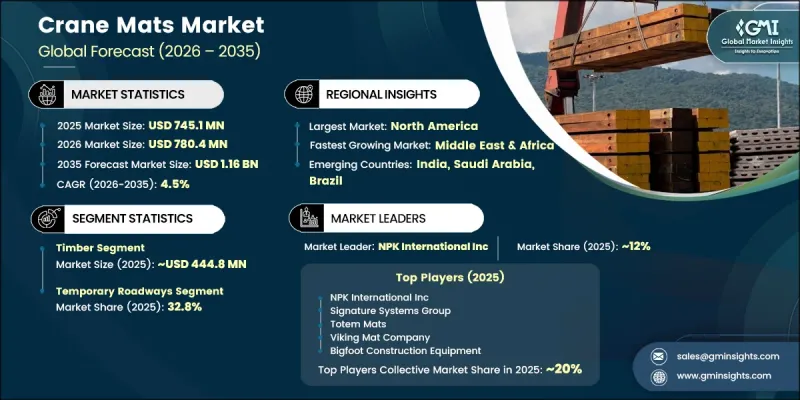
全球起重機墊板市場正穩步成長,這主要得益於基礎設施建設投資的增加、可再生能源項目的擴張以及建築和工業領域對可靠地面保護解決方案日益成長的需求。長期的基礎設施現代化建設以及對公共產業、交通運輸和能源項目的資本投入不斷增加,使得臨時通道和重型設備支撐應用中對起重機墊板的需求持續旺盛。此外,複合材料因其更高的耐久性、更低的維護需求以及在可重複使用應用中的成本效益,日益受到青睞,這也推動了市場發展。不斷增強的環保意識和日益嚴格的職場安全法規促使建築公司採用先進的墊板解決方案,以提高工作安全性並最大限度地減少對地面的影響。對包括大規模風發電工程在內的可再生能源設施的持續投資,進一步推動了產品需求。隨著全球建設活動的擴張以及專案開發商對耐用、可重複使用和高性能地面保護系統的需求,全球起重機墊板市場在基礎設施建設和工業建築領域的前景仍然光明。
| 市場範圍 | |
|---|---|
| 開始年份 | 2025 |
| 預測期 | 2026-2035 |
| 上市時的市場規模 | 7.451億美元 |
| 預測金額 | 11.6億美元 |
| 複合年成長率 | 4.5% |
預計到2025年,木質起重機墊板的銷售額將達到4.448億美元,並在2026年至2035年間以3.1%的複合年成長率成長。木質起重機墊板因其在臨時通道、管道建設項目和一般重型設備支撐應用中的廣泛使用,繼續保持著強勁的市場地位。其易得性、可靠的承載能力以及對惡劣現場條件的適應性,使其成為許多地區的首選解決方案。預計基礎設施、建築和能源項目的穩定需求將在整個預測期內支撐該細分市場的穩定成長。
預計到2025年,臨時道路市場將佔據32.8%的市場佔有率,並在2026年至2035年間以4.3%的複合年成長率成長。該市場持續成長的原因在於,基礎建設項目中,重型機械在複雜地形運作對穩定可靠的臨時道路的需求不斷成長。此外,交通運輸、公共產業和能源基礎設施投資的增加,也為臨時道路的應用創造了更多機遇,並支撐了對起重機墊板解決方案的長期需求。
預計到2025年,美國起重機墊板市場規模將達2.4億美元。強勁的基礎設施投資、不斷擴大的能源產業活動以及公共產業在輸電和電網現代化項目上增加的支出,持續支撐著美國各地對起重機墊板的需求。預計在預測期內,建設活動的活性化和對大規模工業發展的持續投資將進一步鞏固美國市場的主導地位。
目錄
第1章:調查方法
第2章執行摘要
第3章 行業洞察
- 產業生態系分析
- 供應商情況
- 製造商
- 中斷
- 零售商
- 利潤率分析
- 每個階段增加的價值
- 影響價值鏈的因素
- 影響產業的因素
- 促進因素
- 全球上游油氣產業資本投資擴張
- 美國基礎建設投資與全球基礎建設投資
- 可再生能源建設的擴張
- 產業潛在風險與挑戰
- 能源轉型帶來的風險限制了管道需求的成長。
- 木材供應鏈波動及其對永續性的壓力
- 機會
- 促進因素
- 成長潛力分析
- 技術與創新展望
- 最新科技趨勢
- 新興技術
- 價格分析
- 按產品類型分析歷史價格趨勢
- 依球員類型分類的定價策略(高級球員、超值球員、成本加成球員)
- 貿易數據分析
- 進出口量及進口額趨勢
- 主要貿易路線及關稅的影響
- 監理情勢
- 標準和合規要求
- 區域監理框架
- 認證標準
- 波特的分析
- PESTLE分析
- 人工智慧和生成式人工智慧對市場的影響
- 利用人工智慧改造現有經營模式
- 按細分市場分類的生成式人工智慧用例和部署藍圖
- 風險、限制和監管考量
第4章 競爭情勢
- 介紹
- 企業市佔率分析
- 按地區
- 企業矩陣分析
- 主要市場公司的競爭分析
- 競爭定位矩陣
- 主要進展
- 併購
- 夥伴關係和聯盟
- 新產品發布
- 業務拓展計劃
第5章 市場估計與預測:依材料分類,2022-2035年
- 木頭
- 複合材料/塑膠
- 鋼
- 其他
第6章 市場估計與預測:依應用領域分類,2022-2035年
- 臨時道路
- 橋面
- 挖掘支撐工程
- 管道建置
- 其他
第7章 市場估計與預測:依最終用途產業分類,2022-2035年
- 石油和天然氣
- 建造
- 可再生能源
- 採礦和重工業
- 電訊
- 其他
第8章 市場估算與預測:依通路分類,2022-2035年
- 直銷
- 間接銷售
第9章 市場估計與預測:依地區分類,2022-2035年
- 北美洲
- 美國
- 加拿大
- 歐洲
- 德國
- 英國
- 法國
- 義大利
- 西班牙
- 瑞典
- 荷蘭
- 亞太地區
- 中國
- 印度
- 日本
- 韓國
- 澳洲
- 印尼
- 拉丁美洲
- 巴西
- 墨西哥
- 阿根廷
- 中東和非洲
- 沙烏地阿拉伯
- UAE
- 南非
第10章:公司簡介
- 世界公司
- Beasley Group
- NPK/Newpark Resources
- Quality Mat Company
- Spartan Mat
- Viking Mat Company
- VM Group
- Signature Systems Group
- DICA
- 當地公司
- Northern Mat & Bridge
- Crane Mats Industries
- Welex Group
- Ko-Mats GmbH
- Buckeye Mats
- The Crane Mat Company
- Totem Mats
-
- Universal Crane Mats Ltd.
- Boone Valley Forest Products
- Sterling Crane Mats
- Pionier GmbH
- Raptor Tech Inc.
- Calumet Harbor Lumber
The Global Crane Mats Market was valued at USD 745.1 million in 2025 and is estimated to grow at a CAGR of 4.5% to reach USD 1.16 billion by 2035.
The global crane mats market is witnessing steady growth, supported by rising investments in infrastructure development, expanding renewable energy projects, and increasing demand for reliable ground protection solutions across construction and industrial operations. Long-term infrastructure modernization initiatives and growing capital expenditure on utility, transportation, and energy projects are creating sustained demand for crane mats in temporary access roads and heavy equipment support applications. In addition, the market is benefiting from the growing preference for composite materials, which offer improved durability, lower maintenance requirements, and enhanced cost efficiency in applications involving repeated use. Increasing environmental awareness and stricter workplace safety regulations are encouraging contractors to adopt advanced matting solutions that minimize ground disturbance while improving operational safety. Continuous investments in renewable energy installations, including large-scale wind power projects, are further strengthening product demand. As construction activities expand globally and project developers seek durable, reusable, and high-performance ground protection systems, the outlook for the global crane mats market remains positive across both infrastructure development and industrial construction applications.
| Market Scope | |
|---|---|
| Start Year | 2025 |
| Forecast Year | 2026-2035 |
| Start Value | $745.1 Million |
| Forecast Value | $1.16 Billion |
| CAGR | 4.5% |
The timber segment generated USD 444.8 million in 2025 and is expected to grow at a CAGR of 3.1% between 2026 and 2035. Timber crane mats continue to maintain a strong position in the market due to their widespread use in temporary access roads, pipeline construction projects, and general heavy equipment support applications. Their broad availability, dependable load-bearing capabilities, and suitability for demanding site conditions continue to make timber mats a preferred solution across multiple regions. Consistent demand from infrastructure, construction, and energy projects is expected to support the segment's steady growth throughout the forecast period.
The temporary roadways segment accounted for 32.8% share in 2025 and is projected to grow at a CAGR of 4.3% from 2026 to 2035. The segment is experiencing continued growth as infrastructure development projects increasingly require stable temporary access routes for heavy construction equipment operating in challenging terrain. Rising investments in transportation, utility, and energy infrastructure are creating additional opportunities for temporary roadway applications, supporting long-term demand for crane mat solutions.
U.S. Crane Mats Market was valued at USD 240 million in 2025. Strong infrastructure investment, expanding energy sector activities, and increasing expenditures on utility transmission and grid modernization projects continue to support demand for crane mats across the country. Growing construction activity and ongoing investments in large-scale industrial developments are expected to reinforce the U.S. market's leading position during the forecast period.
Major companies operating in the global crane mats market include Beasley Group, Signature Systems Group, Viking Mat Company, Quality Mat Company, NPK / Newpark Resources, VM Group, Spartan Mat, DICA, Northern Mat & Bridge, Crane Mats Industries, Welex Group, Ko-Mats GmbH, Buckeye Mats, The Crane Mat Company, Totem Mats, Universal Crane Mats Ltd., Boone Valley Forest Products, Sterling Crane Mats, Pioonier GmbH, Raptor Tech Inc., and Calumet Harbor Lumber. Companies operating in the crane mats market are strengthening their market presence by expanding product portfolios with durable timber, composite, and engineered mat solutions designed for demanding construction and industrial environments. Manufacturers are investing in advanced materials, product innovation, and manufacturing improvements to enhance load-bearing capacity, product lifespan, and operational efficiency. Strategic collaborations with construction contractors, infrastructure developers, and energy companies are helping businesses secure long-term supply agreements and broaden their customer base. Companies are also expanding production facilities and distribution networks to improve product availability across key regional markets. In addition, investments in sustainable manufacturing practices, equipment rental services, customized mat solutions, and comprehensive after-sales support are enabling market participants to improve customer satisfaction, strengthen competitive positioning, and increase long-term market share in the global crane mats market.
Table of Contents
Chapter 1 Research methodology
- 1.1 Research approach
- 1.2 Quality Commitments
- 1.2.1 GMI AI policy & data integrity commitment
- 1.2.1.1 Source consistency protocol
- 1.2.1 GMI AI policy & data integrity commitment
- 1.3 Research trail & confidence scoring
- 1.3.1 Research trail components
- 1.3.2 Scoring components
- 1.4 Data Collection
- 1.4.1 Partial list of primary sources
- 1.5 Data mining sources
- 1.5.1 Paid sources
- 1.5.1.1 Sources, by region
- 1.5.1 Paid sources
- 1.6 Base estimates and calculations
- 1.6.1 Base year calculation
- 1.7 Forecast model
- 1.7.1 Quantified market impact analysis
- 1.7.1.1 Mathematical impact of growth parameters on forecast
- 1.7.1 Quantified market impact analysis
- 1.8 Research transparency addendum
- 1.8.1 Source attribution framework
- 1.8.2 Quality assurance metrics
- 1.8.3 Our commitment to trust
Chapter 2 Executive Summary
- 2.1 Industry 360° synopsis
- 2.2 Business trends
- 2.3 Regional
- 2.4 Material
- 2.5 Application
- 2.6 End use industry
- 2.7 Distribution channel
Chapter 3 Industry Insights
- 3.1 Industry ecosystem analysis
- 3.1.1 Supplier landscape
- 3.1.2 Manufacturers
- 3.1.3 Distributors
- 3.1.4 Retailers
- 3.1.5 Profit margin analysis
- 3.1.6 Value addition at each stage
- 3.1.7 Factor affecting the value chain
- 3.2 Industry impact forces
- 3.2.1 Growth drivers
- 3.2.1.1 Global oil & gas upstream Capex expansion
- 3.2.1.2 U.S. IIJA and global infrastructure investment
- 3.2.1.3 Renewable energy construction expansion
- 3.2.2 Industry pitfalls & challenges
- 3.2.2.1 Energy transition risk moderating pipeline application growth
- 3.2.2.2 Timber supply chain volatility and sustainability pressure
- 3.2.3 Opportunities
- 3.2.1 Growth drivers
- 3.3 Growth potential analysis
- 3.4 Technology and innovation landscape
- 3.4.1 Current technological trends
- 3.4.2 Emerging technologies
- 3.5 Pricing analysis (driven by primary research)
- 3.5.1 Historical price trend analysis by product category
- 3.5.2 Pricing strategy by player type (premium / value / cost-plus)
- 3.6 Trade data analysis (based on paid database)
- 3.6.1 Import/export volume & value trends
- 3.6.2 Key trade corridors & tariff impact
- 3.7 Regulatory landscape
- 3.7.1 Standards and compliance requirements
- 3.7.2 Regional regulatory frameworks
- 3.7.3 Certification standards
- 3.8 Porter’s analysis
- 3.9 PESTEL analysis
- 3.10 Impact of AI & generative AI on the market
- 3.10.1 AI-driven disruption of existing business models
- 3.10.2 GenAI use cases & adoption roadmap by segment
- 3.10.3 Risks, limitations & regulatory considerations
Chapter 4 Competitive Landscape, 2025
- 4.1 Introduction
- 4.2 Company market share analysis
- 4.2.1 By Region
- 4.2.1.1 North America
- 4.2.1.2 Europe
- 4.2.1.3 Asia Pacific
- 4.2.1.4 Latin America
- 4.2.1.5 Middle East & Africa
- 4.2.1 By Region
- 4.3 Company matrix analysis
- 4.4 Competitive analysis of major market players
- 4.5 Competitive positioning matrix
- 4.6 Key developments
- 4.6.1 Mergers & acquisitions
- 4.6.2 Partnerships & collaborations
- 4.6.3 New product launches
- 4.6.4 Expansion plans
Chapter 5 Market Estimates & Forecast, By Material, 2022 – 2035, (USD Million) (Units)
- 5.1 Key trends
- 5.2 Timber
- 5.3 Composite/plastic
- 5.4 Steel
- 5.5 Others
Chapter 6 Market Estimates & Forecast, By Application, 2022 – 2035, (USD Million) (Units)
- 6.1 Key trends
- 6.2 Temporary roadways
- 6.3 Bridge decking
- 6.4 Excavation support
- 6.5 Pipeline construction
- 6.6 Others
Chapter 7 Market Estimates & Forecast, By End Use Industry, 2022 – 2035, (USD Million) (Units)
- 7.1 Key trends
- 7.2 Oil & gas
- 7.3 Construction
- 7.4 Renewable energy
- 7.5 Mining and heavy industry
- 7.6 Telecommunication
- 7.7 Others
Chapter 8 Market Estimates & Forecast, By Distribution Channel, 2022 – 2035, (USD Million) (Units)
- 8.1 Key trends
- 8.2 Direct Sales
- 8.3 Indirect Sales
Chapter 9 Market Estimates & Forecast, By Region, 2022 – 2035, (USD Million) (Units)
- 9.1 Key trends
- 9.2 North America
- 9.2.1 U.S
- 9.2.2 Canada
- 9.3 Europe
- 9.3.1 Germany
- 9.3.2 UK
- 9.3.3 France
- 9.3.4 Italy
- 9.3.5 Spain
- 9.3.6 Sweden
- 9.3.7 Netherlands
- 9.4 Asia Pacific
- 9.4.1 China
- 9.4.2 India
- 9.4.3 Japan
- 9.4.4 South Korea
- 9.4.5 Australia
- 9.4.6 Indonesia
- 9.5 Latin America
- 9.5.1 Brazil
- 9.5.2 Mexico
- 9.5.3 Argentina
- 9.6 Middle East and Africa
- 9.6.1 Saudi Arabia
- 9.6.2 UAE
- 9.6.3 South Africa
Chapter 10 Company Profiles
- 10.1 Global Players
- 10.1.1 Beasley Group
- 10.1.2 NPK / Newpark Resources
- 10.1.3 Quality Mat Company
- 10.1.4 Spartan Mat
- 10.1.5 Viking Mat Company
- 10.1.6 VM Group
- 10.1.7 Signature Systems Group
- 10.1.8 DICA
- 10.2 Regional Players
- 10.2.1 Northern Mat & Bridge
- 10.2.2 Crane Mats Industries
- 10.2.3 Welex Group
- 10.2.4 Ko-Mats GmbH
- 10.2.5 Buckeye Mats
- 10.2.6 The Crane Mat Company
- 10.2.7 Totem Mats
- 10.3 Emerging Players & Innovators
- 10.3.1 Universal Crane Mats Ltd.
- 10.3.2 Boone Valley Forest Products
- 10.3.3 Sterling Crane Mats
- 10.3.4 Pionier GmbH
- 10.3.5 Raptor Tech Inc.
- 10.3.6 Calumet Harbor Lumber

 礦山複合襯砌市場:全球市場預測,2026-2032年
 2026年全球精準發酵衍生生醫材料市場報告
 全球永續複合材料市場(2027-2037 年)
 運輸容器市場規模、佔有率和成長分析:按產品類型、材料、應用、最終用戶、分銷管道和地區分類 - 產業預測,2026-2033年
 電動車電池外殼複合材料市場分析與預測(至2035年):類型、產品、技術、組件、應用、形狀、材料類型、最終用戶、功能
 2034年風力渦輪機葉片複合材料市場預測-全球分析(依樹脂類型、材料類型、製造流程、葉片長度、應用和地區分類)
 可再生能源領域複合材料:市場佔有率分析、產業趨勢與統計及成長預測(2026-2031)複合材料:市場佔有率分析、產業趨勢與統計、成長預測(2026-2031)
 熱塑性夾芯板市場規模、佔有率和成長分析:按芯材、表面材料、製造方法、應用、終端用戶產業和地區分類-2026-2033年產業預測
 精準發酵衍生生醫材料市場:按類型、應用、原料、最終用戶、國家及地區分類-全球產業分析、市場規模、市場佔有率及2026年至2033年預測