


 |
市場調查報告書
商品編碼
2122399
印度豪華車市場:市場佔有率分析、產業趨勢與統計及成長預測(2026-2031)India Luxury Car - Market Share Analysis, Industry Trends & Statistics, Growth Forecasts (2026 - 2031) |
||||||

※ 本網頁內容可能與最新版本有所差異。詳細情況請與我們聯繫。
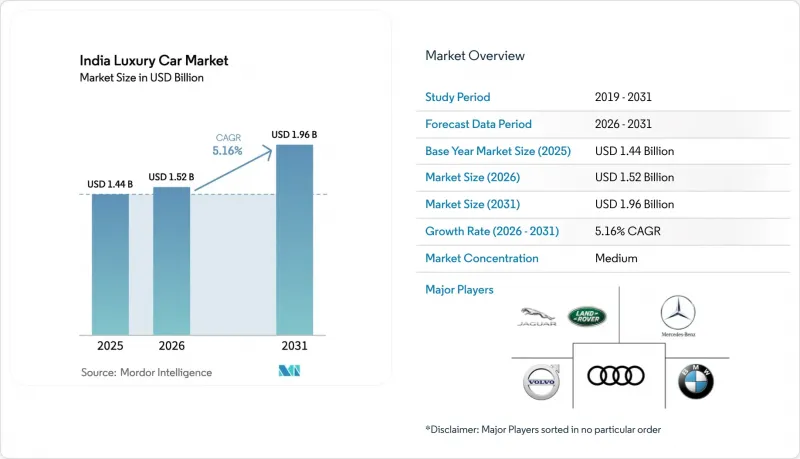
根據 Mordor Intelligence 預測,印度豪華車市場規模將從 2025 年的 14.4 億美元成長到 2026 年的 15.2 億美元,到 2031 年達到 19.6 億美元,預計在預測期(2026-2031 年)內將以 5.16% 的複合年成長率成長。
本報告按車輛類型(SUV、轎車、掀背車)、驅動方式(內燃機、混合動力、純電動車)、價格區間(200萬至500萬印度盧比、500萬至800萬印度盧比、800萬印度盧比以上)、銷售管道(公司自營展示室、授權經銷商、線上分類通路)及印度北部地區(印度北部地區)。市場預測以美元和銷售(輛)兩種形式呈現。
印度豪華車市場的趨勢和洞察
中上階層家庭的優質化
印度目前估計有87.1萬個百萬富翁家庭(定義為淨資產達8,700萬印度盧比或以上的家庭),較2021年(約45.8萬戶)成長了90%。這些富裕家庭約佔印度所有家庭的0.31%,反映了該國在經濟成長驅動下強勁的財富累積。核心家庭目前佔豪華車購買量的62%,因為雙薪家庭越來越重視個人出遊(高於2020年的48%)。資金流動性也反映在UPI匯款額超過10萬印度盧比的匯款數量年增34%。隨著房地產價格上漲速度放緩,擁有汽車作為一種彰顯身分的方式正日益受到關注。
擴大入門車型(CKD)的供應
本地組裝已將這款德國製造轎車的入門價格降至489萬印度盧比。 BMWX1 sDrive18i M Sport比傳統的組裝進口(CBU)車型便宜65萬印度盧比。採用全散件組裝(CKD)方式,可以避免對整車進口徵收100%的關稅,維持28-32%的毛利率,並將交貨時間縮短至六週。梅賽德斯-賓士2024年在印度售出19,565輛汽車。奧迪位於奧蘭加巴德的工廠計劃於2026年底開始生產純電動車平台,這將使CKD的成本優勢擴展到售價低於800萬印度盧比的電動車車型。
能夠操作ADAS和高壓系統的熟練技術人員短缺。
根據汽車技能發展委員會估計,到2026年,美國將出現240萬名汽車技術人員的缺口。目前,50萬名電動車認證技術人員的需求量龐大,但僅有5萬名,供需僅剩10%。這種短缺導致保固索賠的處理時間延長,從大都會圈的4天到哥印拜陀和齋浦爾等二線城市的18天不等。技能缺口直接導致顧客不滿足。 JD Power 2024年的一項調查發現,二線市場42%的豪華電動車車主認為售後服務“低於預期”,原因是技術人員不熟悉電池溫度控管診斷和空中軟體更新。這些因素導致各品牌的淨推薦值(NPS)比大都會圈低18分。
細分市場分析
到2025年,運動型多用途車(SUV)將佔據印度豪華車市場47.43%的佔有率,而轎車預計到2031年將以10.12%的複合年成長率復甦。後排娛樂系統的普及率超過三分之二,顯示消費者越來越重視乘坐舒適性。在路況較差的二線城市,SUV仍然必不可少,而售價超過2000萬印度盧比的超豪華SUV細分市場正在不斷擴大,這主要得益於勞斯萊斯庫里南等車型的推動。
掀背車市場依然非常小規模,沒有一款高階車型的售價低於400萬印度盧比(約4.8萬美元)。賓士A級車於2023年停產後留下的市場空白尚未被競爭對手填補,入門級豪華車市場已被斯柯達明銳等大眾豪華品牌佔據。混合動力傳動系統的出現進一步推動了轎車市場的復甦。例如,BMW530e和賓士E 300e將於2025年9月受惠於商品及服務稅(GST)38%的降幅,屆時其價格將降至90萬至110萬印度盧比(約10,800至13,200美元),與同等級汽油盧比之間的價格(約合10,800至13,200美元),與同等級汽油盧比之間的價格(約4004萬美元)考慮到大都會圈的平均汽油價格為每公升105印度盧比(約1.26美元),車主行駛6萬公里即可收回這部分差價。
截至2025年,內燃機車仍佔據印度豪華車市場74.68%的佔有率,但預計到2031年,純電動車(BEV)的複合年成長率將達到21.98%,是印度整體豪華車市場成長速度的四倍。梅賽德斯-賓士EQS SUV的買家可享有印度稅法規定的首年40%折舊免稅額率,從而縮短投資回收期。隨著商品及服務稅(GST)在2025年9月降至38%,插電式混合動力車市場發展動能強勁,註冊量較上季成長28%。一些買家仍然選擇汽油車,因為他們擔心殘值,而且加油的便利性和較低的購車價格仍然是重要的考慮因素。
內燃機(ICE)電動車的優勢主要源自於三個因素:完善的充電基礎設施(12,000個公共電動車充電樁,而加油站則高達85,000個)、更快的充電速度(快充值僅需725分鐘,而加油站僅需3分鐘)以及更低的初始成本-寶馬530i的售價僅需729萬印度(約187,5000美元eDrive40便宜180萬印度盧比(約21,600美元)。對於每年行駛里程低於15,000公里的消費者來說,這樣的價格差異並不划算。在班加羅爾和浦那等城市,BMW530e和賓士E 300e佔據了市場主導地位,因為這些城市的消費者更重視稅收優惠而非純粹的性能。
其他好處
- Excel格式的市場預測(ME)表
- 3個月的分析師支持
目錄
第1章:引言
- 研究假設和市場定義
- 調查範圍
第2章:調查方法
第3章執行摘要
第4章 市場狀況
- 市場概覽
- 市場促進因素
- 中上階層家庭的優質化
- 擴大入門車型(CKD)的供應
- 州政府促進電動車普及的措施
- 在城際走廊快速部署功率超過150kW的公共直流充電樁
- OEM廠商資助的訂閱和租賃方案
- 中國超豪華電動車品牌正進軍印度市場。
- 市場限制因素
- 高額消費稅及附加稅結構
- 整車進口關稅存在不確定性。
- 認證二手豪華車銷售網路發展落後
- 能夠操作ADAS和高壓系統的熟練技術人員短缺。
- 價值供應鏈分析
- 監理情勢
- 技術展望
- 波特五力分析
第5章 市場規模與成長預測
- 按車輛類型
- 運動型多用途車(SUV)
- 轎車
- 掀背車
- 透過驅動系統
- 內燃機(ICE)
- 混合
- 電池電動車
- 按價格範圍
- 200萬至500萬印度盧比
- 500萬至800萬印度盧比
- 超過800萬印度盧比
- 按銷售管道
- 公司自營展示室
- 授權經銷商/加盟商
- 線上銷售(直接面對消費者)
- 按地區
- 印度北部
- 西印度群島
- 南印度
- 印度東部/印度東北部
第6章 競爭情勢
- 市場集中度
- 策略趨勢
- 市佔率分析
- 公司簡介
- Mercedes-Benz Group AG
- BMW AG
- AUDI AG
- Jaguar Land Rover Automotive PLC
- AB Volvo
- Lexus
- Porsche AG
- Rolls-Royce plc
- Bentley Motors Limited
- Automobili Lamborghini SpA
- Ferrari SpA
- Maserati SpA
- Aston Martin Lagonda Global Holdings PLC
第7章 市場機會與未來展望
According to Mordor Intelligence, the indian luxury car market size is expected to grow from USD 1.44 billion in 2025 to USD 1.52 billion in 2026 and is forecast to reach USD 1.96 billion by 2031, growing at a 5.16% CAGR over the forecast period (2026-2031).
This report is Segmented by Vehicle Type (SUV, Sedan, Hatchback), Drive Type (IC Engine, Hybrid, Battery Electric), Price Range (INR 20 To 50 Lakh, INR 50 To 80 Lakh, Above INR 80 Lakh), Sales Channel (Company-Owned Showrooms, Authorized Dealerships/Franchise, Online), and Geography (North India, West India, South India, and More). The Market Forecasts are Provided in Terms of Value (USD) and Volume (Units).
India Luxury Car Market Trends and Insights
Premiumization of Upper-middle-class Households
India now has an estimated 8.71 lakh millionaire households (defined as households with a net worth of INR 8.7 crore or more), marking a 90 % increase compared with 2021 (from about INR 4.58 lakh). These affluent households represent roughly 0.31 % of all Indian households and reflect strong wealth creation in the country amid economic growth. Nuclear families now account for 62% of luxury purchases, up from 48% in 2020, as dual-income couples increasingly favor personal mobility. Liquidity is evident in UPI transfers above INR 1 lakh, which have surged 34% year over year. Slowing real-estate appreciation redirects status signaling toward automobile ownership.
Rising Availability of Entry-level Models (CKD)
Local assembly cut the entry point for German sedans to INR 48.9 lakh, with BMW's X1 sDrive18i M Sport priced INR 6.5 lakh lower than the prior CBU version. CKD economics avoids 100% CBU duties, preserves 28-32% gross margins, and trims delivery lead times to six weeks. Mercedes-Benz sold 19,565 units in India in 2024. Audi's Aurangabad plant will accommodate BEV platforms by late 2026, extending CKD savings to electric models below INR 80 lakh.
Scarcity of Trained Technicians for ADAS and High-Voltage Systems
The Automotive Skills Development Council estimates a 2.4 million technician shortfall by 2026, with only 50,000 of the 500,000 required EV-certified technicians currently available, resulting in a 10% fill rate. This shortfall extends warranty-claim resolution from 4 days in metros to 18 days in tier-2 cities like Coimbatore and Jaipur. The skills gap manifests in customer dissatisfaction; a 2024 J.D. Power study found that 42% of luxury EV owners in tier-2 markets rated aftersales service below expectations, citing technician unfamiliarity with battery thermal management diagnostics and over-the-air software updates, factors that depress brand Net Promoter Scores by 18 points relative to metro areas.
Other drivers and restraints analyzed in the detailed report include:
- EV Incentives by State Governments
- Rapid Rollout of 150 kW+ Public DC Chargers on Inter-city Corridors
- Slow Build-out of Certified Pre-owned Luxury Networks
For complete list of drivers and restraints, kindly check the Table Of Contents.
Segment Analysis
Sport Utility Vehicles (SUVs) captured 47.43% of India's luxury car market share in 2025, while sedans are expected to resurge with a forecast 10.12% CAGR through 2031. Rear-seat entertainment uptake exceeds 2/3, indicating a shift in value toward ride quality. SUVs remain indispensable in tier-2 markets with poor road surfaces; the ultra-luxury SUV niche, priced above INR 2 crore, is advancing on the back of models like the Rolls-Royce Cullinan.
Hatchbacks remain a negligible segment, constrained by the absence of premium offerings priced below INR 40 lakh (approximately USD 48,000). The discontinuation of the Mercedes A-Class in 2023 left a void that no competitor has filled, ceding the entry-luxury space to mass-premium brands like the Skoda Octavia. Hybrid powertrains further propel the sedan revival - BMW's 530e and Mercedes E 300e - which benefit from the September 2025 GST reduction to 38%, trimming prices by INR 9-11 lakh (approximately USD 10,800-13,200) and compressing the premium over equivalent petrol variants to just INR 4 lakh (approximately USD 4,800), a gap that buyers recover within 60,000 kilometers given petrol prices averaging INR 105 per liter (approximately USD 1.26) in metros.
Internal combustion engines still held 74.68% of India's luxury car market share in 2025; however, BEVs are expected to expand at a 21.98% CAGR through 2031, thereby quadrupling the overall pace of the Indian luxury car market. Mercedes-Benz EQS SUV buyers can leverage a 40% first-year depreciation under India's tax code, thereby narrowing the payback horizon. Plug-in hybrids gained momentum from the September 2025 GST cut to 38%, resulting in a 28% surge in month-on-month registrations. Residual-value anxiety keeps some buyers in petrol variants, where refueling convenience and lower sticker prices remain essential considerations.
The ICE segment's resilience stems from three factors: established refueling infrastructure (85,000 petrol pumps versus 12,000 public EV chargers), faster refueling (3 minutes versus 25 minutes for fast-charging), and lower upfront cost - the BMW 530i at INR 72.9 lakh (approximately USD 87,500) undercuts the i4 eDrive40 by INR 18 lakh (approximately USD 21,600), a gap that buyers with annual mileage under 15,000 kilometers cannot justify. The BMW 530e and Mercedes E 300e are leading the uptake in Bangalore and Pune, cities where buyers prioritize tax efficiency over outright performance.
Complete Report Scope:
- By Vehicle Type
- Sport Utility Vehicles (SUVs)
- Sedan
- Hatchback
- By Drive Type
- Internal Combustion Engine (ICE)
- Hybrid
- Battery Electric
- By Price Range
- INR 20 to 50 Lakh
- INR 50 to 80 Lakh
- Above INR 80 Lakh
- By Sales Channel
- Company-owned Showrooms
- Authorized Dealerships/Franchise
- Online (Direct-to-Consumer)
- By Region
- North India
- West India
- South India
- East and North-East India
List of Companies Covered in this Report:
- Mercedes-Benz Group AG
- BMW AG
- AUDI AG
- Jaguar Land Rover Automotive PLC
- AB Volvo
- Lexus
- Porsche AG
- Rolls-Royce plc
- Bentley Motors Limited
- Automobili Lamborghini S.p.A.
- Ferrari S.p.A.
- Maserati S.p.A
- Aston Martin Lagonda Global Holdings PLC
Additional Benefits:
- The market estimate (ME) sheet in Excel format
- 3 months of analyst support
TABLE OF CONTENTS
1 Introduction
- 1.1 Study Assumptions and Market Definition
- 1.2 Scope of the Study
2 Research Methodology
3 Executive Summary
4 Market Landscape
- 4.1 Market Overview
- 4.2 Market Drivers
- 4.2.1 Premiumization of Upper-Middle-Class Households
- 4.2.2 Rising Availability of Entry-Level Models (CKD)
- 4.2.3 EV Incentives by State Governments
- 4.2.4 Rapid Rollout of 150 kW+ Public DC Chargers on Inter-City Corridors
- 4.2.5 OEM-Financed Subscription and Leasing Schemes
- 4.2.6 Chinese Ultra-Luxury EV Brands Eyeing India as Next Launch Pad
- 4.3 Market Restraints
- 4.3.1 High GST and Cess Structure
- 4.3.2 Import Duty Uncertainty on CBUs
- 4.3.3 Slow Build-Out of Certified Pre-Owned Luxury Networks
- 4.3.4 Scarcity of Trained Technicians for ADAS and High-Voltage Systems
- 4.4 Value/Supply-Chain Analysis
- 4.5 Regulatory Landscape
- 4.6 Technological Outlook
- 4.7 Porter's Five Forces Analysis
- 4.7.1 Bargaining Power of Buyers/Consumers
- 4.7.2 Bargaining Power of Suppliers
- 4.7.3 Threat of New Entrants
- 4.7.4 Threat of Substitute Products
- 4.7.5 Intensity of Competitive Rivalry
5 Market Size and Growth Forecasts (Value (USD) and Volume (Units))
- 5.1 By Vehicle Type
- 5.1.1 Sport Utility Vehicles (SUVs)
- 5.1.2 Sedan
- 5.1.3 Hatchback
- 5.2 By Drive Type
- 5.2.1 Internal Combustion Engine (ICE)
- 5.2.2 Hybrid
- 5.2.3 Battery Electric
- 5.3 By Price Range
- 5.3.1 INR 20 to 50 Lakh
- 5.3.2 INR 50 to 80 Lakh
- 5.3.3 Above INR 80 Lakh
- 5.4 By Sales Channel
- 5.4.1 Company-owned Showrooms
- 5.4.2 Authorized Dealerships/Franchise
- 5.4.3 Online (Direct-to-Consumer)
- 5.5 By Region
- 5.5.1 North India
- 5.5.2 West India
- 5.5.3 South India
- 5.5.4 East and North-East India
6 Competitive Landscape
- 6.1 Market Concentration
- 6.2 Strategic Moves
- 6.3 Market Share Analysis
- 6.4 Company Profiles (Includes Global level Overview, Market level overview, Core Segments, Financials as available, Strategic Information, Market Rank/Share for key companies, Products and Services, and Recent Developments)
- 6.4.1 Mercedes-Benz Group AG
- 6.4.2 BMW AG
- 6.4.3 AUDI AG
- 6.4.4 Jaguar Land Rover Automotive PLC
- 6.4.5 AB Volvo
- 6.4.6 Lexus
- 6.4.7 Porsche AG
- 6.4.8 Rolls-Royce plc
- 6.4.9 Bentley Motors Limited
- 6.4.10 Automobili Lamborghini S.p.A.
- 6.4.11 Ferrari S.p.A.
- 6.4.12 Maserati S.p.A
- 6.4.13 Aston Martin Lagonda Global Holdings PLC
7 Market Opportunities and Future Outlook
- 7.1 White-space and Unmet-need Assessment

 高階和豪華汽車市場機會、成長要素、產業趨勢分析以及 2026-2035 年預測。
 北美豪華車:市場佔有率分析、產業趨勢與統計及成長預測(2026-2031)
 豪華車市場規模、佔有率、成長、全球產業分析、區域洞察及預測(2026-2034 年)豪華車:市場佔有率分析、產業趨勢與統計、成長預測(2026-2031)
 2026年全球豪華車軟管市場報告
 2026-2030年全球豪華車市場2026年全球豪華穹頂車旅遊市場報告2026年全球豪華車市場報告
 豪華車市場規模、佔有率和趨勢分析報告:按車輛類型、驅動方式、地區和細分市場分類的預測(2026-2033 年)
 豪華車市場規模、佔有率、趨勢及報告:按車型、燃料類型、價格範圍和地區分類(2026-2034 年)