


 |
市場調查報告書
商品編碼
2114865
北美豪華車:市場佔有率分析、產業趨勢與統計及成長預測(2026-2031)North America Luxury Car - Market Share Analysis, Industry Trends & Statistics, Growth Forecasts (2026 - 2031) |
||||||

※ 本網頁內容可能與最新版本有所差異。詳細情況請與我們聯繫。
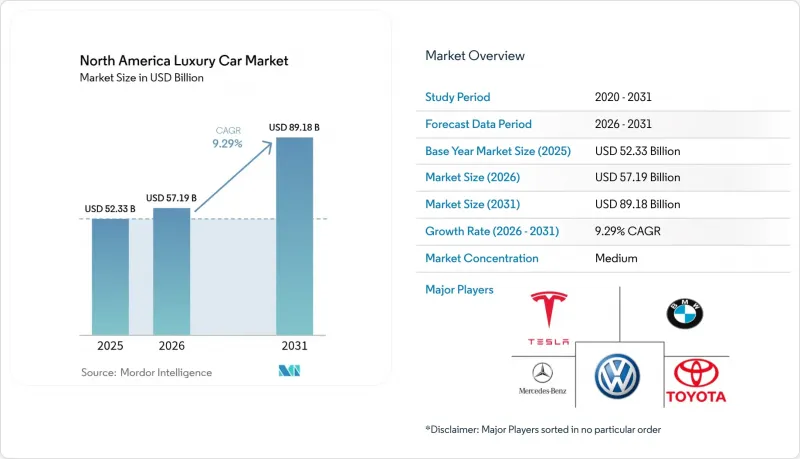
據 Mordor Intelligence 稱,2025 年北美豪華車市值為 523.3 億美元,預計到 2031 年將達到 891.8 億美元,而 2026 年為 571.9 億美元,預測期(2026-2031 年)的複合年成長率為 9.29%。
本報告按車輛類型(轎車、SUV/跨界車、其他)、驅動方式(內燃機、電池式電動車等)、價格區間(高階:5萬至10萬美元,超高階:10萬至20萬美元等)、銷售管道(特許經銷商、直銷等)和國家(美國、加拿大等)進行分類。市場預測以貨幣價值(美元)和銷售(輛)兩種形式呈現。
北美豪華車市場的趨勢與洞察
Y世代/高淨值族群的優質化趨勢
隨著財富向千禧世代和Z世代轉移,如今40%的豪華車富裕買家都來自這兩個世代。他們的購買決策優先考慮內建軟體、環保因素和個人化體驗,這迫使品牌建立全通路銷售通路、捆綁式互聯服務以及基於訂閱的使用模式。隨著科技平台的重要性超越靜態的認同象徵,非現場升級和以服務為基礎的提升銷售的策略價值也日益凸顯。
汽車製造商努力實現到 2030 年,其豪華車中超過 50% 為電動車的目標。
寶馬集團將高階主管獎金與電動車的普及率掛鉤,並據此調整其在北美的新車上市計畫。加拿大的一項補貼計畫進一步強化了這一效應,加快了該市場的車型上市週期。資金流動正在推動電池供應的在地化,但每家公司都必須在內燃機汽車的短期盈利與對電動車的大量資本投資之間取得平衡,因此,投資組合平衡成為經營團隊的關鍵績效指標。
年通貨膨脹率(APR)的上升給租賃協議的擴張帶來了壓力。
與通膨前的基準值相比,租賃付款上漲了25%至30%,這對年輕、富裕的購車者造成了不成比例的影響,並阻礙了他們進入入門級豪華車市場。為了維持銷量,汽車製造商正在實施長期租賃協議、試點訂閱服務和降低利率等措施。
細分市場分析
在北美豪華車市場,預計到2025年,SUV將佔據55.18%的市場佔有率,年複合成長率(CAGR)預計為10.52%。透過將SUV定位為各自技術的旗艦車型,製造商可以獲得更高的利潤率,並抵消電氣化帶來的成本。 BMW、賓士以及其他新晉品牌不斷推出電動SUV,正推動著這一成長動能。轎車在人口密集的大都會圈仍然很受歡迎,但在年輕家庭中,其市場佔有率正被SUV蠶食。小轎車、敞篷車和掀背車則佔據了愛好者的細分市場,它們的總合銷量仍低於5%。
軸距較長的SUV可以容納較大的電池組,而不會犧牲車內空間。因此,純電動SUV在性能需求和環保考量之間取得了平衡,為下一代駕駛輔助系統提供了戰略立足點。高坐姿和靈活多變的載物空間所帶來的情感吸引力,鞏固了SUV作為豪華車型的地位。
即使到了2025年,內燃機車仍將佔據北美豪華車市場64.70%的佔有率,但預計到2031年,電池式電動車的複合年成長率將達到10.76%。混合動力汽車將成為偶爾需要長途旅行的消費者的過渡選擇,而插電式混合動力汽車則無需依賴充電網路即可提供日常純電續航里程。由於缺乏氫能基礎設施,Lexus的燃料電池汽車測試仍然有限。
加拿大相關法規和美國各州零排放強制令正在加速這一進程,促使汽車製造商加快開發專用電動車平台。特斯拉已確立的市場地位迫使現有製造商在空中下載(OTA)更新技術和充電生態系統建設方面迎頭趕上,進一步加速了對電氣化的資本投資。
其他好處:
- Excel格式的市場預測(ME)表
- 3個月的分析師支持
目錄
第1章:引言
- 研究假設和市場定義
- 調查範圍
第2章:調查方法
第3章執行摘要
第4章 市場狀況
- 市場概覽
- 市場促進因素
- Y世代/高淨值人士(HNWI)的優質化趨勢
- 汽車製造商的目標是到 2030 年將豪華電動車佔其車隊的 50%。
- 由於產品線進行了調整,現在主要以SUV為主,因此平均售價有所上漲。
- 來自OTA主導的「按需功能」的收入來源
- 豪華叫車服務和訂閱式試點計畫(那些尚未引起公眾太多關注的項目)
- 一項利用區塊鏈技術的認證二手車計畫(目前尚未引起太多關注)。
- 市場限制因素
- 由於通貨膨脹導致年利率(APR)大幅上升,給簽訂租賃合約帶來了壓力。
- 二手電動車定價不確定性,正在削弱買家的信心。
- 美國原產地規則扭曲了北美電池供應行業的資本投資(這個問題尚未引起公眾的足夠重視)。
- 與 ADAS 相關的訴訟風險迫使廠商進行代價高昂的軟體召回(這些問題並未公開承認)。
- 價值供應鏈分析
- 監理情勢
- 技術展望
- 波特五力模型
第5章 市場規模與成長預測
- 車輛類型
- 轎車
- SUV/跨界車
- 掀背車
- 小轎車
- 敞篷車
- 透過驅動系統
- 內燃機(ICE)
- 輕度/完全混合
- 插電式混合動力汽車(PHEV)
- 電池式電動車(BEV)
- 燃料電池電動車(FCEV)
- 按價格範圍
- 高級版:50,000 美元至 100,000 美元
- 最高保費:10萬美元至20萬美元
- 售價超過20萬美元的超豪華商品
- 按銷售管道
- 特許經銷商
- 直接面對消費者
- 網路市集
- 訂閱/租賃車輛
- 國家
- 美國
- 加拿大
- 其他北美國家
第6章 競爭情勢
- 市場集中度
- 策略趨勢
- 市佔率分析
- 公司簡介
- Tesla Inc.
- BMW AG
- Mercedes-Benz Group AG
- Volkswagen AG
- Toyota Motor Corporation(Lexus)
- General Motors(Cadillac)
- Ford Motor Company(Lincoln)
- Stellantis NV(Maserati, Alfa Romeo)
- Volvo Car AB
- Tata Motors(Jaguar Land Rover)
- Nissan Motor Co.(Infiniti)
- Honda Motor Co.(Acura)
- Kia Corp.(Genesis)
- Lucid Group
- Rivian Automotive
- Ferrari NV
- Aston Martin Lagonda
第7章 市場機會與未來展望
According to Mordor Intelligence, the North America luxury car market size was valued at USD 52.33 billion in 2025 and estimated to grow from USD 57.19 billion in 2026 to reach USD 89.18 billion by 2031, at a CAGR of 9.29% during the forecast period (2026-2031).
This report is Segmented by Vehicle Type (Sedan, SUV/Crossover, and More), Drive Type (ICE, Battery-Electric, and More), Price Band (Premium 50k-100k USD, Upper-Premium 100k-200k USD, and More), Sales Channel (Franchised Dealer, Direct-To-Consumer, and More), and Country (United States, Canada, and More). The Market Forecasts are Provided in Terms of Value (USD) and Volume (Units).
North America Luxury Car Market Trends and Insights
Premiumization Momentum Among Gen-Y/HNWIs
Wealth reallocation toward millennials and Gen-Z means that 40% of high-net-worth buyers choosing premium vehicles now come from these cohorts . Their purchase logic favors embedded software, green footprints, and personalized experiences, pushing brands to craft omnichannel storefronts, connected-service bundles, and subscription-based access models. The emphasis on technology platforms rather than static status symbols raises the strategic value of over-the-air update capability and service-based upselling.
Automaker Push Toward >=50% Luxury EV Mix by 2030
BMW Group ties senior bonuses to electrified-vehicle penetration and has aligned North American launches accordingly . Canadian rebates magnify the effect, prompting faster model cadence in that market. While capital flows favor battery supply localization, firms must juggle near-term ICE profitability with heavy EV capex, making portfolio balancing a critical executive KPI.
Inflation-Induced APR Spikes Squeeze Leasing Uptake
Lease payments have risen 25-30% versus pre-inflation benchmarks, disproportionately affecting younger aspirational buyers and eroding the entry-luxury funnel. Automakers are countering with longer-tenor leases, subscription pilots, and interest-rate buydowns to protect volume.
Other drivers and restraints analyzed in the detailed report include:
- SUV-Centered Product-Mix Realignment Raises ASPs
- OTA-Driven Feature-on-Demand Revenue Streams
- BEV Resale-Value Uncertainty Dents Buyer Confidence
For complete list of drivers and restraints, kindly check the Table Of Contents.
Segment Analysis
The North America luxury car market size attributed to SUVs reached 55.18% in 2025, supported by a 10.52% forecast CAGR. Positioning SUVs as technology flagships unlocks superior margins, letting manufacturers offset electrification costs. Continuous EV SUV introductions by BMW, Mercedes-Benz, and newcomers sustain momentum. Sedans continue to resonate in densely populated metros yet yield ground to SUVs among younger families. Coupes, convertibles, and hatchbacks serve enthusiast niches, collectively under 5% of volume.
A longer wheelbase allows SUVs to house larger battery packs without cabin compromise. Consequently, battery-electric SUVs bridge performance expectations and environmental commitments, making them strategic launchpads for next-gen driver-assist suites. The emotional appeal of heightened seating and versatile cargo room cements the SUV as a luxury staple.
Internal-combustion engines still represented 64.70% of the North America luxury car market share in 2025, but battery-electric vehicles will log an 10.76% CAGR through 2031. Hybrids provide a transitional hedge for buyers with occasional long-distance needs, while plug-in hybrids give daily electric range without charging network dependency. Lexus' fuel-cell pilot remains limited by hydrogen infrastructure.
The regulatory blueprint in Canada and state-level zero-emission mandates in the United States compress timelines, motivating OEMs to accelerate dedicated EV platforms. Tesla's entrenched mindshare forces incumbents to match over-the-air proficiency and charging ecosystems, intensifying capital deployment toward electrification.
Complete Report Scope:
- By Vehicle Type
- Sedan
- SUV/Crossover
- Hatchback
- Coupe
- Convertible
- By Drive Type
- Internal Combustion Engine (ICE)
- Mild/Full Hybrid
- Plug-in Hybrid Vehicle (PHEV)
- Battery-Electric Vehicle (BEV)
- Fuel-Cell Electric Vehicle (FCEV)
- By Price Band
- Premium 50k USD to 100k USD
- Upper-Premium 100k USD to 200k USD
- Ultra-Luxury Above 200k USD
- By Sales Channel
- Franchised Dealer
- Direct-to-Consumer
- Online Marketplace
- Subscription/Lease Fleet
- By Country
- United States
- Canada
- Rest of North America
List of Companies Covered in this Report:
- Tesla Inc.
- BMW AG
- Mercedes-Benz Group AG
- Volkswagen AG
- Toyota Motor Corporation (Lexus)
- General Motors (Cadillac)
- Ford Motor Company (Lincoln)
- Stellantis N.V. (Maserati, Alfa Romeo)
- Volvo Car AB
- Tata Motors (Jaguar Land Rover)
- Nissan Motor Co. (Infiniti)
- Honda Motor Co. (Acura)
- Kia Corp. (Genesis)
- Lucid Group
- Rivian Automotive
- Ferrari N.V.
- Aston Martin Lagonda
Additional Benefits:
- The market estimate (ME) sheet in Excel format
- 3 months of analyst support
TABLE OF CONTENTS
1 Introduction
- 1.1 Study Assumptions & Market Definition
- 1.2 Scope of the Study
2 Research Methodology
3 Executive Summary
4 Market Landscape
- 4.1 Market Overview
- 4.2 Market Drivers
- 4.2.1 Premiumization momentum among Gen-Y/HNWIs
- 4.2.2 Automaker push toward ?50% luxury EV mix by 2030
- 4.2.3 SUV-centred product-mix realignment raises ASPs
- 4.2.4 OTA-driven feature-on-demand revenue streams
- 4.2.5 Luxury ride-hailing & subscription pilots (under-radar)
- 4.2.6 Blockchain-enabled certified-pre-owned programs (under-radar)
- 4.3 Market Restraints
- 4.3.1 Inflation-induced APR spikes squeeze leasing uptake
- 4.3.2 BEV resale-value uncertainty dents buyer confidence
- 4.3.3 US rules of-origin distort NA battery-supply capex (under-radar)
- 4.3.4 ADAS litigation risk forces costly software recalls (under-radar)
- 4.4 Value/Supply-Chain Analysis
- 4.5 Regulatory Landscape
- 4.6 Technological Outlook
- 4.7 Porter's Five Forces
- 4.7.1 Threat of New Entrants
- 4.7.2 Bargaining Power of Buyers/Consumers
- 4.7.3 Bargaining Power of Suppliers
- 4.7.4 Threat of Substitute Products
- 4.7.5 Intensity of Competitive Rivalry
5 Market Size & Growth Forecasts (Value (USD) and Volume (Units))
- 5.1 By Vehicle Type
- 5.1.1 Sedan
- 5.1.2 SUV/Crossover
- 5.1.3 Hatchback
- 5.1.4 Coupe
- 5.1.5 Convertible
- 5.2 By Drive Type
- 5.2.1 Internal Combustion Engine (ICE)
- 5.2.2 Mild/Full Hybrid
- 5.2.3 Plug-in Hybrid Vehicle (PHEV)
- 5.2.4 Battery-Electric Vehicle (BEV)
- 5.2.5 Fuel-Cell Electric Vehicle (FCEV)
- 5.3 By Price Band
- 5.3.1 Premium 50k USD to 100k USD
- 5.3.2 Upper-Premium 100k USD to 200k USD
- 5.3.3 Ultra-Luxury Above 200k USD
- 5.4 By Sales Channel
- 5.4.1 Franchised Dealer
- 5.4.2 Direct-to-Consumer
- 5.4.3 Online Marketplace
- 5.4.4 Subscription/Lease Fleet
- 5.5 By Country
- 5.5.1 United States
- 5.5.2 Canada
- 5.5.3 Rest of North America
6 Competitive Landscape
- 6.1 Market Concentration
- 6.2 Strategic Moves
- 6.3 Market Share Analysis
- 6.4 Company Profiles (Includes Global level Overview, Market Level Overview, Core Segments, Financials as Available, Strategic Information, Market Rank/Share for Key Companies, Products & Services, and Recent Developments)
- 6.4.1 Tesla Inc.
- 6.4.2 BMW AG
- 6.4.3 Mercedes-Benz Group AG
- 6.4.4 Volkswagen AG
- 6.4.5 Toyota Motor Corporation (Lexus)
- 6.4.6 General Motors (Cadillac)
- 6.4.7 Ford Motor Company (Lincoln)
- 6.4.8 Stellantis N.V. (Maserati, Alfa Romeo)
- 6.4.9 Volvo Car AB
- 6.4.10 Tata Motors (Jaguar Land Rover)
- 6.4.11 Nissan Motor Co. (Infiniti)
- 6.4.12 Honda Motor Co. (Acura)
- 6.4.13 Kia Corp. (Genesis)
- 6.4.14 Lucid Group
- 6.4.15 Rivian Automotive
- 6.4.16 Ferrari N.V.
- 6.4.17 Aston Martin Lagonda
7 Market Opportunities & Future Outlook
- 7.1 White-space & Unmet-Need Assessment

 高階和豪華汽車市場機會、成長要素、產業趨勢分析以及 2026-2035 年預測。
 豪華車市場規模、佔有率、成長、全球產業分析、區域洞察及預測(2026-2034 年)
 印度豪華車市場:市場佔有率分析、產業趨勢與統計及成長預測(2026-2031)豪華車:市場佔有率分析、產業趨勢與統計、成長預測(2026-2031)
 2026年全球豪華車軟管市場報告
 2026-2030年全球豪華車市場2026年全球豪華穹頂車旅遊市場報告2026年全球豪華車市場報告
 豪華車市場規模、佔有率和趨勢分析報告:按車輛類型、驅動方式、地區和細分市場分類的預測(2026-2033 年)
 豪華車市場規模、佔有率、趨勢及報告:按車型、燃料類型、價格範圍和地區分類(2026-2034 年)