


 |
市場調查報告書
商品編碼
2122001
中東和非洲平板玻璃市場:市場佔有率分析、行業趨勢和統計數據以及成長預測(2026-2031 年)Middle-East And Africa Flat Glass - Market Share Analysis, Industry Trends & Statistics, Growth Forecasts (2026 - 2031) |
||||||

※ 本網頁內容可能與最新版本有所差異。詳細情況請與我們聯繫。
據 Mordor Intelligence 稱,2025 年中東和非洲的平板玻璃市場價值為 231 萬噸,預計在預測期(2026-2031 年)內將以 3.85% 的複合年成長率成長,從 2026 年的 240 萬噸成長到 2031 年的 289 萬噸。
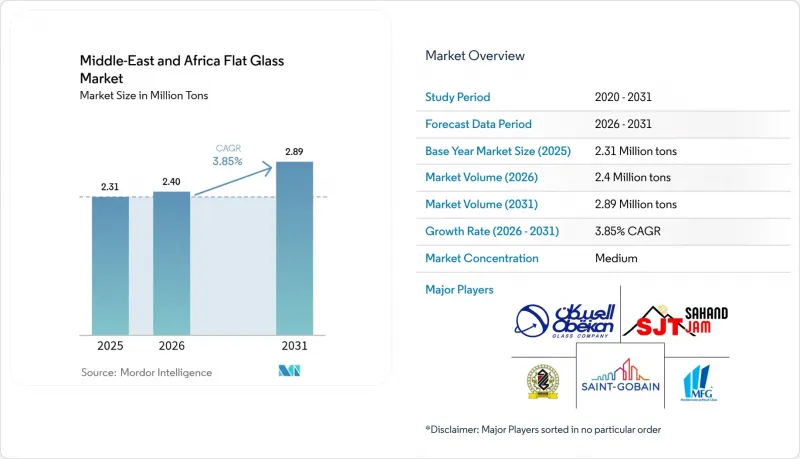
本報告按產品類型(退火玻璃、鍍膜玻璃、加工玻璃、鏡面玻璃、壓花玻璃)、應用領域(建築、汽車、太陽能玻璃及其他終端用戶產業)和地區(沙烏地阿拉伯、卡達、阿拉伯聯合大公國、奈及利亞、埃及、南非及其他中東和非洲國家)進行細分。市場預測以噸為單位。
中東及非洲平板玻璃市場趨勢及洞察
大型企劃管道
海灣合作理事會(GCC)以及北非各地的大規模綜合用途城市、旅遊區和工業走廊正在鞏固未來多年的玻璃需求前景。僅沙烏地阿拉伯的「紅海計畫」就獲得了價值61億美元的契約,涵蓋50個度假村和8000間酒店客房,其中包括一個3700平方公尺的弧形幕牆單元。類似的旗艦項目,例如NEOM的辛達拉島和埃及的新行政首都,都指定使用夾層玻璃、Low-E低輻射鍍膜玻璃和兼具美觀性和隔熱性能的超大尺寸面板。某些經濟特區的高訂單密度使生產商能夠整合交貨、降低物流成本並最佳化熔爐運作計劃,以滿足特定的厚度目標。國際金融公司(IFC)提供的1億美元融資計畫用於擴大埃及的玻璃生產,凸顯了金融機構對該地區建築訂單累積訂單的信心。這些大型企劃鞏固了需求基礎,並為持續投資新建浮法生產線和鍍膜室提供了合理依據。
擴大區域汽車生產群集
沙烏地阿拉伯、阿拉伯聯合大公國和埃及的汽車製造業獎勵政策正在改變汽車玻璃的需求結構。利雅德的汽車投資與發展計畫旨在到2030年實現年產量30萬至50萬輛,而Ceer和Lucid等新興電動汽車製造商則專注於全景天窗和兼容抬頭顯示(HUD)的前擋風玻璃。埃及的在地化藍圖與此策略相契合,推動了對夾層前擋風玻璃、強化玻璃側窗和帶有太陽能控制膜的天窗的需求。隨著整車製造商(OEM)從更靠近其組裝廠的供應商採購,區域平板玻璃製造商看到了深化技術合作、實施線上品質檢測系統和部署準時制(JIT)交貨模式的機會。電池式電動車平台玻璃面積的增加將進一步提高每輛車的玻璃用量。這些汽車產業叢集共同促成了銷售管道的多元化、對進口依賴的降低以及整體熔煉產能運轉率的提高。
能源和堿灰投入價格的波動
2024年,南非堿灰價格每噸上漲20歐元,而歐洲基準價格在175至195歐元之間波動,直接影響了生產成本。由於能源成本佔熔爐營運費用的15%至20%,天然氣現貨價格的飆升立即擠壓了浮法玻璃製造商的利潤空間。對從土耳其和中國進口堿灰的依賴使區域工廠面臨運費波動和外匯錯配的風險。沙烏地阿拉伯已宣佈興建該地區首個合成堿灰裝置,但初期產量不足以完全取代進口,預計短期內價格風險仍將居高不下。為穩定成本,製造商正在加快玻璃廢料回收利用,簽訂固定價格的液化天然氣供應契約,並開展太陽能熔煉技術的試點項目。
細分市場分析
2025年,退火玻璃在中東和非洲平板玻璃市場仍保持79.75%的市場佔有率,這主要得益於其在標準帷幕牆和入門級汽車車窗方面的成本優勢。然而,包括強化玻璃、夾層玻璃和鍍膜玻璃在內的加工玻璃預計將以4.62%的複合年成長率成長,這主要得益於大型專案的設計要求和日益嚴格的能源法規。隨著NEOM的辛達拉計畫等需要滿足高安全荷載要求的多層曲面面板,中東和非洲加工玻璃市場的規模預計將進一步擴大。因此,製造商正在引入用於硬塗層的離線磁控濺鍍設備和數位印刷生產線,以創造附加價值。聖戈班斥資3億歐元維修其埃及工廠,以及Obeykan斥資5.2億歐元在沙烏地阿拉伯建設其第二條浮法生產線等投資項目,都顯示了企業正向利潤率更高的產品類別進行戰略轉型。
同時,鏡面玻璃和圖案玻璃等細分市場在豪華住宅大樓和人流量大的零售場所中日益受到關注。在這些場所,紋理飾面和隱私功能推高了玻璃的溢價。輥波控制和光學畸變測量技術的不斷進步,使本地加工商能夠生產出媲美歐洲品質標準的產品,從而減少了對進口特殊加工拋光邊緣玻璃板的傳統依賴。隨著建築設計偏好轉向超大尺寸面板,區域退火爐的配置也不斷擴展,以處理長度達12公尺的玻璃,這進一步提升了國內熔煉能力在支援專案進度的重要性。總體而言,產品組合的變化表明,市場正逐漸從通用透明浮法玻璃轉向採用塗層、中間層或導電線等差異化產品的市場。
其他好處:
- Excel格式的市場預測(ME)表
- 3個月的分析師支持
目錄
第1章:引言
- 研究假設和市場定義
- 調查範圍
第2章:調查方法
第3章執行摘要
第4章 市場狀況
- 市場概覽
- 市場促進因素
- 大型企劃儲備(海灣合作理事會和北非)
- 該地區汽車生產群集的擴張
- 擴大大規模太陽能發電和建築整合太陽能(BIPV)部署
- 關於低排放(Low-E)/智慧嵌裝玻璃的強制性綠色建築實踐。
- 特色旅遊企業和大型專案正在推動特種曲面玻璃市場的發展。
- 市場限制因素
- 能源和堿灰投入價格的波動
- 來自亞洲的低價進口商品正在擠壓當地企業的利潤空間。
- 玻璃廢料回收基礎設施的匱乏推高了回收成本。
- 價值鏈分析
- 監理情勢
- 技術展望
- 波特五力模型
第5章 市場規模與成長預測
- 依產品類型
- 退火玻璃
- 鍍膜玻璃
- 加工玻璃
- 鏡面玻璃
- 花紋玻璃
- 透過使用
- 建築/施工
- 車
- 太陽能玻璃
- 其他終端用戶產業
- 按地區
- 沙烏地阿拉伯
- 卡達
- 阿拉伯聯合大公國
- 奈及利亞
- 埃及
- 南非
- 其他中東和非洲國家
第6章 競爭情勢
- 市場集中度
- 策略趨勢
- 市佔率/排名分析
- 公司簡介
- Ardakan Glass Corporation
- Emirates Float Glass LLC
- Guardian Industries
- Kaveh Glass Industrial Group
- Mediterranean Float Glass(MFG SPA)
- Obeikan Glass Company
- Sahand Jam Tabriz Company
- Saint-Gobain
- Sphinx Glass
- The National Company for Glass Industries(Zoujaj)
- United Float Glass
- Qazvin Glass Co.
- Azar Mina Jam Glass Industries
- SCHOTT AG
第7章 市場機會與未來展望
According to Mordor Intelligence, the Middle East and Africa Flat Glass Market size was valued at 2.31 million tons in 2025 and estimated to grow from 2.4 million tons in 2026 to reach 2.89 million tons by 2031, at a CAGR of 3.85% during the forecast period (2026-2031).
This report is Segmented by Product Type (Annealed Glass, Coater Glass, Processed Glass, Mirror Glass, and Patterned Glass), Application (Building and Construction, Automotive, Solar Glass, and Other End-User Industries), and Geography (Saudi Arabia, Qatar, UAE, Nigeria, Egypt, South Africa, and Rest of Middle East and Africa). The Market Forecasts are Provided in Terms of Volume (Tons).
Middle-East And Africa Flat Glass Market Trends and Insights
Construction Mega-Projects Pipeline
Massive mixed-use cities, tourism enclaves, and industrial corridors across the Gulf Cooperation Council and North Africa are locking in multi-year visibility for glass offtake. Saudi Arabia's Red Sea Project alone secured USD 6.1 billion in contracts covering 50 resorts and 8,000 hotel rooms, including 3,700 square meters of curved facade units. Comparable flagship sites such as NEOM's Sindalah Island and Egypt's New Administrative Capital are specifying laminated, low-E, and oversized panels that deliver both aesthetic value and thermal performance. High order density within defined economic zones allows producers to consolidate deliveries, cut logistics costs, and optimize furnace campaigns for specific thickness targets. The International Finance Corporation's USD 100 million debt package for Egyptian glass expansion underscores financial institutions' confidence in the region's construction backlog. Taken together, these mega-projects anchor baseline demand and justify continued capital expenditure on new float lines and coating chambers.
Expanding Regional Automotive Production Clusters
Vehicle-manufacturing incentives in Saudi Arabia, the United Arab Emirates, and Egypt are reshaping the demand for automotive glass. Riyadh's Automotive Investment Development Program aims for 300,000-500,000 units per year by 2030, with electric-vehicle newcomers such as Ceer and Lucid emphasizing panoramic roofs and HUD-ready windshields. Egypt's localization roadmap echoes this strategy, catalyzing requirements for laminated windscreens, tempered sidelites, and sunroofs with solar-control films. As OEMs source closer to assembly plants, regional flat-glass converters gain the opportunity to deepen technical partnerships, introduce online quality inspection systems, and roll out just-in-time delivery models. Higher glazing surface area in battery-electric platforms further boosts tonnage per vehicle. Collectively, these automotive clusters diversify sales channels, reduce reliance on imports, and increase overall melting capacity utilization.
Volatile Energy and Soda-Ash Input Prices
Soda-ash quotations jumped EUR 20 per tonne in South Africa during 2024, while European benchmark offers fluctuated between EUR 175 and EUR 195, directly influencing batch costs. Because energy outlays represent 15-20% of furnace operating expense, spikes in spot natural gas immediately compress contribution margins for float producers. Dependence on imported Turkish or Chinese soda ash further exposes regional plants to fluctuations in freight rates and currency mismatches. Although Saudi Arabia has announced the region's first synthetic soda-ash complex, initial volumes will not fully displace imports, leaving price risk elevated in the near term. To stabilize costs, manufacturers are accelerating cullet recycling, signing fixed-price LNG supply contracts, and piloting solar-assisted melting technologies.
Other drivers and restraints analyzed in the detailed report include:
- Utility-Scale Solar and BIPV Build-Outs
- Green-Building Mandates for Low-E / Smart Glazing
- Low-Priced Asian Imports Squeezing Local Margins
For complete list of drivers and restraints, kindly check the Table Of Contents.
Segment Analysis
Annealed glass retained 79.75% of the Middle East and Africa flat glass market share in 2025 due to its cost advantage in standard facades and entry-level automotive windows. However, processed variants-tempered, laminated, and coated-are projected to log a 4.62% CAGR, fueled by design mandates in giga-projects and stringent energy codes. The Middle East and Africa flat glass market size for processed grades is expected to expand as projects, such as NEOM's Sindalah, require multi-layer curved panels that meet high safety loads. Producers are therefore installing offline hard-coat magnetron sputtering units and digital printing lines to capture incremental value. Investments like Saint-Gobain's EUR 300 million Egypt upgrade and Obeikan's SAR 520 million second float line mark a strategic pivot toward higher-margin SKUs.
Simultaneously, mirror and patterned glass niches are gaining traction in luxury residential towers and high-traffic retail centers, where textured finishes and privacy features command premium prices. Continuous advances in roller-wave control and optical distortion measurement allow local processors to match European quality benchmarks, reducing the historic reliance on imports of polished-edge specialty sheets. As architectural preferences favor oversized panels, regional annealing lehr configurations are being lengthened to handle up to 12-meter glass, reinforcing the relevance of domestic melt capacity in supporting project timelines. Overall, the product-mix shift signals a gradual migration away from commoditized clear float to differentiated offerings embedded with coatings, interlayers, or conductive traces.
Complete Report Scope:
- By Product Type
- Annealed Glass
- Coater Glass
- Processed Glass
- Mirror Glass
- Patterned Glass
- By Application
- Building and Construction
- Automotive
- Solar Glass
- Other End-user Industries
- By Geography
- Saudi Arabia
- Qatar
- United Arab Emirates
- Nigeria
- Egypt
- South Africa
- Rest of Middle East and Africa
List of Companies Covered in this Report:
- Ardakan Glass Corporation
- Emirates Float Glass LLC
- Guardian Industries
- Kaveh Glass Industrial Group
- Mediterranean Float Glass (MFG SPA)
- Obeikan Glass Company
- Sahand Jam Tabriz Company
- Saint-Gobain
- Sphinx Glass
- The National Company for Glass Industries (Zoujaj)
- United Float Glass
- Qazvin Glass Co.
- Azar Mina Jam Glass Industries
- SCHOTT AG
Additional Benefits:
- The market estimate (ME) sheet in Excel format
- 3 months of analyst support
TABLE OF CONTENTS
1 Introduction
- 1.1 Study Assumptions & Market Definition
- 1.2 Scope of the Study
2 Research Methodology
3 Executive Summary
4 Market Landscape
- 4.1 Market Overview
- 4.2 Market Drivers
- 4.2.1 Construction mega-projects pipeline (GCC and North Africa)
- 4.2.2 Expanding regional automotive production clusters
- 4.2.3 Utility-scale solar and BIPV build-outs
- 4.2.4 Green-building mandates for low-E / smart glazing
- 4.2.5 Signature tourism and giga-projects driving specialty curved glass
- 4.3 Market Restraints
- 4.3.1 Volatile energy and soda-ash input prices
- 4.3.2 Low-priced Asian imports squeezing local margins
- 4.3.3 Scarce cullet-recycling infrastructure raises costs
- 4.4 Value Chain Analysis
- 4.5 Regulatory Landscape
- 4.6 Technological Outlook
- 4.7 Porter's Five Forces
- 4.7.1 Bargaining Power of Suppliers
- 4.7.2 Bargaining Power of Buyers
- 4.7.3 Threat of New Entrants
- 4.7.4 Threat of Substitutes
- 4.7.5 Degree of Competition
5 Market Size & Growth Forecasts (Volume)
- 5.1 By Product Type
- 5.1.1 Annealed Glass
- 5.1.2 Coater Glass
- 5.1.3 Processed Glass
- 5.1.4 Mirror Glass
- 5.1.5 Patterned Glass
- 5.2 By Application
- 5.2.1 Building and Construction
- 5.2.2 Automotive
- 5.2.3 Solar Glass
- 5.2.4 Other End-user Industries
- 5.3 By Geography
- 5.3.1 Saudi Arabia
- 5.3.2 Qatar
- 5.3.3 United Arab Emirates
- 5.3.4 Nigeria
- 5.3.5 Egypt
- 5.3.6 South Africa
- 5.3.7 Rest of Middle East and Africa
6 Competitive Landscape
- 6.1 Market Concentration
- 6.2 Strategic Moves
- 6.3 Market Share/Ranking Analysis
- 6.4 Company Profiles {(includes Global level Overview, Market level overview, Core Segments, Financials as available, Strategic Information, Market Rank/Share for key companies, Products & Services, and Recent Developments)}
- 6.4.1 Ardakan Glass Corporation
- 6.4.2 Emirates Float Glass LLC
- 6.4.3 Guardian Industries
- 6.4.4 Kaveh Glass Industrial Group
- 6.4.5 Mediterranean Float Glass (MFG SPA)
- 6.4.6 Obeikan Glass Company
- 6.4.7 Sahand Jam Tabriz Company
- 6.4.8 Saint-Gobain
- 6.4.9 Sphinx Glass
- 6.4.10 The National Company for Glass Industries (Zoujaj)
- 6.4.11 United Float Glass
- 6.4.12 Qazvin Glass Co.
- 6.4.13 Azar Mina Jam Glass Industries
- 6.4.14 SCHOTT AG
7 Market Opportunities & Future Outlook
- 7.1 White-space and Unmet-Need Assessment

 印度平板玻璃市場:市場佔有率分析、產業趨勢與統計及成長預測(2026-2031)平板玻璃:市場佔有率分析、產業趨勢與統計、成長預測(2026-2031)
 平板玻璃市場:2026-2032年全球市場預測(依產品類型、鍍膜類型、應用、最終用途及通路分類)
 平板玻璃加工機械市場 - 全球產業規模、佔有率、趨勢、機會、預測:機器類型、終端用戶產業、玻璃類型、自動化程度、地區及競爭格局,2021-2031年
 平板玻璃市場規模、佔有率和趨勢分析報告:按產品、應用、地區和細分市場預測(2026-2033 年)南美洲平板玻璃市場:市場佔有率分析、產業趨勢與統計及成長預測(2026-2031 年)平板玻璃市場-全球產業規模、佔有率、趨勢、機會和預測:按產品類型、技術、終端用戶產業、地區和競爭格局分類,2021-2031年
 平板玻璃市場:按產品、應用和地區分類
 2026年全球平板玻璃市場報告美國平板玻璃:市場佔有率分析、行業趨勢和統計數據、成長預測(2026-2031)