


 |
市場調查報告書
商品編碼
2115205
印度平板玻璃市場:市場佔有率分析、產業趨勢與統計及成長預測(2026-2031)India Flat Glass - Market Share Analysis, Industry Trends & Statistics, Growth Forecasts (2026 - 2031) |
||||||

※ 本網頁內容可能與最新版本有所差異。詳細情況請與我們聯繫。
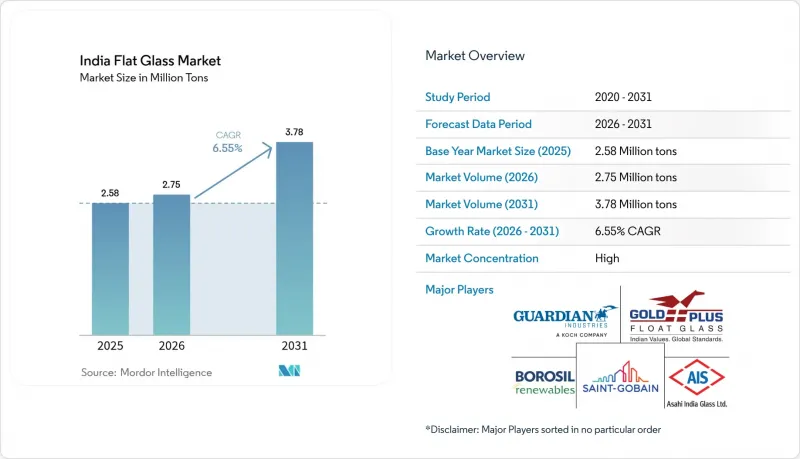
根據 Mordor Intelligence 預測,印度平板玻璃市場預計將從 2025 年的 258 萬噸成長到 2026 年的 275 萬噸,然後在 2031 年達到 378 萬噸,2026 年至 2031 年的複合年成長率為 6.55%。
本報告按產品類型(退火玻璃、鍍膜玻璃、加工玻璃、鏡面玻璃、花紋玻璃)和終端用戶行業(建築、汽車、太陽能玻璃及其他)進行分類。市場預測以噸為單位。
印度平板玻璃市場的趨勢與洞察
城市基礎設施快速發展和智慧城市建設的推進
印度的「智慧城市計畫」已批准8016個項目,總投資額達1.64兆印度盧比,促使公共和私人建築大量採購採用低輻射玻璃、太陽能控制玻璃和夾層玻璃的幕牆,以降低暖通空調負荷。綠色評估的政策要求細化了規範要求,迫使建築師選擇符合認證U值和可見光穿透率標準的玻璃解決方案。國內建築商現在在專案週期的早期階段就競標幕牆組件,這使得玻璃加工商能夠更長期地了解訂單前景,並有助於制定生產力計畫。隨著小規模的城市也效仿智慧城市指南以吸引投資,對認證玻璃的需求正從主要大都會圈。來自歐洲和日本的國際財團合作夥伴正在轉移尖端的幕牆工程技術,鼓勵本地加工商採用先前僅限於高階辦公大樓的三層銀塗層和暖邊間隔條技術。這些最佳實踐的廣泛採用,給傳統的浮式生產線運營商帶來了更大的競爭壓力,導致磁控濺射技術的升級以及塗層工作外包給專業的塗層承包公司。
國家太陽能發電目標正在提升太陽能玻璃的生產能力。
印度的目標是到2030年實現500吉瓦的非石化燃料發電量,其中太陽能發電將佔據最大佔有率,從而對用於太陽能組件的防反射花紋玻璃產生持續需求。對來自中國的進口產品徵收反傾銷稅保護了國內製造商擴大生產規模,使他們能夠將不斷上漲的堿灰成本轉嫁到產品價格上。雙紋理軋延和線上熱解塗層等技術升級已將透光率提高到93%以上,使組件效率與進口玻璃相當。製造商也正在實施錫浴廢熱回收系統,以降低燃料成本並減少範圍1排放。隨著印度製造的組件打入美國和歐洲市場,出口前景日益光明,這些市場要求使用可追溯的低碳玻璃。因此,印度平板玻璃市場將獲得一個高成長的細分市場,從而緩解週期性建築需求的影響。
堿灰和天然氣的價格波動
2024會計年度,印度進口了超過1,000萬噸堿灰,以補充其250萬噸的國內產量。這使得玻璃製造商更容易受到與能源成本和運輸中斷相關的全球價格波動的影響。 2021年,印度國內天然氣價格飆升62%,導致熔爐燃料成本增加,對EBITDA獲利率帶來壓力,尤其是對於能耗超過每噸5吉焦的老式浮法生產線而言。製造商正在透過簽訂堿灰遠期交付或在政策允許的情況下摻入石油焦或爐用燃料油來應對,但所有這些替代方案都需要對燃燒器和排放氣體控制設備進行改造。此外,現貨價格的波動也使新產能專案的預算編制變得更加複雜,導致一些投資者推遲最終的投資決定。由此導致的營運資金需求緊張,在利率居高不下的情況下,增加了借貸需求,給自由現金流帶來壓力,並減緩了待開發區原本有助於緩解國內供不應求。
細分市場分析
2025年,退火玻璃在印度平板玻璃市場仍佔80.05%的佔有率。這主要得益於其在住宅窗戶和對成本要求較高的商業建築中的廣泛應用。此細分市場的規模經濟效益源自於成熟的浮法生產線基礎設施和下游加工工序的簡化。同時,預計到2031年,加工玻璃的複合年成長率將達到7.05%,其在印度平板玻璃市場的佔有率預計將在預測期內顯著成長。這一成長主要受能源法規、建築美學和汽車安全標準等因素的共同驅動,這些因素要求對玻璃進行鋼化、夾層或功能性塗層處理。高階辦公室對雙層玻璃和太陽能控制塗層的日益普及推動了對塗層玻璃的需求,而鏡面玻璃和圖案玻璃則滿足了室內應用和裝飾性外觀的需求。
這項變化將對利潤率趨勢產生策略性影響。加工玻璃的售價通常是退火玻璃出廠價的兩倍,這使得下游加工設備的投資能夠更快地回收成本。目前,一些國內製造商正將其高達45%的浮法玻璃產量分配給自有的強化玻璃和夾層玻璃生產設施,從而獲得綜合附加價值。此外,印度平板玻璃產業正擴大從歐洲公司獲得濺鍍技術的許可,使得本地生產曾經完全依賴進口的低輻射鍍膜成為可能。雖然預計住宅用途對退火玻璃的需求仍將持續,但隨著符合建築規範的窗戶在新房屋建設和維修市場中逐漸普及,其市場佔有率預計將會逐步下降。
其他福利
- Excel格式的市場預測(ME)表
- 3個月的分析師支持
目錄
第1章:引言
- 研究假設和市場定義
- 調查範圍
第2章:調查方法
第3章執行摘要
第4章 市場狀況
- 市場概覽
- 市場促進因素
- 城市基礎設施快速發展和智慧城市建設的推進
- 由於汽車產量增加,對汽車玻璃的需求也隨之增加。
- 根據國家太陽能發電(PV)目標擴大太陽能玻璃產能
- 資料中心建置帶動高性能幕牆玻璃需求成長。
- 透過電子產品PLI(產品許可引進)系統促進特種顯示玻璃的廣泛應用。
- 市場限制因素
- 堿灰和天然氣的價格波動
- 嚴格的排放氣體法規導致合規成本不斷上升
- 各地重型浮法玻璃的進口運費都很高。
- 價值鏈分析
- 波特五力分析
第5章 市場規模與成長預測
- 依產品類型
- 退火玻璃
- 鍍膜玻璃
- 加工玻璃
- 鏡面玻璃
- 花紋玻璃
- 按最終用戶行業分類
- 建築/施工
- 車
- 太陽能玻璃
- 其他
第6章 競爭情勢
- 市場集中度
- 策略趨勢
- 市佔率(%)/排名分析
- 公司簡介
- Asahi India Glass Limited.
- Borosil Renewables
- Emerge Glass
- FUSO
- Gold Plus Group
- Guardian Industries Holdings
- Hindustan National Glass & Industries Limited
- Hi-Tech glass Industries
- Nippon Sheet Glass Co., Ltd
- Saint-Gobain
- SCHOTT
- Sisecam
第7章 市場機會與未來展望
According to Mordor Intelligence, the India flat glass market size is expected to grow from 2.58 million tons in 2025 to 2.75 million tons in 2026 and is forecast to reach 3.78 million tons by 2031 at 6.55% CAGR over 2026-2031.
This report is Segmented by Product Type (Annealed Glass, Coater Glass, Processed Glass, Mirror Glass, Patterned Glass), End-User Industry (Building and Construction, Automotive, Solar Glass, Other End-User Industries). The Market Forecasts are Provided in Terms of Volume (Tons).
India Flat Glass Market Trends and Insights
Urban Infrastructure Boom & Smart Cities Push
India's Smart Cities Mission has approved 8,016 projects worth INR 1.64 trillion, which is translating into large procurement lots for low-emissivity, solar-control, and laminated facades that reduce HVAC load in public and private buildings. Policy mandates for green ratings have expanded specification depth, compelling architects to select glazing solutions with certified U-values and visible-light-transmittance benchmarks. Domestic contractors now tender facade packages earlier in project cycles, giving glass processors longer visibility of order pipelines and supporting capacity planning. As smaller municipalities replicate smart-city guidelines to draw investment, demand for certified glass spreads beyond major metros. International consortium partners from Europe and Japan transfer cutting-edge facade engineering know-how, nudging local processors toward triple-silver coatings and warm-edge spacer technologies that once were confined to premium offices. This diffusion of best practice heightens competitive pressure on legacy float-line operators to upgrade to magnetron sputtering or outsource coating to specialist toll coaters.
National Solar-PV Targets Spurring Solar Glass Capacity
India targets 500 GW of non-fossil power by 2030, of which solar constitutes the largest share, generating durable offtake for anti-reflective patterned glass used in photovoltaic modules. Anti-dumping duties on Chinese imports shield domestic players during scale-up, allowing them to pass through soda-ash cost spikes. Technological upgrades such as dual-textured rolling and online pyrolytic coating boost light transmission above 93%, enabling module efficiencies that rival imported glass. Manufacturers also integrate tin-bath waste-heat recovery to shave fuel costs and lower Scope 1 emissions. Export prospects brighten as Indian modules penetrate U.S. and European markets that require traceable, low-carbon glass inputs. Consequently, the India flat glass market gains a high-growth specialty branch that buffers against cyclicality in construction demand.
Volatile Prices of Soda Ash & Natural Gas
India imported more than 10 million tons of soda ash in FY 2024 to supplement domestic output of 2.5 million tons, exposing glassmakers to global price swings linked to energy costs and shipping disruptions. A 62% jump in domestic natural-gas prices in 2021 raised furnace-fuel costs, eroding EBITDA margins, especially for legacy float lines with specific-energy consumption above 5 GJ per ton. Manufacturers respond by forward-contracting soda-ash deliveries and blending petcoke or furnace oil when policy allows, though each alternative requires burner and emission-control retrofits. Spot gas volatility also complicates new-capacity project budgeting, prompting some investors to delay final investment decisions. The corresponding working-capital strain increases borrowing needs at a time when interest rates are elevated, pressuring free cash flows and slowing greenfield expansions that would otherwise help resolve domestic supply deficits.
Other drivers and restraints analyzed in the detailed report include:
- Data-Centre Construction Driving High-Performance Facade Glass
- PLI Schemes for Electronics Propelling Specialty Display Glass
- Stringent Emission Norms Elevating Compliance Costs
For complete list of drivers and restraints, kindly check the Table Of Contents.
Segment Analysis
Annealed Glass retained an 80.05% India flat glass market share in 2025, anchored by its ubiquitous use in residential windows and cost-sensitive commercial builds. The segment's scale benefits stem from established float-line infrastructure and minimal downstream processing. Yet Processed Glass is set to log a 7.05% CAGR through 2031, ensuring that its slice of the India flat glass market size widens meaningfully over the forecast horizon. Growth stems from the convergence of energy codes, architectural aesthetics, and vehicle-safety norms that require tempering, lamination, or functional coatings. The wider adoption of double-glazed units and solar-control coatings in premium offices drives coated-glass offtake, while mirrored and patterned variants cater to interior applications and decorative facades.
The shift carries strategic implications for margin profiles. Processed-glass realization often doubles the ex-factory price of annealed equivalents, enabling faster return on incremental capex for downstream lines. Several domestic producers now route as much as 45% of float output to their own tempering or lamination facilities, capturing integrated value. The India flat glass industry also observes increased licensing of sputter-coating technology from European firms, unlocking local production of low-E coatings once fully imported. Annealed-glass volumes are expected to persist in mass housing, yet their share gradually declines as code-compliant fenestration becomes mainstream in both new construction and retrofit markets.
Complete Report Scope:
- By Product Type
- Annealed Glass
- Coater Glass
- Processed Glass
- Mirror Glass
- Patterned Glass
- By End-user Industry
- Building and Construction
- Automotive
- Solar Glass
- Other End-user Industries
List of Companies Covered in this Report:
- Asahi India Glass Limited.
- Borosil Renewables
- Emerge Glass
- FUSO
- Gold Plus Group
- Guardian Industries Holdings
- Hindustan National Glass & Industries Limited
- Hi-Tech glass Industries
- Nippon Sheet Glass Co., Ltd
- Saint-Gobain
- SCHOTT
- Sisecam
Additional Benefits:
- The market estimate (ME) sheet in Excel format
- 3 months of analyst support
TABLE OF CONTENTS
1 Introduction
- 1.1 Study Assumptions and Market Definition
- 1.2 Scope of the Study
2 Research Methodology
3 Executive Summary
4 Market Landscape
- 4.1 Market Overview
- 4.2 Market Drivers
- 4.2.1 Urban infrastructure boom and Smart Cities push
- 4.2.2 Automotive glazing demand from rising vehicle production
- 4.2.3 National solar-PV targets spurring solar glass capacity
- 4.2.4 Data-centre construction driving high-performance facade glass
- 4.2.5 PLI schemes for electronics propelling speciality display glass
- 4.3 Market Restraints
- 4.3.1 Volatile prices of soda ash and natural gas
- 4.3.2 Stringent emission norms elevating compliance costs
- 4.3.3 High inbound freight for heavy float glass across regions
- 4.4 Value Chain Analysis
- 4.5 Porter's Five Forces Analysis
- 4.5.1 Bargaining Power of Suppliers
- 4.5.2 Bargaining Power of Buyers
- 4.5.3 Threat of New Entrants
- 4.5.4 Threat of Substitutes
- 4.5.5 Degree of Competition
5 Market Size and Growth Forecasts (Volume)
- 5.1 By Product Type
- 5.1.1 Annealed Glass
- 5.1.2 Coater Glass
- 5.1.3 Processed Glass
- 5.1.4 Mirror Glass
- 5.1.5 Patterned Glass
- 5.2 By End-user Industry
- 5.2.1 Building and Construction
- 5.2.2 Automotive
- 5.2.3 Solar Glass
- 5.2.4 Other End-user Industries
6 Competitive Landscape
- 6.1 Market Concentration
- 6.2 Strategic Moves
- 6.3 Market Share (%)**/Ranking Analysis
- 6.4 Company Profiles (includes Global Level Overview, Market Level Overview, Core Segments, Financials as available, Strategic Information, Market Rank/Share, Products and Services, Recent Developments)
- 6.4.1 Asahi India Glass Limited.
- 6.4.2 Borosil Renewables
- 6.4.3 Emerge Glass
- 6.4.4 FUSO
- 6.4.5 Gold Plus Group
- 6.4.6 Guardian Industries Holdings
- 6.4.7 Hindustan National Glass & Industries Limited
- 6.4.8 Hi-Tech glass Industries
- 6.4.9 Nippon Sheet Glass Co., Ltd
- 6.4.10 Saint-Gobain
- 6.4.11 SCHOTT
- 6.4.12 Sisecam
7 Market Opportunities and Future Outlook
- 7.1 White-space and Unmet-Need Assessment

 中東和非洲平板玻璃市場:市場佔有率分析、行業趨勢和統計數據以及成長預測(2026-2031 年)平板玻璃:市場佔有率分析、產業趨勢與統計、成長預測(2026-2031)
 平板玻璃市場:2026-2032年全球市場預測(依產品類型、鍍膜類型、應用、最終用途及通路分類)
 平板玻璃加工機械市場 - 全球產業規模、佔有率、趨勢、機會、預測:機器類型、終端用戶產業、玻璃類型、自動化程度、地區及競爭格局,2021-2031年
 平板玻璃市場規模、佔有率和趨勢分析報告:按產品、應用、地區和細分市場預測(2026-2033 年)南美洲平板玻璃市場:市場佔有率分析、產業趨勢與統計及成長預測(2026-2031 年)平板玻璃市場-全球產業規模、佔有率、趨勢、機會和預測:按產品類型、技術、終端用戶產業、地區和競爭格局分類,2021-2031年
 平板玻璃市場:按產品、應用和地區分類
 2026年全球平板玻璃市場報告美國平板玻璃:市場佔有率分析、行業趨勢和統計數據、成長預測(2026-2031)