


 |
市場調查報告書
商品編碼
2121955
歐洲智慧製造:市場佔有率分析、產業趨勢與統計及成長預測(2026-2031)Europe Smart Manufacturing - Market Share Analysis, Industry Trends & Statistics, Growth Forecasts (2026 - 2031) |
||||||

※ 本網頁內容可能與最新版本有所差異。詳細情況請與我們聯繫。
根據 Mordor Intelligence 估計,到 2026 年,歐洲智慧製造市場價值將達到 698.7 億美元,高於 2025 年的 623.1 億美元,預計到 2031 年將達到 1,237.8 億美元。
預計從 2026 年到 2031 年,其複合年成長率將達到 12.12%。
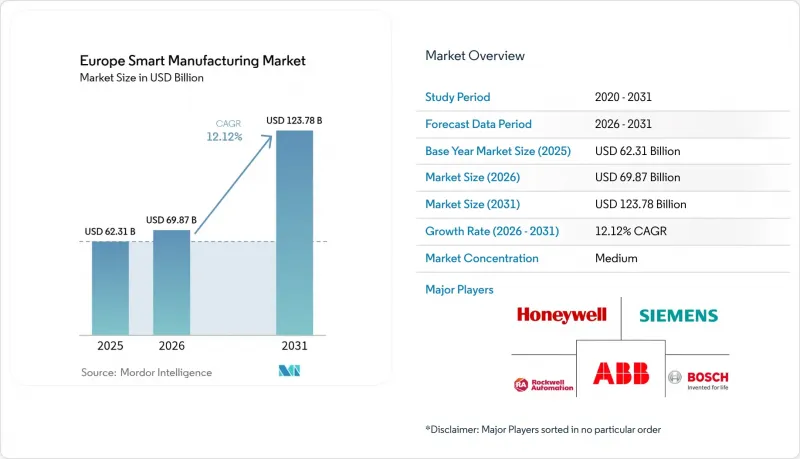
本報告按技術(自動化控制系統、工業機器人等)、組件(硬體、軟體、服務)、終端用戶產業(汽車、航太與國防、化工與石化等)以及國家/地區進行細分。市場規模和預測均以美元計價。
歐洲智慧製造市場的趨勢與洞察
歐盟工業4.0資金籌措計劃
歐洲強勁的資金籌措正為數位轉型調動前所未有的資金。德國的「Manufacturing-X」計畫已撥款1.5億歐元(約1.6億美元)用於建造可互通的工業數據空間,而更廣泛的「InvestAI」架構則正在為整個人工智慧基礎設施建設調動2,000億歐元(約合2130億美元)。隨著中小企業(SME)能夠獲得配套津貼,進入門檻正在降低。在英國的「Made Smarter」試點計畫中,已有2,200萬英鎊(約2,800萬美元)投資於350個技術項目,創造了1,600個新的就業機會。繼公共支出之後,創投也勢頭強勁。例如,在德國,人工智慧驅動的製造業新創公司數量激增67%,AWS、微軟和蘋果等超大規模資料中心業者也承諾進行投資。資本的湧入正在幫助歐洲智慧製造市場確立其作為亞洲契約製造的可靠替代方案的地位,同時也保護了區域技術主權。
人事費用不斷上漲,給工廠自動化帶來了越來越大的壓力。
2024年,歐盟平均每小時人事費用年增5%,達到33.50歐元(35.70美元),進一步拉大了西歐與低工資地區之間的差距。盧森堡的每小時勞動成本最高,達到55.20歐元(58.80美元),這進一步加劇了奢侈品製造商對自動化技術的迫切需求。同時,雇主也面臨嚴重的勞動力短缺問題;在21個國家接受調查的公司中,75%的公司表示難以招募熟練工人。這些相互交織的壓力正將自動化從單純的提高效率的手段轉變為企業生存的必需品,加速了歐洲智慧製造市場向機器人和電腦視覺系統取代重複性工作的轉型。
網路安全和資料主權問題
《網路韌性法案》強制要求根據風險等級進行合規性評估,違規者最高可被處以 1,500 萬歐元(1,600 萬美元)或全球銷售額的 2.5% 作為罰款。 GDPR(一般資料保護規則)和 NIS 2(網路和資訊安全指令第二版)的重疊規定增加了文件編制工作量,尤其對於網路安全團隊有限的中小型企業而言更是如此。對歐盟以外資料傳輸的擔憂減緩了向歐盟以外託管的超大規模平台的過渡,迫使供應商提供主權雲端和邊緣分析設備。這些合規成本延長了引進週期,並減緩了歐洲智慧製造市場的短期成長速度。
細分市場分析
到2025年,工業機器人將佔據歐洲智慧製造市場27.35%的佔有率,這主要得益於汽車組裝自動化和標準化焊接單元的普及。發FANUC)在西班牙的擴張標誌著其正式進軍先前服務不足的南歐叢集,其防爆協作噴塗機器人正在危險環境中開拓應用領域。數位孿生和模擬平台正以16.2%的複合年成長率快速成長,它們將基於物理的模型與人工智慧結合,用於預測資產行為並縮短試運行週期。仿真與製造執行系統(MES)的整合實現了封閉回路型最佳化,使數位孿生成為歐洲智慧製造市場成長最快的驅動力。
隨著工廠向以乙太網路為基礎的現場匯流排轉型,對自動化控制系統(PLC、SCADA、DCS)升級的需求日益成長。人工智慧增強型人機介面(HMI)層,例如Honeywell的Experion Operations Assistant,能夠提供情境化建議並減少警報疲勞。透過Valmet-FactoryPal等收購案例,製造執行系統(MES)的普及速度正在加快,為OEE儀表板增添了指導性洞察。積層製造在備件供應領域保持著獨特的優勢,因為在這些領域,幾何形狀的複雜性遠比大量生產的經濟效益更為重要。該工具集的擴展正在鞏固歐洲智慧製造市場多元化的收入來源。
其他好處:
- Excel格式的市場預測(ME)表
- 3個月的分析師支持
目錄
第1章:引言
- 研究假設和市場定義
- 調查範圍
第2章:調查方法
第3章執行摘要
第4章 市場狀況
- 市場概覽
- 市場促進因素
- 歐盟「工業4.0」資助計劃
- 人事費用上升正在推動工廠自動化。
- 工業物聯網連接的快速普及
- 強制性淨零排放正在加速能源最佳化解決方案的實施。
- 在歐洲中小企業中引入邊緣人工智慧驅動的品質檢測
- 工業5G專用網路的部署
- 市場限制因素
- 網路安全和資料主權問題
- 整合到現有設施所需的資本支出(CAPEX)很高。
- 中東歐(CEE)工廠中分散的傳統機器協議
- 數位孿生領域工程師短缺
- 價值供應鏈分析
- 監管情勢(歐盟數字十年、Gaia-X)
- 科技趨勢(工業物聯網、數位孿生、5G、邊緣人工智慧)
- 波特五力分析
第5章 市場規模與成長預測
- 透過技術
- 自動控制系統(PLC、SCADA、DCS)
- 工業機器人
- 工業IoT平台
- 人機介面(HMI)
- 製造執行系統(MES)
- 產品生命週期管理(PLM)
- 數位孿生與仿真
- 積層製造/3D列印
- 按組件
- 硬體
- 感應器
- 控制器/IPC
- 邊緣運算設備
- 機器視覺系統
- 機器人技術
- 軟體
- SCADA 和 HMIDA
- 分析和人工智慧軟體
- ERP和PLM軟體
- 服務
- 整合與諮詢
- 維護和支援
- 託管服務
- 硬體
- 按最終用戶行業分類
- 車
- 航太/國防
- 化工/石油化工
- 食品/飲料
- 製藥和生物技術
- 金屬和採礦
- 電子和半導體
- 石油和天然氣
- 公共產業和能源
- 國家
- 德國
- 英國
- 法國
- 義大利
- 西班牙
- 俄羅斯
- 荷蘭
- 瑞典
- 波蘭
- 比利時
- 奧地利
- 瑞士
- 挪威
- 芬蘭
第6章 競爭情勢
- 市場集中度
- 策略趨勢
- Market-share Analysis
- 公司簡介
- ABB Ltd
- Siemens AG
- Schneider Electric SE
- Rockwell Automation Inc.
- Honeywell International Inc.
- Emerson Electric Co.
- General Electric Co.
- Robert Bosch GmbH
- FANUC Corporation
- IBM Corporation
- Dassault Systems SE
- SAP SE
- Mitsubishi Electric Corp.
- KUKA AG
- Yokogawa Electric Corp.
- PTC Inc.
- Hexagon AB
- Omron Corp.
- Beckhoff Automation GmbH
- Endress+Hauser AG
第7章 市場機會與未來展望
According to Mordor Intelligence, Europe smart manufacturing market size in 2026 is estimated at USD 69.87 billion, growing from 2025 value of USD 62.31 billion with 2031 projections showing USD 123.78 billion, growing at 12.12% CAGR over 2026-2031.
This report is Segmented by Technology (Automation Control Systems, Industrial Robotics, and More), Component (Hardware, Software, Services), End-User Industry (Automotive, Aerospace and Defense, Chemicals and Petrochemicals, and More), and Country. The Market Sizes and Forecasts are Provided in Terms of Value (USD).
Europe Smart Manufacturing Market Trends and Insights
EU Industry-4.0 Funding Schemes
Robust European funding unlocks unprecedented capital for digital transformation. Germany's Manufacturing-X program supplies EUR 150 million (USD 160 million) to create interoperable industrial data spaces, while the broader InvestAI architecture mobilizes EUR 200 billion (USD 213 billion) across AI infrastructure. SME access to matching grants lowers entry barriers; the UK's Made Smarter pilot has already funnelled GBP 22 million (USD 28 million) into 350 technical projects that generated 1,600 new jobs. Venture momentum follows public outlays, illustrated by Germany's 67% jump in AI-enabled manufacturing start-ups and hyperscaler commitments from AWS, Microsoft, and Apple. These capital flows position the Europe smart manufacturing market as a credible alternative to Asian contract manufacturing while defending regional technology sovereignty.
Rising Labor-Cost Pressure Driving Factory Automation
Average EU hourly labor costs climbed 5% year over year to EUR 33.5 (USD 35.7) in 2024, widening the delta between Western Europe and lower-wage regions. Luxembourg tops the bloc at EUR 55.2 (USD 58.8) per hour, sharpening competitive urgency for automation among premium producers. Employers also confront an acute talent gap: 75% of firms surveyed across 21 countries report difficulty filling skilled roles. These intertwined pressures convert automation from a discretionary efficiency lever into an existential requirement, accelerating replacement of repetitive tasks with robotics and computer-vision systems across the Europe smart manufacturing market.
Cyber-Security and Data-Sovereignty Concerns
The Cyber Resilience Act enforces risk-tiered conformity assessments and may levy penalties up to EUR 15 million (USD 16 million) or 2.5% of global turnover. Overlapping GDPR and NIS 2 rules escalate documentation workloads, especially for SMEs with limited cyber teams. Fear of extraterritorial data transfer slows migration to hyperscale platforms hosted outside the EU, compelling suppliers to offer sovereign clouds or edge-analytics appliances. These compliance costs elongate deployment cycles and temper the near-term growth pace of the Europe smart manufacturing market
Other drivers and restraints analyzed in the detailed report include:
- Rapid Adoption of IIoT Connectivity
- Net-Zero Mandates Accelerating Energy-Optimization Solutions
- High Brown-Field Integration CAPEX
For complete list of drivers and restraints, kindly check the Table Of Contents.
Segment Analysis
Industrial robotics held 27.35% of Europe smart manufacturing market share in 2025, supported by automotive final-assembly automation and standardized welding cells. FANUC's expansion in Spain signals pursuit of underserved Southern European clusters, while its explosion-proof collaborative paint robot opens hazardous-environment applications. Digital twin & simulation platforms are scaling at a 16.2% CAGR, embedding physics-based models alongside AI to forecast asset behaviour and shrink commissioning intervals. Simulation convergence with MES unlocks closed-loop optimisation, positioning digital twins as the fastest lever inside the Europe smart manufacturing market.
Automation control systems (PLC, SCADA, DCS) experience replacement demand as plants migrate to Ethernet-based fieldbuses. AI-augmented HMI layers such as Honeywell's Experion Operations Assistant surface contextual recommendations that cut alarm fatigue. MES penetration quickens through acquisitions like Valmet-FactoryPal, enriching OEE dashboards with prescriptive insights. Additive manufacturing maintains a niche foothold in spare-parts fulfillment, where geometry complexity outweighs volume economics. This broadening toolset cements diversified revenue streams across the Europe smart manufacturing market.
Complete Report Scope:
- By Technology
- Automation Control Systems (PLC, SCADA, DCS)
- Industrial Robotics
- Industrial IoT Platforms
- Human-Machine Interface (HMI)
- Manufacturing Execution System (MES)
- Product Lifecycle Management (PLM)
- Digital Twin and Simulation
- Additive Manufacturing / 3-D Printing
- By Component
- Hardware
- Sensors
- Controllers / IPC
- Edge-Computing Devices
- Machine-Vision Systems
- Robotics
- Software
- SCADA and HMI Software
- Analytics and AI Software
- ERP and PLM Software
- Services
- Integration and Consulting
- Maintenance and Support
- Managed Services
- Hardware
- By End-user Industry
- Automotive
- Aerospace and Defense
- Chemicals and Petrochemicals
- Food and Beverage
- Pharmaceuticals and Biotechnology
- Metals and Mining
- Electronics and Semiconductors
- Oil and Gas
- Utilities and Energy
- By Country
- Germany
- United Kingdom
- France
- Italy
- Spain
- Russia
- Netherlands
- Sweden
- Poland
- Belgium
- Austria
- Switzerland
- Norway
- Finland
List of Companies Covered in this Report:
- ABB Ltd
- Siemens AG
- Schneider Electric SE
- Rockwell Automation Inc.
- Honeywell International Inc.
- Emerson Electric Co.
- General Electric Co.
- Robert Bosch GmbH
- FANUC Corporation
- IBM Corporation
- Dassault Systems SE
- SAP SE
- Mitsubishi Electric Corp.
- KUKA AG
- Yokogawa Electric Corp.
- PTC Inc.
- Hexagon AB
- Omron Corp.
- Beckhoff Automation GmbH
- Endress+Hauser AG
Additional Benefits:
- The market estimate (ME) sheet in Excel format
- 3 months of analyst support
TABLE OF CONTENTS
1 INTRODUCTION
- 1.1 Study Assumptions and Market Definition
- 1.2 Scope of the Study
2 RESEARCH METHODOLOGY
3 EXECUTIVE SUMMARY
4 MARKET LANDSCAPE
- 4.1 Market Overview
- 4.2 Market Drivers
- 4.2.1 EU Industry-4.0 funding schemes
- 4.2.2 Rising labor-cost pressure driving factory automation
- 4.2.3 Rapid adoption of IIoT connectivity
- 4.2.4 Net-zero mandates accelerating energy-optimisation solutions
- 4.2.5 Edge-AI quality-inspection deployment in European SMEs
- 4.2.6 Industrial-grade 5G private-network roll-outs
- 4.3 Market Restraints
- 4.3.1 Cyber-security and data-sovereignty concerns
- 4.3.2 High brown-field integration CAPEX
- 4.3.3 Fragmented legacy machine protocols in CEE plants
- 4.3.4 Scarcity of digital-twin engineering talent
- 4.4 Value / Supply-Chain Analysis
- 4.5 Regulatory Landscape (EU Digital Decade, Gaia-X)
- 4.6 Technological Outlook (IIoT, Digital Twin, 5G, Edge-AI)
- 4.7 Porter's Five Forces Analysis
- 4.7.1 Bargaining Power of Suppliers
- 4.7.2 Bargaining Power of Buyers
- 4.7.3 Threat of New Entrants
- 4.7.4 Threat of Substitutes
- 4.7.5 Competitive Rivalry
5 MARKET SIZE AND GROWTH FORECASTS (VALUE)
- 5.1 By Technology
- 5.1.1 Automation Control Systems (PLC, SCADA, DCS)
- 5.1.2 Industrial Robotics
- 5.1.3 Industrial IoT Platforms
- 5.1.4 Human-Machine Interface (HMI)
- 5.1.5 Manufacturing Execution System (MES)
- 5.1.6 Product Lifecycle Management (PLM)
- 5.1.7 Digital Twin and Simulation
- 5.1.8 Additive Manufacturing / 3-D Printing
- 5.2 By Component
- 5.2.1 Hardware
- 5.2.1.1 Sensors
- 5.2.1.2 Controllers / IPC
- 5.2.1.3 Edge-Computing Devices
- 5.2.1.4 Machine-Vision Systems
- 5.2.1.5 Robotics
- 5.2.2 Software
- 5.2.2.1 SCADA and HMI Software
- 5.2.2.2 Analytics and AI Software
- 5.2.2.3 ERP and PLM Software
- 5.2.3 Services
- 5.2.3.1 Integration and Consulting
- 5.2.3.2 Maintenance and Support
- 5.2.3.3 Managed Services
- 5.2.1 Hardware
- 5.3 By End-user Industry
- 5.3.1 Automotive
- 5.3.2 Aerospace and Defense
- 5.3.3 Chemicals and Petrochemicals
- 5.3.4 Food and Beverage
- 5.3.5 Pharmaceuticals and Biotechnology
- 5.3.6 Metals and Mining
- 5.3.7 Electronics and Semiconductors
- 5.3.8 Oil and Gas
- 5.3.9 Utilities and Energy
- 5.4 By Country
- 5.4.1 Germany
- 5.4.2 United Kingdom
- 5.4.3 France
- 5.4.4 Italy
- 5.4.5 Spain
- 5.4.6 Russia
- 5.4.7 Netherlands
- 5.4.8 Sweden
- 5.4.9 Poland
- 5.4.10 Belgium
- 5.4.11 Austria
- 5.4.12 Switzerland
- 5.4.13 Norway
- 5.4.14 Finland
6 COMPETITIVE LANDSCAPE
- 6.1 Market Concentration
- 6.2 Strategic Moves
- 6.3 Market-share Analysis
- 6.4 Company Profiles (includes Global-level Overview, Market-level Overview, Core Segments, Financials, Strategic Information, Market Rank/Share, Products and Services, Recent Developments)
- 6.4.1 ABB Ltd
- 6.4.2 Siemens AG
- 6.4.3 Schneider Electric SE
- 6.4.4 Rockwell Automation Inc.
- 6.4.5 Honeywell International Inc.
- 6.4.6 Emerson Electric Co.
- 6.4.7 General Electric Co.
- 6.4.8 Robert Bosch GmbH
- 6.4.9 FANUC Corporation
- 6.4.10 IBM Corporation
- 6.4.11 Dassault Systems SE
- 6.4.12 SAP SE
- 6.4.13 Mitsubishi Electric Corp.
- 6.4.14 KUKA AG
- 6.4.15 Yokogawa Electric Corp.
- 6.4.16 PTC Inc.
- 6.4.17 Hexagon AB
- 6.4.18 Omron Corp.
- 6.4.19 Beckhoff Automation GmbH
- 6.4.20 Endress+Hauser AG
7 MARKET OPPORTUNITIES AND FUTURE OUTLOOK
- 7.1 White-space and Unmet-need Assessment

 智慧製造:市場佔有率分析、產業趨勢與統計、成長預測(2026-2031)
 雲端製造市場規模、佔有率和成長分析:按部署模式、服務模式、應用、組織規模、最終用戶產業和地區分類-2026-2033年產業預測雲端製造:市場佔有率分析、產業趨勢與統計、成長預測(2026-2031)亞太地區智慧製造:市場佔有率分析、產業趨勢與統計及成長預測(2026-2031年)
 智慧製造市場:2026-2032年全球市場預測(按組件、技術、類型、模組、組織規模、部署類型、應用和最終用途行業分類)智慧製造平台市場:按組件、部署模式、應用程式和最終用戶產業分類-全球預測,2026-2032年
 全球智慧製造市場:按技術、產業和地區分類-預測至2032年
 智慧製造市場規模、佔有率、趨勢和預測:按組件、技術、最終用途和地區分類,2026-2034 年
 智慧製造平台市場:按平台類型、應用和區域分類
 全球智慧製造平台市場規模、佔有率、趨勢和成長分析報告(2026-2034年)