


 |
市場調查報告書
商品編碼
2117536
雲端製造:市場佔有率分析、產業趨勢與統計、成長預測(2026-2031)Cloud Manufacturing - Market Share Analysis, Industry Trends & Statistics, Growth Forecasts (2026 - 2031) |
||||||

※ 本網頁內容可能與最新版本有所差異。詳細情況請與我們聯繫。
根據 Mordor Intelligence 預測,雲端製造市場預計將在 2025 年達到 366.8 億美元,並在 2026 年至 2031 年以 14.76% 的複合年成長率成長,到 2031 年達到 831.7 億美元。
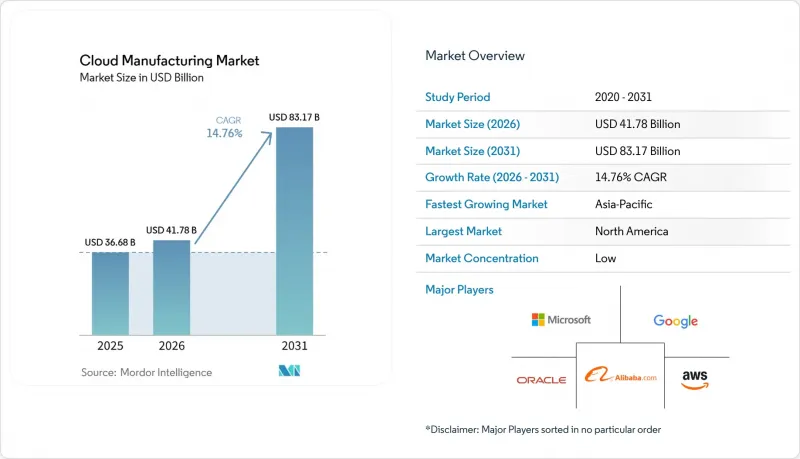
本報告按組件(軟體和服務)、部署模式(公共雲端、私有雲端等)、企業規模(大型企業、中小企業)、最終用戶產業(汽車、航太與國防、電子與半導體、醫療設備與生命科學等)以及地區進行細分。市場預測以價值(美元)表示。
全球雲端製造市場趨勢與洞察
透過智慧工廠和工業4.0實現現代化
智慧工廠專案是雲端製造市場中最明確的需求基礎之一。這是因為僅靠邊緣資料收集無法彌合工廠間在規劃、品質或協作方面的差距。德勤在2025年的報告中指出,88%的美國製造商預計在未來兩年內將繼續或增加對智慧製造的投資,其中先進的生產調度和品管位列升級重點。德國資訊科技協會(Bitkom)在2025年9月發布的數據顯示,71%的德國工業企業已經在使用特定的工業4.0應用。此外,96%的企業認為這項技術對提升國際競爭力至關重要,80%的企業計劃在2025年之前維持或增加相關支出。隨著製造商將生產資料模型、品質系統和供應商工作流程整合到雲端原生平台中,逆轉此決策的成本將更高,從而鞏固其在雲端製造市場的長期地位。日本也進一步加強了這一方向,NEDO分別於2025年5月和2026年2月修訂了《智慧製造建設指南》,以幫助製造商選擇基於雲端的數位化解決方案進行業務轉型。
工業IoT數據的激增以及對可擴展分析的需求
雲端製造市場也受益於互聯工業資產的快速成長。這是因為設備數量的不斷成長帶來了巨大的數據負載,而單一工廠系統難以經濟高效地處理這些數據。畢馬威會計師事務所 (KPMG) 在 2025 年 3 月預測,物聯網連接設備的數量將從 2024 年的 1800 萬台成長到 2026 年的 2240 萬台,這反映出機器連接和數據生成的持續成長。根據中國工業和資訊化部 (MIIT) 的報告,到 2025 年底,將有超過 8,900 萬台設備和裝置連接到主要工業網際網路平台;而 2026 年 1 月公佈的行動計劃的目標是到 2028 年實現超過 1.2 億台工業聯網設備。隨著規模的擴大,對共用資料模型、情境分析和集中處理的需求也日益成長,因為非結構化的原始機器訊號會增加儲存成本,並減慢雲端製造市場的決策週期。日本方面補充說,到 2025 年 6 月,系統整合商和雲端平台供應商將在 26 個主要製造業經濟體的工廠營運夥伴關係中佔比超過 60%,這表明資料情境化正變得與資料收集本身一樣重要。
工業資料的網路安全和隱私風險
網路安全仍然是雲端製造市場面臨的主要結構性限制。這是因為與營運技術 (OT) 相關的安全事件可能導致生產中斷和資料外洩。 2025 年,Verizon 報告稱,在接受調查的製造業安全漏洞中,47% 的漏洞涉及勒索軟體,34% 的攻擊途徑是憑證被盜,而間諜活動也成為該行業漏洞的主要動機。 2025 年 7 月,Google雲端首席資訊安全長 (CISO) 辦公室指出,製造業是最容易受到國家支持的高級持續性威脅 (APT) 攻擊的行業之一,並警告稱,如果資產清單和網路分段不足,混合 OT 和雲端環境將產生新的漏洞。同樣在 2025 年 3 月,畢馬威 (KPMG) 的數據顯示,77% 的組織將勒索軟體列為其 OT 環境中最大的擔憂。這解釋了為什麼製造業雲端市場的雲端遷移決策通常需要長時間的考慮和高昂的安全成本。這不會完全阻止雲端技術的普及,但會提高進入門檻,並使能夠將雲端功能與工業安全措施相結合的供應商獲得優勢。
細分市場分析
到2025年,軟體將佔雲端製造市場規模的37.68%,成為收入最高的組成部分。製造執行和營運管理(MES)應用正成為雲端製造應用的主要切入點,它們將取代老舊的工廠級MES系統,並將現場活動與更廣泛的規劃和合規工作流程連接起來。隨著製造商尋求將財務規劃週期與生產執行數據更直接地連結起來,雲端ERP和生產計畫工具也正在蓬勃發展。 SAP在2026年初透過SAP S/4HANA雲端公用版中的「Joule」發布了AI輔助的生產訂單下達功能,進一步將AI整合到日常製造工作流程中,從而展現了這一發展方向。除了產品生命週期和工程協作工具之外,品質、可追溯性、分析、AI和數位孿生應用正在擴展軟體在雲端製造業的功能,尤其是在需要嚴格版本控制和可審計性的領域。
預計2026年至2031年間,服務市場將以16.62%的複合年成長率成長,成為雲端製造市場中成長最快的細分領域。這一成長反映了將多樣化的OT環境與雲端平台整合所面臨的挑戰,這些平台通常基於較長的更新周期且缺乏通用資料標準。許多製造商需要在最終確定平台選擇之前確定營運模式,因此專案通常從諮詢和流程重整工作開始。實施和整合服務隨後成為專案價值的重要組成部分,尤其是在資料遷移和互連跨越多個舊有系統的多工廠部署中。託管服務也正在蓬勃發展。德勤2025年的一項調查發現,由於招聘困難,65%至70%的美國製造商將其IT、OT和資料科學運營外包,這為提供廣泛服務的供應商提供了長期留住客戶的有力手段。
到2025年,公共雲端將佔據雲端製造市場41.99%的佔有率,並持續維持其最大部署模式的地位。對於製造商而言,公有雲最具吸引力,因為它能夠快速部署、提供可預測的訂閱成本,並定期更新軟體,而無需建立新的內部基礎設施。這對於品質分析、採購計劃和供應商協作等用例尤其重要,因為這些用例對延遲的要求低於即時製程控制。私有雲端在國防、航太和高度監管的生命科學等產業仍然至關重要,因為在這些產業中,資料居住和智慧財產權保護通常比共用環境的成本優勢更為重要。這些部署選項表明,雲端製造市場並非單向發展,製造商正在根據其工作負載的敏感度自訂架構,而不是遵循統一的遷移路徑。
混合雲端預計將在2026年至2031年間以17.34%的複合年成長率成長,成為雲端製造市場中成長最快的部署模式。這種模式更貼近實際工廠的需求,因為可程式邏輯控制器(PLC)、SCADA系統和分散式控制環境仍然需要本地或私有運算資源來實現低延遲運行,而分析和人工智慧訓練則可以受益於可擴展的雲端資源。 2026年1月,奧迪在工業規模上展示了這種模式。其Edge Cloud 4 Production平台以虛擬化的本地雲端架構取代了德國工廠中1000多個工業用電腦 ,同時繼續向集中式管理系統提供分析資料。羅蘭貝格和Aleph Alpha在2025年9月的一份分析報告中也指出,將基於雲端的模型學習與基於邊緣的即時控制相結合,是歐洲製造商建立人工智慧自主性的最可靠途徑。這使得混合方法成為製造商尋求雲端智慧,同時又不犧牲對其生產環境至關重要的本地控制權的現實折衷方案。
區域分析
到2025年,北美將佔據雲端製造市場35.77%的佔有率,並繼續保持其作為最大區域貢獻者的地位。美國之所以引領該地區,是因為主要製造商已在工廠和網路層面全面採用雲端運算。德勤在2025年報告中指出,57%的美國製造商已在這些環境中使用雲端運算。該地區還擁有大量工業軟體、自動化和雲端供應商,能夠支援在複雜的製造網路中進行大規模部署。在雲端製造市場,北美的成長越來越依賴平台的深度利用,包括人工智慧整合、數位孿生和託管服務,而不僅僅是初始遷移。
預計亞太地區在2026年至2031年間將以16.28%的複合年成長率成長,成為雲端製造市場成長最快的區域市場。中國是市場成長的主要驅動力。根據中國工業和資訊化部(工信部)的報告,到2025年底,主要工業網際網路平台將連接超過8,900萬台設備,而2026年1月發布的行動計畫的目標是到2028年連接超過1.2億台設備。這項政策方向正在推動雲端運算的更廣泛應用,因為規模、連接性和平台滲透率不再由單一企業自行決定,而是由國家層級的產業計畫所推動。另一方面,日本是另一個成長要素。日本新能源產業技術綜合開發機構(NEDO)在2025年和2026年修訂了《智慧製造建設指南》,以協助製造商選擇基於雲端的解決方案進行業務轉型。因此,在全部區域,雲端製造市場受到國家主導的產業政策以及電子、半導體和出口主導生產系統的營運需求的雙重影響。
歐洲仍是雲端製造市場第二大區域,其中德國尤為突出,是該領域的活動中心。德國資訊科技協會(Bitkom)在2025年9月發布的報告顯示,71%的德國製造業已經在使用特定的「工業4.0」應用,96%的企業認為這些技術對於提升國際競爭力至關重要,80%的企業計劃在2025年前維持或擴大相關支出。與其他許多地區相比,數據主權是歐洲市場需求的更強勁驅動力。 T-Systems在2026年2月指出,由於在合規平台上部署方面存在尚未解決的問題,近70%的人工智慧驅動型製造舉措仍處於試點階段。南美、中東和非洲在雲端製造市場的規模仍然較小,但正逐步受益於更廣泛的工業數位化專案和不斷擴展的雲端基礎設施。
其他好處:
- Excel格式的市場預測(ME)表
- 3個月的分析師支持
目錄
第1章:引言
- 研究假設和市場定義
- 調查範圍
第2章:調查方法
第3章執行摘要
第4章 市場狀況
- 市場概覽
- 市場促進因素
- 透過智慧工廠和工業4.0實現現代化
- 工業IoT數據的激增以及對可擴展分析的需求
- 需要了解跨多個地點的供應鏈情況以及生產調整。
- 降低了 SaaS 的初始實施成本,從而提高了中小企業的採用率。
- 主權雲和邊緣雲端架構正在擴大受監管工廠的雲端使用量。
- 對產品護照和碳溯源的需求正在推動數位線程的採用。
- 市場限制因素
- 與網路安全和工業資料隱私相關的風險
- 舊有系統中OT-IT整合的複雜性
- 資料主權相關法規阻礙了跨境雲端運算的發展。
- 人工智慧工作負載成本不斷上升和數據管道管治不善正在降低投資回報率。
- 產業價值鏈分析
- 宏觀經濟因素對市場的影響
- 監理情勢
- 技術展望
- 波特五力分析
第5章 市場規模與成長預測
- 按組件
- 軟體
- 製造執行和營運管理軟體
- 雲端ERP和生產計畫軟體
- 產品生命週期與工程協作軟體
- 用於品質、可追溯性和合規性的軟體
- 用於分析、人工智慧和數位孿生的軟體
- 服務
- 諮詢和流程重組服務
- 實施和整合服務
- 託管服務
- 支援和維護服務
- 培訓和變革管理服務
- 軟體
- 按部署模式
- 公共雲端
- 私有雲端
- 混合雲端
- 按公司規模
- 大公司
- 小型企業
- 按最終用戶行業分類
- 車
- 航太/國防
- 電子和半導體
- 工業機械和設備
- 醫療設備與生命科學
- 消費品、食品和飲料
- 化學與材料
- 能源公用事業
- 其他終端用戶產業
- 按地區
- 北美洲
- 美國
- 加拿大
- 墨西哥
- 南美洲
- 巴西
- 阿根廷
- 其他南美國家
- 歐洲
- 德國
- 英國
- 法國
- 義大利
- 其他歐洲國家
- 亞太地區
- 中國
- 日本
- 印度
- 韓國
- 其他亞太國家
- 中東和非洲
- 沙烏地阿拉伯
- 阿拉伯聯合大公國
- 土耳其
- 南非
- 埃及
- 其他中東和非洲國家
- 北美洲
第6章 競爭情勢
- 市場集中度
- 策略趨勢
- 市佔率分析
- 公司簡介
- Microsoft Corporation
- SAP SE
- Oracle Corporation
- Siemens Aktiengesellschaft
- Amazon.com, Inc.
- Google LLC
- International Business Machines Corporation
- PTC Inc.
- Dassault Systemes SE
- Rockwell Automation, Inc.
- Autodesk, Inc.
- ABB Ltd
- Cisco Systems, Inc.
- Hewlett Packard Enterprise Company
- Epicor Software Corporation
- Infor Inc.
- IFS AB
- Tata Consultancy Services Limited
- Hitachi, Ltd.
- Fujitsu Limited
- Tulip Interfaces, Inc.
第7章 市場機會與未來展望
According to Mordor Intelligence, the cloud manufacturing market size stood at USD 36.68 billion in 2025 and is forecast to reach USD 83.17 billion by 2031, at a CAGR of 14.76% from 2026 to 2031.
This report is Segmented by Component (Software, and Services), Deployment Model (Public Cloud, Private Cloud, and More), Enterprise Size (Large Enterprises, and Small and Medium-Sized Enterprises), End-User Industry (Automotive, Aerospace and Defense, Electronics and Semiconductor, Medical Devices and Life Sciences, and More), and Geography. The Market Forecasts are Provided in Terms of Value (USD).
Global Cloud Manufacturing Market Trends and Insights
Smart Factory And Industry 4.0 Modernization
Smart factory programs are creating one of the clearest demand foundations for the cloud manufacturing market because edge data collection alone does not solve planning, quality, or coordination gaps across plants. Deloitte reported in 2025 that 88% of U.S. manufacturers expected smart manufacturing investment to continue or increase over the following 2 years, with advanced production scheduling and quality management ranking among the main upgrade priorities. Bitkom found in September 2025 that 71% of German industrial companies already used concrete Industry 4.0 applications, while 96% viewed the technology as essential for international competitiveness, and 80% maintained or increased spending plans through 2025. Once manufacturers embed production data models, quality schemas, and supplier workflows into a cloud-native platform, the cost of reversing that decision becomes high, which strengthens long-term retention in the cloud manufacturing market. Japan also reinforced this direction when NEDO updated its Smart Manufacturing Construction Guidelines in May 2025 and again in February 2026 to help manufacturers choose cloud-based digital solutions for operational transformation.
Industrial IoT Data Proliferation And Need For Scalable Analytics
The cloud manufacturing market is also gaining from the rapid increase in connected industrial assets, because growing device volumes create data loads that are difficult to process economically in isolated plant systems. KPMG stated in March 2025 that IoT-connected devices were projected to reach 22.4 million units in 2026, up from 18 million in 2024, which reflects a sustained rise in machine connectivity and data generation. China's MIIT reported that key industrial internet platforms had connected more than 89 million devices and equipment sets by the end of 2025, and its January 2026 action plan targeted more than 120 million connected industrial devices by 2028. That scale increases the need for shared data models, contextual analytics, and centralized processing, because raw machine signals without structure raise storage costs and slow decision cycles in the cloud manufacturing market Japan added in June 2025 that system integrators and cloud platform vendors accounted for more than 60% of factory operations partnerships across 26 major manufacturing economies, showing that data contextualization has become as important as data collection itself.
Cybersecurity and Industrial Data Privacy Risks
Cybersecurity remains the main structural drag on the cloud manufacturing market because OT-linked incidents can interrupt production as well as compromise data. Verizon reported in 2025 that ransomware appeared in 47% of manufacturing breaches reviewed, while stolen credentials accounted for 34% of attack vectors, and espionage rose sharply as a breach motive in the sector. Google Cloud's Office of the CISO stated in July 2025 that manufacturing is among the sectors most targeted by state-sponsored advanced persistent threats, and it warned that hybrid OT-cloud environments create new exposure if asset inventories and network segmentation are weak. KPMG also found in March 2025 that 77% of organizations viewed ransomware as the biggest concern in the OT environment, which helps explain why cloud migration decisions in the cloud manufacturing market often involve longer reviews and higher security spending. This does not stop adoption, but it raises the threshold for deployment and favors vendors that can combine cloud capability with industrial security controls.
Other drivers and restraints analyzed in the detailed report include:
- Multi-Site Supply Chain Visibility And Production Orchestration Needs
- Small And Medium-Sized Enterprise Adoption Through Lower Upfront SaaS Costs
- Legacy OT-IT Integration Complexity
For complete list of drivers and restraints, kindly check the Table Of Contents.
Segment Analysis
Software accounted for 37.68% of the cloud manufacturing market size in 2025, which made it the largest component by revenue. Manufacturing execution and operations management applications formed the main entry point because they replace aging plant-level MES installations and connect shop-floor activity with broader planning and compliance workflows. Cloud ERP and production planning tools are also gaining ground as manufacturers try to link financial planning cycles more directly with production execution data. SAP showed this direction in early 2026 when it launched AI-assisted production order release capabilities through Joule in SAP S/4HANA Cloud Public Edition, which brings AI deeper into routine manufacturing workflows. Product lifecycle and engineering collaboration tools, along with quality, traceability, analytics, AI, and digital twin applications, are broadening the functional role of software in the cloud manufacturing industry, especially in sectors that need stricter version control and auditability.
Services are projected to grow at a 16.62% CAGR from 2026 to 2031, making them the fastest-growing component in the cloud manufacturing market. The growth reflects how difficult it is to align cloud platforms with diverse OT estates that were built over long replacement cycles and often lack common data standards. Consulting and process redesign work usually starts the engagement because many manufacturers need operating-model decisions before they can finalize platform selection. Implementation and integration services then capture large project value, especially in multi-plant rollouts where data migration and interconnection span several legacy systems. Managed services are also gaining traction because Deloitte found in 2025 that 65-70% of U.S. manufacturers outsource roles in IT, OT, and data science due to hiring challenges, which gives vendors with service depth a stronger way to retain customers over time.
Public cloud held 41.99% of the cloud manufacturing market size in 2025, which kept it as the largest deployment model. Its appeal remains strongest in workloads where manufacturers want quick deployment, predictable subscription costs, and regular software updates without new internal infrastructure. That has been especially relevant for quality analytics, procurement planning, and supplier collaboration use cases where latency demands are lower than in real-time process control. Private cloud remains important in sectors such as defense, aerospace, and regulated life sciences, where data residency and intellectual property protection often outweigh the cost advantages of shared environments. These deployment choices show that the cloud manufacturing market is not moving in a single direction, because manufacturers are matching architecture to workload sensitivity rather than following a uniform migration path.
Hybrid cloud is projected to expand at a 17.34% CAGR from 2026 to 2031, making it the fastest-growing deployment model in the cloud manufacturing market. The model fits actual factory needs more closely because programmable logic controllers, SCADA, and distributed control environments still require local or private compute for low-latency operations, while analytics and AI training benefit from scalable cloud resources. Audi illustrated this model at industrial scale in January 2026 when its Edge Cloud 4 Production platform replaced more than 1,000 industrial PCs in German plants with a virtualized local cloud architecture that still fed analytics into centralized systems. A September 2025 analysis by Roland Berger and Aleph Alpha also argued that cloud-based model training combined with edge-based real-time control offered the most credible AI sovereignty setup for European manufacturers. That makes hybrid the practical middle ground for manufacturers that want cloud-level intelligence without giving up local control of production-critical environments.
Complete Report Scope:
- By Component
- Software
- Manufacturing Execution and Operations Management Software
- Cloud ERP and Production Planning Software
- Product Lifecycle and Engineering Collaboration Software
- Quality, Traceability and Compliance Software
- Analytics, AI and Digital Twin Software
- Services
- Consulting and Process Redesign Services
- Implementation and Integration Services
- Managed Services
- Support and Maintenance Services
- Training and Change Management Services
- Software
- By Deployment model
- Public cloud
- Private cloud
- Hybrid cloud
- By Enterprise Size
- Large enterprises
- Small and medium-sized enterprises
- By End-User Industry
- Automotive
- Aerospace and Defense
- Electronics and Semiconductor
- Industrial Machinery and Equipment
- Medical Devices and Life Sciences
- Consumer Goods and Food and Beverage
- Chemicals and Materials
- Energy and Utilities
- Other End-User Industries
- By Geography
- North America
- United States
- Canada
- Mexico
- South America
- Brazil
- Argentina
- Rest of South America
- Europe
- Germany
- United Kingdom
- France
- Italy
- Rest of Europe
- Asia-Pacific
- China
- Japan
- India
- South Korea
- Rest of Asia-Pacific
- Middle East and Africa
- Saudi Arabia
- United Arab Emirates
- Turkey
- South Africa
- Egypt
- Rest of Middle East and Africa
- North America
Geography Analysis
North America held 35.77% of the cloud manufacturing market share in 2025, which kept it as the largest regional contributor. The United States led the region because large manufacturers had already built meaningful cloud adoption at the facility and network level, and Deloitte reported in 2025 that 57% of U.S. manufacturers used cloud computing in those settings. The region also benefits from a dense base of industrial software, automation, and cloud vendors that can support large-scale deployments across complex manufacturing networks. In the cloud manufacturing market, North American growth is increasingly tied to deeper platform use, including AI integration, digital twins, and managed services, rather than first-time migration alone.
Asia-Pacific is projected to expand at a 16.28% CAGR from 2026 to 2031, making it the fastest-growing regional segment in the cloud manufacturing market. China is the main volume engine because MIIT reported that key industrial internet platforms had connected more than 89 million devices by the end of 2025, and the January 2026 action plan targeted more than 120 million connected devices by 2028. That policy direction supports broader cloud adoption because scale, connectivity, and platform penetration are now being pushed through national industrial programs rather than left to isolated enterprise decisions. Japan adds a different layer of growth because NEDO updated its Smart Manufacturing Construction Guidelines in 2025 and 2026 to help manufacturers choose cloud-based solutions for operational transformation. Across Asia-Pacific, the cloud manufacturing market is therefore being shaped by both state-backed industrial policy and the operational demands of electronics, semiconductor, and export-led production systems.
Europe remained the second-largest region in the cloud manufacturing market, with Germany as the clearest center of activity. Bitkom reported in September 2025 that 71% of German industrial firms already used concrete Industry 4.0 applications, 96% saw these technologies as essential for international competitiveness, and 80% maintained or increased related spending plans through 2025. Data sovereignty is shaping demand more strongly in Europe than in many other regions, and T-Systems said in February 2026 that nearly 70% of AI manufacturing initiatives had remained in pilot stages because deployment on compliant platforms was unresolved. South America, the Middle East and Africa remain smaller in the cloud manufacturing market, but they are gradually benefiting from wider industrial digitalization programs and the expansion of cloud infrastructure footprints.
- Microsoft Corporation
- SAP SE
- Oracle Corporation
- Siemens Aktiengesellschaft
- Amazon.com, Inc.
- Google LLC
- International Business Machines Corporation
- PTC Inc.
- Dassault Systemes SE
- Rockwell Automation, Inc.
- Autodesk, Inc.
- ABB Ltd
- Cisco Systems, Inc.
- Hewlett Packard Enterprise Company
- Epicor Software Corporation
- Infor Inc.
- IFS AB
- Tata Consultancy Services Limited
- Hitachi, Ltd.
- Fujitsu Limited
- Tulip Interfaces, Inc.
Additional Benefits:
- The market estimate (ME) sheet in Excel format
- 3 months of analyst support
TABLE OF CONTENTS
1 INTRODUCTION
- 1.1 Study Assumptions and Market Definition
- 1.2 Scope of the Study
2 RESEARCH METHODOLOGY
3 EXECUTIVE SUMMARY
4 MARKET LANDSCAPE
- 4.1 Market Overview
- 4.2 Market Drivers
- 4.2.1 Smart Factory and Industry 4.0 Modernization
- 4.2.2 Industrial IoT Data Proliferation and Need for Scalable Analytics
- 4.2.3 Multi-Site Supply Chain Visibility and Production Orchestration Needs
- 4.2.4 Small and Medium-Sized Enterprise Adoption Through Lower Upfront SaaS Costs
- 4.2.5 Sovereign and Edge-Cloud Architectures Expanding Cloud Use in Regulated Plants
- 4.2.6 Product Passport and Carbon Traceability Demands Strengthening Digital Thread Adoption
- 4.3 Market Restraints
- 4.3.1 Cybersecurity and Industrial Data Privacy Risks
- 4.3.2 Legacy OT-IT Integration Complexity
- 4.3.3 Data Sovereignty Rules Fragmenting Cross-Border Cloud Manufacturing Rollouts
- 4.3.4 AI Workload Cost Inflation and Poor Data Pipeline Governance Eroding ROI
- 4.4 Industry Value Chain Analysis
- 4.5 Impact of Macroeconomic Factors on the Market
- 4.6 Regulatory Landscape
- 4.7 Technological Outlook
- 4.8 Porter's Five Forces Analysis
- 4.8.1 Threat of New Entrants
- 4.8.2 Bargaining Power of Suppliers
- 4.8.3 Bargaining Power of Buyers
- 4.8.4 Threat of Substitutes
- 4.8.5 Competitive Rivalry
5 MARKET SIZE AND GROWTH FORECASTS (VALUE)
- 5.1 By Component
- 5.1.1 Software
- 5.1.1.1 Manufacturing Execution and Operations Management Software
- 5.1.1.2 Cloud ERP and Production Planning Software
- 5.1.1.3 Product Lifecycle and Engineering Collaboration Software
- 5.1.1.4 Quality, Traceability and Compliance Software
- 5.1.1.5 Analytics, AI and Digital Twin Software
- 5.1.2 Services
- 5.1.2.1 Consulting and Process Redesign Services
- 5.1.2.2 Implementation and Integration Services
- 5.1.2.3 Managed Services
- 5.1.2.4 Support and Maintenance Services
- 5.1.2.5 Training and Change Management Services
- 5.1.1 Software
- 5.2 By Deployment model
- 5.2.1 Public cloud
- 5.2.2 Private cloud
- 5.2.3 Hybrid cloud
- 5.3 By Enterprise Size
- 5.3.1 Large enterprises
- 5.3.2 Small and medium-sized enterprises
- 5.4 By End-User Industry
- 5.4.1 Automotive
- 5.4.2 Aerospace and Defense
- 5.4.3 Electronics and Semiconductor
- 5.4.4 Industrial Machinery and Equipment
- 5.4.5 Medical Devices and Life Sciences
- 5.4.6 Consumer Goods and Food and Beverage
- 5.4.7 Chemicals and Materials
- 5.4.8 Energy and Utilities
- 5.4.9 Other End-User Industries
- 5.5 By Geography
- 5.5.1 North America
- 5.5.1.1 United States
- 5.5.1.2 Canada
- 5.5.1.3 Mexico
- 5.5.2 South America
- 5.5.2.1 Brazil
- 5.5.2.2 Argentina
- 5.5.2.3 Rest of South America
- 5.5.3 Europe
- 5.5.3.1 Germany
- 5.5.3.2 United Kingdom
- 5.5.3.3 France
- 5.5.3.4 Italy
- 5.5.3.5 Rest of Europe
- 5.5.4 Asia-Pacific
- 5.5.4.1 China
- 5.5.4.2 Japan
- 5.5.4.3 India
- 5.5.4.4 South Korea
- 5.5.4.5 Rest of Asia-Pacific
- 5.5.5 Middle East and Africa
- 5.5.5.1 Saudi Arabia
- 5.5.5.2 United Arab Emirates
- 5.5.5.3 Turkey
- 5.5.5.4 South Africa
- 5.5.5.5 Egypt
- 5.5.5.6 Rest of Middle East and Africa
- 5.5.1 North America
6 COMPETITIVE LANDSCAPE
- 6.1 Market Concentration
- 6.2 Strategic Moves
- 6.3 Market Share Analysis
- 6.4 Company Profiles (includes Global Level Overview, Market Level Overview, Core Segments, Financials as available, Strategic Information, Market Rank/Share, Products and Services, Recent Developments)
- 6.4.1 Microsoft Corporation
- 6.4.2 SAP SE
- 6.4.3 Oracle Corporation
- 6.4.4 Siemens Aktiengesellschaft
- 6.4.5 Amazon.com, Inc.
- 6.4.6 Google LLC
- 6.4.7 International Business Machines Corporation
- 6.4.8 PTC Inc.
- 6.4.9 Dassault Systemes SE
- 6.4.10 Rockwell Automation, Inc.
- 6.4.11 Autodesk, Inc.
- 6.4.12 ABB Ltd
- 6.4.13 Cisco Systems, Inc.
- 6.4.14 Hewlett Packard Enterprise Company
- 6.4.15 Epicor Software Corporation
- 6.4.16 Infor Inc.
- 6.4.17 IFS AB
- 6.4.18 Tata Consultancy Services Limited
- 6.4.19 Hitachi, Ltd.
- 6.4.20 Fujitsu Limited
- 6.4.21 Tulip Interfaces, Inc.
7 MARKET OPPORTUNITIES AND FUTURE OUTLOOK
- 7.1 White-Space and Unmet-Need Assessment

 歐洲智慧製造:市場佔有率分析、產業趨勢與統計及成長預測(2026-2031)智慧製造:市場佔有率分析、產業趨勢與統計、成長預測(2026-2031)
 雲端製造市場規模、佔有率和成長分析:按部署模式、服務模式、應用、組織規模、最終用戶產業和地區分類-2026-2033年產業預測亞太地區智慧製造:市場佔有率分析、產業趨勢與統計及成長預測(2026-2031年)
 智慧製造市場:2026-2032年全球市場預測(按組件、技術、類型、模組、組織規模、部署類型、應用和最終用途行業分類)智慧製造平台市場:按組件、部署模式、應用程式和最終用戶產業分類-全球預測,2026-2032年
 全球智慧製造市場:按技術、產業和地區分類-預測至2032年
 智慧製造市場規模、佔有率、趨勢和預測:按組件、技術、最終用途和地區分類,2026-2034 年
 智慧製造平台市場:按平台類型、應用和區域分類
 全球智慧製造平台市場規模、佔有率、趨勢和成長分析報告(2026-2034年)