


 |
市場調查報告書
商品編碼
2121854
細菌生物農藥:市場佔有率分析、產業趨勢與統計、成長預測(2026-2031)Bacterial Biopesticides - Market Share Analysis, Industry Trends & Statistics, Growth Forecasts (2026 - 2031) |
||||||

※ 本網頁內容可能與最新版本有所差異。詳細情況請與我們聯繫。
根據 Mordor Intelligence 預測,細菌生物農藥的市場規模預計將從 2025 年的 27.5 億美元成長到 2026 年的 31.5 億美元,並將從 2026 年到 2031 年以 14.70% 的複合年成長率成長,到 2031 億美元。
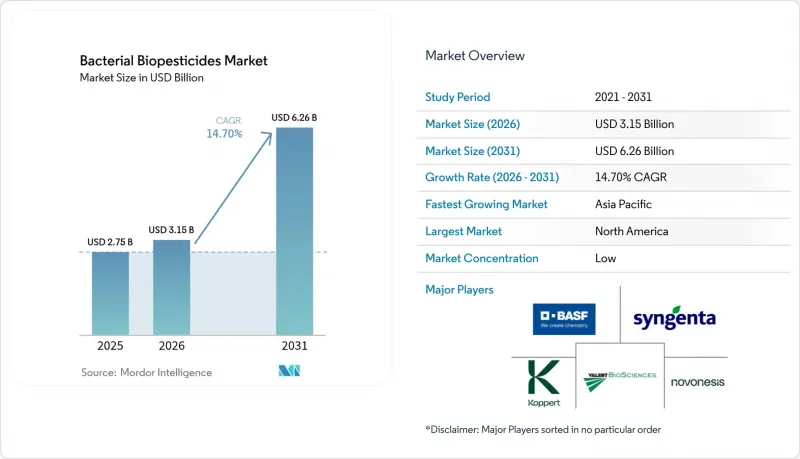
本報告按產品類型(蘇力菌、枯草芽孢桿菌、螢光假單胞菌及其他)、施用方法(葉面噴布、種子處理及其他)、作物類型(穀類、油籽、豆類及其他)和地區(北美、歐洲、亞太、南美、非洲)進行細分。市場預測以美元計價。
全球細菌生物農藥市場趨勢及洞察
監管和政策支持
歐洲生物農藥的核准流程已從九年縮短至約三年,清理了超過100種未處理的積壓申請。歐盟委員會計劃於2025年實施新的歐盟法規,並在第四季最佳化生物農藥的核准流程。 2026年的《生物技術法案》將著重填補當前的監管空白。巴西也取得了類似的進展,包括批准了一種源自去活化伯克氏菌的生物農藥產品。美國環保署(EPA)正在清理根據《聯邦殺蟲劑、殺菌劑和滅鼠劑法案》(FIFRA)積壓的申請。這些監管變化將擴大註冊機會,降低合規成本,並使中小企業能夠進入細菌生物農藥市場。
人們越來越意識到傳統農藥的有害影響
研究表明,合成農藥造成的生物多樣性喪失和土壤劣化正在影響高階零售管道的購買決策。麻省理工學院2025年的研究顯示,全球31%的農業土壤面臨農藥污染的高風險。北美和歐洲的零售商正在實施嚴格的殘留標準,並優先考慮零殘留生物來源產品。隨著生產者適應這些要求,細菌製劑已從單純的有機農業解決方案發展成為綜合蟲害管理(IPM)方案的重要組成部分。這種轉變正在推動細菌生物農藥市場的成長,尤其適用於收穫間隔期較短的作物。
冷鏈物流限制了生物來源農藥的保存期限。
由於孢子製劑通常在高於 25 度C的溫度下失去活性,因此需要冷藏運輸和冷藏保管,這推高了最終成本。在赤道市場,由於小規模分銷網路中溫控儲存設施稀缺,這項挑戰尤其嚴峻。雖然新的包封技術正在提高室溫下的細胞活性並緩解分銷限制,但擴大生產規模和獲得監管部門批准需要多個生長季。這些物流限制阻礙了市場滲透,並削弱了細菌生物農藥與保存期限更長、儲存要求更低的化學農藥之間的競爭。
細分市場分析
預計到2025年,Bt將佔銷售額的73.60%,繼續保持其在細菌生物農藥市場的主導地位。其市場主導地位歸功於其對鱗翅目幼蟲的靶向毒性、廣泛的有機認證以及全球監管機構的批准。由於新型包封技術的出現,提高了Bt產品在高紫外線(UV)條件下的田間持久性,預計Bt產品的市場規模將進一步擴大。 2024年的研究證實,Bt毒素對鱗翅目、甲蟲、半翅目、雙翅目和線蟲害蟲均有效。
枯草桿菌(Bacillus subtilis)尤其在高價值園藝領域展現出巨大的成長潛力,年複合成長率高達16.50%,這得益於其兼具病害控制和促進植物生長的雙重優勢。螢光假單胞菌(Pseudomonas fluorescens)已確立其在控制土壤傳播病原菌方面的作用,而沙雷氏菌屬(Serratia)和鏈黴菌屬(Streptomyces)的菌種因其幾丁質酶活性和產生抗生素代謝物的能力而備受關注,並有望應用於特定領域。
區域分析
北美將繼續佔據主導地位,預計2025年將佔全球銷售額的37.50%。在美國,大規模玉米和大豆種植中廣泛採用細菌製劑是推動市場規模成長的主要因素。在加拿大,溫室叢集透過使用與水耕施肥和灌溉系統相容的液體接種劑,正在提升當地需求。 2023年,加拿大920家商業溫室蔬菜種植設施共生產了802,163噸蔬菜,比2022年增加了7%。
亞太地區呈現最強勁的成長勢頭,預計2031年年複合成長率(CAGR)將達到17.40%。中國的「五年生物防治規劃」和印度的生物投入補貼計畫正在推動國內生產和應用。日本和新加坡的垂直農業企業為專為可控環境農業開發的液體製劑提供了成熟的市場。
儘管歐洲對生物農藥仍實施嚴格的監管,但近期監管政策的調整加速了其應用。歐盟委員會的《2025快速通道法規》縮短了申請審查時間,並使其與北美標準接軌。這將有助於更多產品註冊,並鼓勵製造商在歐盟範圍內擴大產品標籤範圍。斯堪的斯堪地那維亞學校膳食的公共採購政策以及德國「從農場到餐桌」計劃中農藥減量目標,都推動了對生物農藥的需求成長,尤其是含有蘇雲金芽孢桿菌(Bt)和枯草芽孢桿菌(B. subtilis)的葉面噴布產品。東歐穀物生產商也開始測試基於芽孢桿菌的種子處理方法,以符合出口市場更嚴格的殘留限量要求,其應用範圍已擴展到傳統的高價值園藝領域之外。
其他好處
- Excel格式的市場預測(ME)表
- 3個月的分析師支持
目錄
第1章:引言
- 研究假設和市場定義
- 調查範圍
第2章:調查方法
第3章執行摘要
第4章 市場動態
- 市場概覽
- 市場促進因素
- 監管和政策支持
- 人們越來越意識到傳統農藥的有害影響
- 在無殘留農產品需求的推動下,Bt解決方案
- 可控環境農業的擴張帶動了對液態細菌製劑需求的成長。
- 擴大綜合蟲害管理(IPM)策略的應用
- 製劑和給藥系統的技術進步
- 市場限制因素
- 冷鏈物流限制了生物來源農藥的保存期限。
- 生產和配方方面的挑戰
- 人們普遍認為其見效緩慢,導致農場採用率下降。
- 它比傳統殺蟲劑更貴。
- 波特五力分析
第5章 市場區隔
- 依產品類型
- 蘇力菌
- 枯草桿菌
- 螢光假單胞菌
- 其他
- 透過應用方法
- 葉面噴布
- 種子處理
- 土壤處理
- 後處理
- 按作物類型
- 水果和蔬菜
- 穀類和穀類食品
- 油籽/豆類
- 草坪和觀賞植物
- 種植作物
- 按地區
- 北美洲
- 美國
- 加拿大
- 墨西哥
- 其他北美國家
- 南美洲
- 巴西
- 阿根廷
- 智利
- 其他南美國家
- 歐洲
- 德國
- 法國
- 英國
- 西班牙
- 義大利
- 其他歐洲國家
- 非洲
- 南非
- 埃及
- 其他非洲國家
- 亞太地區
- 中國
- 印度
- 日本
- 韓國
- 澳洲
- 其他亞太國家
- 北美洲
第6章 競爭情勢
- 策略趨勢
- 市佔率分析
- 公司簡介
- Certis Biologicals
- Valent BioSciences
- Bayer CropScience AG
- Syngenta AG
- Corteva Agriscience
- BASF SE
- UPL Limited
- FMC Corporation
- Nufarm Limited
- Koppert Biological Systems
- Novonesis
第7章 市場機會與未來趨勢
According to Mordor Intelligence, the bacterial biopesticides market size is expected to grow from USD 2.75 billion in 2025 to USD 3.15 billion in 2026 and is forecast to reach USD 6.26 billion by 2031 at 14.70% CAGR over 2026-2031.
This report is Segmented by Product Type (Bacillus Thuringiensis, Bacillus Subtilis, Pseudomonas Fluorescens, and Other Types), Mode of Application (Seed Treatment, Foliar Spray, and More ), Crop Type (Grains and Cereals, Oilseeds and Pulses, and More), and Geography (North America, Europe, Asia-Pacific, South America, and Africa). The Market Forecasts are Provided in Terms of Value (USD).
Global Bacterial Biopesticides Market Trends and Insights
Regulatory and Policy Support
The European approval process for biopesticides has reduced from nine years to approximately three years, addressing a backlog of over 100 pending substances. The European Commission intends to implement new EU regulations in 2025 to optimize biopesticide approval processes by Q4. The 2026 Biotech Act will focus on filling current regulatory gaps. Brazil has demonstrated similar progress by approving bio-insecticidal products derived from inactivated Burkholderia cells. The United States Environmental Protection Agency (EPA) is reducing application backlogs under FIFRA (Federal Insecticide, Fungicide, and Rodenticide Act). These regulatory changes expand registration opportunities, reduce compliance costs, and enable smaller companies to enter the bacterial biopesticides market.
Rising Awareness of the Harms of Conventional Pesticides
Research demonstrating biodiversity loss and soil degradation from synthetic pesticides influences purchasing decisions in premium retail channels. A 2025 Massachusetts Institute of Technology study revealed that 31% of global agricultural soils faced high risks from pesticide contamination. North American and European retailers implement strict residue limits, favoring zero-residue biological products. As growers adapt to these requirements, bacterial agents have evolved from organic-only solutions to essential components of integrated pest management programs. This transition drives growth in the bacterial biopesticides market, especially for crops with short pre-harvest intervals.
Cold-Chain Logistics Limiting Shelf-Life of Biologicals
Live spore formulations typically lose viability at temperatures above 25°C, necessitating refrigerated transport and storage, which increases the final cost. This challenge is particularly significant in equatorial markets where small-scale distribution networks lack temperature-controlled storage facilities. While new encapsulation technologies are improving cell viability at room temperature and reducing distribution constraints, the processes for scale-up and regulatory approval require multiple growing seasons. These logistical limitations restrict market penetration, reducing the competitiveness of bacterial biopesticides against chemical pesticides that offer extended shelf life and minimal storage requirements.
Other drivers and restraints analyzed in the detailed report include:
- Demand for Residue-Free Produce Driving Bt Solutions
- Expansion of Controlled-Environment Agriculture Boosting Liquid Formulations
- Perceived Slower Knock-Down Reducing Adoption in Farms
For complete list of drivers and restraints, kindly check the Table Of Contents.
Segment Analysis
Bt accounted for 73.60% of 2025 revenue, maintaining its dominant position in the bacterial biopesticides market. This market leadership stems from its targeted toxicity against lepidopteran larvae, extensive organic certifications, and regulatory acceptance worldwide. The market size for Bt products is projected to expand due to new encapsulation technologies that improve field persistence in high-UV conditions. A 2024 study confirmed Bt toxins' effectiveness against lepidopteran, coleopteran, hemipteran, dipteran, and nematode pests.
Bacillus subtilis shows strong growth potential with a projected 16.50% CAGR, driven by its dual benefits of disease suppression and plant growth promotion, particularly in high-value horticulture. Pseudomonas fluorescens has established its role in controlling soil-borne pathogens, while Serratia and Streptomyces species are gaining traction in specialized applications through their chitinase activity and antibiotic metabolite production capabilities.
Complete Report Scope:
- By Product Type
- Bacillus thuringiensis
- Bacillus subtilis
- Pseudomonas fluorescens
- Other Types
- By Mode of Application
- Foliar Spray
- Seed Treatment
- Soil Treatment
- Post-Harvest Treatment
- By Crop Type
- Fruits and Vegetables
- Cereals and Grains
- Oilseeds and Pulses
- Turf and Ornamentals
- Plantation Crops
- By Geography
- North America
- United States
- Canada
- Mexico
- Rest of North America
- South America
- Brazil
- Argentina
- Chile
- Rest of South America
- Europe
- Germany
- France
- United Kingdom
- Spain
- Italy
- Rest of Europe
- Africa
- South Africa
- Egypt
- Rest of Africa
- Asia-Pacific
- China
- India
- Japan
- South Korea
- Australia
- Rest of Asia-Pacific
- North America
Geography Analysis
North America maintained its dominant position with a 37.50% share of the 2025 global revenue. The United States drives market volumes through widespread integration of bacterial solutions in large-scale corn and soybean operations. Canadian greenhouse clusters strengthen regional demand by utilizing liquid inoculants compatible with hydroponic fertigation systems. In 2023, Canada's 920 commercial greenhouse vegetable operations produced 802,163 metric tons of vegetables, a 7% increase from 2022.
Asia-Pacific demonstrates the strongest growth trajectory with an anticipated 17.40% CAGR through 2031. China's five-year green pest-control plan and India's bio-input subsidy programs encourage domestic production and adoption. Japan and Singapore's vertical farming operations provide established markets for liquid formulations specifically developed for controlled environment agriculture.
Europe maintains strict regulations for biopesticides, though recent changes have accelerated their adoption. The European Commission's 2025 fast-track regulation reduced dossier review times to align with North American standards, enabling more product registrations and encouraging manufacturers to expand their EU product labels. The demand for biopesticides has increased through Scandinavian public procurement policies for school meals and Germany's Farm-to-Fork pesticide reduction targets, particularly benefiting Bt and B. subtilis foliar products. Eastern European grain producers have initiated Bacillus-based seed treatment trials in response to export markets' stricter residue requirements, expanding beyond traditional high-value horticultural applications.
- Certis Biologicals
- Valent BioSciences
- Bayer CropScience AG
- Syngenta AG
- Corteva Agriscience
- BASF SE
- UPL Limited
- FMC Corporation
- Nufarm Limited
- Koppert Biological Systems
- Novonesis
Additional Benefits:
- The market estimate (ME) sheet in Excel format
- 3 months of analyst support
TABLE OF CONTENTS
1 INTRODUCTION
- 1.1 Study Assumptions and Market Definition
- 1.2 Scope of the Study
2 RESEARCH METHODOLOGY
3 EXECUTIVE SUMMARY
4 MARKET DYNAMICS
- 4.1 Market Overview
- 4.2 Market Drivers
- 4.2.1 Regulatory and Policy Support
- 4.2.2 Rising Awareness of the Harms of Conventional Pesticides
- 4.2.3 Demand for residue-free produce driving Bt solutions
- 4.2.4 Expansion of controlled-environment agriculture boosting demand for liquid bacterial formulations
- 4.2.5 Increasing adoption of integrated pest management (IPM) strategies
- 4.2.6 Technological advancements in formulation and delivery systems
- 4.3 Market Restraints
- 4.3.1 Cold-chain logistics limiting shelf-life of Biological biopesticides
- 4.3.2 Production and Formulation Challenges
- 4.3.3 Perceived slower knock-down reducing adoption in farms
- 4.3.4 Higher costs compared to conventional pesticides
- 4.4 Porter's Five Forces Analysis
- 4.4.1 Threat of New Entrants
- 4.4.2 Bargaining Power of Suppliers
- 4.4.3 Bargaining Power of Buyers
- 4.4.4 Threat of Substitute Products
- 4.4.5 Intensity of Competitive Rivalry
5 MARKET SEGMENTATION
- 5.1 By Product Type
- 5.1.1 Bacillus thuringiensis
- 5.1.2 Bacillus subtilis
- 5.1.3 Pseudomonas fluorescens
- 5.1.4 Other Types
- 5.2 By Mode of Application
- 5.2.1 Foliar Spray
- 5.2.2 Seed Treatment
- 5.2.3 Soil Treatment
- 5.2.4 Post-Harvest Treatment
- 5.3 By Crop Type
- 5.3.1 Fruits and Vegetables
- 5.3.2 Cereals and Grains
- 5.3.3 Oilseeds and Pulses
- 5.3.4 Turf and Ornamentals
- 5.3.5 Plantation Crops
- 5.4 By Geography
- 5.4.1 North America
- 5.4.1.1 United States
- 5.4.1.2 Canada
- 5.4.1.3 Mexico
- 5.4.1.4 Rest of North America
- 5.4.2 South America
- 5.4.2.1 Brazil
- 5.4.2.2 Argentina
- 5.4.2.3 Chile
- 5.4.2.4 Rest of South America
- 5.4.3 Europe
- 5.4.3.1 Germany
- 5.4.3.2 France
- 5.4.3.3 United Kingdom
- 5.4.3.4 Spain
- 5.4.3.5 Italy
- 5.4.3.6 Rest of Europe
- 5.4.4 Africa
- 5.4.4.1 South Africa
- 5.4.4.2 Egypt
- 5.4.4.3 Rest of Africa
- 5.4.5 Asia-Pacific
- 5.4.5.1 China
- 5.4.5.2 India
- 5.4.5.3 Japan
- 5.4.5.4 South Korea
- 5.4.5.5 Australia
- 5.4.5.6 Rest of Asia-Pacific
- 5.4.1 North America
6 COMPETITIVE LANDSCAPE
- 6.1 Strategic Moves
- 6.2 Market Share Analysis
- 6.3 Company Profiles
- 6.3.1 Certis Biologicals
- 6.3.2 Valent BioSciences
- 6.3.3 Bayer CropScience AG
- 6.3.4 Syngenta AG
- 6.3.5 Corteva Agriscience
- 6.3.6 BASF SE
- 6.3.7 UPL Limited
- 6.3.8 FMC Corporation
- 6.3.9 Nufarm Limited
- 6.3.10 Koppert Biological Systems
- 6.3.11 Novonesis
7 MARKET OPPORTUNITIES AND FUTURE TRENDS

 美國生物農藥:市場佔有率分析、行業趨勢和統計數據、成長預測(2026-2031 年)
 生物農藥市場規模、佔有率、成長、全球產業分析、區域趨勢及2026年至2034年預測。日本生物農藥:市場佔有率分析、產業趨勢與統計、成長預測(2026-2031)中國生物農藥市場:市場佔有率分析、產業趨勢與統計及成長預測(2026-2031年)
 生物農藥市場:2026-2032年全球市場預測(按類型、作物、製劑形式、生物來源、應用、銷售管道和最終用戶分類)
 生物農藥市場預測至2034年-按產品類型、作物類型、原料、配方、應用方式和地區分類的全球分析
 液體生物農藥市場規模、佔有率和成長分析:按產品類型、原料、應用方法、作物、配方類型、最終用戶、配銷通路和地區分類——2026-2033年行業預測
 生物殺蟲劑市場報告:按產品、配方、原料、應用方法、作物類型和地區分類(2026-2034 年)全球生物農藥市場規模、佔有率、趨勢和成長分析報告(2026-2034年)
 2026年全球生物農藥市場報告