


 |
市場調查報告書
商品編碼
2113368
中國生物農藥市場:市場佔有率分析、產業趨勢與統計及成長預測(2026-2031年)China Biopesticides - Market Share Analysis, Industry Trends & Statistics, Growth Forecasts (2026 - 2031) |
||||||

※ 本網頁內容可能與最新版本有所差異。詳細情況請與我們聯繫。
根據 Mordor Intelligence 預測,中國生物農藥市場規模將從 2025 年的 3,221.5 億美元成長到 2026 年的 3,547.3 億美元,然後在 2031 年達到 5,764.4 億美元,2026 年至 2031 年的複合成長率年為 10.20%。
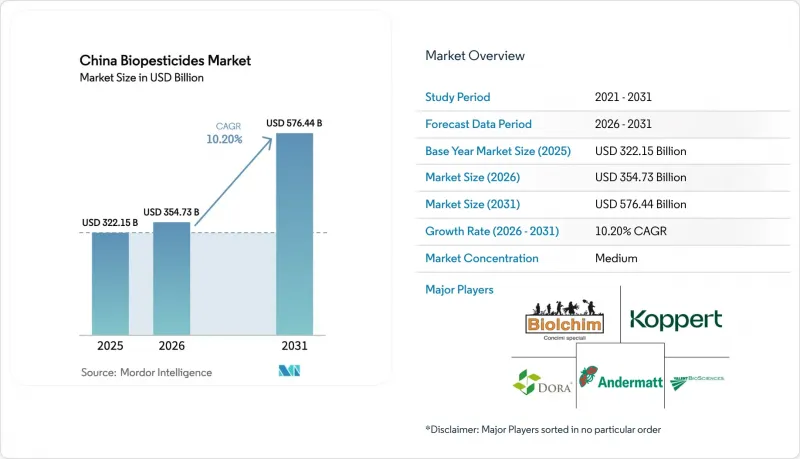
本報告按劑型(生物除草劑、生物殺蟲劑、生物殺菌劑和其他生物農藥)和作物類型(經濟作物、大田作物和園藝作物)進行分類。市場預測以價值(美元)和數量(公噸)表示。
中國生物農藥市場趨勢與洞察
政策性補貼正在加速補貼的推出。
2024年4月,農業農村部撥款1.998億美元用於一項綜合蟲害管理計劃,該計劃為生產者提供生物農藥投入成本20%的補貼。補貼的前提條件是生產者需證明其合成活性成分的使用量比前一年減少10%,使得生物農藥的使用成為強制性要求,而非可選項。面積在3.3公頃及以上的合作社和家庭農場自動符合補貼資格,這部分農民最有能力執行精準的施藥方案。浙江省和江蘇省的省級政府部門已簡化電子憑證系統,並在發票上傳後7天內發放補貼,以改善生產者的現金流。廣東省的農業推廣中心正在彌合先前阻礙推廣應用的知識鴻溝,在補貼申請流程之外,還提供關於儲存和施用時間的培訓。初步影響評估顯示,試點地區第一季的施藥面積增加了32%,證實了補助金發揮了促進作用。
減少農藥使用的強制性目標
「十四五」規劃(2021-2025年)設定了絕對噸位限制,要求蔬果農藥用量較2016-2020年基準值降低10%,主要糧食作物農藥用量降低5%。與2017年實施的「零成長」政策不同,新框架限制的是農藥用量而非強度,從而推動市場轉向高效生物農藥。蘇力菌產品每克可提供100億菌落形成單位(CFU),有助於農民在不降低農藥效力的前提下達到用量限制。隨著歐盟於2024年收緊對47種合成活性成分的殘留限制,山東和浙江等出口導向省份的農民也面臨類似的壓力,進一步鞏固了對生物農藥的需求。目前,透過快速審查程序,每公頃活性成分含量降低 30% 的配方可在 18 個月內獲得臨時批准,這鼓勵製造商重新設計傳統菌株以增加孢子數量。
田間活微生物功效的差異
在南方省份,氣溫超過35度C、濕度超過80%時,蘇雲金蘇力菌和哈茨木黴產品的菌落形成單位(CFU)存活率會降低40-60%,因此需要7-10天的噴灑間隔。紫外線會在兩天內使孢子數量減半,需要在清晨或黃昏時分噴灑,但這與無人機噴灑服務的時間衝突。廣東省農業科學院的研究發現,中午而非清晨噴灑生物農藥可以降低害蟲死亡率。雖然生產商正在推出紫外線阻隔劑和耐熱菌株,但15-20%的溢價阻礙了價格敏感型農民的購買意願。由於缺乏標準化的功效標籤,農民只能透過口碑相傳來比較不同品牌,這在害蟲爆發時會降低其可靠性。
細分市場分析
預計到2025年,生物殺菌劑將佔銷售額的40%。這主要得益於枯草芽孢桿菌和哈茨木黴產品,它們對鐮刀菌、腐霉菌和絲核菌有效,已應用於580萬公頃的保護地栽培園藝區。溫室經營者優先考慮無殘留防治,這使他們能夠在滿足有機認證標準的同時,將零售價格提高50%至100%。 Koppert和山東蘇卡漢的哈茨木黴產品系列保持領先的市場佔有率,其防治效果高達85%,與合成農藥相當。以蘇力菌為主的生物殺蟲劑在棉花和蔬菜種植面積正以12%的複合年成長率成長,這些地區的害蟲對擬除蟲菊酯類殺蟲劑的抗藥性正在降低化學農藥的有效性。生物除草劑的市佔率仍較低,其除草率僅40-55%,遠低於Glyphosate的85-95%。然而,國家農業化學品管理總局對脂肪酸類和化感作用型生物除草劑的批准表明,該領域未來具有成長潛力。成都新森公司的奈米封裝原型產品旨在在2027年縮小這一功效差距,這有望擴大中國生物農藥市場中生物除草劑的市場佔有率。
次要需求因素正在推動生物殺菌劑佔據主導地位。保護面積栽培面積的擴大加劇了病害壓力,但控制施藥時間可以最大限度地發揮活性微生物的功效。供應商正在銷售袋裝製劑,這些製劑能夠定植於根系區域,並在整個生長季節抑制病害,從而減輕了人們對葉面噴布頻率的擔憂。同時,生物殺蟲劑的成長取決於無人機服務的普及率以及新疆維吾爾自治區棉花抗性管理的強制性規定。如果江蘇瑞豐正在研發的桿狀病毒基產品獲得批准,生物殺蟲劑領域的競爭將更加激烈,迫使生產商採用差異化的載體和包封技術。
其他好處:
- Excel格式的市場預測(ME)表
- 3個月的分析師支持
目錄
第1章:引言
- 研究假設和市場定義
- 調查範圍
- 調查方法
第2章:本報告的內容
第3章:執行摘要和主要發現
第4章:主要產業趨勢
- 有機耕作面積
- 人均有機產品支出
- 法律規範
- 價值鍊和通路分析
- 市場促進因素
- 政府補貼正在加速這些措施的實施。
- 減少化學物質使用的強制性目標
- 優質有機食品的需求日益成長
- 利用無人機進行精準噴灑
- 合成生物學成本降低
- 對東南亞國家聯盟(東協)和歐洲的出口勢頭強勁
- 市場限制因素
- 田間活微生物的有效性有差異。
- 小規模農戶初期投入成本高
- 新股登記需要時間。
- 農業推廣服務短缺
第5章 市場規模與成長預測
- 按形式
- 生物消毒劑
- 生物除草劑
- 生物來源殺蟲劑
- 其他生物農藥
- 按作物類型
- 經濟作物
- 園藝作物
- 大田作物
第6章 競爭情勢
- 關鍵策略趨勢
- 市佔率分析
- 企業狀況
- 公司簡介
- Valent Biosciences LLC(Sumitomo Chemical Co. Ltd.)
- Andermatt Group AG
- Dora Agri-Tech
- Biolchim SPA(Hello Nature SpA)
- Koppert Biological Systems Inc.
- Henan Jiyuan Baiyun Industry Co. Ltd.
- King Biotec Corporation
- Zhejiang Qianjiang Biochemical Co. Ltd.
- Shandong Sukahan Bio-Technology Co. Ltd.
- Hebei Zhongbao Green Crop Technology Co. Ltd.
- Rainbow Agro Co. Ltd.
- Wuhan Kono Biological Technology Co. Ltd.
- Chengdu Newsun Crop Science Co. Ltd.
- Jiangsu Ruifeng Bio-Tech Co. Ltd.
- Wuhan Taixin Biological Technology Co. Ltd.
第7章 農業生技公司執行長面臨的關鍵策略挑戰
According to Mordor Intelligence, the China biopesticides market size is anticipated to grow from USD 322.15 billion in 2025 to USD 354.73 billion in 2026 and is forecast to reach USD 576.44 billion by 2031 at a 10.20% CAGR over 2026-2031.
This report is Segmented by Form (Bioherbicides, Bioinsecticides, Biofungicides, and Other Biopesticides), and by Crop Type (Cash Crops, Row Crops, and Horticultural Crops). The Market Forecasts in Terms of Value (USD) and Volume (Metric Tons).
China Biopesticides Market Trends and Insights
Policy Subsidies Accelerating Adoption
In April 2024 the Ministry of Agriculture and Rural Affairs earmarked USD 199.8 million for integrated pest-management programs that reimburse growers up to 20% of biological input costs. Disbursement is contingent on documented 10% year-on-year reductions in synthetic active ingredients, a rule that converts biopesticides into compliance essentials rather than optional add-ons. Cooperatives and family farms above 3.3 hectares qualify automatically, capturing the segment most capable of managing precise spray protocols. Provincial bureaus in Zhejiang and Jiangsu have streamlined e-voucher systems that credit reimbursements within seven days of invoice upload, improving cash-flow for growers. Guangdong extension stations bundle subsidy access with storage and timing workshops, closing the knowledge gap that previously curbed uptake. Early impact assessments show treated acreage rising 32% in pilot counties during the first season, confirming the subsidy's catalytic role.
Mandatory Chemical-Use Reduction Targets
The Fourteenth Five-Year Plan (2021-2025) locks in absolute tonnage ceilings that force a 10% cut in pesticide use on fruit and vegetables and 5% on major grains versus the 2016-2020 baseline. Unlike the zero-growth policy achieved in 2017, the new framework caps volume rather than intensity, pushing demand toward high-potency biopesticide formulations. Bacillus thuringiensis products that deliver 10 billion colony-forming units per gram help growers meet tonnage limits without sacrificing efficacy. Export-oriented farmers in Shandong and Zhejiang face parallel pressure from European Union residue limits tightened for 47 synthetic actives in 2024, further locking in biological demand. Fast-track review now grants provisional clearance within 18 months for formulations demonstrating 30% lower active-ingredient mass per hectare, incentivizing manufacturers to redesign legacy strains for higher spore counts.
Variable Field Efficacy of Live Microbes
Colony-forming-unit viability in Bacillus thuringiensis and Trichoderma harzianum products can fall 40-60% when temperatures surpass 35 °C and humidity exceeds 80% in southern provinces, forcing spray intervals of seven to ten days. Ultraviolet light halves spore counts within two days, demanding dawn or dusk applications that clash with drone-service schedules. Guangdong Academy of Agricultural Sciences measured lower pest-mortality when biopesticides were sprayed at noon versus dawn. Manufacturers have introduced UV-shield adjuvants and thermotolerant strains, yet price premiums of 15-20% deter price-sensitive growers. Absence of standardized efficacy labels leaves farmers comparing brands via word-of-mouth, hampering confidence when pest pressure spikes.
Other drivers and restraints analyzed in the detailed report include:
- Rising Organic-Food Premium Demand
- Drone-Enabled Precision Spraying
- Higher Upfront Cost for Smallholders
For complete list of drivers and restraints, kindly check the Table Of Contents.
Segment Analysis
Biofungicides captured 40% of 2025 revenue, driven by Bacillus subtilis and Trichoderma harzianum products effective against Fusarium, Pythium, and Rhizoctonia in 5.8 million hectares of protected horticulture. Greenhouse operators value residue-free protection that secures 50-100% retail premiums and meets organic-label rules. Trichoderma lines from Koppert and Shandong Sukahan reach 85% control efficacy, on par with synthetics and thus maintain share leadership. Bioinsecticides, dominated by Bacillus thuringiensis, are rising at 12% CAGR on cotton and vegetable acreage where pyrethroid resistance erodes chemical efficacy. Bioherbicides remain at fewer share due to 40-55% weed-control levels versus glyphosate's 85-95%, though Institute for the Control of Agrochemicals approvals for fatty-acid and allelopathic products signal future upside. Chengdu Newsun's nano-encapsulated prototypes aim to close the efficacy gap by 2027, which could lift the China biopesticides market size for herbicidal categories.
Second-order demand factors reinforce the leadership of biofungicides. Protected-cultivation acreage increases disease pressure yet offers spray-timing control that maximizes live-microbe performance. Suppliers bundle sachet formulations that colonize root zones for season-long suppression, reducing frequency concerns tied to foliar routes. Meanwhile, bioinsecticide growth will hinge on drone-service density and resistance-management mandates in Xinjiang cotton. Should baculovirus platforms under development by Jiangsu Ruifeng secure approvals, competitive intensity in the bioinsecticide niche will climb, pushing producers toward differentiated carrier and encapsulation technologies.
Complete Report Scope:
- By Form
- Biofungicides
- Bioherbicides
- Bioinsecticides
- Other Biopesticides
- By Crop Type
- Cash Crops
- Horticultural Crops
- Row Crops
List of Companies Covered in this Report:
- Valent Biosciences LLC (Sumitomo Chemical Co. Ltd.)
- Andermatt Group AG
- Dora Agri-Tech
- Biolchim SPA (Hello Nature SpA)
- Koppert Biological Systems Inc.
- Henan Jiyuan Baiyun Industry Co. Ltd.
- King Biotec Corporation
- Zhejiang Qianjiang Biochemical Co. Ltd.
- Shandong Sukahan Bio-Technology Co. Ltd.
- Hebei Zhongbao Green Crop Technology Co. Ltd.
- Rainbow Agro Co. Ltd.
- Wuhan Kono Biological Technology Co. Ltd.
- Chengdu Newsun Crop Science Co. Ltd.
- Jiangsu Ruifeng Bio-Tech Co. Ltd.
- Wuhan Taixin Biological Technology Co. Ltd.
Additional Benefits:
- The market estimate (ME) sheet in Excel format
- 3 months of analyst support
TABLE OF CONTENTS
1 Introduction
- 1.1 Study Assumptions and Market Definition
- 1.2 Scope of the Study
- 1.3 Research Methodology
2 Report Offers
3 Executive Summary and Key Findings
4 Key Industry Trends
- 4.1 Area Under Organic Cultivation
- 4.2 Per Capita Spending on Organic Products
- 4.3 Regulatory Framework
- 4.4 Value Chain and Distribution Channel Analysis
- 4.5 Market Drivers
- 4.5.1 Policy subsidies accelerating adoption
- 4.5.2 Mandatory chemical-use reduction targets
- 4.5.3 Rising organic-food premium demand
- 4.5.4 Drone-enabled precision spraying
- 4.5.5 Synthetic-biology cost reductions
- 4.5.6 Export momentum to Association of Southeast Asian Nations (ASEAN) and Europe
- 4.6 Market Restraints
- 4.6.1 Variable field efficacy of live microbes
- 4.6.2 Higher upfront cost for smallholders
- 4.6.3 Lengthy registration for novel strains
- 4.6.4 Limited agronomic extension services
5 Market Size and Growth Forecasts (Value and Volume)
- 5.1 By Form
- 5.1.1 Biofungicides
- 5.1.2 Bioherbicides
- 5.1.3 Bioinsecticides
- 5.1.4 Other Biopesticides
- 5.2 By Crop Type
- 5.2.1 Cash Crops
- 5.2.2 Horticultural Crops
- 5.2.3 Row Crops
6 Competitive Landscape
- 6.1 Key Strategic Moves
- 6.2 Market Share Analysis
- 6.3 Company Landscape
- 6.4 Company Profiles (Includes Global Level Overview, Market Level Overview, Core Segments, Financials as Available, Strategic Information, Market Rank/Share for Key Companies, Products and Services, and Recent Developments)
- 6.4.1 Valent Biosciences LLC (Sumitomo Chemical Co. Ltd.)
- 6.4.2 Andermatt Group AG
- 6.4.3 Dora Agri-Tech
- 6.4.4 Biolchim SPA (Hello Nature SpA)
- 6.4.5 Koppert Biological Systems Inc.
- 6.4.6 Henan Jiyuan Baiyun Industry Co. Ltd.
- 6.4.7 King Biotec Corporation
- 6.4.8 Zhejiang Qianjiang Biochemical Co. Ltd.
- 6.4.9 Shandong Sukahan Bio-Technology Co. Ltd.
- 6.4.10 Hebei Zhongbao Green Crop Technology Co. Ltd.
- 6.4.11 Rainbow Agro Co. Ltd.
- 6.4.12 Wuhan Kono Biological Technology Co. Ltd.
- 6.4.13 Chengdu Newsun Crop Science Co. Ltd.
- 6.4.14 Jiangsu Ruifeng Bio-Tech Co. Ltd.
- 6.4.15 Wuhan Taixin Biological Technology Co. Ltd.
7 Key Strategic Questions for Agricultural Biologicals CEOs

 美國生物農藥:市場佔有率分析、行業趨勢和統計數據、成長預測(2026-2031 年)
 生物農藥市場規模、佔有率、成長、全球產業分析、區域趨勢及2026年至2034年預測。細菌生物農藥:市場佔有率分析、產業趨勢與統計、成長預測(2026-2031)日本生物農藥:市場佔有率分析、產業趨勢與統計、成長預測(2026-2031)
 生物農藥市場:2026-2032年全球市場預測(按類型、作物、製劑形式、生物來源、應用、銷售管道和最終用戶分類)
 生物農藥市場預測至2034年-按產品類型、作物類型、原料、配方、應用方式和地區分類的全球分析
 液體生物農藥市場規模、佔有率和成長分析:按產品類型、原料、應用方法、作物、配方類型、最終用戶、配銷通路和地區分類——2026-2033年行業預測
 生物殺蟲劑市場報告:按產品、配方、原料、應用方法、作物類型和地區分類(2026-2034 年)全球生物農藥市場規模、佔有率、趨勢和成長分析報告(2026-2034年)
 2026年全球生物農藥市場報告