

 |
市場調查報告書
商品編碼
2113741
日本生物農藥:市場佔有率分析、產業趨勢與統計、成長預測(2026-2031)Japan Biopesticide - Market Share Analysis, Industry Trends & Statistics, Growth Forecasts (2026 - 2031) |
||||||

※ 本網頁內容可能與最新版本有所差異。詳細情況請與我們聯繫。
據 Mordor Intelligence 稱,2025 年日本生物農藥市值為 1.85 億美元,預計到 2031 年將達到 4.0813 億美元,而 2026 年為 2.1105 億美元,預測期(2026-2031 年)的複合年成長率為 14.08%。
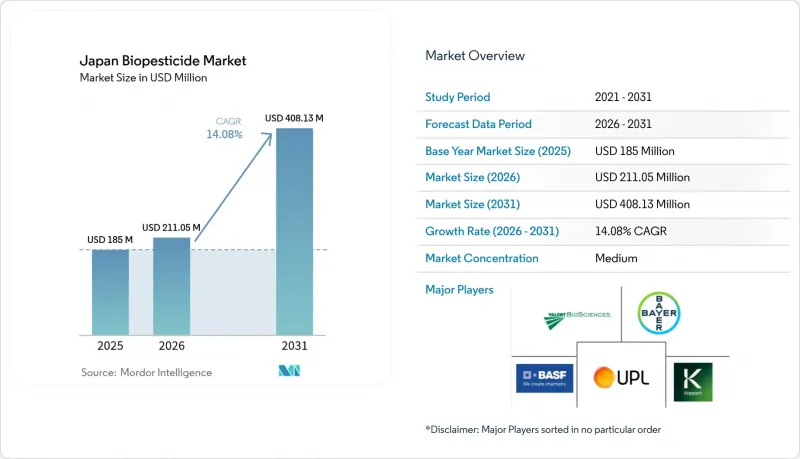
本報告按產品(生物除草劑、生物殺蟲劑、生物殺菌劑及其他產品)和應用(糧食作物和非糧食作物)進行細分。市場預測以貨幣價值(美元)表示。
日本生物農藥市場趨勢與洞察
對有機農業和有機農產品的需求日益成長
在日本,受消費者願意為不含農藥的農產品支付26%至29%的溢價的推動,有機農產品的零售額不斷成長。然而,這筆溢價往往不足以彌補有機農戶面臨的1.35至1.6倍的更高生產成本。 「綠之戰略」旨在2050年將有機農田面積擴大到100萬公頃,比目前水準成長十倍,從而創造對生物農藥的結構性需求,以應對農田從傳統耕作向認證有機耕作過渡的時期。永旺和Seven & i Holdings等零售商正在飽和的生鮮食品市場中拓展其有機自有品牌產品線,並利用強調減少化學殘留的可追溯系統作為差異化優勢。這一趨勢在關東地區的郊區蔬菜產區最為顯著,位置東京富裕的消費群體,使得有機生產系統的高投入成本和複雜的物流系統更具吸引力。
監管支持永續農業
農林水產省(MAFF)根據修訂後的《農藥法》推出了生物農藥快速核准程序。該程序將安全性已證實的微生物活性成分的註冊期限從36個月縮短至24個月,並降低了生物防治領域創新企業的市場進入門檻。將於2024年生效的《綠色食品體係法》指定了超過17,000家獲得認證的生產者,他們有資格獲得直接補貼和技術支持,這些生產者將組成一個採用者群體,作為生物防治實踐的示範點。這些政策措施透過分擔社會各界的過渡成本,並縮短生產者投資新噴灑設備和培訓的投資回收期,共同降低了生物農藥推廣應用帶來的風險。
農民缺乏意識和技術知識
在日本,僅有28%的小規模農戶接受過微生物製劑施用程序的訓練。這種知識不足導致施用時間不當、劑量錯誤和儲存不當等問題。這些因素降低了生物農藥的有效性,並削弱了農民對生物解決方案的信心。隨著農民老化(超過70%的農民年齡在65歲以上),他們對採用需要改變施用時間、引入專用設備以及即時病蟲害監測才能達到與合成農藥相同效果的新技術存在抵觸情緒。將生物農藥的作用機制與特定害蟲的生命週期和環境條件相匹配,在技術上非常複雜,需要許多農民缺乏的先進農業知識。因此,存在著效能差距,阻礙了市場向早期採用者群體以外的擴展。
細分市場分析
預計到2025年,生物殺蟲劑將佔據日本生物農藥市場37.40%的佔有率。這反映了生物殺蟲劑在防治水稻、蔬菜和果樹中的鱗翅目害蟲方面已取得的顯著成效,而這些害蟲對擬除蟲菊酯類殺蟲劑的抗藥性降低了傳統化學農藥的防治效果。蘇力菌製劑,例如DiPel和Agree,在該領域佔據主導地位,這得益於它們已在日本農林水產省註冊,涵蓋50多種作物-害蟲組合,以及其基於與農業合作社合作的分銷網路。源自土壤細菌棘孢糖多孢菌(Saccharopolyspora spinosa)的棘黴素產品,因其良好的葉面滲透性和較短的採收前間隔期,符合集約化種植計劃和出口殘留標準,在溫室蔬菜種植中獲得了市場佔有率。
到2031年,生物化學農藥的複合年成長率將達到14.95%。這種加速成長的驅動力在於草坪和觀賞草負責人優先選擇零殘留解決方案,以最大限度地降低接觸噴霧器的風險,同時保持美觀,尤其是在高爾夫球場和城市公園等高人流量區域。基於費洛蒙的交配抑制系統在青森縣的蘋果園和鳥取縣的梨園中越來越受歡迎,它們能夠有效控制整個生長季的蘋果甲蟲和東方果苔,而無需像殺蟲劑那樣增加噴灑頻率和產生抗藥性風險。
其他好處:
- Excel格式的市場預測(ME)表
- 3個月的分析師支持
目錄
第1章:引言
- 研究假設和市場定義
- 調查範圍
第2章:調查方法
第3章執行摘要
第4章 市場狀況
- 市場概覽
- 市場促進因素
- 對有機農業和有機農產品的需求日益成長
- 監管支持永續農業
- 環境和健康問題
- 政府對綜合蟲害管理的補貼
- 目標害蟲對化學殺蟲劑的抗藥性增強
- 給予生物來源投入物優惠待遇的排碳權計劃
- 市場限制因素
- 農民的意識和技術知識有限。
- 與合成產品相比,成本高且難以規模化生產。
- 對出口產品中微生物衍生活性成分的殘留標準更加嚴格。
- 對進口取得專利的微生物菌株的依賴
- 監理情勢
- 波特五力分析
第5章 市場規模與成長預測
- 依產品類型
- 生物來源除草劑
- 生物來源殺蟲劑
- 生物來源的消毒劑
- 其他
- 透過使用
- 食用作物
- 穀物和穀類
- 油籽
- 水果和蔬菜
- 不食用作物
- 草坪和觀賞草
- 其他
- 食用作物
第6章 競爭情勢
- 市場集中度
- 策略趨勢
- 市佔率分析
- 公司簡介
- Valent BioSciences LLC
- Bayer CropScience AG
- BASF SE
- Koppert BV
- UPL Limited
- Pro Farm Group Inc.
- Certis Biologicals LLC
- Mitsui Chemicals Agro, Inc.
- Ishihara Sangyo Kaisha, Ltd.
- OAT Agrio Co., Ltd.
- SDS Biotech KK
- Emery Oleochemicals Sdn. Bhd.
- Nihon Nohyaku Co., Ltd.
- Chr. Hansen Holding A/S
- Andermatt Biocontrol AG
第7章 市場機會與未來展望
According to Mordor Intelligence, the Japan biopesticide market size was valued at USD 185 million in 2025 and estimated to grow from USD 211.05 million in 2026 to reach USD 408.13 million by 2031, at a CAGR of 14.08% during the forecast period (2026-2031).
This report is Segmented by Product (Bioherbicides, Bioinsecticides, Biofungicides, and Other Products) and by Application (Food Crop and Non-Food Crop). The Market Forecasts are Provided in Terms of Value (USD).
Japan Biopesticide Market Trends and Insights
Rising Demand for Organic Farming and Produce
Japan's organic retail sales expanded, driven by consumer willingness to pay a 26 to 29% premium for pesticide-free produce, yet this premium often fails to cover the 1.35 to 1.6 times higher production costs that organic growers face. The MIDORI Strategy's target of 1 million hectares of organic farmland by 2050 represents a tenfold increase from current levels, creating a structural demand pull for biopesticides that can bridge the transition period when fields are converting from conventional to certified organic status . Retailers such as Aeon and Seven and i Holdings are expanding organic private-label lines, leveraging traceability systems that highlight reduced chemical residue as a point of differentiation in saturated fresh produce categories. This dynamic is most pronounced in Kanto's peri-urban vegetable belts, where proximity to Tokyo's affluent consumer base justifies the higher input costs and logistical complexity of organic production systems.
Regulatory Support for Sustainable Agriculture
The Ministry of Agriculture, Fisheries and Food (MAFF) introduced a fast-track approval pathway for biopesticides under the revised Agricultural Chemicals Regulation Law, reducing registration timelines from 36 months to 24 months for microbial actives with established safety profiles, thereby lowering market entry barriers for biocontrol innovators. The Green Food System Law, enacted in 2024, designated over 17,000 certified producers eligible for direct payments and technical assistance, creating a cohort of early adopters who serve as demonstration sites for biological pest management practices. These policy instruments collectively de-risk biopesticide adoption by socializing transition costs and compressing the payback period for growers who invest in new application equipment and training.
Limited Farmer Awareness and Technical Know-How
Only 28% of Japanese smallholders have received training in microbial application protocols, a knowledge deficit that manifests in suboptimal timing, dosing errors, and inadequate storage practices that degrade biopesticide efficacy and erode grower confidence in biological solutions. The aging farmer demographic, with over 70% of operators older than 65 years, creates resistance to adopting new technologies that require modified spray schedules, specialized equipment, and real-time pest monitoring to achieve performance parity with synthetic chemistries. The technical complexity of matching biopesticide modes of action to specific pest life stages and environmental conditions requires a level of agronomic sophistication that many growers lack, creating a performance gap that undermines market expansion beyond early-adopter cohorts.
Other drivers and restraints analyzed in the detailed report include:
- Environmental and Health Concerns
- Government Subsidies for Integrated Pest Management
- Higher Cost and Scalability Challenges Versus Synthetics
For complete list of drivers and restraints, kindly check the Table Of Contents.
Segment Analysis
Bioinsecticides held a 37.40% share of the Japanese biopesticide market in 2025, reflecting their established efficacy against lepidopteran pests in rice, vegetables, and fruit crops, where pyrethroid resistance has eroded the performance of conventional chemistries. Bacillus thuringiensis formulations such as DiPel and Agree dominate this segment, leveraging MAFF registrations that span over 50 crop-pest combinations and distribution networks anchored by Sumitomo Chemical's agricultural cooperative partnerships. Spinosad products, derived from the soil bacterium Saccharopolyspora spinosa, captured a share in greenhouse vegetable systems where their translaminar activity and short pre-harvest intervals align with intensive cropping schedules and export residue requirements.
Biochemical biopesticides are advancing at a 14.95% CAGR toward 2031, this acceleration is driven by turf and ornamental grass managers who prioritize residue-free solutions that preserve aesthetic quality and minimize applicator exposure risks, particularly in high-traffic areas such as golf courses and urban parks. Pheromone-based mating disruption systems are gaining adoption in apple orchards in Aomori and pear orchards in Tottori, where they provide season-long control of codling moth and Oriental fruit moth without the spray frequency and resistance risks associated with insecticides.
Complete Report Scope:
- By Product Type
- Bioherbicides
- Bioinsecticides
- Biofungicides
- Others
- By Application
- Food Crop
- Grains and cereals
- Oilseeds
- Fruits and vegetables
- Non-food Crop
- Turf and ornamental grass
- Others
- Food Crop
List of Companies Covered in this Report:
- Valent BioSciences LLC
- Bayer CropScience AG
- BASF SE
- Koppert B.V.
- UPL Limited
- Pro Farm Group Inc.
- Certis Biologicals LLC
- Mitsui Chemicals Agro, Inc.
- Ishihara Sangyo Kaisha, Ltd.
- OAT Agrio Co., Ltd.
- SDS Biotech K.K.
- Emery Oleochemicals Sdn. Bhd.
- Nihon Nohyaku Co., Ltd.
- Chr. Hansen Holding A/S
- Andermatt Biocontrol AG
Additional Benefits:
- The market estimate (ME) sheet in Excel format
- 3 months of analyst support
TABLE OF CONTENTS
1 INTRODUCTION
- 1.1 Study Assumptions and Market Definition
- 1.2 Scope of the Study
2 RESEARCH METHODOLOGY
3 EXECUTIVE SUMMARY
4 MARKET LANDSCAPE
- 4.1 Market Overview
- 4.2 Market Drivers
- 4.2.1 Rising demand for organic farming and produce
- 4.2.2 Regulatory support for sustainable agriculture
- 4.2.3 Environmental and health concerns
- 4.2.4 Government subsidies for integrated pest management
- 4.2.5 Increasing chemical-pesticide resistance in target pests
- 4.2.6 Carbon-credit programs favoring biologically derived inputs
- 4.3 Market Restraints
- 4.3.1 Limited farmer awareness and technical know-how
- 4.3.2 Higher cost and scalability challenges versus synthetics
- 4.3.3 Ultra-strict residue limits for microbial actives on exports
- 4.3.4 Dependence on imported patented microbial strains
- 4.4 Regulatory Landscape
- 4.5 Porter's Five Forces Analysis
- 4.5.1 Threat of New Entrants
- 4.5.2 Bargaining Power of Buyers/Consumers
- 4.5.3 Bargaining Power of Suppliers
- 4.5.4 Threat of Substitute Products
- 4.5.5 Intensity of Competitive Rivalry
5 MARKET SIZE AND GROWTH FORECASTS (VALUE)
- 5.1 By Product Type
- 5.1.1 Bioherbicides
- 5.1.2 Bioinsecticides
- 5.1.3 Biofungicides
- 5.1.4 Others
- 5.2 By Application
- 5.2.1 Food Crop
- 5.2.1.1 Grains and cereals
- 5.2.1.2 Oilseeds
- 5.2.1.3 Fruits and vegetables
- 5.2.2 Non-food Crop
- 5.2.2.1 Turf and ornamental grass
- 5.2.2.2 Others
- 5.2.1 Food Crop
6 COMPETITIVE LANDSCAPE
- 6.1 Market Concentration
- 6.2 Strategic Moves
- 6.3 Market Share Analysis
- 6.4 Company Profiles (Includes Global level Overview, Market level overview, Core Segments, Financials as available, Strategic Information, Market Rank/Share for key companies, Products and Services, and Recent Developments)
- 6.4.1 Valent BioSciences LLC
- 6.4.2 Bayer CropScience AG
- 6.4.3 BASF SE
- 6.4.4 Koppert B.V.
- 6.4.5 UPL Limited
- 6.4.6 Pro Farm Group Inc.
- 6.4.7 Certis Biologicals LLC
- 6.4.8 Mitsui Chemicals Agro, Inc.
- 6.4.9 Ishihara Sangyo Kaisha, Ltd.
- 6.4.10 OAT Agrio Co., Ltd.
- 6.4.11 SDS Biotech K.K.
- 6.4.12 Emery Oleochemicals Sdn. Bhd.
- 6.4.13 Nihon Nohyaku Co., Ltd.
- 6.4.14 Chr. Hansen Holding A/S
- 6.4.15 Andermatt Biocontrol AG
7 MARKET OPPORTUNITIES AND FUTURE OUTLOOK

 美國生物農藥:市場佔有率分析、行業趨勢和統計數據、成長預測(2026-2031 年)
 生物農藥市場規模、佔有率、成長、全球產業分析、區域趨勢及2026年至2034年預測。細菌生物農藥:市場佔有率分析、產業趨勢與統計、成長預測(2026-2031)中國生物農藥市場:市場佔有率分析、產業趨勢與統計及成長預測(2026-2031年)
 生物農藥市場:2026-2032年全球市場預測(按類型、作物、製劑形式、生物來源、應用、銷售管道和最終用戶分類)
 生物農藥市場預測至2034年-按產品類型、作物類型、原料、配方、應用方式和地區分類的全球分析
 液體生物農藥市場規模、佔有率和成長分析:按產品類型、原料、應用方法、作物、配方類型、最終用戶、配銷通路和地區分類——2026-2033年行業預測
 生物殺蟲劑市場報告:按產品、配方、原料、應用方法、作物類型和地區分類(2026-2034 年)全球生物農藥市場規模、佔有率、趨勢和成長分析報告(2026-2034年)
 2026年全球生物農藥市場報告