


 |
市場調查報告書
商品編碼
2121649
中東和非洲智慧電錶:市場佔有率分析、行業趨勢和統計數據以及成長預測(2026-2031 年)Middle East And Africa Smart Meters - Market Share Analysis, Industry Trends & Statistics, Growth Forecasts (2026 - 2031) |
||||||

※ 本網頁內容可能與最新版本有所差異。詳細情況請與我們聯繫。
根據 Mordor Intelligence 預測,中東和非洲的智慧電錶市場規模將從 2025 年的 254.2 億美元成長到 2026 年的 276.1 億美元,然後在 2031 年達到 417.6 億美元,2026 年至 2031 年的複合成長率為 8.62%。
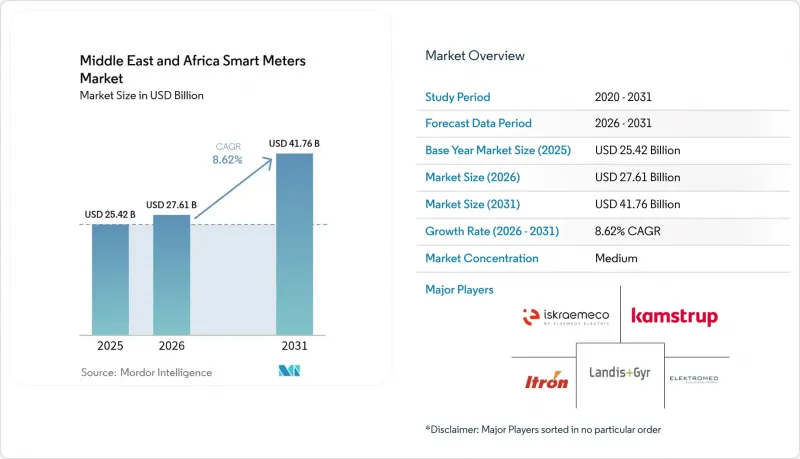
本報告按最終用戶(住宅、商業、工業)、計量表類型(智慧電錶、智慧燃氣表、智慧水錶)、通訊技術(射頻網狀網路、電力線通訊、蜂窩網路)、相數(單相、三相)和地區(中東和非洲)進行細分。市場預測以美元計價。
中東和非洲智慧電錶市場趨勢與洞察
公共產業正迅速採取措施提高能源效率,以減少AT和C損耗。
由於技術和商業性效率低下,中東和非洲各地的電力公司正面臨15%至25%的電力供應損失。這造成了不可接受的收入損失,因此智慧電錶部署計畫已成為一項策略重點。 2024年,奈及利亞一家配電公司啟動了舉措,在易受竊電影響的地區部署140萬個智慧電錶;與此同時,津巴布韋加快了智慧電錶的部署,以提高計費的準確性。此外,海灣國家的能源效率標籤法規要求提供詳細的用電量證明,這促使電力公司越來越依賴智慧電錶資料作為合規的基礎。因此,採購需求激增,中東和非洲的智慧電錶市場正在擴張,多供應商競標正在加速進行,分析服務也被定位為高附加價值服務。能夠快速量化損耗降低效果的電力公司將在電價調整方面獲得優勢,並進一步擴大其在全部區域的先行效益。
政府為推廣智慧電錶而製定的強制性規定和獎勵
從「可選」到「強制」的智慧電錶監管轉變,為市場需求設定了強勁的下限。南非國家監管體系049:2016規定了高級計量規範,在開普敦,新建建築安裝智慧電錶已成為強制性要求。波灣合作理事會(GCC)的G-Mark認證統一了多個國家的技術標準,顯著降低了供應商的合規成本,並加快了出貨速度。埃及修訂後的物聯網框架解決了先前圍繞蜂窩電錶的模糊不清的問題,而這正是先前的瓶頸。隨著強制部署範圍的擴大,中東和非洲的智慧電錶市場變得更加可預測,這使得金融機構更容易支持長期部署計劃,即使是那些公共產業狀況緊張的公用事業公司也能受益。涵蓋初始終端成本的補貼計畫進一步擴大了目標基本客群。
高昂的初始設備和安裝成本
智慧電錶的單價在50美元到150美元之間,安裝費用包括人事費用和通訊網路費用。撒哈拉以南非洲的電力公司經常受到貨幣波動的影響,同時也面臨進口價格波動帶來的額外挑戰,這進一步加劇了它們的預算壓力。由於缺乏批量採購,它們的議價能力遠遜於海灣合作理事會(GCC)成員國。標準傳輸規範(STS)認證費用增加了預付解決方案的合規成本。雖然有捐助方資助項目,但資金撥付時間很少與電錶更換週期相匹配,導致長期依賴過時的設備,從而限制了中東和非洲低收入地區智慧電錶市場的發展。
細分市場分析
工業應用領域預計在2026年至2031年間將成為中東和非洲智慧電錶市場成長最快的細分領域,年複合成長率高達12.22%。沙烏地阿拉伯和阿拉伯聯合大公國的海水淡化廠、礦場以及快速發展的製造地等工業設施需要精細的能源數據來最佳化生產流程並整合現場可再生能源。這些需求刺激了對具備電能品質分析功能的三相雙向電錶的需求,其平均售價高於住宅用電錶,並有助於提升整體收入。海灣國家的「2030訂單」計畫也提振了訂單前景,電力公司正與工業園區開發商合作,預先安裝智慧電錶基礎設施。
預計到2025年,住宅用戶將佔中東和非洲智慧電錶市場佔有率的46.31%,並繼續成為該市場出貨量的核心。開普敦和海灣合作理事會國家的強制安裝,以及消費者對透明帳單的需求,都支撐著出貨量的穩定成長。然而,低收入市場的價格擔憂限制了住宅用戶的普及率,促使供應商推出功能豐富的預付模式。商業建築則介於兩者之間,利用智慧電錶進行需量反應和能源效率認證。這三類使用者共同構成了多元化的需求結構,使得整個市場不易受單一產業波動的影響。
到2025年,智慧電錶將在中東和非洲的智慧電錶市場佔據60.85%的佔有率,進一步鞏固電力在該地區公共產業營運中的主導地位。智慧電錶是技術基礎,通常構成多功能公用事業平台的核心。同時,智慧水錶預計到2031年將以10.35%的複合年成長率成長,隨著海水淡化依賴程度的提高以及未收取的水費給供水事業帶來更大的財務壓力,智慧水錶的發展勢頭強勁。能夠承受惡劣鹽環境的超音波和電磁式智慧水錶尤其受到青睞,在阿曼和以色列等市場競標活躍。
由於管道基礎設施持續有限,燃氣表在大都會圈以外的地區仍屬於小眾市場。然而,電力、水和燃氣整合平台能夠降低整個生命週期的IT成本,並使多產品部署更具吸引力。中東和非洲的水務智慧電錶市場雖然目前規模較小,但成長速度最快,吸引了專業供應商與區域系統整合商成立合資企業。由於電網的強制性現代化改造仍在進行,對電錶的需求持續旺盛,但隨著硬體商品化,競爭利潤空間正在縮小,價值正轉向軟體分析。
其他好處:
- Excel格式的市場預測(ME)表
- 3個月的分析師支持
目錄
第1章:引言
- 研究假設和市場定義
- 調查範圍
第2章:調查方法
第3章執行摘要
第4章 市場狀況
- 市場概覽
- 市場促進因素
- 電力公司迅速推廣節能措施,以減少AT和C損耗。
- 政府為推廣智慧電錶而製定的強制性規定和激勵措施
- 對智慧城市和物聯網基礎設施的投資
- 精準收費和客戶參與工具的需求日益成長。
- 屋頂分散式太陽能發電裝置數量的快速成長,使得雙向測量成為必要。
- 海水淡化廠的電氣化正在推動水錶的數位化。
- 市場限制因素
- 終端和安裝的初始成本較高
- 對公共產業資本投資和資金籌措的限制
- 地方公共產業網路安全人員短缺
- 傳統 AMR 與新型 AMI 架構之間的互通性挑戰
- 產業價值鏈分析
- 監理情勢
- 技術展望
- 波特五力分析
- 宏觀經濟因素的影響
第5章 市場規模與成長預測
- 最終用戶
- 住宅
- 商業的
- 產業
- 依計量器類型
- 智慧電錶
- 智慧燃氣表
- 智慧水錶
- 透過通訊技術
- 射頻網狀網路
- 電力線通訊
- 細胞
- 按階段
- 單相
- 三相
- 按地區
- 中東
- 沙烏地阿拉伯
- 阿拉伯聯合大公國
- 卡達
- 科威特
- 阿曼
- 巴林
- 土耳其
- 以色列
- 約旦
- 黎巴嫩
- 非洲
- 南非
- 埃及
- 奈及利亞
- 肯亞
- 摩洛哥
- 阿爾及利亞
- 迦納
- 衣索比亞
- 坦尚尼亞
- 中東
第6章 競爭情勢
- 市場集中度
- 策略趨勢
- 市佔率分析
- 公司簡介
- Landis+Gyr Group AG
- Kamstrup A/S
- Itron Inc.
- Iskraemeco dd
- Electromed Termikel Group
- Holley Technology Ltd.
- Hexing Electrical Co. Ltd.
- Sensus-Xylem Inc.
- Diehl Metering GmbH-FZE
- Sagemcom SAS
- Elster Group GmbH-Honeywell
- ADD Grup
- Aclara Technologies LLC
- Apator SA
- ZIV Automation
- Wasion Group Holdings Ltd.
- EDMI Limited
- Gridspertise Srl
- Neptune Technology Group Inc.
- Networked Energy Services Corporation
第7章 市場機會與未來展望
According to Mordor Intelligence, the Middle East and Africa smart meters market size is expected to grow from USD 25.42 billion in 2025 to USD 27.61 billion in 2026 and is forecast to reach USD 41.76 billion by 2031 at 8.62% CAGR over 2026-2031.
This report is Segmented by End User (Residential, Commercial, and Industrial), Meter Type (Smart Electricity Meters, Smart Gas Meters, and Smart Water Meters), Communication Technology (RF Mesh, Power Line Communication, and Cellular), Phase (Single-Phase, and Three-Phase), and Geography (Middle East, and Africa). The Market Forecasts are Provided in Terms of Value (USD).
Middle East And Africa Smart Meters Market Trends and Insights
Rapid utility push for energy efficiency to reduce AT and C losses
Utilities across the Middle East and Africa lose 15-25% of supplied electricity to technical and commercial inefficiencies, an unacceptable revenue drain that elevates smart-meter programs to strategic priority. Nigeria's distribution companies launched a 1.4-million-meter initiative in 2024 to target theft hotspots, while Zimbabwe accelerated its own installations to tighten billing accuracy. In parallel, Gulf efficiency-label regulations demand granular consumption evidence, so utilities increasingly treat smart-meter data as the compliance backbone. The resulting procurement surge enlarges the Middle East and Africa smart meters market, encourages multi-vendor tenders, and positions analytics services as high-value add-ons. Utilities that quantify loss reductions faster secure tariff-review advantages, amplifying first-mover benefits across the region.
Government mandates and incentives for smart-meter rollouts
Regulatory shifts from voluntary to mandatory deployments create a powerful demand floor. South Africa's National Regulatory System 049:2016 sets advanced-metering specifications, and Cape Town now requires smart meters in new buildings. The Gulf Cooperation Council's G-Mark certification aligns multi-country technical standards, slashing vendor compliance costs and accelerating shipments. Egypt's refreshed IoT framework clears cellular-meter ambiguity, a previous bottleneck. As mandates widen, the Middle East and Africa smart meters market gains predictability that helps financiers back long-term rollouts, even in utilities with constrained balance sheets. Subsidy schemes covering up-front device costs further widen the addressable customer base.
High upfront device and installation costs
Smart-meter hardware ranges from USD 50-150 per unit, and installation adds labour plus communication-network expenses. Sub-Saharan African utilities, often operating under currency volatility, face additional import-price swings that strain budgets. Lack of large-volume purchase power weakens their bargaining position relative to GCC peers. Certification fees from the Standard Transfer Specification Association raise compliance overheads for pre-paid solutions. Although donor-finance programs exist, disbursement timelines rarely align with meter-replacement cycles, prolonging reliance on legacy equipment and constraining the Middle East and Africa smart meters market in low-income regions.
Other drivers and restraints analyzed in the detailed report include:
- Smart city and IoT infrastructure investments
- Rising demand for precise billing and customer-engagement tools
- Limited utility CAPEX and financing constraints
For complete list of drivers and restraints, kindly check the Table Of Contents.
Segment Analysis
Industrial applications accounted for 12.22% CAGR growth potential, signalling the segment's role as the fastest-expanding component of the Middle East and Africa smart meters market size between 2026 and 2031. Industrial facilities including desalination plants, mines, and fast-growing manufacturing hubs in Saudi Arabia and the UAE require granular energy data to optimize production processes and integrate on-site renewables. These requirements stimulate demand for three-phase bi-directional meters capable of power-quality analytics, pushing average selling prices above the residential range and boosting overall revenue contribution. Vision 2030 agendas across Gulf economies strengthen the order pipeline as utilities partner with industrial-estate developers to pre-install smart-meter infrastructure.
Residential deployments, holding a 46.31% share in 2025, remain core to volume shipments within the Middle East and Africa smart meters market. Mandated rollouts in Cape Town and GCC states, coupled with consumer demand for transparent billing, sustain steady unit growth. Affordability concerns in lower-income markets, however, temper residential conversion rates, prompting suppliers to introduce stripped-down prepaid variants. Commercial buildings sit between the two extremes, leveraging meters for demand-response participation and energy-efficiency certification. Together, the three user categories form a diversified demand canvas that insulates the overall market from cyclical stocks in any single sector.
Smart electricity meters commanded 60.85% of Middle East and Africa smart meters market share in 2025, reinforcing electricity's primacy in regional utility operations. They serve as the technological baseline and often anchor multi-utility platforms. Yet, smart water meters, forecast to post a 10.35% CAGR through 2031, gain momentum as desalination reliance and non-revenue water issues intensify financial pressures on water utilities. Ultrasonic and electromagnetic models that withstand harsh saline environments register robust bid volumes, especially in Oman and Israel.
Gas-meter adoption stays niche because pipeline infrastructure remains limited outside metropolitan pockets. Nevertheless, integrated electricity-water-gas platforms lower lifetime IT costs and make multi-commodity rollouts more attractive. The Middle East and Africa smart meters market size for water applications, while smaller today, exhibits the steepest trajectory, drawing specialized vendors into joint ventures with regional system integrators. Electricity-meter demand continues unabated due to ongoing grid-modernization mandates, but competitive margins narrow as hardware commoditizes, and value migrates to software analytics.
Complete Report Scope:
- By End User
- Residential
- Commercial
- Industrial
- By Meter Type
- Smart Electricity Meters
- Smart Gas Meters
- Smart Water Meters
- By Communication Technology
- RF Mesh
- Power Line Communication
- Cellular
- By Phase
- Single-Phase
- Three-Phase
- By Geography
- Middle East
- Saudi Arabia
- United Arab Emirates
- Qatar
- Kuwait
- Oman
- Bahrain
- Turkey
- Israel
- Jordan
- Lebanon
- Africa
- South Africa
- Egypt
- Nigeria
- Kenya
- Morocco
- Algeria
- Ghana
- Ethiopia
- Tanzania
- Middle East
List of Companies Covered in this Report:
- Landis+Gyr Group AG
- Kamstrup A/S
- Itron Inc.
- Iskraemeco d.d.
- Electromed Termikel Group
- Holley Technology Ltd.
- Hexing Electrical Co. Ltd.
- Sensus - Xylem Inc.
- Diehl Metering GmbH - FZE
- Sagemcom SAS
- Elster Group GmbH - Honeywell
- ADD Grup
- Aclara Technologies LLC
- Apator SA
- ZIV Automation
- Wasion Group Holdings Ltd.
- EDMI Limited
- Gridspertise S.r.l.
- Neptune Technology Group Inc.
- Networked Energy Services Corporation
Additional Benefits:
- The market estimate (ME) sheet in Excel format
- 3 months of analyst support
TABLE OF CONTENTS
1 INTRODUCTION
- 1.1 Study Assumptions and Market Definition
- 1.2 Scope of the Study
2 RESEARCH METHODOLOGY
3 EXECUTIVE SUMMARY
4 MARKET LANDSCAPE
- 4.1 Market Overview
- 4.2 Market Drivers
- 4.2.1 Rapid utility push for energy efficiency to reduce AT and C losses
- 4.2.2 Government mandates and incentives for smart meter rollouts
- 4.2.3 Smart city and IoT infrastructure investments
- 4.2.4 Rising demand for precise billing and customer engagement tools
- 4.2.5 Surge in distributed solar rooftop connections necessitating bi-directional metering
- 4.2.6 Desalination plant electrification driving water meter digitization
- 4.3 Market Restraints
- 4.3.1 High upfront device and installation costs
- 4.3.2 Limited utility CAPEX and financing constraints
- 4.3.3 Cybersecurity skill gap within regional utilities
- 4.3.4 Interoperability challenges between legacy AMR and new AMI architectures
- 4.4 Industry Value-Chain Analysis
- 4.5 Regulatory Landscape
- 4.6 Technological Outlook
- 4.7 Porter's Five Forces Analysis
- 4.7.1 Threat of New Entrants
- 4.7.2 Bargaining Power of Buyers
- 4.7.3 Bargaining Power of Suppliers
- 4.7.4 Threat of Substitute Products
- 4.7.5 Intensity of Competitive Rivalry
- 4.8 Impact of Macroeconomic Factors
5 MARKET SIZE AND GROWTH FORECASTS (VALUE)
- 5.1 By End User
- 5.1.1 Residential
- 5.1.2 Commercial
- 5.1.3 Industrial
- 5.2 By Meter Type
- 5.2.1 Smart Electricity Meters
- 5.2.2 Smart Gas Meters
- 5.2.3 Smart Water Meters
- 5.3 By Communication Technology
- 5.3.1 RF Mesh
- 5.3.2 Power Line Communication
- 5.3.3 Cellular
- 5.4 By Phase
- 5.4.1 Single-Phase
- 5.4.2 Three-Phase
- 5.5 By Geography
- 5.5.1 Middle East
- 5.5.1.1 Saudi Arabia
- 5.5.1.2 United Arab Emirates
- 5.5.1.3 Qatar
- 5.5.1.4 Kuwait
- 5.5.1.5 Oman
- 5.5.1.6 Bahrain
- 5.5.1.7 Turkey
- 5.5.1.8 Israel
- 5.5.1.9 Jordan
- 5.5.1.10 Lebanon
- 5.5.2 Africa
- 5.5.2.1 South Africa
- 5.5.2.2 Egypt
- 5.5.2.3 Nigeria
- 5.5.2.4 Kenya
- 5.5.2.5 Morocco
- 5.5.2.6 Algeria
- 5.5.2.7 Ghana
- 5.5.2.8 Ethiopia
- 5.5.2.9 Tanzania
- 5.5.1 Middle East
6 COMPETITIVE LANDSCAPE
- 6.1 Market Concentration
- 6.2 Strategic Moves
- 6.3 Market Share Analysis
- 6.4 Company Profiles (includes Global level Overview, Market level overview, Core Segments, Financials as available, Strategic Information, Market Rank/Share for key companies, Products and Services, and Recent Developments)
- 6.4.1 Landis+Gyr Group AG
- 6.4.2 Kamstrup A/S
- 6.4.3 Itron Inc.
- 6.4.4 Iskraemeco d.d.
- 6.4.5 Electromed Termikel Group
- 6.4.6 Holley Technology Ltd.
- 6.4.7 Hexing Electrical Co. Ltd.
- 6.4.8 Sensus - Xylem Inc.
- 6.4.9 Diehl Metering GmbH - FZE
- 6.4.10 Sagemcom SAS
- 6.4.11 Elster Group GmbH - Honeywell
- 6.4.12 ADD Grup
- 6.4.13 Aclara Technologies LLC
- 6.4.14 Apator SA
- 6.4.15 ZIV Automation
- 6.4.16 Wasion Group Holdings Ltd.
- 6.4.17 EDMI Limited
- 6.4.18 Gridspertise S.r.l.
- 6.4.19 Neptune Technology Group Inc.
- 6.4.20 Networked Energy Services Corporation
7 MARKET OPPORTUNITIES AND FUTURE OUTLOOK
- 7.1 White-space and unmet-need assessment

 全球智慧電錶市場:按類型、組件、技術、通訊技術、最終用戶和地區分類-預測至2031年
 南美和中美洲智慧電錶:市場佔有率分析、行業趨勢和統計數據以及成長預測(2026-2031 年)
 智慧電錶市場:按類型、通訊技術、技術、組件、階段、應用、最終用途、部署模式和客戶類型分類-2026-2032年全球市場預測
 歐洲智慧電錶市場(第20版)智慧電錶:市場佔有率分析、產業趨勢與統計、成長預測(2026-2031)
 智慧電錶市場規模、佔有率和趨勢分析報告:按組件、類型、技術、最終用途、地區和細分市場分類(2026-2033 年)
 智慧電錶市場預測——全球產品、組件、通訊技術、技術、應用、最終用戶和地區分析——2034年
 物聯網市場追蹤調查:計量北美智慧電錶:市場佔有率分析、產業趨勢與統計及成長預測(2026-2031 年)
 2026年全球智慧電錶市場報告