


 |
市場調查報告書
商品編碼
2113437
南美和中美洲智慧電錶:市場佔有率分析、行業趨勢和統計數據以及成長預測(2026-2031 年)South And Central America Smart Meters - Market Share Analysis, Industry Trends & Statistics, Growth Forecasts (2026 - 2031) |
||||||

※ 本網頁內容可能與最新版本有所差異。詳細情況請與我們聯繫。
據 Mordor Intelligence 稱,南美洲和中美洲的智慧電錶市場預計到 2026 年價值 21.2 億美元,高於 2025 年的 19.8 億美元,預計到 2031 年將達到 29.9 億美元。
預計從 2026 年到 2031 年,其複合年成長率將達到 7.11%。
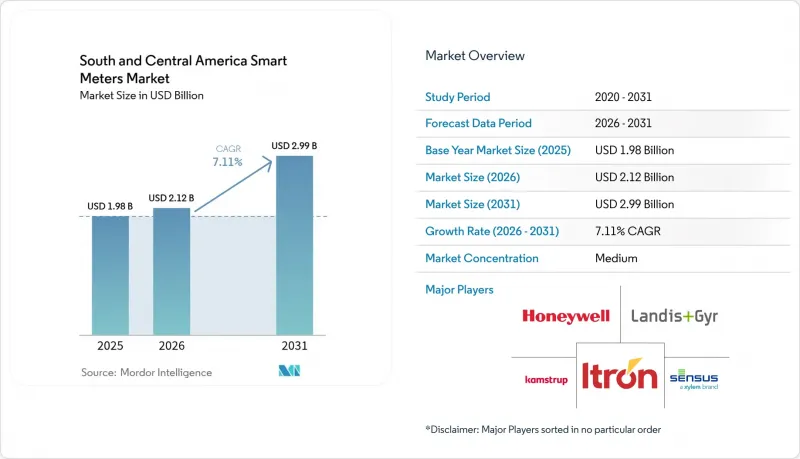
本報告按儀表類型(智慧電錶、智慧水錶、智慧燃氣表)、通訊技術(射頻網狀網路、PLC、蜂巢式物聯網)、終端用戶產業(住宅、商業、工業)和國家細分。市場預測以價值(美元)和銷售量(出貨量)表示。
南美與中美洲智慧電錶市場趨勢與洞察
擴大具備AMI功能的智慧電網計畫的投資
電力公司正在加速投資最新的高級計量基礎設施(AMI)平台,淘汰電子機械電錶,實現停電管理自動化,並支援雙向電力流動。巴西電力公司Copel報告稱,計劃在2024年部署50萬台智慧電錶,這將使現場巡檢次數減少20%,並顯著降低尖峰時段技術損耗。哥倫比亞和智利的配電營運商正在實施AMI和饋線自動化相結合的方案,以最大限度地提高電網數位化帶來的投資回報。美洲開發銀行(IDB)的資金支持減輕了電力公司在高利率環境下的債務負擔,使其能夠將投資分散到更長的期限內。蜂巢NB-IoT連接技術正日益普及,因為它可以利用現有的通訊塔,避免了在電線杆頂部安裝射頻網狀中繼器所需的前期土木工程。這些發展趨勢共同推動了智慧電錶市場的擴張,使以往依賴電價調整週期的採購決策得以提前。
各國強制推行淨計量及動態定價計劃
巴西國家電力監管局 (ANEEL) 現已強制要求所有屋頂太陽能發電系統裝置容量超過 75 千瓦的產消者安裝智慧電錶;阿根廷能源監管局 (ENRE) 也針對自主管理的分散式能源製定了類似的規定。智利的分時電價系統要求每 15 分鐘提供一次數據,以確保在動態定價下消費者獲得公平的計費。這些規定迫使電力公司用能夠即時記錄能源輸入和輸出的高級計量基礎設施 (AMI) 設備取代傳統的自動抄表 (AMR) 設備。這種設計轉變正在擴大智慧電錶市場,因為部署不能推遲到設備達到使用壽命終點,而這是併網的法律要求。隨著新的屋頂太陽能發電系統投入運作,電錶升級也在同步進行,從而形成良性循環的需求,支持在地採購,並為國內電錶工廠創造就業機會。
初始資本支出高,投資回收期長
全面改造智慧電錶(AMI)的成本可能在每台電錶150至300美元之間,這將為公共產業帶來數億美元的預算壓力,並加劇其內部借貸能力的緊張。大多數電子元件以美元採購,但計費卻以披索或雷亞爾等該地貨幣進行,外匯波動進一步加劇了成本風險。小規模的本地配電業者不願採用智慧電錶,除非監管機構允許其在費率方案中加快成本回收,這阻礙了智慧電錶在農村地區的普及。雖然開發銀行提供優惠融資,但貸款發放的節點有時會與政治選舉週期重合,導致董事會批准延遲。這些延誤正在減緩智慧電錶市場的短期成長,儘管其長期商業前景仍然可行。
細分市場分析
預計到2025年,智慧電錶將佔整個智慧電錶市場的63.65%,而智慧水錶預計將以最高的成長率成長,到2031年年複合成長率(CAGR)將達到9.22%。電力領域受益於十年的自動抄表(AMR)經驗,這簡化了採購規範和安裝人員培訓。電力營運商正在利用電壓降分析和相位不平衡警報來減少技術損耗,並改善向監管機構提交的電能品質報告。供水事業,尤其是在遭受乾旱的智利和秘魯,正在快速部署配備聲學洩漏檢測模組的超音波水錶,該模組可以即時檢測爆管和非法分支。由於這些業者以該地貨幣披索計費,而電子產品則以美元採購,因此,為了規避外匯波動風險,電錶供應商擴大在南方共同市場(Mercosur)地區內設立組裝廠。智慧燃氣表在智慧電錶市場中仍處於起步階段,但與氫氣相容的型號已經在阿根廷內格羅河省的一個工業叢集的試點微電網中投入使用。
電力產業的成熟度支撐了供應商的收入,而10-12年的硬體更新周期則為高價值升級創造了空間,例如基於邊緣人工智慧的異常檢測和無線計量升級。在水務業,洩漏分析已將無收益水(NRW)從45%降低至30%,從而釋放了營運資金用於支付計量即服務(MaaS)合約。儘管除阿根廷和巴西以外,天然氣管網的普及率仍然有限,但面臨環境、社會和治理(ESG)壓力的工業客戶正在尋求透明的氫氣流量測量,這促使一些專業供應商進入市場,並推動標準化機構制定氫氣測量協議。這些趨勢共同作用,進一步擴大了智慧電錶市場的整體規模。
其他好處:
- Excel格式的市場預測(ME)表
- 3個月的分析師支持
目錄
第1章:引言
- 研究假設和市場定義
- 調查範圍
第2章:調查方法
第3章執行摘要
第4章 市場狀況
- 市場概覽
- 市場促進因素
- 增加具備AMI功能的智慧電網計畫的投資
- 各國強制實施淨計量及動態定價制度
- 低收入地區從電子機械電錶過渡到智慧預付電錶
- 公共產業公司為減少非技術性損失所做的努力
- 一項綠色氫氣試點計畫正在催生對先進燃氣表的需求。
- 在乾旱地區,即時洩漏分析正在推動智慧水系統的應用。
- 市場限制因素
- 高初始資本支出(CAPEX)和較長的投資回收期
- 傳統AMI前端系統中的網路安全漏洞
- 在主要城市以外,蜂巢式物聯網覆蓋範圍不均勻。
- PLC/RF回程傳輸傳頻段分配延遲
- 價值鏈分析
- 監理情勢
- 波特五力分析
第5章 市場規模與成長預測
- 依計量器類型
- 智慧電錶
- 智慧水錶
- 智慧燃氣表
- 透過通訊技術
- 射頻網狀網路
- PLC
- 蜂巢式物聯網(NB-IoT、LTE-M)
- 按最終用戶行業分類
- 住宅
- 商業
- 產業
- 國家
- 巴西
- 阿根廷
- 智利
- 哥倫比亞
- 其他中南美洲
第6章 競爭情勢
- 市場集中度
- 策略趨勢
- 市佔率分析
- 公司簡介
- Landis+Gyr Group AG
- Itron Inc.
- Honeywell International Inc.(Elster)
- Sensus(Xylem)
- Kamstrup A/S
- Diehl Metering GmbH
- Wasion Holdings Limited
- Aclara Technologies LLC
- EDMI Limited
- Hexing Electrical Co., Ltd.
- Holley Technology Ltd.
- Siemens AG
- Sagemcom SAS
- Arad Group
- Zenner International GmbH & Co. KG
- Badger Meter Inc.
- AEM Metering Srl
第7章 市場機會與未來展望
According to Mordor Intelligence, South and Central America Smart Meters Market size in 2026 is estimated at USD 2.12 billion, growing from 2025 value of USD 1.98 billion with 2031 projections showing USD 2.99 billion, growing at 7.11% CAGR over 2026-2031.
This report is Segmented by Meter Type (Smart Electricity Meters, Smart Water Meters, Smart Gas Meters), Communication Technology (RF Mesh, PLC, Cellular IoT), End-User Industry (Residential, Commercial, Industrial), and Country. The Market Forecasts are Provided in Terms of Value (USD) and Volume (Shipments).
South And Central America Smart Meters Market Trends and Insights
Rising Investments in AMI-Ready Smart-Grid Projects
Utilities are accelerating capital expenditure on modern AMI platforms to retire electromechanical meters, automate outage management, and support bi-directional power flows. Brazil's Copel deployed 500,000 smart meters in 2024, reporting a 20% cut in truck rolls and a measurable drop in peak-hour technical losses. Colombian and Chilean distribution firms are bundling AMI with feeder automation to maximize returns on network digitalization. Funding support from the Inter-American Development Bank eases debt burdens in high-interest environments, enabling utilities to spread capex over longer tenors. Cellular NB-IoT connectivity is gaining ground because it leverages existing towers, avoiding the up-front civil works tied to pole-top RF mesh repeaters. Collectively, these moves enlarge the smart meters market by pulling forward procurement decisions that previously hinged on tariff-review cycles.
National Net-Metering Mandates and Dynamic Tariff Programs
Brazil's ANEEL now obligates smart meters for every prosumer with >75 kW rooftop solar, a rule mirrored by ENRE in Argentina for self-managed distributed resources. Chile's time-of-use tariff regime further demands 15-minute interval data to bill consumers fairly under dynamic pricing. These rules force utilities to swap legacy AMR devices for AMI units able to log import-export energy flows in real time. The design shift enlarges the smart meters market because installations cannot be deferred until assets reach the end of life; they are legal prerequisites for grid interconnection. As new rooftop arrays go online, meter upgrades occur concurrently, creating a demand flywheel that supports component localization and job creation inside national meter factories.
High Upfront CAPEX and Long Pay-Back Periods
A full AMI refresh can cost USD 150-300 per meter, saddling utilities with nine-figure program budgets that stretch internal debt capacity. Currency volatility further amplifies cost risk because most electronic components are sourced in USD yet billed in local pesos or reais. Smaller municipal distributors hesitate to proceed unless regulators grant accelerated cost recovery in tariff plans, delaying penetration in secondary cities. Development banks offer concessional loans, but disbursement milestones sometimes clash with political election cycles that stall board approvals. The resulting lag subdues near-term growth for the smart meters market, even though the long-term business case remains intact.
Other drivers and restraints analyzed in the detailed report include:
- Migration from Electromechanical to Smart Pre-Paid Meters in Low-Income Areas
- Utilities' Drive to Curb Non-Technical Losses
- Cyber-Security Vulnerabilities in Legacy AMI Head-End Systems
For complete list of drivers and restraints, kindly check the Table Of Contents.
Segment Analysis
Smart electricity meters accounted for a 63.65% smart meters market share in 2025, while smart water meters delivered the highest 9.22% CAGR outlook through 2031. The electricity segment benefits from a decade of AMR experience that simplifies procurement specifications and installer training. Utilities exploit voltage sag analytics and phase-imbalance alarms to cut technical loss plus improve power-quality reporting to regulators. Water utilities, especially in drought-stricken Chile and Peru, are fast-tracking ultrasonic meters fitted with acoustic leakage modules that immediately expose bursts and illegal taps. Because those utilities bill in local pesos but buy electronics in USD, meter suppliers increasingly locate assembly plants inside Mercosur zones to hedge forex swings. Smart gas meters form a nascent slice of the smart meters market size, but hydrogen-compatible variants now appear in pilot microgrids serving industrial clusters in Argentina's Rio Negro province.
The electricity segment's maturity anchors vendor revenue, but hardware replacement cycles every 10-12 years open room for value-added upgrades such as edge AI anomaly detection and over-the-air tariff table pushes. In the water space, leak analytics slash non-revenue water from 45% to 30%, freeing operating cash that funds meter-as-a-service contracts. Although gas networks remain limited outside Argentina and Brazil, industrial customers that face ESG pressure are demanding transparent hydrogen flow measurement, attracting niche suppliers and prompting standards bodies to define hydrogen measuring protocols. These combined trends reinforce the widening breadth of the overarching smart meters market.
Complete Report Scope:
- By Meter Type
- Smart Electricity Meters
- Smart Water Meters
- Smart Gas Meters
- By Communication Technology
- RF Mesh
- PLC
- Cellular IoT (NB-IoT, LTE-M)
- By End-user Industry
- Residential
- Commercial
- Industrial
- By Country
- Brazil
- Argentina
- Chile
- Colombia
- Rest of South and Central America
List of Companies Covered in this Report:
- Landis+Gyr Group AG
- Itron Inc.
- Honeywell International Inc.(Elster)
- Sensus (Xylem)
- Kamstrup A/S
- Diehl Metering GmbH
- Wasion Holdings Limited
- Aclara Technologies LLC
- EDMI Limited
- Hexing Electrical Co., Ltd.
- Holley Technology Ltd.
- Siemens AG
- Sagemcom SAS
- Arad Group
- Zenner International GmbH & Co. KG
- Badger Meter Inc.
- AEM Metering S.r.l.
Additional Benefits:
- The market estimate (ME) sheet in Excel format
- 3 months of analyst support
TABLE OF CONTENTS
1 INTRODUCTION
- 1.1 Study Assumptions and Market Definition
- 1.2 Scope of the Study
2 RESEARCH METHODOLOGY
3 EXECUTIVE SUMMARY
4 MARKET LANDSCAPE
- 4.1 Market Overview
- 4.2 Market Drivers
- 4.2.1 Rising investments in AMI-ready smart-grid projects
- 4.2.2 National net-metering mandates and dynamic tariff programs
- 4.2.3 Migration from electromechanical to smart pre-paid meters in low-income areas
- 4.2.4 Utilities' drive to curb non-technical losses
- 4.2.5 Green hydrogen pilots creating demand for advanced gas meters
- 4.2.6 Real-time leakage analytics in drought-prone regions boosting smart-water roll-outs
- 4.3 Market Restraints
- 4.3.1 High upfront CAPEX and long pay-back periods
- 4.3.2 Cyber-security vulnerabilities in legacy AMI head-end systems
- 4.3.3 Patchy cellular IoT coverage outside tier-1 cities
- 4.3.4 Delays in spectrum allocation for PLC/RF mesh backhaul
- 4.4 Value Chain Analysis
- 4.5 Regulatory Landscape
- 4.6 Porter's Five Forces Analysis
- 4.6.1 Bargaining Power of Suppliers
- 4.6.2 Bargaining Power of Consumers
- 4.6.3 Threat of New Entrants
- 4.6.4 Intensity of Competitive Rivalry
- 4.6.5 Threat of Substitutes
5 MARKET SIZE AND GROWTH FORECASTS (VALUE)
- 5.1 By Meter Type
- 5.1.1 Smart Electricity Meters
- 5.1.2 Smart Water Meters
- 5.1.3 Smart Gas Meters
- 5.2 By Communication Technology
- 5.2.1 RF Mesh
- 5.2.2 PLC
- 5.2.3 Cellular IoT (NB-IoT, LTE-M)
- 5.3 By End-user Industry
- 5.3.1 Residential
- 5.3.2 Commercial
- 5.3.3 Industrial
- 5.4 By Country
- 5.4.1 Brazil
- 5.4.2 Argentina
- 5.4.3 Chile
- 5.4.4 Colombia
- 5.4.5 Rest of South and Central America
6 COMPETITIVE LANDSCAPE
- 6.1 Market Concentration
- 6.2 Strategic Moves
- 6.3 Market Share Analysis
- 6.4 Company Profiles (includes Global level Overview, Market level overview, Core Segments, Financials as available, Strategic Information, Market Rank/Share for key companies, Products and Services, and Recent Developments)
- 6.4.1 Landis+Gyr Group AG
- 6.4.2 Itron Inc.
- 6.4.3 Honeywell International Inc.(Elster)
- 6.4.4 Sensus (Xylem)
- 6.4.5 Kamstrup A/S
- 6.4.6 Diehl Metering GmbH
- 6.4.7 Wasion Holdings Limited
- 6.4.8 Aclara Technologies LLC
- 6.4.9 EDMI Limited
- 6.4.10 Hexing Electrical Co., Ltd.
- 6.4.11 Holley Technology Ltd.
- 6.4.12 Siemens AG
- 6.4.13 Sagemcom SAS
- 6.4.14 Arad Group
- 6.4.15 Zenner International GmbH & Co. KG
- 6.4.16 Badger Meter Inc.
- 6.4.17 AEM Metering S.r.l.
7 MARKET OPPORTUNITIES AND FUTURE OUTLOOK
- 7.1 White-space and Unmet-Need Assessment

 全球智慧電錶市場:按類型、組件、技術、通訊技術、最終用戶和地區分類-預測至2031年
 中東和非洲智慧電錶:市場佔有率分析、行業趨勢和統計數據以及成長預測(2026-2031 年)
 智慧電錶市場:按類型、通訊技術、技術、組件、階段、應用、最終用途、部署模式和客戶類型分類-2026-2032年全球市場預測
 歐洲智慧電錶市場(第20版)智慧電錶:市場佔有率分析、產業趨勢與統計、成長預測(2026-2031)
 智慧電錶市場規模、佔有率和趨勢分析報告:按組件、類型、技術、最終用途、地區和細分市場分類(2026-2033 年)
 智慧電錶市場預測——全球產品、組件、通訊技術、技術、應用、最終用戶和地區分析——2034年
 物聯網市場追蹤調查:計量北美智慧電錶:市場佔有率分析、產業趨勢與統計及成長預測(2026-2031 年)
 2026年全球智慧電錶市場報告