


 |
市場調查報告書
商品編碼
2061558
智慧電錶:市場佔有率分析、產業趨勢與統計、成長預測(2026-2031)Smart Meters - Market Share Analysis, Industry Trends & Statistics, Growth Forecasts (2026 - 2031) |
||||||

※ 本網頁內容可能與最新版本有所差異。詳細情況請與我們聯繫。
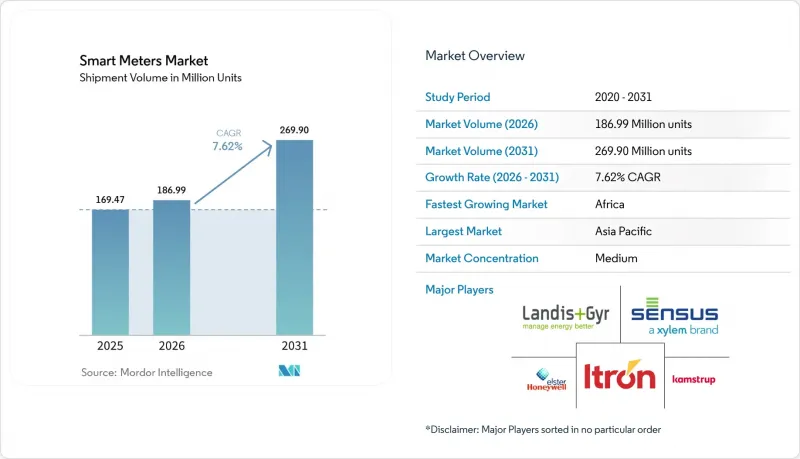
根據 Mordor Intelligence 預測,智慧電錶市場(以出貨量計算)預計將從 2025 年的 1.6947 億台成長到 2026 年的 1.8699 億台,到 2031 年達到 2.699 億台,2026 年至 2031 年的複合年成長率為 2031 年的複合年成長率。
本報告按產品類型(智慧電錶、智慧燃氣表、智慧水錶)、通訊技術(射頻網狀網路、電力線通訊 (PLC)、蜂巢式網路(2G-5G/NB-IoT/LTE-M)、低功耗廣域網路 (LPWA))、組件(硬體、軟體、服務)、最終用戶(住宅、商業、工業和公共產業)以及區域進行工業細分和公用事業區域。市場預測以銷售量(單位)為基礎。
全球智慧電錶市場趨勢及洞察
政府授權在全國範圍內實施
強制部署仍然是智慧電錶市場最強勁的驅動力。歐盟的《能源效率指令》要求成員國實現80%的智慧電錶普及率,使得蘭吉爾和艾創的採購計畫延長至2026年。加州公共產業已完成州政府強制實施的項目,而由高級計量基礎設施(AMI)支持的即時定價在德克薩斯州的零售市場競爭中仍然備受重視。中國國家電網計畫在2024年至2029年間更換3億個電錶,以適應車輛到電網(V2G)供電能力,此舉預計將消耗和興電氣和威盛控股的產能。印度已在其「配電產業改革計畫」下撥款3.03兆盧比(約364億美元),並將2025年的競標授予了拉森特博洛和能源效率服務有限公司。雖然此類指令可以降低投資風險,但卻使供應商面臨政治延誤的風險,如果部署計畫被推遲,可能會對利潤率造成壓力。
提高電力公司效率並減少非技術性損失
非技術性損失估計每年高達960億美元,奈及利亞、南非和拉丁美洲的電力公司正在實施防篡改電錶和遠端斷電系統以減少這些損失。阿布加電力公司在2024年安裝了50萬個預付電錶後,一年內損失減少了15%。南非國家電力公司(Eskom)在約翰尼斯堡的試點計畫利用基於區塊鏈的時間戳技術來防止事後篡改,該計畫已引起肯亞和加納的關注。美國供水系統每天浪費60億加侖的水,洛杉磯和鳳凰城正在實施聲學洩漏檢測系統,可在15分鐘內向工作人員發出警報。營運成本的降低通常可在五年內收回高級計量基礎設施(AMI)的年度成本,而減少損失是資金不足地區實現資金籌措的重要驅動力。
初始資本支出高,投資回收期長
每個終端的實施總成本在150美元到300美元之間,對於擁有100萬用戶的公共產業公司而言,總成本將達到1.5億美元到3億美元。如果監理機關禁止分時電價和資源最佳化支付,投資回收期可能延長至8到12年。肯亞電力公司在2024年暫停了300萬個電錶的競標,原因是財政部因債務問題而拒絕提供貸款擔保。同樣,阿根廷科爾多瓦和門多薩的公共產業公司在比索披索導致進口電錶成本飆升40%後,也縮減了2025年的競標規模。供水事業面臨的處境更加艱難,因為服務成本規則將其利潤率限制在6%到8%,而且由於缺乏補貼,資本形成也受到限制。
細分市場分析
預計到2025年,智慧電錶將佔據70.84%的市場佔有率,這反映了數十年來監管機構的重視。該領域的成長主要受電錶更換週期的驅動,因為智慧電錶在許多先進電網中已達到很高的普及率。相較之下,預計到2031年,智慧水錶的複合年成長率將達到9.62%,主要得益於城市為減少無收益水消耗(通常佔供水量的30%以上)而製定的目標。整合在水錶中的聲學洩漏檢測系統已在洛杉磯和新加坡部署,這些部署時間在2024年至2025年之間。該系統能夠在15分鐘內精確定位洩漏點,使工作人員能夠優先進行維修,而無需更換整條管道。雖然燃氣表的安裝量仍然較低,但歐洲燃氣指令正在推動義大利和荷蘭在2025年前實現全國範圍內的燃氣表部署,這表明遠端關閉功能作為安全和收費管理工具的有效性。
許多市政當局仍然依賴季度人工抄表和固定費率收費,這表明數位化仍有很大的發展空間。中東和南加州地區對ISO 24516洩漏檢測標準的要求進一步凸顯了這項需求。由於燃氣能量密度低且價格波動小,詳細的間隔數據優勢減弱,因此燃氣表的普及仍面臨一些限制。然而,安全法規正迫使公共產業過渡到自動斷氣系統,這可能會在未來十年內促進智慧燃氣的普及。
預計2025年,射頻網狀網路技術將佔據57.24%的市場。這是因為自癒拓撲結構最大限度地減少了對授權頻寬的需求,並支援在高密度都市區部署。儘管如此,窄頻物聯網預計到2031年將以8.02%的複合年成長率成長。沃達豐和中國移動已將每台設備的資料通訊降至2024年每月不到1美元,並調整了總體擁有成本(TCO),使公共產業能夠將網路營運外包。電力線通訊在歐洲市場保持一定的地位,該市場更傾向於PRIME和G3-PLC協議,但在亞洲和非洲部分地區,噪音較大的傳輸線路限制了其擴展性。低功率廣域網路(例如LoRaWAN)正在填補農村地區的網路空白,但它們面臨生態系統碎片化和漫遊限制的問題。
由於3GPP Release 17保證了99.5%的運轉率,且電池壽命超過10年,公共產業越來越傾向於採用蜂窩通訊。這種模式將對專用網狀網路的資本投資轉化為可預測的營運成本,符合優先考慮成本效益的監管要求。雖然在需要高密度局部中繼的場景下,網狀網路仍然十分重要,但發展趨勢顯然正轉向基於許可的蜂窩平台。
區域分析
受中國「十四五」規劃和印度配電產業改革計畫的推動,亞太地區預計到2025年將佔據智慧電錶市場48.58%的佔有率。國家電網將在2020年至2025年間部署2.8億台智慧電錶,並實施分時電價,將12%的住宅用電力負載轉移到非尖峰時段。日本和韓國作為先驅者,目前正在升級其第一代智慧電錶,以適應V2G(車網互動)的整合。東南亞的情況則不盡相同。泰國和越南計劃於2024年啟動試點項目,但面臨資金短缺;而澳洲和紐西蘭已於2024年完成了強制性部署,重點是與屋頂太陽能發電系統整合。
非洲是成長最快的地區,預計到2031年將以8.44%的複合年成長率成長。奈及利亞的電錶資產提供者(MAP)計畫已資助部署了400萬台預付電錶,並在18個月內將其總損耗率從35%降低至28%。南非的分期預付系統允許用戶使用行動支付進行電費支付並可遠端斷電,該系統目前正在肯亞、加納和坦尚尼亞進行試點。埃及已授予Elsewedi Electric公司一份價值3億美元的契約,由非洲開發銀行提供資金,用於在2025年前供應500萬台電錶。政治風險和外匯波動限制了短期供應,但人口成長和電氣化目標支撐了長期需求。
到2025年,歐洲將維持22%的市場佔有率。斯堪地那維亞、英國和義大利的家庭智慧電錶覆蓋率已接近完美,而德國、法國和西班牙在能源效率指令的執行方面也已完成一半。由於東歐團結基金,波蘭和羅馬尼亞在2024年至2025年間參與了競標。北美約佔18%的市場佔有率,在美國,雖然私營公用事業公司的覆蓋率已接近飽和,但市政和合作社系統仍落後於其他地區。加拿大已於2024年完成了省級部署,而墨西哥聯邦電力委員會(CFE)的目標是到2027年安裝1000萬個智慧電錶。南美洲和中東各佔5%至7%的市場佔有率,其中巴西、阿根廷、沙烏地阿拉伯和阿拉伯聯合大公國在區域內引領智慧電錶的普及。
其他好處:
- Excel格式的市場預測(ME)表
- 3個月的分析師支持
目錄
第1章:引言
- 研究假設和市場定義
- 調查範圍
第2章:調查方法
第3章執行摘要
第4章 市場狀況
- 市場概覽
- 市場促進因素
- 政府授權在全國範圍內實施
- 提高電力公司效率並減少非技術性損失
- 電網現代化和分散式能源(DER)的併網
- 智慧城市/物聯網基礎設施的擴展
- 需要數位化計量的ESG關聯融資
- 人工智慧賦能的邊緣分析開啟了新的收入來源。
- 市場限制因素
- 初始投資額高,投資回收期長
- 與網路安全和資料隱私相關的風險
- 傳統電網和IT整合的複雜性
- 半導體供應鏈的波動性
- 產業價值/價值鏈分析
- 監理情勢
- 技術展望
- 波特五力分析
- 宏觀經濟因素對市場的影響
第5章 市場規模與成長預測
- 依產品類型
- 智慧電錶
- 智慧燃氣表
- 智慧水錶
- 透過通訊技術
- 射頻網狀網路
- 電力線路通訊(PLC)
- 蜂窩網路(2G-5G/NB-IoT/LTE-M)
- 低功耗廣域通訊(LoRaWAN/Sigfox/Wize)
- 按組件
- 硬體
- 軟體
- 服務
- 最終用戶
- 住宅
- 商業
- 工業和公共產業
- 按地區
- 北美洲
- 美國
- 加拿大
- 墨西哥
- 南美洲
- 巴西
- 阿根廷
- 其他南美國家
- 歐洲
- 德國
- 英國
- 法國
- 義大利
- 西班牙
- 俄羅斯
- 其他歐洲國家
- 亞太地區
- 中國
- 日本
- 印度
- 韓國
- 澳洲和紐西蘭
- 東南亞
- 其他亞太國家
- 中東
- 沙烏地阿拉伯
- 阿拉伯聯合大公國
- 土耳其
- 其他中東國家
- 非洲
- 南非
- 奈及利亞
- 埃及
- 其他非洲國家
- 北美洲
第6章 競爭情勢
- 市場集中度
- 策略趨勢
- 市佔率分析
- 公司簡介
- Landis+Gyr Group AG
- Itron Inc.
- Sensus USA Inc.(Xylem Inc.)
- Honeywell(Elster Group)
- Kamstrup A/S
- Siemens AG
- Schneider Electric SE
- Huawei Technologies Co. Ltd.
- General Electric Co.
- Aclara Technologies LLC(Hubbell)
- EDMI Limited(Osaki Electric)
- Apator SA
- Arad Group
- Badger Meter Inc.
- Diehl Metering GmbH
- Hexing Electrical Co. Ltd.
- Holley Technology Ltd.
- Jiangsu Linyang Energy Co.
- Wasion Holdings Ltd.
- Zenner International GmbH
- Neptune Technology Group(Roper)
- Baylan Water Meters
- ZIV Automation
- Pietro Fiorentini SpA
- ADD GRUP
- Yazaki Corporation
第7章 市場機會與未來展望
According to Mordor Intelligence, the smart meters market size in terms of shipment volume is expected to increase from 169.47 Million units in 2025 to 186.99 Million units in 2026 and reach 269.90 Million units by 2031, growing at a CAGR of 7.62% over 2026-2031.
This report is Segmented by Product Type (Smart Electricity Meters, Smart Gas Meters, and Smart Water Meters), Communication Technology (RF Mesh, Power-Line Communication (PLC), Cellular (2G-5G / NB-IoT / LTE-M), and LPWA), Component (Hardware, Software, and Services), End User (Residential, Commercial, and Industrial and Utilities), and Geography. The Market Forecasts are Provided in Terms of Volume (Units).
Global Smart Meters Market Trends and Insights
Government Mandates for Nationwide Roll-outs
Mandated deployments remain the most potent catalyst for the smart meters market. The European Union's Energy Efficiency Directive compelled members to reach 80% penetration, extending procurement pipelines for Landis and Gyr and Itron into 2026. California utilities completed state-ordered programs, and Texas retail competition continues to reward real-time pricing enabled by AMI. China's State Grid scheduled replacement of 300 Million meters during 2024-2029 to accommodate vehicle-to-grid functionality, a move absorbing capacity from Hexing Electrical and Wasion Holdings. India earmarked INR 3.03 Trillion (USD 36.4 Billion) under its Revamped Distribution Sector Scheme, awarding 2025 tenders to Larsen and Toubro and Energy Efficiency Services Limited. While mandates de-risk investment, they expose vendors to political delays that can compress margins when roll-out schedules slip.
Utility Efficiency and Non-Technical-Loss Reduction
Non-technical losses drain an estimated USD 96 Billion annually, and utilities in Nigeria, South Africa, and Latin America are using tamper-proof meters and remote disconnects to address the gap. Abuja Electricity Distribution Company cut losses by 15% within a year after installing 500,000 prepaid meters in 2024. Eskom's Johannesburg pilot utilized blockchain time stamping to thwart post-facto tampering, attracting interest across Kenya and Ghana. U.S. systems waste 6 Billion gallons daily, prompting Los Angeles and Phoenix to adopt acoustic leak detection that alerts crews within 15 minutes. Operational savings often recoup annualized AMI costs inside five years, making loss reduction a self-funding driver in cash-strapped territories.
High Upfront CAPEX and Long Payback Cycles
All-in deployment costs range from USD 150 to USD 300 per endpoint, translating into USD 150 Million-USD 300 Million for a 1 Million-customer utility. Payback can stretch to 8-12 years if regulators prohibit time-of-use tariffs or resource adequacy payments. Kenya Power paused a 3 Million-meter tender in 2024 after its National Treasury withheld loan guarantees over debt concerns. Argentina's Cordoba and Mendoza utilities similarly downsized tenders in 2025 after peso depreciation inflated imported meter costs by 40%. Water utilities feel an even tighter squeeze because cost-of-service rules cap returns at 6%-8%, limiting capital formation without subsidies.
Other drivers and restraints analyzed in the detailed report include:
- Grid Modernization and DER Integration Programs
- Smart-City and IoT Infrastructure Expansion
- Cyber-Security and Data-Privacy Risks
For complete list of drivers and restraints, kindly check the Table Of Contents.
Segment Analysis
Smart electricity meters commanded 70.84% share in 2025, reflecting decades of regulatory focus. The segment has reached high penetration in many developed grids, so growth aligns mainly with replacement cycles. Smart water meters, by contrast, are poised for a 9.62% CAGR to 2031 as cities target non-revenue water that often exceeds 30% of supply. Acoustic leak detection embedded in meters deployed by Los Angeles and Singapore in 2024-2025 demonstrated sub-15-minute burst identification, enabling crews to triage repairs without wholesale main replacement. Gas meters remain smaller in volume, yet Europe's Gas Directive drove nationwide roll-outs in Italy and the Netherlands by 2025, validating remote shut-off as a safety and billing tool.
Many municipalities still rely on quarterly manual reads or flat-rate billing, leaving substantial digital headroom. Compliance with ISO 24516 leak detection targets in the Middle East and Southern California adds urgency. Gas meter adoption remains constrained by lower energy density and minimal price differentiation throughout the day, reducing the benefit of granular interval data. However, safety regulations are nudging utilities toward automated shut-off, which could bolster smart gas penetration over the next decade.
RF mesh technology held a 57.24% share in 2025 because self-healing topology minimizes the need for licensed spectrum and supports dense urban deployments. Even so, narrowband IoT is projected to advance at an 8.02% CAGR through 2031. Vodafone and China Mobile slashed per-device data tariffs below USD 1 per month in 2024, realigning total cost of ownership and enabling utilities to outsource network operations. Power-line communication retains a foothold in European markets favoring PRIME and G3-PLC protocols, yet noisy feeders in parts of Asia and Africa limit scalability. Low-power wide-area networks such as LoRaWAN fill rural gaps but suffer from ecosystem fragmentation and limited roaming.
Utilities increasingly prefer cellular because 3GPP Release 17 extends battery life past 10 years while guaranteeing 99.5% uptime. The model converts capital outlay for private mesh into a predictable operating expense, aligning with regulatory requirements that favor rate-base efficiency. Mesh will remain relevant where density justifies localized relay, yet the growth trajectory clearly tilts toward licensed cellular platforms.
Geography Analysis
Asia Pacific secured 48.58% of the smart meters market share in 2025, powered by China's 14th Five-Year Plan and India's Revamped Distribution Sector Scheme. State Grid deployed 280 Million meters during 2020-2025, enabling time-of-use tariffs that shifted 12% of residential load to off-peak hours. Japan and South Korea, early adopters, are now upgrading first-generation devices to support vehicle-to-grid aggregation. Southeast Asia remains uneven; Thailand and Vietnam launched pilots in 2024 but face funding gaps, while Australia and New Zealand completed mandatory roll-outs by 2024 with a focus on rooftop solar integration.
Africa is the fastest expanding region at 8.44% CAGR to 2031. Nigeria's Meter Asset Provider program financed 4 Million prepaid meters, trimming aggregate losses from 35% to 28% inside 18 months. South Africa's split-prepaid systems allow mobile money purchases and remote disconnect, an approach Kenya, Ghana, and Tanzania are now testing. Egypt awarded Elsewedy Electric a USD 300 Million contract in 2025 to supply 5 Million meters under African Development Bank financing. Political risk and currency volatility temper near-term volume, but demographic growth and electrification targets underpin long-run demand.
Europe maintained 22% share in 2025. Scandinavia, the United Kingdom, and Italy achieved near-universal penetration, while Germany, France, and Spain are midway through compliance with the Energy Efficiency Directive. Eastern European cohesion funds propelled Poland and Romania into tenders during 2024-2025. North America captured roughly 18%, with the United States approaching saturation in investor-owned utility territories but lagging in municipal and cooperative systems. Canada finished provincial roll-outs by 2024, whereas Mexico's Comision Federal de Electricidad targets 10 Million meters by 2027. South America and the Middle East each accounted for 5%-7% of revenues, with Brazil, Argentina, Saudi Arabia, and the United Arab Emirates driving localized initiatives.
- Landis+Gyr Group AG
- Itron Inc.
- Sensus USA Inc. (Xylem Inc.)
- Honeywell (Elster Group)
- Kamstrup A/S
- Siemens AG
- Schneider Electric SE
- Huawei Technologies Co. Ltd.
- General Electric Co.
- Aclara Technologies LLC (Hubbell)
- EDMI Limited (Osaki Electric)
- Apator SA
- Arad Group
- Badger Meter Inc.
- Diehl Metering GmbH
- Hexing Electrical Co. Ltd.
- Holley Technology Ltd.
- Jiangsu Linyang Energy Co.
- Wasion Holdings Ltd.
- Zenner International GmbH
- Neptune Technology Group (Roper)
- Baylan Water Meters
- ZIV Automation
- Pietro Fiorentini SpA
- ADD GRUP
- Yazaki Corporation
Additional Benefits:
- The market estimate (ME) sheet in Excel format
- 3 months of analyst support
TABLE OF CONTENTS
1 INTRODUCTION
- 1.1 Study Assumptions and Market Definition
- 1.2 Scope of the Study
2 RESEARCH METHODOLOGY
3 EXECUTIVE SUMMARY
4 MARKET LANDSCAPE
- 4.1 Market Overview
- 4.2 Market Drivers
- 4.2.1 Government Mandates for Nationwide Roll-outs
- 4.2.2 Utility Efficiency and Non-Technical-Loss Reduction
- 4.2.3 Grid Modernisation and DER Integration Programs
- 4.2.4 Smart-City / IoT Infrastructure Expansion
- 4.2.5 ESG-Linked Financing Requiring Digital Metering
- 4.2.6 AI-Ready Edge Analytics Unlocking New Revenue Streams
- 4.3 Market Restraints
- 4.3.1 High Upfront CAPEX and Long Payback Cycles
- 4.3.2 Cyber-Security and Data-Privacy Risks
- 4.3.3 Legacy Grid and IT Integration Complexity
- 4.3.4 Semiconductor Supply-Chain Volatility
- 4.4 Industry Value / Supply-Chain Analysis
- 4.5 Regulatory Landscape
- 4.6 Technological Outlook
- 4.7 Porter's Five Forces Analysis
- 4.7.1 Bargaining Power of Suppliers
- 4.7.2 Bargaining Power of Buyers
- 4.7.3 Threat of New Entrants
- 4.7.4 Threat of Substitute Products
- 4.7.5 Degree of Competition
- 4.8 Impact of Macroeconomic Factors on the Market
5 MARKET SIZE AND GROWTH FORECASTS (VOLUME)
- 5.1 By Product Type
- 5.1.1 Smart Electricity Meters
- 5.1.2 Smart Gas Meters
- 5.1.3 Smart Water Meters
- 5.2 By Communication Technology
- 5.2.1 RF Mesh
- 5.2.2 Power-Line Communication (PLC)
- 5.2.3 Cellular (2G-5G / NB-IoT / LTE-M)
- 5.2.4 Low-Power Wide Area (LoRaWAN / Sigfox / Wize)
- 5.3 By Component
- 5.3.1 Hardware
- 5.3.2 Software
- 5.3.3 Services
- 5.4 By End-User
- 5.4.1 Residential
- 5.4.2 Commercial
- 5.4.3 Industrial and Utilities
- 5.5 By Geography
- 5.5.1 North America
- 5.5.1.1 United States
- 5.5.1.2 Canada
- 5.5.1.3 Mexico
- 5.5.2 South America
- 5.5.2.1 Brazil
- 5.5.2.2 Argentina
- 5.5.2.3 Rest of South America
- 5.5.3 Europe
- 5.5.3.1 Germany
- 5.5.3.2 United Kingdom
- 5.5.3.3 France
- 5.5.3.4 Italy
- 5.5.3.5 Spain
- 5.5.3.6 Russia
- 5.5.3.7 Rest of Europe
- 5.5.4 Asia Pacific
- 5.5.4.1 China
- 5.5.4.2 Japan
- 5.5.4.3 India
- 5.5.4.4 South Korea
- 5.5.4.5 Australia and New Zealand
- 5.5.4.6 Southeast Asia
- 5.5.4.7 Rest of Asia Pacific
- 5.5.5 Middle East
- 5.5.5.1 Saudi Arabia
- 5.5.5.2 United Arab Emirates
- 5.5.5.3 Turkey
- 5.5.5.4 Rest of Middle East
- 5.5.6 Africa
- 5.5.6.1 South Africa
- 5.5.6.2 Nigeria
- 5.5.6.3 Egypt
- 5.5.6.4 Rest of Africa
- 5.5.1 North America
6 COMPETITIVE LANDSCAPE
- 6.1 Market Concentration
- 6.2 Strategic Moves
- 6.3 Market Share Analysis
- 6.4 Company Profiles (includes Global level Overview, Market level overview, Core Segments, Financials as available, Strategic Information, Market Rank/Share for key companies, Products and Services, and Recent Developments)
- 6.4.1 Landis+Gyr Group AG
- 6.4.2 Itron Inc.
- 6.4.3 Sensus USA Inc. (Xylem Inc.)
- 6.4.4 Honeywell (Elster Group)
- 6.4.5 Kamstrup A/S
- 6.4.6 Siemens AG
- 6.4.7 Schneider Electric SE
- 6.4.8 Huawei Technologies Co. Ltd.
- 6.4.9 General Electric Co.
- 6.4.10 Aclara Technologies LLC (Hubbell)
- 6.4.11 EDMI Limited (Osaki Electric)
- 6.4.12 Apator SA
- 6.4.13 Arad Group
- 6.4.14 Badger Meter Inc.
- 6.4.15 Diehl Metering GmbH
- 6.4.16 Hexing Electrical Co. Ltd.
- 6.4.17 Holley Technology Ltd.
- 6.4.18 Jiangsu Linyang Energy Co.
- 6.4.19 Wasion Holdings Ltd.
- 6.4.20 Zenner International GmbH
- 6.4.21 Neptune Technology Group (Roper)
- 6.4.22 Baylan Water Meters
- 6.4.23 ZIV Automation
- 6.4.24 Pietro Fiorentini SpA
- 6.4.25 ADD GRUP
- 6.4.26 Yazaki Corporation
7 MARKET OPPORTUNITIES AND FUTURE OUTLOOK
- 7.1 White-Space and Unmet-Need Assessment

 全球智慧電錶市場:按類型、組件、技術、通訊技術、最終用戶和地區分類-預測至2031年
 中東和非洲智慧電錶:市場佔有率分析、行業趨勢和統計數據以及成長預測(2026-2031 年)南美和中美洲智慧電錶:市場佔有率分析、行業趨勢和統計數據以及成長預測(2026-2031 年)
 智慧電錶市場:按類型、通訊技術、技術、組件、階段、應用、最終用途、部署模式和客戶類型分類-2026-2032年全球市場預測
 歐洲智慧電錶市場(第20版)
 智慧電錶市場規模、佔有率和趨勢分析報告:按組件、類型、技術、最終用途、地區和細分市場分類(2026-2033 年)
 智慧電錶市場預測——全球產品、組件、通訊技術、技術、應用、最終用戶和地區分析——2034年
 物聯網市場追蹤調查:計量北美智慧電錶:市場佔有率分析、產業趨勢與統計及成長預測(2026-2031 年)
 2026年全球智慧電錶市場報告