


 |
市場調查報告書
商品編碼
2121452
美國溫度感測器:市場佔有率分析、行業趨勢和統計數據、成長預測(2026-2031)US Temperature Sensors - Market Share Analysis, Industry Trends & Statistics, Growth Forecasts (2026 - 2031) |
||||||

※ 本網頁內容可能與最新版本有所差異。詳細情況請與我們聯繫。
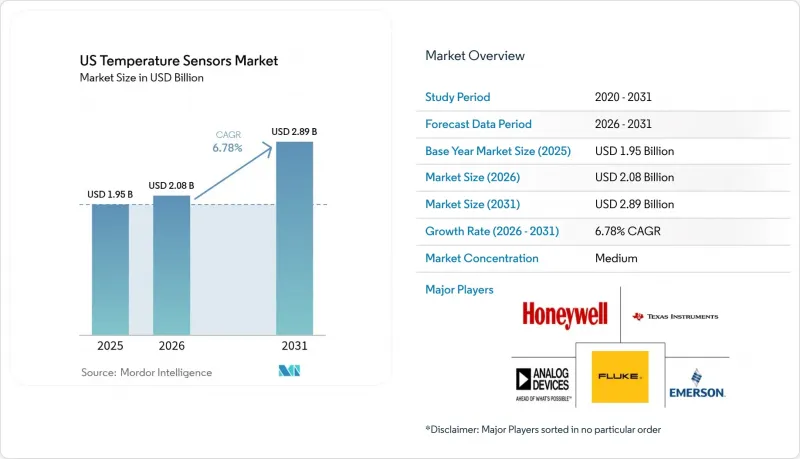
根據 Mordor Intelligence 預測,美國溫度感測器市場將從 2025 年的 19.5 億美元成長到 2026 年的 20.8 億美元,然後在 2031 年達到 28.9 億美元,2026 年至 2031 年的複合年成長率為 6.78%。
本報告依類型(有線、無線)、技術(紅外線、熱電偶、熱電阻、熱敏電阻器等)、終端用戶產業(化學及石化、石油天然氣、金屬及採礦等)、連接方式(接觸式、非接觸式)及應用環境(工業製程監控、暖通空調、建築自動化等)分類。市場預測以美元計價。
美國溫度感測器市場趨勢與洞察
工業4.0的擴展和智慧工廠的引入
工業數位化正在透過整合人工智慧、機器人和互聯測量儀器(其中溫度感測是核心)來變革工廠車間。預測性維護程序曾經僅對少數關鍵資產進行採樣,如今已涵蓋覆蓋整條生產線的數百個節點,能夠在機械故障發生前數小時檢測到溫度異常。德克薩斯(TI) 的新型感測器整合了邊緣人工智慧晶片組,可處理本地資料流,並在毫秒延遲的情況下觸發自動響應警報。 FOUNDATION Fieldbus 和 PROFINET 等互通協定簡化了系統整合。此外,堅固的機殼和寬廣的溫度範圍確保即使在多塵和高振動的環境中也能可靠運作。因此,美國溫度感測器市場持續受益於傳統 PLC 網路的替換需求以及新建智慧工廠的新增需求。
穿戴式消費性電子產品對溫度感測的需求日益成長。
微型化、低功耗晶片將臨床級溫度精度整合到日常設備中,使消費者能夠以±0.1 度C的精度追蹤核心體溫,從而實現疾病的早期檢測。可拉伸的基板能夠與皮膚保持數天不刺激,而雙感測器耳道設計則可提供適用於遠端醫療工作流程的連續測量。第五代蜂窩通訊和邊緣運算晶片將加密資料流傳輸到醫療儀表板,使臨床醫生能夠進行遠端干預。這項功能在居家照護計畫中備受重視。對於感測器製造商而言,採用這些設計在同樣對功耗要求嚴格的工業IoT領域以及可以進行大規模生產的消費管道中都具有技術優勢。由此產生的需求正在推動美國溫度感測器市場迎來一波快速的創新浪潮。
半導體和鉑族金屬價格波動
鎵、鍺和鉑的價格波動正在擾亂電阻溫度檢測器器 (RTD) 和高精度晶片式探頭的成本結構。由於中國在鎵和鍺的提煉方面佔據主導地位,美國買家容易受到出口限制的影響。同時,隨著燃料電池和觸媒轉換器需求的不斷成長,鉑薄膜的供應也日益緊張。預算的不確定性可能會推遲升級項目,可能會導致美國溫度感測器市場短期銷售下降。
細分市場分析
由於關鍵迴路和現有DCS佈線中有線連接的可靠性,有線設備在2025年佔銷售額的68.62%;而無線節點則因其易於維修和安裝成本較低,正以10.22%的複合年成長率快速成長。預計到2031年,美國溫度感測器市場中無線產品的市場規模將達到10.9億美元,反映出資料中心和食品加工廠對無線產品的強勁需求。麻省理工學院開發的自發電能量採集器消除了電池維護的障礙,拓展了其在泵浦、窯爐和旋轉機械等領域的應用。在大型工廠中,LoRaWAN和5G NB-IoT技術能夠以毫瓦級的電力消耗實現數公里級的通訊範圍,使工廠管理人員無需鋪設電纜即可獲得精細的熱力圖。
隨著跳頻和AES-128加密技術的標準化,曾經籠罩無線技術的可靠性問題逐漸消退。邊緣微控制器現在能夠預處理測量數據,從而顯著減少資料包有效載荷,緩解工廠骨幹網路的擁塞。同時,在核能、製藥和航太領域,有線技術仍佔據主導地位,因為管治協議要求採用固定佈線和類比輸出。供應商將4-20 mA迴路與連接Wi-Fi或低頻段無線電的混合模式閘道器捆綁銷售,正乘著混合部署的浪潮,不斷擴大其在美國溫度感測器市場的佔有率。
熱電偶能夠承受高達 2300 度C 的極端溫度,在 2025 年的銷售額中佔 31.95%。然而,隨著工業領域對空間解析度而非點測量的需求不斷成長,分散式光纖系統市場正以 11.10% 的複合年成長率快速成長。預計到 2031 年,美國分散式溫度感測 (DTS) 溫度感測器市場規模將超過 5.254 億美元。不受電磁干擾 (EMI) 影響的光纖線路可用於高壓艙和感應爐等電子設備無法正常運作的場所。 Luna Innovations 的高解析度裝置可實現亞毫米級解析度,目前正用於電池模組和低溫管道的測繪。
在製藥無塵室和測量實驗室等需要±0.1 度C精度的場所,電阻式溫度檢測器(RTD)仍佔據主導地位。熱敏電阻器則用於對成本要求較高的設備,而紅外線陣列則支援熱成像技術,可用於預測性維護。支援HART、Modbus或乙太網路協定的混合型變送器簡化了與數位孿生系統的整合。提供全端解決方案(包括感測元件、頭戴式傳送器和分析韌體)的供應商正在增強其收入來源,並鞏固其在美國溫度感測器市場的地位。
其他好處:
- Excel格式的市場預測(ME)表
- 3個月的分析師支持
目錄
第1章:引言
- 研究假設和市場定義
- 調查範圍
第2章:調查方法
第3章執行摘要
第4章 市場狀況
- 市場概覽
- 市場促進因素
- 工業4.0的擴展和智慧工廠的引入
- 穿戴式消費性電子產品對溫度感測功能的需求日益成長。
- 汽車電子產品和電動車對溫度控管的要求日益提高
- 物聯網感測器在mRNA疫苗冷鏈物流的應用
- 隨著資料中心對液冷的需求快速成長,分散式感測將變得不可或缺。
- 聯邦政府為促進國內生產而製定的政策正在推動製造工廠採用熱過程感測器。
- 市場限制因素
- 半導體和鉑族金屬價格波動
- 由於設計引進週期延長,受監管區域的感測器更新滯後。
- 關鍵基礎設施中無線感測器的網路安全問題
- 光纖安裝技術人員短缺阻礙了分散式感測技術的應用。
- 監理情勢
- 技術展望
- 波特五力分析
第5章 市場規模與成長預測
- 按類型
- 有線型
- 無線的
- 透過技術
- 紅外線的
- 熱電偶
- 電阻溫度檢測器(RTD)
- 熱敏電阻器
- 溫度變送器
- 光纖
- 其他
- 按最終用戶行業分類
- 化工/石油化工
- 石油和天然氣
- 金屬和採礦
- 發電
- 食品/飲料
- 車
- 醫學領域
- 航太/軍事
- 家用電子產品
- 其他終端用戶產業
- 連結性別
- 聯繫類型
- 非接觸式
- 按部署環境
- 工業製程監控
- 暖通空調和建築自動化
- 醫療保健和穿戴式設備
- 電動汽車電池管理
- 資料中心和通訊
第6章 競爭情勢
- 市場集中度
- 策略趨勢
- 市佔率分析
- 公司簡介
- Texas Instruments Inc.
- Honeywell International Inc.
- TE Connectivity Ltd
- Analog Devices Inc.
- Siemens AG
- Panasonic Corp.
- ABB Ltd
- Emerson Electric Co.
- STMicroelectronics
- Microchip Technology Inc.
- NXP Semiconductors NV
- Robert Bosch GmbH
- DENSO Corp.
- FLIR Systems(Teledyne)
- Omron Corp.
- Maxim Integrated(ADI)
- Fluke Process Instruments
- Sensirion AG
- Amphenol Advanced Sensors
- Silixa Ltd
- AP Sensing GmbH
第7章 市場機會與未來展望
According to Mordor Intelligence, the US temperature sensors market size is expected to grow from USD 1.95 billion in 2025 to USD 2.08 billion in 2026 and is forecast to reach USD 2.89 billion by 2031 at 6.78% CAGR over 2026-2031.
This report is Segmented by Type (Wired, Wireless), Technology (Infrared, Thermocouple, RTD, Thermistor and More), End-User Industry (Chemical and Petrochemical, Oil and Gas, Metal and Mining and More), Connectivity (Contact, Non-Contact), Application Environment (Industrial Process Monitoring, HVAC and Building Automation and More). The Market Forecasts are Provided in Terms of Value (USD).
US Temperature Sensors Market Trends and Insights
Expansion of Industry 4.0 and smart-factory adoption
Industrial digitalization reshapes factory floors by fusing AI, robotics, and connected instrumentation, and temperature sensing sits at the heart of that convergence. Predictive maintenance programs that once sampled a few key assets now blanket entire production lines with hundreds of nodes that flag thermal deviations hours before mechanical breakdowns. Edge AI chipsets embedded in new sensors from Texas Instruments crunch local data streams so millisecond-level alerts can trigger automated responses without cloud latency. Interoperable protocols such as FOUNDATION Fieldbus and PROFINET simplify system integration, while ruggedized housings and extended temperature ranges ensure reliable service in dusty, high-vibration zones. As a result, the US temperature sensors market keeps enjoying replacement sales into heritage PLC networks and fresh demand from green-field smart factories.
Growing demand for temperature sensing in wearable consumer electronics
Miniaturized, low-power die have brought clinical-grade temperature accuracy into everyday devices, letting consumers track core body temperature within +-0.1 °C for early illness detection. Stretchable substrates now conform to skin for days without irritation, and dual-sensor ear-canal designs deliver continuous readings that fit into telehealth workflows. Fifth-generation cellular links and edge computing chips send encrypted streams to healthcare dashboards so clinicians can intervene remotely, a capability valued by aging-in-place programs. For sensor makers, these design wins offer high-volume consumer channels plus technology leverage across industrial IoT where power budgets are equally tight. The resulting pull keeps the US temperature sensors market on a steep innovation curve.
Volatility in semiconductor and platinum-group metal prices
Price swings in gallium, germanium, and platinum upset cost structures for RTDs and high-precision chip-based probes. China's command of gallium and germanium refining keeps US buyers vulnerable to export restrictions, while platinum thin films face supply tightness amid intensified fuel-cell and catalytic-converter demand. Budget uncertainty can delay upgrade projects, trimming near-term volumes inside the US temperature sensors market.
Other drivers and restraints analyzed in the detailed report include:
- Rising automotive electronics and EV thermal-management requirements
- Adoption of cold-chain IoT sensors for mRNA-vaccine logistics
- Cyber-security concerns over wireless sensors in critical infrastructure
For complete list of drivers and restraints, kindly check the Table Of Contents.
Segment Analysis
Wired devices retained 68.62% of 2025 revenue thanks to hard-wired reliability in safety-critical loops and existing DCS cabling, yet wireless nodes are scaling 10.22% CAGR on retrofit ease and lower installation costs. The US temperature sensors market size for wireless products is forecast to reach USD 1.09 billion by 2031, reflecting robust adoption in data centers and food plants. Self-powered harvesters developed at MIT remove battery maintenance barriers and widen use cases in pumps, kilns, and rotating equipment. In sprawling factories, LoRaWAN and 5G NB-IoT enable kilometer-scale reach with milliwatt power budgets, giving plant managers granular heat maps without trenching cable.
Reliability fears that once shadowed wireless have faded as frequency-hopping and AES-128 encryption become standard. Edge microcontrollers now pre-process readings to slash packet payloads, reducing congestion on factory backbones. Meanwhile, wired incumbency endures in nuclear, pharma, and aerospace lines where governance protocols require fixed cabling and analog outputs. Suppliers that bundle mixed-mode gateways bridging 4-20 mA loops with Wi-Fi or Sub-GHz radios capitalize on hybrid roll-outs and expand their stake in the US temperature sensors market.
Thermocouples brought in 31.95% of 2025 turnover by covering extreme heat up to 2,300 °C, but distributed fiber-optic systems are rocketing at 11.10% CAGR as industries crave spatial resolution over point checks. The US temperature sensors market size for DTS is projected to exceed USD 525.4 million by 2031. Immune to EMI, fiber lines navigate high-voltage bays and induction furnaces where electronics fail. High-definition units from Luna Innovations achieve sub-millimeter granularity, mapping battery modules and cryogenic pipelines alike.
Resistance Temperature Detectors still dominate pharma cleanrooms and metrology labs that stipulate +-0.1 °C accuracy. Thermistors capture cost-sensitive appliances, while infrared arrays unlock thermal imaging for predictive maintenance. Hybrid transmitters delivering HART, Modbus, or Ethernet protocols simplify integration into digital twins. Vendors that supply full stacks sensing element, head-mount transmitter, and analytics firmware bolster recurring revenue and deepen their position inside the US temperature sensors market.
Complete Report Scope:
- By Type
- Wired
- Wireless
- By Technology
- Infrared
- Thermocouple
- Resistance Temperature Detector (RTD)
- Thermistor
- Temperature Transmitter
- Fiber Optic
- Others
- By End-user Industry
- Chemical and Petrochemical
- Oil and Gas
- Metal and Mining
- Power Generation
- Food and Beverage
- Automotive
- Medical
- Aerospace and Military
- Consumer Electronics
- Other End-user Industries
- By Connectivity
- Contact
- Non-Contact
- By Application Environment
- Industrial Process Monitoring
- HVAC and Building Automation
- Healthcare and Wearables
- Electric-Vehicle Battery Management
- Data Centers and Telecom
List of Companies Covered in this Report:
- Texas Instruments Inc.
- Honeywell International Inc.
- TE Connectivity Ltd
- Analog Devices Inc.
- Siemens AG
- Panasonic Corp.
- ABB Ltd
- Emerson Electric Co.
- STMicroelectronics
- Microchip Technology Inc.
- NXP Semiconductors NV
- Robert Bosch GmbH
- DENSO Corp.
- FLIR Systems (Teledyne)
- Omron Corp.
- Maxim Integrated (ADI)
- Fluke Process Instruments
- Sensirion AG
- Amphenol Advanced Sensors
- Silixa Ltd
- AP Sensing GmbH
Additional Benefits:
- The market estimate (ME) sheet in Excel format
- 3 months of analyst support
TABLE OF CONTENTS
1 INTRODUCTION
- 1.1 Study Assumptions and Market Definition
- 1.2 Scope of the Study
2 RESEARCH METHODOLOGY
3 EXECUTIVE SUMMARY
4 MARKET LANDSCAPE
- 4.1 Market Overview
- 4.2 Market Drivers
- 4.2.1 Expansion of Industry 4.0 and smart-factory adoption
- 4.2.2 Growing demand for temperature sensing in wearable consumer electronics
- 4.2.3 Rising automotive electronics and EV thermal-management requirements
- 4.2.4 Adoption of cold-chain IoT sensors for mRNA-vaccine logistics
- 4.2.5 Rapid growth of data-center liquid-cooling needs distributed sensing
- 4.2.6 Federal on-shoring incentives boosting in-fab thermal-process sensors
- 4.3 Market Restraints
- 4.3.1 Volatility in semiconductor and platinum-group metal prices
- 4.3.2 Lengthy design-in cycles slow sensor replacement in regulated sectors
- 4.3.3 Cyber-security concerns over wireless sensors in critical infrastructure
- 4.3.4 Shortage of fiber-optic installers curbs distributed sensing roll-out
- 4.4 Regulatory Landscape
- 4.5 Technological Outlook
- 4.6 Porter's Five Forces Analysis
- 4.6.1 Bargaining Power of Suppliers
- 4.6.2 Bargaining Power of Buyers
- 4.6.3 Threat of New Entrants
- 4.6.4 Threat of Substitutes
- 4.6.5 Competitive Rivalry Intensity
5 MARKET SIZE AND GROWTH FORECASTS (VALUE)
- 5.1 By Type
- 5.1.1 Wired
- 5.1.2 Wireless
- 5.2 By Technology
- 5.2.1 Infrared
- 5.2.2 Thermocouple
- 5.2.3 Resistance Temperature Detector (RTD)
- 5.2.4 Thermistor
- 5.2.5 Temperature Transmitter
- 5.2.6 Fiber Optic
- 5.2.7 Others
- 5.3 By End-user Industry
- 5.3.1 Chemical and Petrochemical
- 5.3.2 Oil and Gas
- 5.3.3 Metal and Mining
- 5.3.4 Power Generation
- 5.3.5 Food and Beverage
- 5.3.6 Automotive
- 5.3.7 Medical
- 5.3.8 Aerospace and Military
- 5.3.9 Consumer Electronics
- 5.3.10 Other End-user Industries
- 5.4 By Connectivity
- 5.4.1 Contact
- 5.4.2 Non-Contact
- 5.5 By Application Environment
- 5.5.1 Industrial Process Monitoring
- 5.5.2 HVAC and Building Automation
- 5.5.3 Healthcare and Wearables
- 5.5.4 Electric-Vehicle Battery Management
- 5.5.5 Data Centers and Telecom
6 COMPETITIVE LANDSCAPE
- 6.1 Market Concentration
- 6.2 Strategic Moves
- 6.3 Market Share Analysis
- 6.4 Company Profiles (includes Global level Overview, Market level overview, Core Segments, Financials as available, Strategic Information, Market Rank/Share for key companies, Products and Services, and Recent Developments)
- 6.4.1 Texas Instruments Inc.
- 6.4.2 Honeywell International Inc.
- 6.4.3 TE Connectivity Ltd
- 6.4.4 Analog Devices Inc.
- 6.4.5 Siemens AG
- 6.4.6 Panasonic Corp.
- 6.4.7 ABB Ltd
- 6.4.8 Emerson Electric Co.
- 6.4.9 STMicroelectronics
- 6.4.10 Microchip Technology Inc.
- 6.4.11 NXP Semiconductors NV
- 6.4.12 Robert Bosch GmbH
- 6.4.13 DENSO Corp.
- 6.4.14 FLIR Systems (Teledyne)
- 6.4.15 Omron Corp.
- 6.4.16 Maxim Integrated (ADI)
- 6.4.17 Fluke Process Instruments
- 6.4.18 Sensirion AG
- 6.4.19 Amphenol Advanced Sensors
- 6.4.20 Silixa Ltd
- 6.4.21 AP Sensing GmbH
7 MARKET OPPORTUNITIES AND FUTURE OUTLOOK
- 7.1 White-space and Unmet-need Assessment

 液態氮溫度感測器市場報告:趨勢、預測和競爭分析(至2035年)
 溫度感測器:市場佔有率分析、產業趨勢與統計、成長預測(2026-2031)熱敏電阻器電阻溫度感測器:市場佔有率分析、產業趨勢與統計及成長預測(2026-2031)
 溫度感測器市場-全球市場預測(2026-2032年)
 無線溫度鉗市場規模、佔有率和成長分析:按連接方式、顯示配置、鉗口寬度、應用、分銷管道和地區分類-2026-2033年產業預測
 體溫偵測螢幕市場規模、佔有率和成長分析:按類型、應用、精確度、最終用戶、通路和地區分類-2026-2033年產業預測
 城市氣候監測系統市場預測至2034年—按組件、部署模式、技術、應用、最終用戶和地區分類的全球分析
 溫度感測器市場:按類型和地區分類雙感測器模組市場:按模組類型、感測器類型、技術、應用、終端用戶產業和分銷管道分類,全球預測,2026-2032年
 體溫篩檢系統市場規模、佔有率和成長分析:按產品類型、技術、最終用戶和地區分類-2026-2033年產業預測