


 |
市場調查報告書
商品編碼
2120434
溫度感測器:市場佔有率分析、產業趨勢與統計、成長預測(2026-2031)Temperature Sensors - Market Share Analysis, Industry Trends & Statistics, Growth Forecasts (2026 - 2031) |
||||||

※ 本網頁內容可能與最新版本有所差異。詳細情況請與我們聯繫。
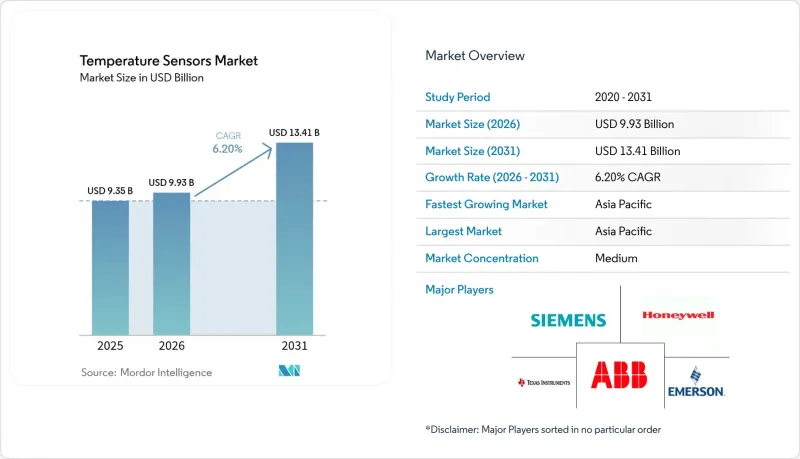
根據 Mordor Intelligence 預測,溫度感測器市場規模將從 2025 年的 93.5 億美元成長到 2026 年的 99.3 億美元,到 2031 年將達到 134.1 億美元,2026 年至 2031 年的複合年成長率為 6.2%。
本報告按類型(有線、無線)、輸出(類比、數位)、技術(接觸式熱電偶等)、終端用戶產業(化學和石化、石油和天然氣等)以及地區進行細分。市場預測以美元計價。
全球溫度感測器市場趨勢及洞察
歐洲製程工業中智慧工業物聯網溫度網路的擴展
歐洲製造商正將無線溫度節點整合到現有的控制架構中,以實現工業5.0在能源效率和工人安全方面的目標。免維護感測器設計降低了生命週期成本,簡化了改裝部署,使其對化學、紡織廠和暖通空調升級改造極具吸引力。人工智慧驅動的控制迴路利用更豐富的資料流來穩定壓力和溫度環境,從而提高產品產量並減少停機時間。一項針對美國小規模工廠的投資回報率 (ROI) 研究表明,營運成本的節省超過了初始工業物聯網 (IIoT) 硬體成本,證明了類似專案的資本預算是合理的。因此,即使在可靠性要求極高的應用中,無線節點的採用也正在加速發展,溫度感測器市場正迅速轉型為互聯架構。
GaN/SiC功率電子技術的日益普及推動了對精密冷卻感測器的需求。
氮化鎵 (GaN) 和碳化矽 (SiC) 裝置以更高的功率密度運行,導致局部發熱,因此需要小於一度的監測精度。半導體供應商預測,GaN 將在快速充電器、人工智慧伺服器和電動車轉換器等領域迎來商業性轉折點。汽車製造商正在指定即使在強電磁場下也能保持校準的感測器,而資料中心營運商則採用多點熱分佈圖來降低熱點風險。對氮化鋁薄膜感測器的研究證實,其在高達 900 度C下仍能可靠運行,從而將感測器的應用範圍擴展到嚴苛的電力電子環境。能夠以具競爭力的成本提供高精度和抗電磁干擾性能的供應商,在溫度感測器市場中佔據有利地位,並有望擴大市場佔有率。
低成本中國供應商對平均售價(ASP)構成下行壓力
政府扶持的規模經濟使得中國供應商能夠以低於全球競爭對手的價格銷售通用熱電偶和基礎型熱電阻,從而擠壓了整個溫度感測器市場的利潤空間。歐洲公司正透過推出性價比高且精度高的型號來應對這項挑戰,例如Sensirion的STS4L。此型號在保持±0.4 度C精度的同時,功耗僅為微瓦級,使其能夠在不直接捲入價格戰的情況下保住市場佔有率。
細分市場分析
有線感測器將繼續主導市場,預計到2025年將佔84.35%的銷售額,為必須承受電磁干擾和延遲風險的關鍵生產迴路提供支援。同時,無線節點正在縮小差距,預計到2031年將以11.2%的複合年成長率成長,這主要得益於工廠維修現有生產線以及建築管理公司採用無需管道施工即可安裝的電池供電發送器。溫度感測器市場正受益於無線維修,這種升級通常涉及引入額外的冗餘通道,從而提高銷售和業務收益。應用場景包括化學反應器、暖通空調平衡和遠端油井監測,所有這些都需要安全的協議棧和長達數年的電池壽命。
協議的快速成熟縮小了無線技術與銅纜在可靠性方面的差距,多節點部署專案的平均投資回收期不到兩年。Honeywell符合 ISA100 標準的 SmartLine 發射器就是一個典型的例子,它採用加密網狀架構,實現了亞秒級的更新頻率,並將丟包率控制在 0.01% 以下 [honeywell.com]。營運商也非常青睞韌體空中升級 (FOTA) 功能,該功能允許在不中斷線路的情況下部署網路安全補丁,如今已成為溫度感測器市場的普遍特性。因此,整個溫度感測器產業不再將無線技術視為小眾技術,而是將其視為現有設施(棕地)的長期標準。
即使到了2025年,類比裝置預計仍將佔據70.65%的銷售額。這是因為4-20 mA迴路仍然是煉油廠和鋼鐵廠分散式控制系統(DCS)輸入的基礎。然而,隨著工業乙太網、I2C和1-Wire匯流排在邊緣到雲端架構中日益普及,預計2031年,數位感測器的年複合成長率將達到9.1%。將基於EEPROM的校準功能整合到數位節點中,無需安裝人員在工廠現場進行微調,從而降低了試運行成本並縮短了停機時間。反映出這種加速轉型,預計到2031年,數位設備溫度感測器的市場規模將達到53.8億美元。
德克薩斯(TI) 的 TMP117 溫度感測器精度高達 ±0.08 度C,其整合的 CRC 保護寄存器顯著提升了製藥廠的可追溯性,尤其是在需要為 FDA 審核存檔校準資料的製藥廠 [ti.com]。此外,其巨量資料包支援資產性能管理演算法,可在故障發生前進行預測,從而延長泵浦和馬達的使用壽命並降低責任風險。因此,供應商正將分析儀表板作為增值訂閱服務進行捆綁銷售,以緩解溫度感測器市場收入的周期性波動。
區域分析
預計到2025年,亞太地區將佔全球收入的44.72%,年複合成長率達7.05%,主要得益於中國5G大型基地台的部署以及印度符合GMP標準的疫苗生產廠的建設。政府對電動車電池生產線的補貼提高了單車感測器的密度,而國內半導體晶圓廠正在採用需要±0.2 度C RTD的無塵室迴路。日本和韓國正在推動對精密製造的需求,尤其是在需要耐溫高達1400 度C感測器的碳化矽晶圓爐領域。
在北美,市場成長主要受製藥業對冷鏈法規的遵守以及超大規模雲園區的推動,這些園區通常每個站點部署超過150公里的光纖分散式溫度感測系統(DTS)。美國食品藥物管理局(FDA)對某些臨床體溫計的2025年豁免政策正在加速設備認證週期,而美國能源部(DOE)資助的能源效率目標正促使資料中心營運商將進氣溫度控制在度C1度以下。儘管汽車業一級供應商的設計週期較長,但隨著每個新型電動車平台的推出,溫度控管節點也在不斷擴展,溫度感測器市場與底特律的電氣化進程相契合。
在歐洲,維修為「工業5.0」是重中之重,歐盟層級正利用津貼支持智慧工廠升級,以整合無線感測器網路和數位孿生技術。同樣,電動車的日益普及也導致每輛車電池溫度控管單元數量的增加。該地區的能源轉型刺激了對氫電解槽和離岸風力發電轉換器中耐腐蝕探頭的需求。總體而言,歐洲溫度感測器產業的特點是平均售價高,且測量標準嚴格,這有利於保護利潤率免受全球競爭的影響。
其他好處:
- Excel格式的市場預測(ME)表
- 3個月的分析師支持
目錄
第1章:引言
- 研究假設和市場定義
- 調查範圍
第2章:調查方法
第3章執行摘要
第4章 市場狀況
- 市場概覽
- 市場促進因素
- 歐洲製程工業中智慧工業物聯網溫度網路的擴展
- GaN/SiC 功率電子技術的日益普及推動了對精密冷卻感測器的需求(亞洲)。
- 生技藥品和mRNA疫苗的強制性冷鏈可追溯性(北美)
- 部署需要車載溫度監測的5G基地台(亞洲)
- 歐洲電動車溫度控管模組的部署現狀
- 超大規模資料中心建設的擴張正在推動分散式光纖感測(在全球範圍內)。
- 市場限制因素
- 低成本中國供應商對平均售價(ASP)構成下行壓力
- 用於熱電阻的高純度鉑絲的供應風險。
- 因藥品生產中的校準漂移而引起的損害賠償訴訟(美國/歐盟)
- 汽車產業一級供應商的長期設計凍結週期
- 價值供應鏈分析
- 監管和技術展望
- 波特五力分析
第5章 市場規模與成長預測
- 類型
- 有線
- 無線的
- 產量
- 模擬
- 數位的
- 科技
- 接觸式熱電偶
- 電阻溫度檢測器(RTD)
- 熱敏電阻器(NTC/PTC)
- 溫度積體電路
- 非接觸式紅外線
- 光纖
- 終端用戶產業
- 化工/石油化工
- 石油和天然氣
- 金屬和採礦
- 發電
- 食品/飲料
- 汽車和電動旅行
- 醫療保健
- 航太/國防
- 家用電子電器和穿戴式裝置
- 其他行業
- 按地區
- 北美洲
- 美國
- 加拿大
- 墨西哥
- 歐洲
- 英國
- 德國
- 法國
- 義大利
- 其他歐洲國家
- 亞太地區
- 中國
- 印度
- 日本
- 韓國
- 澳洲
- 其他亞太國家
- 南美洲
- 巴西
- 阿根廷
- 其他南美國家
- 中東
- 阿拉伯聯合大公國
- 沙烏地阿拉伯
- 其他中東國家
- 非洲
- 南非
- 奈及利亞
- 其他非洲國家
- 北美洲
第6章 競爭情勢
- 市場集中度
- 策略趨勢
- 市佔率分析
- 公司簡介
- Honeywell International Inc.
- Siemens AG
- Texas Instruments Inc.
- STMicroelectronics NV
- TE Connectivity Ltd.
- Panasonic Corporation
- ABB Ltd
- Emerson Electric Co.
- Analog Devices Inc.
- Denso Corporation
- Microchip Technology Inc.
- Amphenol Advanced Sensors
- Sensirion AG
- Endress+Hauser AG
- Robert Bosch GmbH
- Fluke Process Instruments
- FLIR Systems(Teledyne)
- Gnther GmbH Temperaturmesstechnik
- Kongsberg Gruppen
- Maxim Integrated Products
- Thermometris
第7章 市場機會與未來展望
According to Mordor Intelligence, the temperature sensor market size is expected to grow from USD 9.35 billion in 2025 to USD 9.93 billion in 2026 and is forecast to reach USD 13.41 billion by 2031 at 6.2% CAGR over 2026-2031.
This report is Segmented Into Type (Wired, Wireless), Output (Analog, Digital), Technology (Contact Thermocouple, and More), End-User Industry (Chemical and Petrochemical, Oil and Gas and More), and Geography. The Market Forecasts are Provided in Terms of Value (USD).
Global Temperature Sensors Market Trends and Insights
Expansion of Smart IIoT Temperature Networks in European Process Industries
European manufacturers are integrating wireless temperature nodes into existing control architectures to meet Industry 5.0 goals for energy efficiency and worker safety. Maintenance-free sensor designs lower lifecycle cost and simplify retrofit deployment, which is attractive in chemical-fiber plants and HVAC upgrades. AI-enabled control loops use the richer data stream to stabilize air-pressure and thermal conditions, improving product yield and reducing downtime. Return-on-investment studies in small US factories show operating savings that outweigh initial IIoT hardware spend, validating capital budgets for similar. As a result, wireless nodes gain momentum even in reliability-critical applications, accelerating the temperature sensor market toward connected architectures.
GaN/SiC Power Electronics Adoption Elevating Precision-Cooling Sensor Demand
Gallium-nitride and silicon-carbide devices operate at higher power densities, creating localized heat zones that require sub-degree monitoring accuracy. Semiconductor suppliers forecast GaN reaching commercial tipping points in fast chargers, AI servers, and electric-vehicle converters. Automotive OEMs specify sensors that maintain calibration under strong electromagnetic fields, while data-center operators adopt multi-point thermal maps to contain hotspot risk. Research into aluminum-nitride thin-film sensors shows reliable operation up to 900 °C, extending sensor use into extreme power-electronics environments . Suppliers that deliver precision and EMI immunity at competitive cost are well-positioned to gain share in the temperature sensor market.
Downward ASP Pressure from Chinese Low-Cost Suppliers
State-supported economies of scale allow Chinese vendors to undercut global peers on commodity thermocouples and basic RTDs, eroding margins across the temperature sensor market. European firms are countering by releasing cost-efficient yet accurate models such as Sensirion's STS4L, which draws micro-watts of power while holding +-0.4 °C accuracy, thereby defending share without direct price wars
Other drivers and restraints analyzed in the detailed report include:
- Mandatory Cold-Chain Traceability for Biologics & mRNA Vaccines
- 5G Base-Station Roll-outs Requiring On-Board Thermal Monitoring
- Supply Risk of High-Purity Platinum Wire for RTDs
For complete list of drivers and restraints, kindly check the Table Of Contents.
Segment Analysis
Wired sensors continued to dominate with 84.35 % revenue in 2025, anchoring production-critical loops that must resist electromagnetic interference and latency risks. Wireless nodes are closing the gap, expanding at 11.2 % CAGR to 2031 as factories retrofit legacy lines and building-management firms deploy battery-powered transmitters that install without conduit work. The temperature sensor market benefits because every wireless retrofit typically adds extra redundancy channels, lifting unit volumes and service revenues. Use cases span chemical reactors, HVAC balancing and remote well-head monitoring, each demanding secure protocol stacks and multi-year battery life.
Rapid protocol maturation is reducing the reliability delta versus copper cabling and bringing average project payback below two years for multi-node deployments. Honeywell's ISA100-compliant SmartLine transmitter illustrates how encrypted mesh architectures keep packet loss below 0.01 % while reporting sub-second updates [honeywell.com]. Operators also value firmware-over-the-air upgrades that let them roll out cyber-security patches without line shutdowns, a feature now common across the temperature sensor market. The overall temperature sensor industry therefore sees wireless not as a niche but as the long-term default for brown-field sites.
Analog devices retained 70.65 % revenue in 2025 because 4-20 mA loops still anchor distributed-control-system (DCS) inputs in refineries and steel mills. Digital sensors, however, are expanding 9.1 % CAGR to 2031 as industrial Ethernet, I2C and 1-Wire buses proliferate in edge-to-cloud architectures. When digital nodes embed EEPROM-based calibration, installers no longer need plant-floor trim, cutting commissioning cost and shortening downtime. The temperature sensor market size for digital devices is projected to reach USD 5.38 billion by 2031, reflecting this accelerating conversion.
Texas Instruments' +-0.08 °C TMP117 exemplifies how embedded CRC-protected registers improve traceability in pharmaceutical plants that must archive calibration data for FDA audits [ti.com]. Data-rich packets also enable asset-performance-management algorithms that predict failure before excursions occur, extending pump and motor life and lowering indemnity exposure. Vendors consequently bundle analytics dashboards as value-added subscriptions that smooth revenue cyclicality across the temperature sensor market.
Complete Report Scope:
- Type
- Wired
- Wireless
- Output
- Analog
- Digital
- Technology
- Contact Thermocouple
- Resistance Temperature Detector (RTD)
- Thermistor (NTC/PTC)
- Temperature IC
- Non-Contact Infrared
- Fiber-Optic
- End-User Industry
- Chemical and Petrochemical
- Oil and Gas
- Metals and Mining
- Power Generation
- Food and Beverage
- Automotive and E-Mobility
- Medical and Healthcare
- Aerospace and Defense
- Consumer Electronics and Wearables
- Other Industries
- By Geography
- North America
- United States
- Canada
- Mexico
- Europe
- United Kingdom
- Germany
- France
- Italy
- Rest of Europe
- Asia-Pacific
- China
- India
- Japan
- South Korea
- Australia
- Rest of Asia-Pacific
- South America
- Brazil
- Argentina
- Rest of South America
- Middle East
- United Arab Emirates
- Saudi Arabia
- Rest of Middle East
- Africa
- South Africa
- Nigeria
- Rest of Africa
- North America
Geography Analysis
Asia-Pacific generated 44.72 % of 2025 revenue and is advancing at a 7.05 % CAGR, supported by China's 5G macro-cell rollout and India's build-out of GMP-compliant vaccine plants. Government subsidies for EV battery lines amplify sensor density per vehicle, while domestic semiconductor fabs adopt clean-room loops that demand +-0.2 °C RTDs. Japan and South Korea add precision-manufacturing pull, especially for SiC wafer furnaces requiring 1,400 °C sensors.
North America follows with pharmaceutical cold-chain compliance and hyperscale cloud campuses that often deploy >150 km of fiber DTS per site. The FDA's 2025 waiver on certain clinical thermometers accelerates device qualification cycles, while DOE-funded efficiency targets push data-center operators to sub-1 °C inlet-air control. Automotive Tier-1 design cycles are longer, yet every new EV platform still expands thermal nodes, tying the temperature sensor market to Detroit's electrification timetable.
Europe prioritizes Industry 5.0 retrofits, leveraging EU-level grants for smart-factory upgrades that merge wireless sensor networks with digital twins. EV adoption likewise lifts battery thermal-management units per vehicle. The region's energy transition stimulates demand for corrosion-resistant probes in hydrogen electrolyzers and offshore wind converters. Overall the temperature sensor industry in Europe is characterised by premium ASPs and stringent metrology standards that shield margins against global price competition.
- Honeywell International Inc.
- Siemens AG
- Texas Instruments Inc.
- STMicroelectronics N.V.
- TE Connectivity Ltd.
- Panasonic Corporation
- ABB Ltd
- Emerson Electric Co.
- Analog Devices Inc.
- Denso Corporation
- Microchip Technology Inc.
- Amphenol Advanced Sensors
- Sensirion AG
- Endress+Hauser AG
- Robert Bosch GmbH
- Fluke Process Instruments
- FLIR Systems (Teledyne)
- Gnther GmbH Temperaturmesstechnik
- Kongsberg Gruppen
- Maxim Integrated Products
- Thermometris
Additional Benefits:
- The market estimate (ME) sheet in Excel format
- 3 months of analyst support
TABLE OF CONTENTS
1 INTRODUCTION
- 1.1 Study Assumptions and Market Definition
- 1.2 Scope of the Study
2 RESEARCH METHODOLOGY
3 EXECUTIVE SUMMARY
4 MARKET LANDSCAPE
- 4.1 Market Overview
- 4.2 Market Drivers
- 4.2.1 Expansion of Smart IIoT Temperature Networks in European Process Industries
- 4.2.2 GaN/SiC Power Electronics Adoption Elevating Precision-Cooling Sensor Demand (Asia)
- 4.2.3 Mandatory Cold-Chain Traceability for Biologics and mRNA Vaccines (North America)
- 4.2.4 5G Base-Station Roll-outs Requiring On-Board Thermal Monitoring (Asia)
- 4.2.5 Electrified-Mobility Thermal-Management Modules Adoption (Europe)
- 4.2.6 Hyperscale Data-Center Build-out Driving Fiber-Optic Distributed Sensing (Global)
- 4.3 Market Restraints
- 4.3.1 Downward ASP Pressure from Chinese Low-Cost Suppliers
- 4.3.2 Supply Risk of High-Purity Platinum Wire for RTDs
- 4.3.3 Calibration-Drift Liability Claims in Pharma Manufacturing (US/EU)
- 4.3.4 Long Design-in Freeze Cycles in Automotive Tier-1s
- 4.4 Value / Supply-Chain Analysis
- 4.5 Regulatory or Technological Outlook
- 4.6 Porter's Five Forces Analysis
- 4.6.1 Bargaining Power of Suppliers
- 4.6.2 Bargaining Power of Buyers
- 4.6.3 Threat of New Entrants
- 4.6.4 Intensity of Competitive Rivalry
- 4.6.5 Threat of Substitute Products
5 MARKET SIZE AND GROWTH FORECASTS (VALUE)
- 5.1 Type
- 5.1.1 Wired
- 5.1.2 Wireless
- 5.2 Output
- 5.2.1 Analog
- 5.2.2 Digital
- 5.3 Technology
- 5.3.1 Contact Thermocouple
- 5.3.2 Resistance Temperature Detector (RTD)
- 5.3.3 Thermistor (NTC/PTC)
- 5.3.4 Temperature IC
- 5.3.5 Non-Contact Infrared
- 5.3.6 Fiber-Optic
- 5.4 End-User Industry
- 5.4.1 Chemical and Petrochemical
- 5.4.2 Oil and Gas
- 5.4.3 Metals and Mining
- 5.4.4 Power Generation
- 5.4.5 Food and Beverage
- 5.4.6 Automotive and E-Mobility
- 5.4.7 Medical and Healthcare
- 5.4.8 Aerospace and Defense
- 5.4.9 Consumer Electronics and Wearables
- 5.4.10 Other Industries
- 5.5 By Geography
- 5.5.1 North America
- 5.5.1.1 United States
- 5.5.1.2 Canada
- 5.5.1.3 Mexico
- 5.5.2 Europe
- 5.5.2.1 United Kingdom
- 5.5.2.2 Germany
- 5.5.2.3 France
- 5.5.2.4 Italy
- 5.5.2.5 Rest of Europe
- 5.5.3 Asia-Pacific
- 5.5.3.1 China
- 5.5.3.2 India
- 5.5.3.3 Japan
- 5.5.3.4 South Korea
- 5.5.3.5 Australia
- 5.5.3.6 Rest of Asia-Pacific
- 5.5.4 South America
- 5.5.4.1 Brazil
- 5.5.4.2 Argentina
- 5.5.4.3 Rest of South America
- 5.5.5 Middle East
- 5.5.5.1 United Arab Emirates
- 5.5.5.2 Saudi Arabia
- 5.5.5.3 Rest of Middle East
- 5.5.6 Africa
- 5.5.6.1 South Africa
- 5.5.6.2 Nigeria
- 5.5.6.3 Rest of Africa
- 5.5.1 North America
6 COMPETITIVE LANDSCAPE
- 6.1 Market Concentration
- 6.2 Strategic Moves
- 6.3 Market Share Analysis
- 6.4 Company Profiles (includes Global level Overview, Market level overview, Core Segments, Financials as available, Strategic Information, Market Rank/Share for key companies, Products and Services, and Recent Developments)
- 6.4.1 Honeywell International Inc.
- 6.4.2 Siemens AG
- 6.4.3 Texas Instruments Inc.
- 6.4.4 STMicroelectronics N.V.
- 6.4.5 TE Connectivity Ltd.
- 6.4.6 Panasonic Corporation
- 6.4.7 ABB Ltd
- 6.4.8 Emerson Electric Co.
- 6.4.9 Analog Devices Inc.
- 6.4.10 Denso Corporation
- 6.4.11 Microchip Technology Inc.
- 6.4.12 Amphenol Advanced Sensors
- 6.4.13 Sensirion AG
- 6.4.14 Endress+Hauser AG
- 6.4.15 Robert Bosch GmbH
- 6.4.16 Fluke Process Instruments
- 6.4.17 FLIR Systems (Teledyne)
- 6.4.18 Gnther GmbH Temperaturmesstechnik
- 6.4.19 Kongsberg Gruppen
- 6.4.20 Maxim Integrated Products
- 6.4.21 Thermometris
7 MARKET OPPORTUNITIES AND FUTURE OUTLOOK
- 7.1 White-space and Unmet-Need Assessment

 液態氮溫度感測器市場報告:趨勢、預測和競爭分析(至2035年)
 美國溫度感測器:市場佔有率分析、行業趨勢和統計數據、成長預測(2026-2031)熱敏電阻器電阻溫度感測器:市場佔有率分析、產業趨勢與統計及成長預測(2026-2031)
 溫度感測器市場-全球市場預測(2026-2032年)
 無線溫度鉗市場規模、佔有率和成長分析:按連接方式、顯示配置、鉗口寬度、應用、分銷管道和地區分類-2026-2033年產業預測
 體溫偵測螢幕市場規模、佔有率和成長分析:按類型、應用、精確度、最終用戶、通路和地區分類-2026-2033年產業預測
 城市氣候監測系統市場預測至2034年—按組件、部署模式、技術、應用、最終用戶和地區分類的全球分析
 溫度感測器市場:按類型和地區分類雙感測器模組市場:按模組類型、感測器類型、技術、應用、終端用戶產業和分銷管道分類,全球預測,2026-2032年
 體溫篩檢系統市場規模、佔有率和成長分析:按產品類型、技術、最終用戶和地區分類-2026-2033年產業預測