


 |
市場調查報告書
商品編碼
2121434
歐洲位置分析:市場佔有率分析、行業趨勢和統計數據、成長預測(2026-2031 年)Europe Location Analytics - Market Share Analysis, Industry Trends & Statistics, Growth Forecasts (2026 - 2031) |
||||||

※ 本網頁內容可能與最新版本有所差異。詳細情況請與我們聯繫。
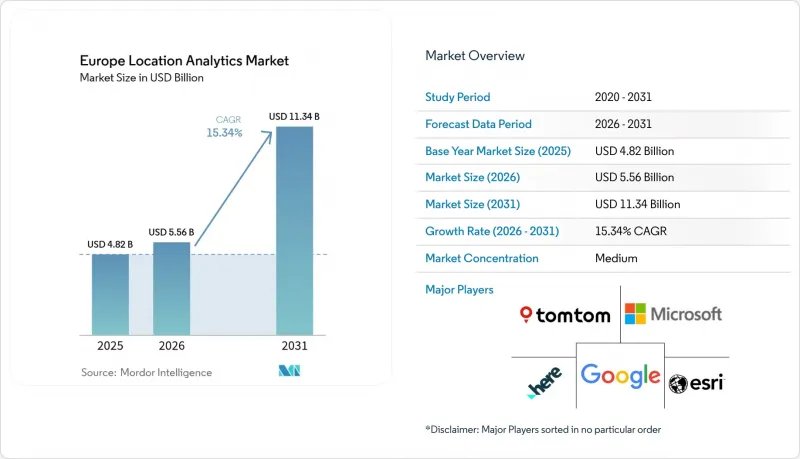
2025 年歐洲位置分析市場價值 48.2 億美元,預計到 2031 年將達到 113.4 億美元,高於 2026 年的 55.6 億美元,預測期(2026-2031 年)複合年成長率為 15.34%。
本報告按位置類型(室內和室外)、部署類型(雲端和本地部署)、最終用戶(銀行、金融服務和保險等)、應用程式(客戶訪客分析、資產追蹤、風險和事件管理等)以及地區(德國、英國等)進行細分。市場預測以美元計價。
歐洲位置分析市場的趨勢與洞察
擴大即時車輛管理解決方案的應用
物流公司正將地理空間分析技術融入其遠端資訊處理系統中,以縮短運輸距離並滿足《企業永續發展報告指令》(CSRD) 的範圍 3 要求。 2024 年,DHL 為其歐洲電動車車隊撥款 20 億歐元(約 23.3 億美元),並透過將邊緣閘道器與交通、天氣和貨量密度數據連接,將路線變動性降低了 12%。馬士基的預測性預計到達時間 (ETA) 引擎透過將基於位置的人工智慧應用於鐵路到港口的貨物交接,在 2024 年上半年將樞紐停留時間縮短了 12%。德鐵貨運 (DB Cargo) 透過實施自動地理圍籬技術加快了海關流程,每次清關時間縮短了 18 分鐘。車輛管理軟體現已將位置分析與預測性維護相結合,透過將海拔剖面圖和路況與零件磨損預測關聯起來,防止車輛故障。
5G部署加速帶來的超在地化分析
獨立組網的5G網路採用網路切片技術,可確保延遲低於10毫秒,進而實現擴增實境(AR)導航和倉庫堆高機的自主運作。沃達豐德國已建成厘米級精度的私有5G網路,並計劃在2024年中期利用室內定位技術覆蓋90%的人口。法國Orange的目標是在2024年底前將5G網路覆蓋率提升至75%,為零售商提供更即時的擁塞密度熱力圖。歐盟「數位十年」計畫的目標是到2030年實現75%的5G網路覆蓋率,並支持在機場和體育場館中使用毫米波波束成形技術。德國電信和通快公司在一家支援超寬頻(UWB)技術的工廠中實現了30公分的定位精度,這表明5G邊緣運算無需依賴雲端核心網即可實現對在製品庫存的定位。
GDPR嚴格的位置同意要求
2024年,歐洲資料保護委員會明確指出,透過Wi-Fi和BLE追蹤MAC位址屬於個人數據,並強制零售商展示同意橫幅。這導致選擇加入率較選擇退出地區下降了30%至40%。德國聯邦資訊安全局(BSI)強烈建議採用設備端處理和差分隱私技術,以減少資料傳輸到雲端。比利時對一家信標供應商處以25萬歐元(約291,596.25美元)的罰款,原因是其未能獲得明確同意,此舉引發了一系列行業範圍內的審計。合規成本對中小企業的影響最為沉重,促使它們與擁有內部法務部門的大型平台供應商簽訂契約,同時也增加了對本地部署的需求,以避免跨境數據傳輸——這正是Schrems II裁決中強調的一個關鍵問題。
細分市場分析
預計2026年至2031年間,室內分析市場將以15.52%的複合年成長率成長,超過室外系統(2025年室外系統佔市場支出的63.61%)。 Wiliot售價低於1美元的環境物聯網標籤和Quuppa精度達10厘米的超寬頻(UWB,到達角測量)技術降低了硬體准入門檻,進一步深化了歐洲定位分析市場在劇院、航站樓、醫院病房等場所的滲透。企業負責人青睞其無需電池的設計,因為它省去了每月維護的麻煩;醫院的設備遺失率也降低了18%。由於伽利略的高精度服務和無所不在的GPS,室外分析在公共交通和精密農業仍然至關重要。然而,隨著各國醫療系統和零售商專注於結合低功耗藍牙(BLE)和超寬頻(UWB)的混合解決方案,室內分析的應用正在迅速成長。
邊緣閘道符合GDPR的資料最小化原則,僅在頻寬可用時才將亞秒室內資料轉換為雲端儀錶板資料。德國電信在金屬密集型工廠開展的30公分超寬頻(UWB)先導計畫證明了其即使在Wi-Fi多徑效應顯著的環境中也具有出色的穩健性。超寬頻(UWB)在高價值工業應用場景中日益普及,而低功耗藍牙(BLE)則在注重成本的零售業迅速崛起。這些因素共同拓展了目標應用場景的範圍,並隨著室內定位精度的提高,進一步鞏固了歐洲位置分析市場。
預計到 2025 年,雲端運算支出將佔總支出的 57.12%,年複合成長率 (CAGR) 為 16.1%,這反映了 Azure、AWS 和 Fabric 內部 API 的商品搭售。微軟和 TomTom 已將 Orbis Maps 在 Azure 上的可用性延長至 2030 年,簡化了授權流程,並鼓勵開發者採用付費使用制。 HERE 公司 2024 年第三季營收為 4.28 億歐元(4.9921 億美元),年增 16%,證實了企業正持續從本地環境遷移到雲端。微軟 Fabric 為 OneLake 新增了空間連接功能,使 SQL 分析師無需安裝 GIS 即可執行地理圍籬查詢。
在國防、銀行和關鍵基礎設施領域,本地部署解決方案仍然至關重要。歐洲銀行管理局 (EBA) 的外包指南建議金融機構在私有雲端超大規模資料中心業者承擔常規空間處理任務,供應商正將重點轉向高價值的孿生模擬和 AI 驅動的洞察層,以在歐洲位置分析市場中脫穎而出。
其他好處:
- Excel格式的市場預測(ME)表
- 3個月的分析師支持
目錄
第1章:引言
- 研究假設和市場定義
- 調查範圍
第2章:調查方法
第3章執行摘要
第4章 市場狀況
- 市場概覽
- 市場促進因素
- 擴大即時車輛管理解決方案的應用
- 5G的加速部署正在實現超本地化分析。
- 將地理空間人工智慧融入公共安全行動
- 智慧城市開放資料入口網站的強制性要求
- 數位孿生基礎設施項目的擴展
- 零售業室內物聯網感測器融合的激增
- 市場限制因素
- GDPR 規定的基於位置的嚴格同意要求
- 地方政府採購週期碎片化
- 高解析度衛星影像的授權費用正在飆升。
- 熟練的地理人工智慧人員供不應求
- 產業價值鏈分析
- 監理情勢
- 技術展望
- 宏觀經濟因素對市場的影響
- 波特五力分析
第5章 市場規模與成長預測
- 按位置類型
- 室內的
- 戶外的
- 不同的發展
- 雲
- 現場
- 最終用戶
- 銀行、金融服務和保險(BFSI)
- 零售
- 運輸/物流
- 旅遊與飯店
- 衛生保健
- 透過使用
- 顧客訪客數量分析
- 資產追蹤
- 風險與事件管理
- 最佳化行銷宣傳活動
- 都市計畫和分區
- 國家
- 德國
- 英國
- 法國
- 其他歐洲國家
第6章 競爭情勢
- 市場集中度
- 策略趨勢
- 市佔率分析
- 公司簡介
- Microsoft Corporation
- Esri Global, Inc.
- HERE Global BV
- Google LLC
- TomTom International BV
- SAS Institute Inc.
- Tableau Software LLC
- QlikTech International AB
- TIBCO Software Inc.
- Alteryx Inc.
- Hexagon AB
- Cisco Systems Inc.
- SAP SE
- Pitney Bowes Inc.
- Galigeo SAS
- Carto
- Foursquare
第7章 市場機會與未來展望
According to Mordor Intelligence, the Europe location analytics market size was valued at USD 4.82 billion in 2025 and estimated to grow from USD 5.56 billion in 2026 to reach USD 11.34 billion by 2031, at a CAGR of 15.34% during the forecast period (2026-2031).
This report is Segmented by Location Type (Indoor, and Outdoor), Deployment (Cloud, and On-Premise), End User (Banking, Financial Services and Insurance, and More), Application (Customer Footfall Analytics, Asset Tracking, Risk and Incident Management, and More), and Geography (Germany, United Kingdom, and More). The Market Forecasts are Provided in Terms of Value (USD).
Europe Location Analytics Market Trends and Insights
Rising Adoption of Real-Time Fleet Management Solutions
Logistics carriers are embedding geospatial analytics into their telematics stacks to reduce empty-mile kilometers and meet the scope 3 requirements of the Corporate Sustainability Reporting Directive. DHL earmarked EUR 2 billion (USD 2.33 billion) for European EV fleets in 2024, pairing edge gateways with traffic, weather, and volume density feeds to reduce route variance by 12%. Maersk's predictive ETA engine cut hub dwell time 12% in H1 2024 by applying location AI to rail-port handoffs. DB Cargo has adopted automated geofencing, which reduces border crossings by 18 minutes per shipment, thereby accelerating customs clearance. Fleet software now bundles location analytics with predictive maintenance, tying elevation profiles and road quality to part-wear forecasts that pre-empt breakdowns.
Accelerated 5G Roll-Out Enabling Hyper-Local Analytics
Standalone 5G with network slicing guarantees sub-10 ms latency, unlocking augmented-reality navigation and autonomous warehouse forklifts. Vodafone Germany reached 90% population coverage by mid-2024, enabling private 5G networks employing centimeter-accurate indoor positioning. Orange France extended 5G to 75% of citizens by late-2024 to fuel real-time crowd-density heatmaps for retailers. EU Digital Decade aims for 75% 5G coverage by 2030, supporting millimeter-wave beamforming in airports and arenas. Deutsche Telekom and TRUMPF reached 30 cm accuracy in UWB-enabled factories, illustrating how 5G edge compute can localize work-in-progress inventory without relying on cloud cores.
Stringent GDPR Location-Consent Requirements
The European Data Protection Board clarified in 2024 that Wi-Fi and BLE MAC tracking counts as personal data, forcing retailers to deploy consent banners that sink opt-in rates 30-40% below opt-out regions. Germany's BSI urges on-device processing and differential privacy to curb cloud transfers. Belgium fined a beacon vendor EUR 250,000 (USD 291596.25) for lack of explicit consent, triggering sector-wide audits. Compliance costs hit SMEs hardest, steering contracts toward big-platform players with legal benches, yet also spur demand for on-premise deployments that avoid cross-border transfers flagged by the Schrems II ruling.
Other drivers and restraints analyzed in the detailed report include:
- Integration of Geospatial AI in Public-Safety Operations
- Mandates for Smart-City Open Data Portals
- De-Fragmented Local Government Procurement Cycles
For complete list of drivers and restraints, kindly check the Table Of Contents.
Segment Analysis
Indoor analytics posted a 15.52% CAGR forecast from 2026 to 2031, eclipsing outdoor systems that still held 63.61% of 2025 spend. Sub-USD 1 ambient-IoT tags from Wiliot and 10-cm angle-of-arrival UWB from Quuppa shrink hardware barriers and push the Europe location analytics market deeper into theaters, terminals, and wards. Enterprise buyers prize the batteryless form factor that eliminates monthly maintenance rounds, while hospitals cut equipment loss 18%. The Galileo High Accuracy Service and ubiquitous GPS keep outdoor analytics indispensable for transit and precision agriculture. Still, indoor adoption surges as national health systems and retailers converge on hybrid BLE-UWB blueprints.
Edge gateways translate sub-second indoor feeds to cloud dashboards only when bandwidth permits, honoring GDPR minimization. Deutsche Telekom's 30-cm UWB pilot inside metal-dense factories validates robustness where Wi-Fi multipath prevails. Ultra-wideband captures high-value industrial cases, while BLE dominates cost-sensitive retail. Collectively these factors multiply addressable use cases, reinforcing the Europe location analytics market as indoor accuracy climbs.
Cloud held 57.12% of the 2025 spend and is projected to have a 16.1% CAGR, reflecting API bundling within Azure, AWS, and Fabric. Microsoft and TomTom extended Orbis Maps in Azure through 2030, simplifying licensing and encouraging developers to adopt consumption-based billing. HERE's EUR 428 million(USD 499.21 million) Q3 2024 revenue, up 16%, underscores migration from on-premise estates. Microsoft Fabric has added spatial joins to OneLake, enabling SQL analysts to run geofencing queries without requiring GIS installations.
On-premise remains vital for defense, banking, and critical infrastructure. The European Banking Authority's outsourcing guide encourages financial institutions to maintain customer geolocation in private clouds. Esri's January 2025 link-up with TomTom channels cloud routing into ArcGIS, while datasets remain local, demonstrating hybrid traction. As hyperscalers swallow routine spatial operations, vendors pivot to value-added twin simulations and AI-driven insight layers, sustaining differentiation inside the Europe location analytics market.
Complete Report Scope:
- By Location Type
- Indoor
- Outdoor
- By Deployment
- Cloud
- On-Premise
- By End User
- Banking, Financial Services and Insurance (BFSI)
- Retail
- Transportation and Logistics
- Tourism and Hospitality
- Healthcare
- By Application
- Customer Footfall Analytics
- Asset Tracking
- Risk and Incident Management
- Marketing Campaign Optimization
- Urban Planning and Zoning
- By Country
- Germany
- United Kingdom
- France
- Rest of Europe
List of Companies Covered in this Report:
- Microsoft Corporation
- Esri Global, Inc.
- HERE Global B.V.
- Google LLC
- TomTom International B.V.
- SAS Institute Inc.
- Tableau Software LLC
- QlikTech International AB
- TIBCO Software Inc.
- Alteryx Inc.
- Hexagon AB
- Cisco Systems Inc.
- SAP SE
- Pitney Bowes Inc.
- Galigeo SAS
- Carto
- Foursquare
Additional Benefits:
- The market estimate (ME) sheet in Excel format
- 3 months of analyst support
TABLE OF CONTENTS
1 INTRODUCTION
- 1.1 Study Assumptions and Market Definition
- 1.2 Scope of the Study
2 RESEARCH METHODOLOGY
3 EXECUTIVE SUMMARY
4 MARKET LANDSCAPE
- 4.1 Market Overview
- 4.2 Market Drivers
- 4.2.1 Rising Adoption of Real-Time Fleet Management Solutions
- 4.2.2 Accelerated 5G Roll-Out Enabling Hyper-Local Analytics
- 4.2.3 Integration of Geospatial AI in Public-Safety Operations
- 4.2.4 Mandates for Smart-City Open Data Portals
- 4.2.5 Growth of Digital-Twin Infrastructure Projects
- 4.2.6 Surge in Indoor IoT Sensor Fusion for Retail
- 4.3 Market Restraints
- 4.3.1 Stringent GDPR Location-Consent Requirements
- 4.3.2 De-Fragmented Local Government Procurement Cycles
- 4.3.3 Rising Cost of High-Resolution Satellite Imagery Licensing
- 4.3.4 Limited Availability of Qualified Geo-AI Talent
- 4.4 Industry Value Chain Analysis
- 4.5 Regulatory Landscape
- 4.6 Technological Outlook
- 4.7 Impact of Macroeconomic Factors on the Market
- 4.8 Porter's Five Forces Analysis
- 4.8.1 Threat of New Entrants
- 4.8.2 Bargaining Power of Suppliers
- 4.8.3 Bargaining Power of Buyers
- 4.8.4 Threat of Substitute Products
- 4.8.5 Intensity of Competitive Rivalry
5 MARKET SIZE AND GROWTH FORECASTS (VALUE)
- 5.1 By Location Type
- 5.1.1 Indoor
- 5.1.2 Outdoor
- 5.2 By Deployment
- 5.2.1 Cloud
- 5.2.2 On-Premise
- 5.3 By End User
- 5.3.1 Banking, Financial Services and Insurance (BFSI)
- 5.3.2 Retail
- 5.3.3 Transportation and Logistics
- 5.3.4 Tourism and Hospitality
- 5.3.5 Healthcare
- 5.4 By Application
- 5.4.1 Customer Footfall Analytics
- 5.4.2 Asset Tracking
- 5.4.3 Risk and Incident Management
- 5.4.4 Marketing Campaign Optimization
- 5.4.5 Urban Planning and Zoning
- 5.5 By Country
- 5.5.1 Germany
- 5.5.2 United Kingdom
- 5.5.3 France
- 5.5.4 Rest of Europe
6 COMPETITIVE LANDSCAPE
- 6.1 Market Concentration
- 6.2 Strategic Moves
- 6.3 Market Share Analysis
- 6.4 Company Profiles (includes Global level Overview, Market level overview, Core Segments, Financials as available, Strategic Information, Market Rank/Share for key companies, Products and Services, and Recent Developments)
- 6.4.1 Microsoft Corporation
- 6.4.2 Esri Global, Inc.
- 6.4.3 HERE Global B.V.
- 6.4.4 Google LLC
- 6.4.5 TomTom International B.V.
- 6.4.6 SAS Institute Inc.
- 6.4.7 Tableau Software LLC
- 6.4.8 QlikTech International AB
- 6.4.9 TIBCO Software Inc.
- 6.4.10 Alteryx Inc.
- 6.4.11 Hexagon AB
- 6.4.12 Cisco Systems Inc.
- 6.4.13 SAP SE
- 6.4.14 Pitney Bowes Inc.
- 6.4.15 Galigeo SAS
- 6.4.16 Carto
- 6.4.17 Foursquare
7 MARKET OPPORTUNITIES AND FUTURE OUTLOOK
- 7.1 White-Space and Unmet-Need Assessment

 位置分析市場規模、佔有率和趨勢分析報告:按組件、分析類型、技術、位置類型、部署方式、企業規模、最終用途和細分市場預測(2026-2033 年)
 中東和非洲地區市場分析:市場佔有率分析、行業趨勢和統計數據、成長預測(2026-2031年)北美地區市場分析:市場佔有率分析、產業趨勢與統計、成長預測(2026-2031 年)
 位置分析市場:按組件、部署模式、分析類型和應用分類-2026-2032年全球市場預測
 位置分析市場:按元件、位置類型、部署方式、產業和地區分類
 2026年全球位置分析市場報告
 位置分析市場規模、佔有率、趨勢和預測:按組件、部署類型、位置類型、應用、最終用戶行業和地區分類,2026-2034 年
 位置分析市場分析及預測(至 2035 年):按類型、產品類型、服務、技術、組件、應用、部署類型、最終用戶和解決方案分類
 位置分析市場規模、佔有率、成長率和全球產業分析:按類型、應用和地區分類的洞察,2026-2034 年預測
 全球位置分析市場(至 2035 年):按組件類型、位置類型、部署類型、應用類型、行業類型、地區、行業趨勢和預測