


 |
市場調查報告書
商品編碼
2121267
農業檢驗:市場佔有率分析、產業趨勢與統計、成長預測(2026-2031)Agricultural Testing - Market Share Analysis, Industry Trends & Statistics, Growth Forecasts (2026 - 2031) |
||||||

※ 本網頁內容可能與最新版本有所差異。詳細情況請與我們聯繫。
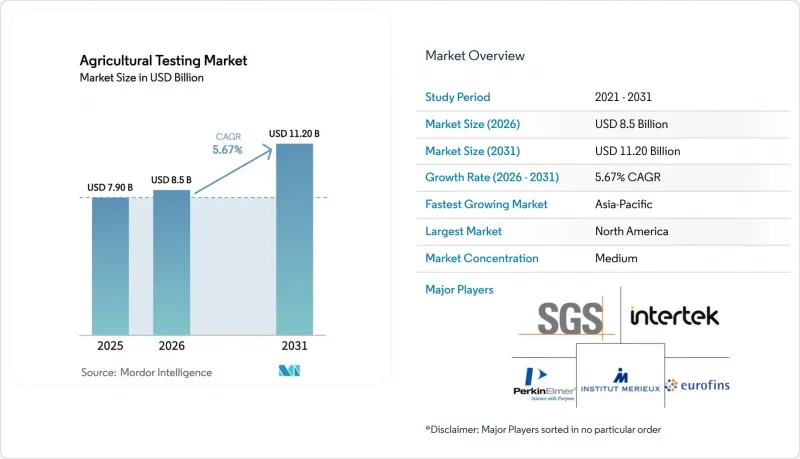
根據 Mordor Intelligence 預測,農業檢測市場規模將從 2025 年的 79 億美元成長到 2026 年的 85 億美元,到 2031 年將達到 112 億美元,2026 年至 2031 年的複合年成長率為 5.67%。
本報告按樣本類型(水質檢測、土壤檢測、種子檢測、生物固形物檢測、堆肥檢測及其他樣本)、應用領域(安全檢測和品質保證)、技術(傳統檢測和快速檢測)以及地區(北美、歐洲、亞太、南美以及中東和非洲)進行細分。市場預測以美元(USD)計價。
全球農業檢驗市場趨勢及洞察
全球食品安全法規日趨嚴格。
美國食品藥物管理局(FDA) 於 2024 年生效的修正案規定,每個生長週期必須進行兩次農業用水檢測,這將顯著增加農業檢測市場對常規檢測的需求。歐盟委員會宣布,自 2025 年起,將降低 47 種農藥的最大殘留基準值。這項變更要求巴西、印度和肯亞等國的出口商提交多基質證書,以避免在入境檢查時被拒收。此外,中國現在強制要求所有新鮮農產品在原產地和進口港口進行雙重檢驗,實際上使每批貨物的分析次數加倍。隨著合規性審計越來越重視分析方法等效性的檢驗,獲得美國官方分析化學家協會 (AOAC) 認證的檢測實驗室在零售商的供應商名單中被優先考慮。因此,即使在農產品價格低迷時期,農業檢測市場也受惠於法規帶來的穩定需求。
食物中毒病例的增加加速了快速檢測技術的引進。
2024年至2025年間,美國疾病管制與預防中心(CDC)將12起跨州沙門氏菌疫情與哈密瓜、黃瓜和綠葉蔬菜連結起來。這促使零售商要求在接收貨物前提供當日病原體陰性檢測結果。攜帶式聚合酵素鏈鎖反應(PCR)試劑盒能夠在90分鐘內檢測出田間沙門氏菌、大腸桿菌O157:H7和李斯特菌,已成為農業檢測市場的重要工具。一條售價15美元的田間檢測條即可避免可能造成超過50萬美元損失的召回事件,這使得生產商越來越願意接受較高的單次檢測成本。在英國,監管機構強制要求從2026年1月起對包裝廠進行每週一次的環境拭子檢測,這將進一步增加對快速檢測解決方案的需求。然而,在冷鏈物流和電力供應中斷影響試劑穩定性的地區,快速檢測解決方案的普及率存在差異。
引進先進實驗室設備成本高昂
截至2025年,一台用於達到0.01 ppm農藥檢測閾值的液相層析法串聯式質譜質譜儀的價格在40萬至60萬美元之間。同樣,感應耦合電漿等離子體質譜儀的價格在30萬至50萬美元之間。租賃可以將這些成本分攤到三到五年,但通常需要銀行擔保,而該地區的許多企業難以獲得此類擔保。 2025年3月,美國工業與安全局(BIS)實體清單的擴大,以及同年5月人工智慧(AI)擴散法規的撤銷,對中東地區的技術買家造成了嚴重的監管延誤。對於高度敏感組件的運輸,許可核准流程經常會延遲長達九個月。在奈及利亞和印尼等國,由於基礎設施和熟練工人的匱乏,分析檢測工作被外包給南非和新加坡的機構,而像Eurofins和SGS這樣的公司在這些機構中佔據主導地位。這種依賴性增加了成本,降低了當地的利潤率,並減緩了農業檢測市場的成長。
細分市場分析
至2025年,土壤分析將佔農業檢測市場規模的45.6%,凸顯其在養分平衡管理、重金屬監測和碳排放交易中的核心作用。這一類別構成了農場層級農業檢測市場規模的基礎。種子檢測預計到2031年將以8.8%的複合年成長率成長,是所有檢體類型中成長最快的。這主要是由於植物檢疫法規要求跨境運輸前必須使用無病原體批次的種子。土壤生物學檢測計畫目前已包含微生物生物量指標,但只有不到20%的檢測實驗室提供這項服務,而且價格通常較高。其他一些規模較小但較專業的檢測領域包括水質、生物固形物、牲畜糞便和植物組織檢測。
排碳權法規要求進行基準和年度土壤採樣,這可提供穩定的收入,有助於緩解季節性波動。 2025年2月,美國自然資源保護局(NRCS)修訂了其指南,強制要求採集60公分的土壤芯樣。這實際上使每個農場的樣本量加倍,提高了農業檢測市場的處理能力。此外,《國際植物保護公約》(IPPC)關於種子病蟲害的規定已將發芽率、純度和病害檢測列為重要的貿易要求。如果美國環保署(EPA)強制要求擁有10名或以上員工的企業進行季前篩檢檢測,則對水質檢測的需求可能會增加,從而為美國檢測實驗室創造一個價值2億至3億美元的市場。
區域分析
預計到2025年,北美將引領農業檢測市場,佔全球銷售額的39%。這一主導地位歸功於《食品安全現代化法案》的強制性要求,以及利用機器人技術加快農藥檢測速度的成熟檢測實驗室網路。檢測能力集中在加州、佛羅裡達州和德克薩斯州等關鍵州,使出口商能夠在36小時內獲得證書。相較之下,亞太地區是成長最快的地區,預計到2031年年複合成長率(CAGR)將達到8.8%。這一成長主要得益於中國更嚴格的殘留標準和印度有機農業的面積。這兩個地區都受益於政府強力的檢測費用津貼計劃,但它們的成長受到不同因素的影響,例如北美注重嚴格的監管合規,而亞太地區則更側重於出口主導認證。
歐洲、南美洲以及中東和非洲整體上都面臨產能過剩與新興需求並存的局面。在歐洲,檢測實驗室在淡季期間運轉率有所下降,但加強黴菌毒素監測正在緩解這項挑戰。在南美洲,農產品出口仍然是主要驅動力,巴西和阿根廷的機器人檢測線顯著縮短了大豆和牛肉的認證時間。中東的糧食安全計畫和非洲的黃麴毒素應對措施正在刺激該地區對檢測實驗室的投資。然而,物流限制和技術純熟勞工短缺仍然是這些地區發展的主要障礙。
在北美,重點在於整合快速篩檢和區塊鏈技術,以進一步縮短清關時間並確保高價值合約的簽訂。在亞太地區,檢測能力正透過增設液相層析法-串聯式質譜質譜儀來滿足出口需求,同時行動檢測單元正將服務擴展到農村農業地區。歐洲的檢測實驗室正將其業務多元化拓展至碳權相關的土壤項目,以減少對殘留物檢測的依賴。同時,南美洲和非洲的檢測實驗室正提供採樣和分析一體化服務,以吸引跨國公司成為客戶。這些努力共同推動了各地區檢測量的逐步成長,而嚴格的監管和數位化應對力在決定各地區的成長速度方面發揮著至關重要的作用。
其他好處:
- Excel格式的市場預測(ME)表
- 3個月的分析師支持
目錄
第1章:引言
- 研究假設和市場定義
- 調查範圍
第2章:調查方法
第3章執行摘要
第4章 市場狀況
- 市場概覽
- 市場促進因素
- 世界各地的食品安全法規正變得越來越嚴格。
- 食物中毒病例的增加推動了快速檢測技術的快速普及。
- 需要進行認證檢測的有機食品貿易正在激增。
- 現場DNA/奈米孔定序為現場病原體診斷開啟了新的可能性。
- 土壤碳權計畫正在促使土壤健康檢測的頻率增加。
- 出口合約中基於區塊鏈的可追溯性條款正在促進使用檢驗的測試數據。
- 市場限制因素
- 先進實驗設備高額的購置成本
- 熟練實驗室技術人員嚴重短缺
- 非標準資料格式限制了不同研究機構之間人工智慧(AI)的互通性。
- 試劑進口關稅不斷上漲,給小規模實驗室的利潤率帶來了壓力。
- 技術展望
- 監理情勢
- 波特五力模型
第5章 市場規模與成長預測
- 樣本
- 水質檢測
- 土壤檢測
- 種子檢驗
- 生物固形物檢測
- 肥料分析
- 其他樣本
- 透過使用
- 安全測試
- 品質保證
- 透過技術
- 常規測試
- 快速檢測
- 按地區
- 北美洲
- 美國
- 加拿大
- 墨西哥
- 其他北美國家
- 歐洲
- 德國
- 英國
- 法國
- 俄羅斯
- 西班牙
- 其他歐洲國家
- 亞太地區
- 印度
- 中國
- 澳洲
- 日本
- 其他亞太國家
- 南美洲
- 巴西
- 阿根廷
- 其他南美國家
- 中東
- 沙烏地阿拉伯
- 阿拉伯聯合大公國
- 其他中東國家
- 非洲
- 南非
- 奈及利亞
- 其他非洲國家
- 北美洲
第6章 競爭情勢
- 市場集中度
- 策略趨勢
- 市佔率分析
- 公司簡介
- SGS Societe Generale de Surveillance SA
- Eurofins Scientific SE
- Intertek Group plc
- PerkinElmer, Inc.
- ALS Limited
- Merieux NutriSciences Corporation
- Tentamus Group GmbH
- Neogen Corporation
- Agilent Technologies Inc.
- TUV NORD AG
- LGC Limited
- AsureQuality Limited
- AGROLAB GmbH
- Romer Labs GmbH
- Fera Science Ltd
第7章 市場機會與未來展望
According to Mordor Intelligence, the agricultural testing market size is anticipated to grow from USD 7.9 billion in 2025 to USD 8.5 billion in 2026 and is forecast to reach USD 11.2 billion by 2031 at a 5.67% CAGR over 2026-2031.
This report is Segmented by Sample (Water Testing, Soil Testing, Seed Testing, Bio-Solids Testing, Manure Testing, and Other Samples), Application (Safety Testing and Quality Assurance), Technology (Conventional Testing and Rapid Testing), and Geography (North America, Europe, Asia-Pacific, South America, Middle East, and Africa). The Market Forecasts are Provided in Terms of Value (USD).
Global Agricultural Testing Market Trends and Insights
Stringent Food-Safety Regulations Tightening Worldwide
United States Food and Drug Administration revisions that took effect in 2024 require two agricultural-water tests per growing cycle, adding significant recurring volume to the agricultural testing market . The European Commission has announced reductions in the maximum residue levels for 47 pesticides, effective in 2025. This change requires exporters from countries such as Brazil, India, and Kenya to provide multi-matrix certificates to avoid rejection at entry checkpoints. Additionally, China now mandates dual testing, at the origin and the port of entry, for all fresh produce shipments, effectively doubling the number of analyses required per consignment. Laboratories with validations from the Association of Official Analytical Chemists are prioritized on retailer vendor lists, as compliance audits increasingly focus on verifying method equivalency. Consequently, the agricultural testing market benefits from regulation-driven demand stability, even during periods of commodity downturns.
Escalating Food-Borne Illness Outbreaks Driving Rapid Test Adoption
Between 2024 and 2025, the Centers for Disease Control and Prevention linked 12 multistate Salmonella outbreaks to cantaloupes, cucumbers, and leafy greens, leading retailers to stipulate same-day pathogen clearances before accepting shipments. Portable polymerase chain reaction (PCR) kits can now detect Salmonella, Escherichia coli O157:H7, and Listeria within 90 minutes on-site, positioning them as a valuable tool in the agricultural testing market. A USD 15 field strip helps prevent recalls that can cost over USD 500,000, making growers more inclined to accept the higher per-test cost. In the United Kingdom, regulators have mandated weekly environmental swabbing in packhouses starting in January 2026, increasing demand for rapid testing solutions. However, adoption remains inconsistent in regions where interruptions in cold-chain logistics or power supply affect reagent stability.
High Capital Cost of Advanced Laboratory Instrumentation
In 2025, the cost of a single liquid chromatography-tandem mass spectrometer, required to achieve 0.01 ppm pesticide thresholds, ranged from USD 400,000 to USD 600,000. Similarly, an inductively coupled plasma mass spectrometer for heavy metal analysis was priced between USD 300,000 and USD 500,000. While leasing options allowed these costs to be spread over three to five years, they often required bank guarantees that many regional operators found difficult to secure. The expansion of the Bureau of Industry and Security (BIS) Entity List in March 2025, along with the rescission of the Artificial Intelligence (AI) Diffusion Rule in May, created a significant regulatory backlog for technology buyers in the Middle East. Shipments of sensitive components frequently faced delays of up to 9 months in license processing. In countries such as Nigeria and Indonesia, limited infrastructure and skill shortages have led to the outsourcing of analytical testing to hubs in South Africa and Singapore, where companies like Eurofins and SGS hold dominant positions. This dependency increases costs, reduces local profit margins, and slows the growth of the agricultural testing market.
Other drivers and restraints analyzed in the detailed report include:
- Surge in Organic Food Trade Requiring Certification Testing
- On-Site Deoxyribonucleic Acid (DNA) and Nanopore Sequencing Unlocking Field Pathogen Diagnostics
- Acute Shortage of Skilled Laboratory Technicians
For complete list of drivers and restraints, kindly check the Table Of Contents.
Segment Analysis
Soil assays accounted for 45.6% of the agricultural testing market size in 2025, underscoring their central role in nutrient budgeting, heavy-metal surveillance, and carbon trading enrollment. The category anchors the agricultural testing market size at the farm level. Seed tests are expanding at an 8.8% CAGR to 2031, the swiftest pace among samples, because phytosanitary rules require pathogen-free lots before cross-border shipment. Soil biology panels now include microbial biomass metrics, a feature currently offered by fewer than 20% of laboratories and typically priced at a premium. Specialized but smaller segments of demand include testing for water, biosolids, manure, and plant tissue.
Carbon-credit protocols mandate baseline and annual soil sampling, providing consistent revenues that help mitigate seasonal fluctuations. In February 2025, the United States Natural Resources Conservation Service updated its guidelines to require 60-centimeter cores, effectively doubling the sample volume per farm and driving increased throughput in the agricultural testing market. Additionally, the International Plant Protection Convention's mandates on seed pests have transformed germination, purity, and disease checks into essential trade requirements. Water testing demand may rise if the Environmental Protection Agency implements mandatory pre-season screenings for operations with ten or more workers, potentially creating a USD 200-300 million market segment for laboratories in the United States.
Complete Report Scope:
- By Sample
- Water Testing
- Soil Testing
- Seed Testing
- Bio-solids Testing
- Manure Testing
- Other Samples
- By Application
- Safety Testing
- Quality Assurance
- By Technology
- Conventional Testing
- Rapid Testing
- By Geography
- North America
- United States
- Canada
- Mexico
- Rest of North America
- Europe
- Germany
- United Kingdom
- France
- Russia
- Spain
- Rest of Europe
- Asia-Pacific
- India
- China
- Australia
- Japan
- Rest of Asia-Pacific
- South America
- Brazil
- Argentina
- Rest of South America
- Middle East
- Saudi Arabia
- United Arab Emirates
- Rest of Middle East
- Africa
- South Africa
- Nigeria
- Rest of Africa
- North America
Geography Analysis
North America is projected to lead the agricultural testing market, accounting for 39% of global revenue in 2025. This dominance is attributed to the mandates of the Food Safety Modernization Act and a well-established laboratory network that employs robotics to expedite pesticide testing. Laboratories in key states such as California, Florida, and Texas concentrate testing capacity, enabling exporters to secure certificates within 36 hours. In contrast, Asia-Pacific is the fastest-growing region, with a compound annual growth rate of 8.8% through 2031. This growth is driven by China's tightening of residue limits and India's expansion of organic farming acreage. Both regions benefit from robust government programs that subsidize testing, though their growth is influenced by distinct factors, such as North America's focus on compliance enforcement and Asia-Pacific's emphasis on export-led certification.
Europe, South America, the Middle East, and Africa collectively represent a mix of surplus capacity and emerging demand. European laboratories experience underutilization during off-peak months, though increased mycotoxin surveillance helps alleviate this challenge. In South America, commodity exports remain a primary driver, with robotic testing lines in Brazil and Argentina significantly reducing turnaround times for soybean and beef certification. The Middle East's food security programs and Africa's aflatoxin initiatives are spurring investments in regional laboratories. However, logistical constraints and shortages of skilled labor continue to hinder progress in these regions.
North America is focusing on integrating rapid screening with blockchain technology to further reduce clearance times and attract premium contracts. In Asia-Pacific, laboratories are expanding their capabilities by installing additional Liquid Chromatography with Tandem Mass Spectrometry instruments to meet export requirements, while mobile units are extending services to rural farming areas. European providers are diversifying into carbon-credit soil projects to reduce reliance on residue testing. Meanwhile, laboratories in South America and Africa are bundling sampling and analytics services to appeal to multinational clients. These initiatives collectively contribute to incremental volume growth across all regions, with regulatory stringency and digital readiness playing a critical role in determining regional growth rates.
- SGS Societe Generale de Surveillance SA
- Eurofins Scientific SE
- Intertek Group plc
- PerkinElmer, Inc.
- ALS Limited
- Merieux NutriSciences Corporation
- Tentamus Group GmbH
- Neogen Corporation
- Agilent Technologies Inc.
- TUV NORD AG
- LGC Limited
- AsureQuality Limited
- AGROLAB GmbH
- Romer Labs GmbH
- Fera Science Ltd
Additional Benefits:
- The market estimate (ME) sheet in Excel format
- 3 months of analyst support
TABLE OF CONTENTS
1 Introduction
- 1.1 Study Assumptions and Market Definition
- 1.2 Scope of the Study
2 Research Methodology
3 Executive Summary
4 Market Landscape
- 4.1 Market Overview
- 4.2 Market Drivers
- 4.2.1 Stringent food-safety regulations tightening worldwide
- 4.2.2 Escalating food-borne illness outbreaks driving rapid test adoption
- 4.2.3 Surge in organic food trade requiring certification testing
- 4.2.4 On-site DNA/Nanopore sequencing unlocking field pathogen diagnostics
- 4.2.5 Carbon-credit soil programs spurring high-frequency soil health testing
- 4.2.6 Blockchain traceability clauses in export contracts boosting verified test data
- 4.3 Market Restraints
- 4.3.1 High capital cost of advanced laboratory instrumentation
- 4.3.2 Acute shortage of skilled laboratory technicians
- 4.3.3 Non-standard data formats limiting Artificial Intelligence (AI) interoperability across labs
- 4.3.4 Rising reagent import tariffs straining small laboratory margins
- 4.4 Technological Outlook
- 4.5 Regulatory Landscape
- 4.6 Porter's Five Forces
- 4.6.1 Bargaining Power of Buyers
- 4.6.2 Bargaining Power of Suppliers
- 4.6.3 Threat of New Entrants
- 4.6.4 Threat of Substitute Products
- 4.6.5 Intensity of Competitive Rivalry
5 Market Size and Growth Forecasts (Value)
- 5.1 By Sample
- 5.1.1 Water Testing
- 5.1.2 Soil Testing
- 5.1.3 Seed Testing
- 5.1.4 Bio-solids Testing
- 5.1.5 Manure Testing
- 5.1.6 Other Samples
- 5.2 By Application
- 5.2.1 Safety Testing
- 5.2.2 Quality Assurance
- 5.3 By Technology
- 5.3.1 Conventional Testing
- 5.3.2 Rapid Testing
- 5.4 By Geography
- 5.4.1 North America
- 5.4.1.1 United States
- 5.4.1.2 Canada
- 5.4.1.3 Mexico
- 5.4.1.4 Rest of North America
- 5.4.2 Europe
- 5.4.2.1 Germany
- 5.4.2.2 United Kingdom
- 5.4.2.3 France
- 5.4.2.4 Russia
- 5.4.2.5 Spain
- 5.4.2.6 Rest of Europe
- 5.4.3 Asia-Pacific
- 5.4.3.1 India
- 5.4.3.2 China
- 5.4.3.3 Australia
- 5.4.3.4 Japan
- 5.4.3.5 Rest of Asia-Pacific
- 5.4.4 South America
- 5.4.4.1 Brazil
- 5.4.4.2 Argentina
- 5.4.4.3 Rest of South America
- 5.4.5 Middle East
- 5.4.5.1 Saudi Arabia
- 5.4.5.2 United Arab Emirates
- 5.4.5.3 Rest of Middle East
- 5.4.6 Africa
- 5.4.6.1 South Africa
- 5.4.6.2 Nigeria
- 5.4.6.3 Rest of Africa
- 5.4.1 North America
6 Competitive Landscape
- 6.1 Market Concentration
- 6.2 Strategic Moves
- 6.3 Market Share Analysis
- 6.4 Company Profiles (includes Global-level Overview, Market-level Overview, Core Segments, Financials as available, Strategic Information, Market Rank/Share for Key Companies, Products and Services, and Recent Developments)
- 6.4.1 SGS Societe Generale de Surveillance SA
- 6.4.2 Eurofins Scientific SE
- 6.4.3 Intertek Group plc
- 6.4.4 PerkinElmer, Inc.
- 6.4.5 ALS Limited
- 6.4.6 Merieux NutriSciences Corporation
- 6.4.7 Tentamus Group GmbH
- 6.4.8 Neogen Corporation
- 6.4.9 Agilent Technologies Inc.
- 6.4.10 TUV NORD AG
- 6.4.11 LGC Limited
- 6.4.12 AsureQuality Limited
- 6.4.13 AGROLAB GmbH
- 6.4.14 Romer Labs GmbH
- 6.4.15 Fera Science Ltd
7 Market Opportunities and Future Outlook

 全球農藥殘留檢測市場規模、佔有率、趨勢及成長分析報告(2026-2034年)
 農業檢驗市場規模、佔有率和趨勢分析報告:按樣本、類型、技術、最終用途、地區和細分市場預測(2026-2033 年)
 食品和農業檢測、檢驗和認證:市場佔有率分析、行業趨勢和統計數據、成長預測(2026-2031 年)馬來西亞和越南花卉栽培材料:市場佔有率分析、行業趨勢和統計數據以及成長預測(2026-2031 年)
 農業檢驗市場:2026-2032年全球市場預測(按檢驗類型、作物類型、技術、服務形式、最終用戶和應用分類)
 農藥殘留檢測市場:商機、成長要素、產業趨勢分析及2026-2035年預測
 農業用品直銷市場:未來預測(至2034年)-依產品類型、平台類型、經營模式、作物類型、農場規模、最終用戶、通路和地區進行分析
 農業檢驗市場規模、佔有率、趨勢和預測:按樣本、技術、應用和地區分類(2026-2034 年)
 2026年全球農業材料市場報告
 農業檢驗市場:依樣本數和地區分類