


 |
市場調查報告書
商品編碼
2118041
馬來西亞和越南花卉栽培材料:市場佔有率分析、行業趨勢和統計數據以及成長預測(2026-2031 年)Malaysia and Vietnam Floriculture Inputs - Market Share Analysis, Industry Trends & Statistics, Growth Forecasts (2026 - 2031) |
||||||

※ 本網頁內容可能與最新版本有所差異。詳細情況請與我們聯繫。
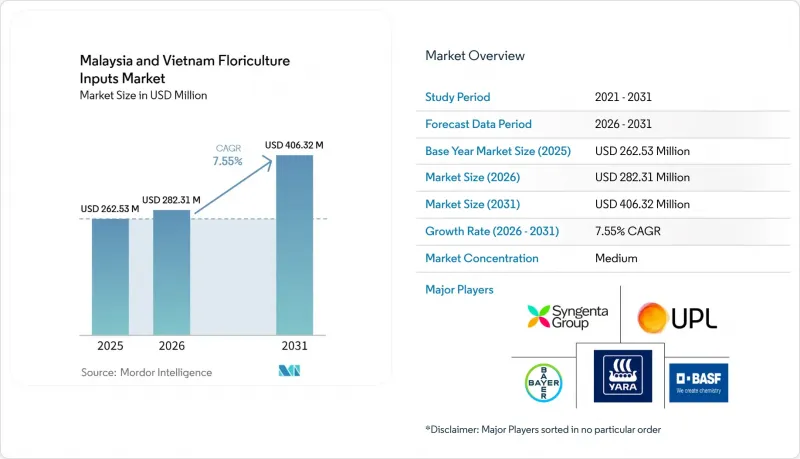
根據 Mordor Intelligence 預測,馬來西亞和越南的花卉栽培材料市場規模預計將從 2025 年的 2.6253 億美元和 2026 年的 2.8231 億美元成長到 2031 年的 4.0632 億美元,2026 年至 2031 年的複合年成長率為 7.5%。
本報告按產品類型(種子和種植材料、肥料和植物營養產品、農作物保護產品等)、最終用戶(商業花卉種植者、苗圃和繁殖中心、園林綠化公司)以及地區(馬來西亞和越南)進行細分。報告以美元計價,呈現市場規模和預測數據。
馬來西亞及越南花卉栽培材料市場趨勢及洞察
商業花卉生產和出口型苗圃的擴張
馬來西亞和越南的花卉材料市場直接受益於兩國已有的花卉生產規模。越南鮮切花和花蕾的出口額預計到2025年將超過8,150萬美元,種植面積近4.5萬公頃。這表明商業性花卉種植已不再是市場上的小眾領域。馬來西亞仍是該地區的主要出口國,根據國際貿易中心(ITC)貿易地圖顯示,光是鮮切花的出口額預計到2025年就將超過8,230萬美元。在林同省,高品質的花卉農場已經創造了顯著的附加價值,這促使他們持續投資於更好的肥料、作物保護項目和繁殖材料,而不是一次性的低成本採購。此外,馬來西亞農業部已公佈了2026年園藝產品出口的植物檢疫要求,這進一步促使生產商使用經過認證的種植材料和品質有保證的供應品。隨著出口苗圃和大型生產商的擴張,馬來西亞和越南的花卉供應市場受益於更規律的訂單模式以及對符合運輸品質標準產品需求的成長。這一因素尤其重要,因為它支持在多個種植週期內持續供應,而非僅限於單一季節的短期需求激增。
保護性栽培和環境控制生產的廣泛應用。
隨著網室、溫室和可控栽培系統的普及,馬來西亞和越南的花卉供應市場正在改變。 2024年3月,亞洲生產力組織和越南國家生產力研究院在大叻建立了一個示範溫室農場,引進了日本物聯網微氣候控制系統。這表明,先進的生產工具已開始在主要花卉產區推廣應用。同樣在2024年,河內的一家商業蘭花種植基地採用了逆滲透水處理、先進的空調設備和組織培養技術。這反映了觀賞植物種植環境朝更可控的方向發展的趨勢。這些系統改變了供應鏈,因為無土栽培和基質栽培依賴於水溶性肥料、更清潔的水源和針對性的植物保護措施,而不是大面積的田間噴灑。在馬來西亞,金馬倫高原變幻莫測的天氣凸顯了露天種植的脆弱性,因此,採用能夠穩定產量、減少損失的保護性栽培設施對企業而言變得越來越重要。隨著種植者轉向這些設施,他們對栽培基質、灌溉系統和計劃施肥方案的依賴性也隨之增加。因此,保護性栽培不僅是農業現代化的體現,也是馬來西亞和越南市場對花卉材料需求翻倍的因素之一。
小規模生產者基礎分散,投資能力有限
馬來西亞和越南的花卉供應市場仍面臨許多根本性限制。許多生產商小規模,難以承擔高品質方案的成本。在林同省,小規模農戶佔花卉生產的絕大部分,這意味著市場的大部分資金周轉週期仍然很短,流動資金也十分緊張。馬來西亞的生產商群體也較為分散,分散在金馬崙高原花卉種植者協會和柔佛州苗圃產業協會等組織中,供應商的覆蓋範圍仍依賴眾多小規模貿易夥伴,而非少數幾個實力雄厚的農業集團。這種結構阻礙了緩釋肥、生物作物管理以及施肥灌溉系統的推廣應用,因為投資回收期通常需要幾個種植週期。化肥價格上漲進一步加劇了這種猶豫,因為生產商優先考慮的是確保流動資金,而不是投資高價肥料。因此,供應商往往只向大規模苗圃和出口農場銷售更先進的方案,而廣大生產商則繼續使用傳統產品。因此,馬來西亞和越南的花卉栽培材料市場持續成長,但高附加價值材料在整個基本客群中的普及速度正在放緩。
細分市場分析
2025年,肥料和植物營養產品佔馬來西亞和越南花卉種植供應市場的38.4%,繼續保持領先地位,遠超農作物保護產品和其他產品類別。這個主導地位源自於切花、盆栽觀賞植物和幼苗的日常營養需求,因為均衡施肥會影響這些作物的莖稈強度、花朵均勻度和採後壽命。農作物保護產品緊隨其後,主要是因為兩國濕潤的產區需要持續進行病蟲害防治。此外,為了滿足馬來西亞和越南對花卉種植供應產品的整體需求,種植基質、土壤改良劑、灌溉用品和種子也成為市場的重要組成部分。
在馬來西亞和越南的花卉栽培材料市場,預計到2031年,生技藥品將以10.9%的複合年成長率(CAGR)實現最高成長。這主要得益於出口路線對殘留物問題的重視以及越南生物農業的日益普及。隨著當地組織培養能力的提升以及種植者對更可靠植物品質的需求,種子和種苗的重要性也不斷提高。精準營養產品因其水溶性以及溫室和灌溉系統中對分階段施肥的需求,預計將持續成長。隨著保護性栽培的擴展,灌溉相關材料和先進栽培基質的需求也預計將增加。同時,作物保護仍將是種植者應對病害風險和天氣相關壓力等各種作物種植環節的關鍵要素。
其他好處:
- Excel格式的市場預測(ME)表
- 3個月的分析師支持
目錄
第1章:引言
- 研究假設和市場定義
- 調查範圍
第2章:調查方法
第3章執行摘要
第4章 市場動態
- 市場概覽
- 市場促進因素
- 商業花卉生產和出口型苗圃的擴張
- 保守的耕作方式和環境控制的生產方法正變得越來越普遍。
- 對高品質種植和農業材料的需求不斷成長。
- 擴大生物製藥和永續作物管理解決方案的應用
- 城市綠化、旅館業和觀賞植物的需求
- 實施精準營養與專業植物營養方案
- 市場限制因素
- 小規模生產者群體分散,投資能力有限。
- 對進口種苗和專用投入材料的依賴
- 投入成本波動與生產成本上升
- 與病蟲害、疾病和氣候相關的生產風險。
- 監理情勢
- 技術展望
- 波特五力分析
第5章 市場規模與成長預測
- 依產品類型
- 種子和種植材料
- 肥料和植物營養產品
- 農作物保護產品
- 栽培基質和土壤改良劑
- 灌溉和保護性栽培材料
- 生物製藥
- 最終用戶
- 商業花卉生產商
- 苗圃和幼苗中心
- 景觀與城市園藝企業
- 按地區
- 馬來西亞
- 越南
第6章 競爭情勢
- 市場集中度
- 策略趨勢
- 市佔率分析
- 公司簡介
- Syngenta Group
- Bayer AG
- BASF SE
- UPL Limited
- Yara International ASA
- Corteva Agriscience
- FMC Corporation
- Sumitomo Chemical Co., Ltd.
- Nutrien Ltd.
- Haifa Group
- Vinaseed(PAN Group)
- 前農集團
- Advansia Sdn Bhd
- Agromaster Fertilizer Sdn Bhd
- Known-You Seed
第7章 市場機會與未來展望
According to Mordor Intelligence, the Malaysia and Vietnam floriculture inputs market size is anticipated to expand from USD 262.53 million in 2025 and USD 282.31 million in 2026 to USD 406.32 million by 2031, registering a CAGR of 7.55% between 2026 and 2031.
This report is Segmented by Product Type (Seeds and Planting Material, Fertilizers and Plant Nutrition Products, Crop Protection Products, and More), by End User (Commercial Floriculture Growers, Nurseries and Propagation Centers, and Landscaping Operators), and by Geography (Malaysia and Vietnam). The Report Offers the Market Size and Forecasts in Terms of Value (USD).
Malaysia and Vietnam Floriculture Inputs Market Trends and Insights
Expansion of Commercial Floriculture Production and Export-Oriented Nurseries
The Malaysia and Vietnam floriculture inputs market gains direct support from the scale of flower production that is already in place across both countries. Vietnam's cut flowers and flower buds export turnover passed USD 81.5 million in 2025, and the production area reached nearly 45,000 hectares, which shows that commercial flower growing is no longer a small niche in that market. Malaysia also remained a major regional exporter, and fresh-cut flower exports alone reached more than USD 82.3 million in 2025, according to ITC Trade Map. In Lam Dong, high-grade flower farms are already producing significant value, which supports repeat spending on better fertilizers, crop protection programs, and propagation materials rather than one-time low-cost purchases. Malaysia's Department of Agriculture also issued its 2026 phytosanitary requirements for horticulture exports, which adds another reason for growers to use certified planting material and quality-assured inputs. As export nurseries and larger growers expand, the Malaysia and Vietnam floriculture inputs market benefits from more regular ordering patterns and stronger demand for products that help meet shipment quality standards. This driver is especially important because it supports recurring input use over many crop cycles rather than a short burst of demand tied to a single season.
Rising Adoption of Protected Cultivation and Controlled-Environment Production
The Malaysia and Vietnam floriculture inputs market is also moving with the wider use of net houses, greenhouses, and controlled growing systems. In March 2024, the Asian Productivity Organization and the Vietnam National Productivity Institute established a demonstration greenhouse farm in Da Lat with a Japanese Internet of Things-enabled microclimate control system, which shows that precision production tools are already being introduced in a key flower-growing area. A commercial orchid facility in Hanoi also used reverse osmosis water treatment, advanced air conditioning, and tissue culture methods in 2024, which reflects the move toward more managed growing conditions for ornamentals. These systems change the input mix because soilless or substrate-based cultivation depends on soluble nutrition, cleaner water, and targeted plant protection rather than broad field applications. In Malaysia, weather disruptions in Cameron Highlands have shown how exposed open cultivation remains, which strengthens the business case for protected structures that can stabilize production and reduce losses. Once growers shift into these structures, they also become more dependent on growing media, irrigation tools, and measured feeding programs. That is why protected cultivation is not only a farming upgrade, but also a demand multiplier for the Malaysia and Vietnam floriculture inputs market.
Fragmented Grower Base and Limited Investment Capacity Among Small-Scale Producers
The Malaysia and Vietnam floriculture inputs market still faces a basic limit because many growers remain small and cannot absorb the cost of premium programs easily. In Lam Dong, small farming households account for the major share of flower production, which means a large part of the market still buys with short cash cycles and tight working capital. Malaysia's grower base is also scattered across associations such as the Cameron Highlands Floriculturist Association and the Nursery Industry Association of Johor, which shows that supplier reach still depends on many smaller accounts rather than a few dominant farm groups. This structure slows adoption of controlled-release fertilizers, biological crop care, and fertigation systems because the payback often comes over several crop cycles. Higher fertilizer prices make that hesitation worse because growers first protect operating cash before they move into premium inputs. As a result, suppliers often sell more advanced programs only to larger nurseries and export farms, while the wider base stays with conventional products. This keeps the Malaysia and Vietnam floriculture inputs market growing, but it slows the speed at which higher-value inputs can spread across the full customer base.
Other drivers and restraints analyzed in the detailed report include:
- Increasing Demand for High-Quality Planting Material and Crop Inputs
- Growing Use of Biologicals and Sustainable Crop Management Solutions
- Dependence on Imported Planting Material and Specialized Inputs
For complete list of drivers and restraints, kindly check the Table Of Contents.
Segment Analysis
Fertilizers and plant nutrition products held 38.4% of the Malaysia and Vietnam floriculture inputs market size in 2025, which kept them firmly ahead of crop protection products and the other product groups. Their lead came from the daily nutrient needs of cut flowers, potted ornamentals, and nursery stock, where balanced feeding affects stem strength, flower uniformity, and post-harvest life. Crop protection products followed because humid production areas in both countries require steady disease and pest management. Growing media, soil amendments, irrigation inputs, and seeds were then added to support demand across the Malaysia and Vietnam floriculture inputs market.
Biologicals are anticipated to record the fastest CAGR at 10.9% through 2031 in the Malaysia and Vietnam floriculture inputs market, supported by residue-sensitive export channels and more formal promotion of biological crop care in Vietnam. Seeds and planting material also gain relevance as local tissue culture capacity expands and growers seek more reliable plant quality. Precision nutrition products are likely to keep growing because greenhouse and fertigation systems need soluble and stage-specific feeding. Irrigation-related inputs and advanced media should rise with protected cultivation, while crop protection remains essential as growers manage disease risk and weather-related pressure across the product mix.
Complete Report Scope:
- By Product Type
- Seeds and Planting Material
- Fertilizers and Plant Nutrition Products
- Crop Protection Products
- Growing Media and Soil Amendments
- Irrigation and Protected Cultivation Inputs
- Biologicals
- By End User
- Commercial Floriculture Growers
- Nurseries and Propagation Centers
- Landscaping and Urban Horticulture Operators
- By Geography
- Malaysia
- Vietnam
List of Companies Covered in this Report:
- Syngenta Group
- Bayer AG
- BASF SE
- UPL Limited
- Yara International ASA
- Corteva Agriscience
- FMC Corporation
- Sumitomo Chemical Co., Ltd.
- Nutrien Ltd.
- Haifa Group
- Vinaseed (PAN Group)
- Tiến Nong Group
- Advansia Sdn Bhd
- Agromaster Fertilizer Sdn Bhd
- Known-You Seed
Additional Benefits:
- The market estimate (ME) sheet in Excel format
- 3 months of analyst support
TABLE OF CONTENTS
1 Introduction
- 1.1 Study Assumptions and Market Definition
- 1.2 Scope of the Study
2 Research Methodology
3 Executive Summary
4 Market Dynamics
- 4.1 Market Overview
- 4.2 Market Drivers
- 4.2.1 Expansion of commercial floriculture production and export-oriented nurseries
- 4.2.2 Rising adoption of protected cultivation and controlled-environment production
- 4.2.3 Increasing demand for high-quality planting material and crop inputs
- 4.2.4 Growing use of biologicals and sustainable crop management solutions
- 4.2.5 Urban landscaping, hospitality, and ornamental plant demand
- 4.2.6 Adoption of precision nutrition and specialized plant nutrition programs
- 4.3 Market Restraints
- 4.3.1 Fragmented grower base and limited investment capacity among small-scale producers
- 4.3.2 Dependence on imported planting material and specialized inputs
- 4.3.3 Input cost volatility and rising production expenses
- 4.3.4 Pest, disease, and climate-related production risks
- 4.4 Regulatory Landscape
- 4.5 Technological Outlook
- 4.6 Porter's Five Forces Analysis
- 4.6.1 Bargaining Power of Suppliers
- 4.6.2 Bargaining Power of Buyers
- 4.6.3 Threat of New Entrants
- 4.6.4 Threat of Substitutes
- 4.6.5 Competitive Rivalry
5 Market Size and Growth Forecasts (Value)
- 5.1 By Product Type
- 5.1.1 Seeds and Planting Material
- 5.1.2 Fertilizers and Plant Nutrition Products
- 5.1.3 Crop Protection Products
- 5.1.4 Growing Media and Soil Amendments
- 5.1.5 Irrigation and Protected Cultivation Inputs
- 5.1.6 Biologicals
- 5.2 By End User
- 5.2.1 Commercial Floriculture Growers
- 5.2.2 Nurseries and Propagation Centers
- 5.2.3 Landscaping and Urban Horticulture Operators
- 5.3 By Geography
- 5.3.1 Malaysia
- 5.3.2 Vietnam
6 Competitive Landscape
- 6.1 Market Concentration
- 6.2 Strategic Moves
- 6.3 Market Share Analysis
- 6.4 Company Profiles (Includes Global Level Overview, Market Level Overview, Core Segments, Financials as available, Strategic Information, Market Rank/Share, Products and Services, Recent Developments)
- 6.4.1 Syngenta Group
- 6.4.2 Bayer AG
- 6.4.3 BASF SE
- 6.4.4 UPL Limited
- 6.4.5 Yara International ASA
- 6.4.6 Corteva Agriscience
- 6.4.7 FMC Corporation
- 6.4.8 Sumitomo Chemical Co., Ltd.
- 6.4.9 Nutrien Ltd.
- 6.4.10 Haifa Group
- 6.4.11 Vinaseed (PAN Group)
- 6.4.12 Tiến Nong Group
- 6.4.13 Advansia Sdn Bhd
- 6.4.14 Agromaster Fertilizer Sdn Bhd
- 6.4.15 Known-You Seed
7 Market Opportunities and Future Outlook

 全球農藥殘留檢測市場規模、佔有率、趨勢及成長分析報告(2026-2034年)
 農業檢驗市場規模、佔有率和趨勢分析報告:按樣本、類型、技術、最終用途、地區和細分市場預測(2026-2033 年)
 食品和農業檢測、檢驗和認證:市場佔有率分析、行業趨勢和統計數據、成長預測(2026-2031 年)農業檢驗:市場佔有率分析、產業趨勢與統計、成長預測(2026-2031)
 農業檢驗市場:2026-2032年全球市場預測(按檢驗類型、作物類型、技術、服務形式、最終用戶和應用分類)
 農藥殘留檢測市場:商機、成長要素、產業趨勢分析及2026-2035年預測
 農業用品直銷市場:未來預測(至2034年)-依產品類型、平台類型、經營模式、作物類型、農場規模、最終用戶、通路和地區進行分析
 農業檢驗市場規模、佔有率、趨勢和預測:按樣本、技術、應用和地區分類(2026-2034 年)
 2026年全球農業材料市場報告
 農業檢驗市場:依樣本數和地區分類