


 |
市場調查報告書
商品編碼
2120744
起重機:市場佔有率分析、行業趨勢和統計數據、成長預測(2026-2031 年)Crane - Market Share Analysis, Industry Trends & Statistics, Growth Forecasts (2026 - 2031) |
||||||

※ 本網頁內容可能與最新版本有所差異。詳細情況請與我們聯繫。
根據 Mordor Intelligence 預測,起重機市場規模將從 2025 年的 344.1 億美元成長到 2026 年的 358.2 億美元,到 2031 年將達到 437.8 億美元,2026 年至 2031 年的複合年成長率為 4.10%。
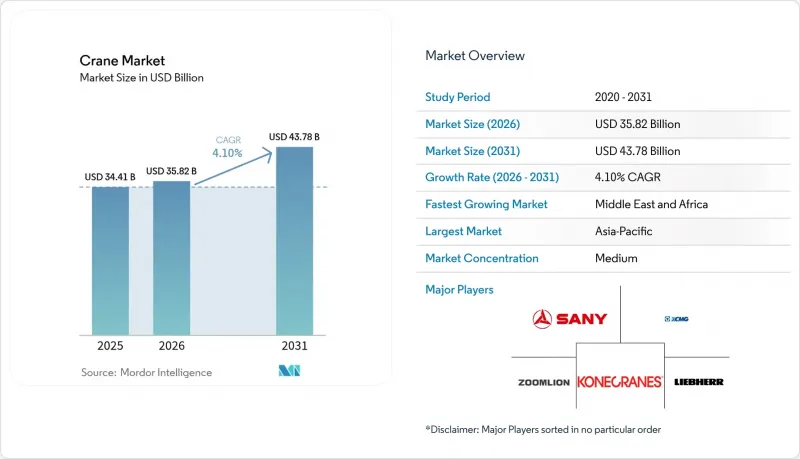
本報告按類型(移動式起重機、固定式起重機、船舶及海上起重機)、負載容量(50噸以下、51-150噸、151-300噸、300噸以上)、動力來源(柴油、混合動力、純電動)、臂架類型(桁架臂、伸縮臂)、應用領域(建築、採礦等)、應用領域和地區進行細分。市場預測以價值(美元)和數量(台)表示。
全球起重機市場趨勢與洞察
擴大基礎建設
基礎設施現代化正成為起重機需求的主要驅動力,光是《基礎設施投資與就業法案》就預計將在交通運輸、能源和數位基礎設施領域投資超過1.2兆美元。這項基礎設施發展不僅限於傳統的道路和橋樑項目,還包括資料中心、半導體製造廠和清潔能源設施,這些都需要專業的重型起重能力。預計建築支出將達到每年2.13兆美元,公共基礎設施預計將以每年約8%的速度成長。基礎設施的復興為起重機營運商提供了多年的業務前景,大量項目已訂單滿至2027年。此外,基礎設施專案中模組化施工技術的普及也推動了對能夠處理數百噸重預製構件的高精度起重設備的需求。聯邦基礎設施資金使各州能夠投資於培訓項目,從而解決合格起重機操作員嚴重短缺的問題,否則這一短缺可能會限制市場成長。
可再生能源設施安裝量快速成長
向可再生能源轉型正在從根本上改變起重機市場的動態。離岸風力發電電場的建造推動了對專用海上起重機的需求,這些起重機能夠吊裝重達2500噸以上的渦輪機零件。風力發電機安裝船配備了日益精密的起重系統,例如卡德勒公司的「風峰號」(Wind Peak)起重機,能夠一次性運輸七台15兆瓦的渦輪機組件。可再生能源的部署規模正以前所未有的速度擴張,像豪斯曼這樣的公司正在開發專用的離岸風力發電安裝起重機和運動補償平台,用於在超過150公尺的高度搬運零件。太陽能發電廠的建造也推動了對移動式起重機的需求,尤其是在大型專案中,需要將面板和安裝系統精確定位在廣闊的區域內。可再生能源產業的成長正在為起重機創造新的應用領域,從浮體式海上風電場到需要專用起重解決方案的聚光型太陽光電發電廠。由於可再生能源基礎設施需要持續維護和零件更換,預計這種能源轉型將使起重機的需求持續成長,遠遠超出傳統的建築週期。
高昂的資本成本和營運成本
起重機產業正面臨日益成長的成本壓力,這限制了市場擴張。新型重型起重機,例如馬尼托瓦克31000型起重機,售價高達3000萬美元,且需要大量的持續維護投入。材料成本上漲,主要市場的建築材料價格平均上漲15%,直接影響起重機的製造成本和租賃價格。高利率加劇了這些挑戰,顯著推高了設備資金籌措成本,並影響了起重機的購買和租賃需求。小規模起重機業者尤其容易受到這些成本壓力的影響,由於規模較小,難以消化價格上漲,這可能迫使它們退出市場或與大型業者合併。現代起重機系統日益複雜,也推高了維護成本,由於需要專業技術人員和昂貴的更換零件,可能會對營運商的預算造成壓力。認證操作員的培訓成本也在上升;雖然基於模擬的培訓計畫能夠帶來長期效益,例如縮短培訓時間和提高安全性,但它們需要大量的初期投資。
細分市場分析
截至2025年,移動式起重機將保持最大的市場佔有率,達到44.82%,這反映了其在建築、基礎設施和工業應用領域的廣泛適用性。移動式起重機能夠適應各種工作場所,並可快速部署到多個項目,因此是管理多樣化工作量的承包商的理想選擇。受離岸風電設施空前擴張和對專用船載起重解決方案的需求推動,預計2026年至2031年間,海洋和近海起重機將呈現最強勁的成長勢頭,複合年成長率將達到7.12%。
固定式起重機,包括塔式起重機和架空起重機系統,在高層建築和工業設施中發揮著至關重要的作用,尤其在中東和亞太地區的大型都市區大型企劃中需求強勁。海洋和近海領域的快速成長反映了離岸風力發電機安裝的特殊性,該安裝要求起重機在惡劣的海洋環境中運作,同時搬運重達數千噸的零件。像凱德勒(Cadeler)這樣的公司正在大力投資建造配備2200噸起重能力起重機的風力發電機安裝船,以滿足不斷成長的離岸風電市場需求。隨著離岸風力發電機尺寸的不斷增大,對能夠在極端天氣條件下進行高精度吊裝的更先進的海洋起重機系統的需求也日益成長。
到2025年,51-150噸級起重機將佔據最大的市場佔有率,達到33.60%,是通用建築和工業應用的理想選擇。 300噸級起重機將最快成長,2026年至2031年的複合年成長率將達到7.78%,這反映出產業正向需要前所未有的起重能力的大型企劃轉型。這一中等噸位的起重機在起重能力和操作柔軟性之間實現了完美的平衡,使其適用於從商業建築到基礎設施建設等各種類型的建築項目。
核能發電廠、石化設施和海上能源項目的建設推動了重型起重設備的需求,這些項目需要能夠吊裝數百噸重的核子反應爐部件、製程模組和渦輪組件的起重機。 Mamoyet 的 SK6000 起重機起重能力達 6000 噸,象徵著業界對超重型起重能力的堅定承諾。 50 噸以下的起重機適用於小規模建設項目和維護工作,而 151-300 噸級的起重機則滿足中型工業和基礎設施項目的需求。中聯重科的 3,600 噸履帶式起重機創造了單台起重重量的世界紀錄,展現了重型起重能力的科技進步。模組化建築的趨勢正在推動全噸位起重機的需求,因為預製構件需要精準的起吊和定位能力。
區域分析
2025年,亞太地區佔起重機市場收入的41.70%。這主要得益於中國持續高水準的公共工程支出以及印度工廠建設的加速發展。中國在港口自動化方面的成功,使得橋式起重機平均每小時處理60.9個貨櫃,這充分展現了該地區在貨物裝卸效率方面的領先地位。印度2025年的聯邦預算繼續保持著較高的基礎設施撥款水平,儘管正值選舉年,市場態度較為謹慎,但仍支撐了對履帶式起重機和塔式起重機的持續需求。日本和韓國則維持著個位數的低成長率,這主要得益於設施維護和現代化改造。
預計中東和非洲地區將錄得最高成長率,2026年至2031年的複合年成長率將達到6.38%。光是沙烏地阿拉伯就計畫為NEOM新城及相關大型計畫安裝約2萬台塔式起重機。沃爾夫克蘭和扎米爾集團等本地合資企業的新工廠正在縮短進口前置作業時間,並建立本地化的供應鏈。原油價格上漲正在推動下游石化聯合企業的收入成長,這些企業依賴履帶式起重機進行重型吊裝,並拓展其應用領域。
北美正受惠於1.2兆美元的《基礎設施投資與就業法案》,該法案已資助超過6萬個項目,並維持了多年的工作。預計到2025年,美國施工機械租賃市場規模將達到773億美元,其中起重機佔據了很大一部分市場佔有率。歐洲的情況則是喜憂參半。離岸風力發電正在加速設備需求,而利率上升則抑制了商業房地產的開工。拉丁美洲的復甦取決於大宗商品價格,但巴西恢復能源競標正在增加該地區對重型起重機的訂單。
其他好處:
- Excel格式的市場預測(ME)表
- 3個月的分析師支持
目錄
第1章:引言
- 研究假設和市場定義
- 調查範圍
第2章:調查方法
第3章執行摘要
第4章 市場狀況
- 市場概覽
- 市場促進因素
- 基礎建設的擴展
- 可再生能源(風力發電廠)的裝置容量正在迅速增加。
- 新興經濟體的工業成長
- 加速都市化和大型企劃規劃
- 利用車載資訊科技最佳化車輛運行(這一趨勢尚未得到太多關注)
- 為因應現場排放法規,引入了混合動力/電動起重機(這項發展並未引起公眾的太多關注)。
- 市場限制因素
- 高昂的資本和營運成本
- 建築支出的周期性特徵
- 持證起重機駕駛人短缺(一個未被公開承認的問題)
- 對碳足跡進行徹底檢查,並發布一份「從搖籃到墳墓」的報告(該報告不會公開發布)。
- 價值供應鏈分析
- 監理情勢
- 技術展望
- 波特五力模型
第5章 市場規模與成長預測
- 按類型
- 移動式起重機
- 全地形起重機
- 用於崎嶇地形的起重機
- 履帶式起重機
- 車載起重機
- 其他移動式起重機
- 固定起重機
- 單軌型和懸臂型
- 天花板軌道類型
- 塔式起重機
- 船舶和海上起重機
- 移動式港口起重機
- 固定式港口起重機
- 海上起重機
- 船舶起重機
- 移動式起重機
- 按產能
- 50噸或以下
- 51~150 T
- 151~300 T
- 超過300噸
- 透過電源
- 柴油引擎
- 混合
- 純電動
- 按吊臂類型
- 格構梁
- 伸縮臂
- 透過使用
- 建築和採礦
- 能源公用事業
- 造船和港口
- 工業製造
- 物流和倉儲
- 按地區
- 北美洲
- 美國
- 加拿大
- 其他北美國家
- 南美洲
- 巴西
- 阿根廷
- 其他南美國家
- 歐洲
- 德國
- 英國
- 法國
- 義大利
- 西班牙
- 其他歐洲國家
- 亞太地區
- 中國
- 日本
- 印度
- 韓國
- 其他亞太國家
- 中東和非洲
- 沙烏地阿拉伯
- 阿拉伯聯合大公國
- 南非
- 其他中東和非洲國家
- 北美洲
第6章 競爭情勢
- 市場集中度
- 策略趨勢
- 市佔率分析
- 公司簡介
- Liebherr-International AG
- Tadano Ltd.
- Konecranes Plc
- Manitowoc Co.
- XCMG Group
- Terex Corporation
- SANY Group
- Zoomlion Heavy Industry Sci and Tech
- Kobelco Construction Machinery
- Palfinger AG
- Hitachi Sumitomo Cranes
- Favelle Favco Group
- Cargotec Oyj(Hiab)
- Sarens NV
- Mammoet
- Link-Belt Cranes
- Altec Inc.
- Effer SpA
- Bocker Maschinenwerke
第7章 市場機會與未來展望
According to Mordor Intelligence, the crane market size is expected to grow from USD 34.41 billion in 2025 to USD 35.82 billion in 2026 and is forecast to reach USD 43.78 billion by 2031 at 4.10% CAGR over 2026-2031.
This report is Segmented by Type (Mobile Crane, Fixed Crane, and Marine and Offshore Crane), Capacity (Up To 50 T, 51 To 150 T, 151 To 300 T, and Above 300 T), Power Source (Diesel, Hybrid, and Fully Electric), Boom Type (Lattice Boom and Telescopic Boom), Application (Construction and Mining and More), and Geography. The Market Forecasts are Provided in Terms of Value (USD) and Volume (Units).
Global Crane Market Trends and Insights
Growing Infrastructure Development
Infrastructure modernization has emerged as the primary catalyst for crane demand, with the Infrastructure Investment and Jobs Act alone generating over USD 1.2 trillion in planned investments across transportation, energy, and digital infrastructure. The scale of this infrastructure push extends beyond traditional road and bridge projects to encompass data centers, semiconductor fabs, and clean energy facilities that require specialized heavy-lifting capabilities. Construction spending is projected to reach USD 2.13 trillion annually, with public infrastructure accounting for nearly 8% year-over-year growth. This infrastructure renaissance creates multi-year visibility for crane operators, extending project backlogs well into 2027. The shift toward modular construction techniques in infrastructure projects also drives demand for precision lifting equipment capable of handling prefabricated components weighing hundreds of tons. Federal infrastructure funding has enabled states to invest in workforce development programs, addressing the critical shortage of certified crane operators that could otherwise constrain market growth.
Surge in Renewable Energy Installations
The renewable energy transition fundamentally reshapes crane market dynamics, with offshore wind installations driving demand for specialized marine cranes capable of lifting turbine components exceeding 2,500 tons. Wind turbine installation vessels are being delivered with increasingly sophisticated crane systems, including Cadeler's Wind Peak vessel, capable of transporting seven complete 15 MW turbine sets per load. The scale of renewable energy deployment is unprecedented, with companies like Huisman developing specialized offshore wind installation cranes and motion-compensated platforms to handle components at heights exceeding 150 meters. Solar installations drive demand for mobile cranes, particularly in utility-scale projects where panels and mounting systems require precise positioning across vast areas. The growth of the renewable energy sector is creating new crane application categories, from floating offshore wind platforms to concentrated solar power installations requiring specialized lifting solutions. This energy transition is expected to sustain crane demand growth well beyond traditional construction cycles, as renewable energy infrastructure requires ongoing maintenance and component replacement.
High Capital and Operating Costs
The crane industry faces mounting cost pressures constraining market expansion, with new heavy-lift cranes like Manitowoc's Model 31000 commanding prices of USD 30 million while requiring substantial ongoing maintenance investments. Material cost inflation has increased construction input prices by an average of 15% across major markets, directly impacting crane manufacturing costs and rental rates. High interest rates compound these challenges, with equipment financing costs rising significantly and affecting crane purchases and rental demand. Smaller crane operators are particularly vulnerable to these cost pressures, as they lack the scale to absorb price increases and may be forced to exit the market or consolidate with larger players. The complexity of modern crane systems is also driving up maintenance costs, requiring specialized technicians and expensive replacement parts that can strain operator budgets. Training costs for certified operators are increasing, with simulation-based programs requiring substantial upfront investments despite their long-term benefits in reducing training time and improving safety outcomes.
Other drivers and restraints analyzed in the detailed report include:
- Industrial Growth Across Emerging Economies
- Accelerated Urbanization & Megaproject Pipelines
- Economic Cyclicality of Construction Spending
For complete list of drivers and restraints, kindly check the Table Of Contents.
Segment Analysis
Mobile cranes maintain the largest market share at 44.82% in 2025, reflecting their versatility across construction, infrastructure, and industrial applications. The mobile crane segment benefits from its adaptability to diverse job sites and the ability to be rapidly deployed across multiple projects, making it the preferred choice for contractors managing varied workloads. Marine and offshore cranes are experiencing the strongest growth trajectory at 7.12% CAGR 2026-2031, driven by the unprecedented expansion of offshore wind installations and the need for specialized vessel-mounted lifting solutions.
Fixed cranes, encompassing tower cranes and overhead systems, serve critical roles in high-rise construction and industrial facilities, with the demand particularly strong in urban megaprojects across the Middle East and Asia Pacific. The marine and offshore segment's rapid growth reflects the specialized nature of offshore wind turbine installation, where cranes must operate in challenging maritime environments while handling components weighing thousands of tons. Companies like Cadeler invest heavily in wind turbine installation vessels equipped with 2,200-ton capacity cranes to serve the growing offshore wind market. The evolution toward larger offshore wind turbines drives demand for increasingly sophisticated marine crane systems capable of lifting precision in harsh weather conditions.
The 51-150 ton segment commands the largest market share at 33.60% in 2025, representing the sweet spot for general construction and industrial applications. The above 300-ton capacity segment is experiencing the fastest growth at 7.78% CAGR 2026-2031, reflecting the industry's shift toward megaprojects requiring unprecedented lifting capabilities. This mid-range capacity segment benefits from its balance of lifting capability and operational flexibility, making it suitable for various construction projects from commercial buildings to infrastructure development.
Heavy-lift applications are being driven by nuclear power plant construction, petrochemical facilities, and offshore energy projects that require cranes capable of lifting reactor components, process modules, and turbine assemblies weighing hundreds of tons. Mammoet's 6,000-ton capacity SK6000 crane development exemplifies the industry's push toward ultra-heavy lifting capabilities. The up to 50-ton segment serves smaller construction projects and maintenance applications, while the 151-300 ton range addresses mid-scale industrial and infrastructure needs. Zoomlion's 3,600-ton crawler crane, setting world records for single lifting weight, demonstrates the technological advancement in heavy-lift capabilities. Modular construction trends drive demand across all capacity ranges, as prefabricated components require precise lifting and positioning capabilities.
Complete Report Scope:
- By Type
- Mobile Crane
- All-terrain Crane
- Rough-terrain Crane
- Crawler Crane
- Truck-mounted Crane
- Other Mobile Cranes
- Fixed Crane
- Monorail and Under-hung
- Overhead Track-mounted
- Tower Crane
- Marine and Offshore Crane
- Mobile Harbor Crane
- Fixed Harbor Crane
- Offshore Crane
- Ship Crane
- Mobile Crane
- By Capacity
- Up to 50 T
- 51 to 150 T
- 151 to 300 T
- Above 300 T
- By Power Source
- Diesel
- Hybrid
- Fully Electric
- By Boom Type
- Lattice Boom
- Telescopic Boom
- By Application
- Construction and Mining
- Energy and Utilities
- Shipbuilding and Ports
- Industrial Manufacturing
- Logistics and Warehousing
- By Geography
- North America
- United States
- Canada
- Rest of North America
- South America
- Brazil
- Argentina
- Rest of South America
- Europe
- Germany
- United Kingdom
- France
- Italy
- Spain
- Rest of Europe
- Asia-Pacific
- China
- Japan
- India
- South Korea
- Rest of Asia-Pacific
- Middle East and Africa
- Saudi Arabia
- United Arab Emirates
- South Africa
- Rest of Middle East and Africa
- North America
Geography Analysis
Asia-Pacific accounted for 41.70% of crane market revenue in 2025 as China sustained high public works spending and India accelerated factory construction. Chinese port automation success stories, with single bridge cranes averaging 60.9 container moves an hour, illustrate regional leadership in throughput performance. India's Union Budget 2025 maintained elevated infrastructure allocations, underpinning continued demand for crawlers and tower cranes despite election-year caution. Japan and South Korea post low-single-digit growth, driven by facility maintenance and modernization.
The Middle East and Africa region is projected to post the fastest 6.38% CAGR between 2026-2031. Saudi Arabia alone intends to deploy about 20,000 tower cranes for NEOM and associated giga-projects. Local joint ventures, such as Wolffkran and Zamil Group's new factory, reduce import lead times and create a localized supply chain. High oil prices funnel revenue into downstream petrochemical complexes that rely on heavy-lift crawler cranes, broadening application diversity.
North America benefits from the USD 1.2 trillion Infrastructure Investment and Jobs Act, which funds over 60,000 projects and sustains multi-year workloads. The U.S. equipment rental sector is forecast to reach USD 77.3 billion in 2025, with cranes forming a sizable share. Europe faces mixed signals: offshore wind accelerates equipment demand, yet elevated interest rates suppress commercial real estate starts. Latin America's recovery hinges on commodity pricing, while renewed Brazilian energy auctions boost regional heavy-lift orders.
- Liebherr-International AG
- Tadano Ltd.
- Konecranes Plc
- Manitowoc Co.
- XCMG Group
- Terex Corporation
- SANY Group
- Zoomlion Heavy Industry Sci and Tech
- Kobelco Construction Machinery
- Palfinger AG
- Hitachi Sumitomo Cranes
- Favelle Favco Group
- Cargotec Oyj (Hiab)
- Sarens NV
- Mammoet
- Link-Belt Cranes
- Altec Inc.
- Effer SpA
- Bocker Maschinenwerke
Additional Benefits:
- The market estimate (ME) sheet in Excel format
- 3 months of analyst support
TABLE OF CONTENTS
1 Introduction
- 1.1 Study Assumptions and Market Definition
- 1.2 Scope of the Study
2 Research Methodology
3 Executive Summary
4 Market Landscape
- 4.1 Market Overview
- 4.2 Market Drivers
- 4.2.1 Growing infrastructure development
- 4.2.2 Surge in renewable-energy (wind-farm) installations
- 4.2.3 Industrial growth across emerging economies
- 4.2.4 Accelerated urbanisation and megaproject pipelines
- 4.2.5 Telematics-driven fleet optimisation (under-radar)
- 4.2.6 Adoption of hybrid/e-cranes to meet site-emission rules (under-radar)
- 4.3 Market Restraints
- 4.3.1 High capital and operating costs
- 4.3.2 Economic cyclicality of construction spending
- 4.3.3 Shortage of certified crane operators (under-radar)
- 4.3.4 Carbon-footprint scrutiny and cradle-to-grave reporting (under-radar)
- 4.4 Value / Supply-Chain Analysis
- 4.5 Regulatory Landscape
- 4.6 Technological Outlook
- 4.7 Porter's Five Forces
- 4.7.1 Threat of New Entrants
- 4.7.2 Bargaining Power of Buyers
- 4.7.3 Bargaining Power of Suppliers
- 4.7.4 Threat of Substitute Products
- 4.7.5 Intensity of Competitive Rivalry
5 Market Size and Growth Forecasts
- 5.1 By Type
- 5.1.1 Mobile Crane
- 5.1.1.1 All-terrain Crane
- 5.1.1.2 Rough-terrain Crane
- 5.1.1.3 Crawler Crane
- 5.1.1.4 Truck-mounted Crane
- 5.1.1.5 Other Mobile Cranes
- 5.1.2 Fixed Crane
- 5.1.2.1 Monorail and Under-hung
- 5.1.2.2 Overhead Track-mounted
- 5.1.2.3 Tower Crane
- 5.1.3 Marine and Offshore Crane
- 5.1.3.1 Mobile Harbor Crane
- 5.1.3.2 Fixed Harbor Crane
- 5.1.3.3 Offshore Crane
- 5.1.3.4 Ship Crane
- 5.1.1 Mobile Crane
- 5.2 By Capacity
- 5.2.1 Up to 50 T
- 5.2.2 51 to 150 T
- 5.2.3 151 to 300 T
- 5.2.4 Above 300 T
- 5.3 By Power Source
- 5.3.1 Diesel
- 5.3.2 Hybrid
- 5.3.3 Fully Electric
- 5.4 By Boom Type
- 5.4.1 Lattice Boom
- 5.4.2 Telescopic Boom
- 5.5 By Application
- 5.5.1 Construction and Mining
- 5.5.2 Energy and Utilities
- 5.5.3 Shipbuilding and Ports
- 5.5.4 Industrial Manufacturing
- 5.5.5 Logistics and Warehousing
- 5.6 By Geography
- 5.6.1 North America
- 5.6.1.1 United States
- 5.6.1.2 Canada
- 5.6.1.3 Rest of North America
- 5.6.2 South America
- 5.6.2.1 Brazil
- 5.6.2.2 Argentina
- 5.6.2.3 Rest of South America
- 5.6.3 Europe
- 5.6.3.1 Germany
- 5.6.3.2 United Kingdom
- 5.6.3.3 France
- 5.6.3.4 Italy
- 5.6.3.5 Spain
- 5.6.3.6 Rest of Europe
- 5.6.4 Asia-Pacific
- 5.6.4.1 China
- 5.6.4.2 Japan
- 5.6.4.3 India
- 5.6.4.4 South Korea
- 5.6.4.5 Rest of Asia-Pacific
- 5.6.5 Middle East and Africa
- 5.6.5.1 Saudi Arabia
- 5.6.5.2 United Arab Emirates
- 5.6.5.3 South Africa
- 5.6.5.4 Rest of Middle East and Africa
- 5.6.1 North America
6 Competitive Landscape
- 6.1 Market Concentration
- 6.2 Strategic Moves
- 6.3 Market Share Analysis
- 6.4 Company Profiles (includes Global level Overview, Market level overview, Core Segments, Financials as available, Strategic Information, Market Rank/Share for key companies, Products and Services, and Recent Developments)
- 6.4.1 Liebherr-International AG
- 6.4.2 Tadano Ltd.
- 6.4.3 Konecranes Plc
- 6.4.4 Manitowoc Co.
- 6.4.5 XCMG Group
- 6.4.6 Terex Corporation
- 6.4.7 SANY Group
- 6.4.8 Zoomlion Heavy Industry Sci and Tech
- 6.4.9 Kobelco Construction Machinery
- 6.4.10 Palfinger AG
- 6.4.11 Hitachi Sumitomo Cranes
- 6.4.12 Favelle Favco Group
- 6.4.13 Cargotec Oyj (Hiab)
- 6.4.14 Sarens NV
- 6.4.15 Mammoet
- 6.4.16 Link-Belt Cranes
- 6.4.17 Altec Inc.
- 6.4.18 Effer SpA
- 6.4.19 Bocker Maschinenwerke
7 Market Opportunities and Future Outlook
- 7.1 White-space and Unmet-Need Assessment

 2026-2030年全球全地形起重機市場
 2026-2034年全球硬腿起重機市場規模、佔有率、趨勢和成長分析報告全球固定式起重機市場規模、佔有率、趨勢和成長分析報告(2026-2034年)
 林業起重機市場規模、佔有率和成長分析:按產品類型、臂架類型、起重能力、最終用戶、分銷管道和地區分類-2026-2033年產業預測
 氫動力建築起重機市場分析及預測(至2035年):類型、產品、服務、技術、組件、應用、最終用戶、功能、安裝配置
 印度起重機市場:市場佔有率分析、產業趨勢與統計、成長預測(2026-2031)
 全地形起重機市場-2026-2032年全球市場預測
 固定式起重機市場商機、成長要素、產業趨勢分析及2026-2035年預測起重機市場機會、成長要素、產業趨勢分析及2026-2035年預測。剛性腿起重機市場機會、成長要素、產業趨勢分析及 2026-2035 年預測。