


 |
市場調查報告書
商品編碼
2114331
印度起重機市場:市場佔有率分析、產業趨勢與統計、成長預測(2026-2031)India Crane - Market Share Analysis, Industry Trends & Statistics, Growth Forecasts (2026 - 2031) |
||||||

※ 本網頁內容可能與最新版本有所差異。詳細情況請與我們聯繫。
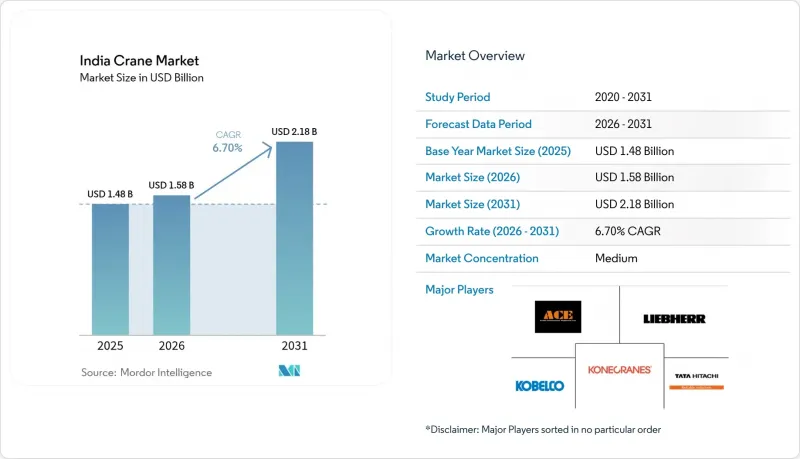
據 Mordor Intelligence 稱,2025 年印度起重機市場價值 14.8 億美元,預計到 2031 年將從 2026 年的 15.8 億美元成長至 21.8 億美元,預測期(2026-2031 年)複合年成長率為 6.70%。
本報告按機器類型(移動式起重機、固定式/塔式起重機等)、應用領域(建築、採礦/挖掘、海洋/近海等)、起重機能力(20噸以下、20-100噸、其他)、臂架類型(伸縮臂、桁架臂等)和動力來源(柴油、混合動力、純電動)進行分類。市場預測以價值(美元)和數量(台)表示。
印度起重機市場趨勢與洞察
國家基礎建設項目(NIPs)投資激增
1.4兆美元的國家投資計畫(NIP)為公路、港口、機場和城市交通項目提供資金,優先採用機械化施工而非人工施工,從而推動了起重機的年度需求。 Bharatmala公路建設項目和Sagarmala港口現代化項目佔施工機械總銷售額的30-40%。承包商依靠租賃來確保設備按時到位,這支撐了Sanghvi Movers車隊兩位數的成長。
透過「智慧城市計畫」實現以住宅主導的城市更新
智慧城市計畫已在8,000個在建工程中投資超過200億美元,在城市中心創造了高密度的起重需求,塔式起重機和小型移動式起重機均能滿足這些需求。佔據塔式起重機市場65%以上佔有率的ACE公司計劃部署25噸級平頭起重機,以滿足高層建築群的需求。永續性要求正在推動採用能夠減少排放氣體和噪音的電動和混合動力起重機。專案管理平台需要支援物聯網的起重解決方案,遠端資訊處理技術也正從「可選」轉變為「必備」。
持證起重機操作員及索具工短缺
由於設備複雜程度的提升速度超過了熟練工人的供應速度,合格人員的短缺限制了起重機隊的運轉率。基礎設施設備技能委員會提供6至12個月的培訓課程,但需求遠大於供給。雖然原始設備製造商(OEM)運營的培訓機構對操作人員進行培訓,但具備先進風力起重機和都市區吊裝技術專長的專業人員仍然短缺,這使得勞動力短缺成為限制行業發展的瓶頸。
細分市場分析
到2025年,移動式起重機將佔印度起重機市場規模的62.55%。這主要歸功於其在道路、港口和工業場所等領域的快速部署。隨著承包商對能夠滿足日益縮短的專案工期的多功能起重能力的需求不斷成長,預計該細分市場的主導地位將繼續保持。固定式起重機和塔式起重機的需求正以8.20%的複合年成長率成長,反映出市場對穩定重型起重解決方案的需求日益成長。固定式塔式起重機在基於「智慧城市計畫」的高層住宅開發案中仍然至關重要,而船舶起重機則透過電動港口設備(例如在維沙卡帕特南安裝的利勃海爾LHM 550雙機組)開闢了新的細分市場。
移動式起重機製造商正透過設計注重全地形機動性和遠端資訊處理功能的起重機來提升其租賃產品的吸引力。履帶式起重機製造商則專注於400-800噸級機型,這些機型配備長臂和可縮短組裝時間的自組裝系統。值得注意的是,由於履帶式起重機被歸類為高風險類別,印度標準局(BIS)正在進行更嚴格的審核,而擁有可靠的認證記錄是採購標準之一。隨著租賃業者努力提高運轉率,涵蓋用於一般建築的移動式起重機和用於專業起重機作業的履帶式起重機的多樣化機型已成為一項競爭優勢。因此,ACE在移動式起重機業務領域保持著其規模優勢,而三一重工、利勃海爾和神鋼則透過在印度起重機市場發展在地化生產,瞄準了履帶式起重機市場的機會。
預計到2025年,建築業將佔印度起重機銷售額的57.05%,成為印度起重機市場的基石。住宅、商業和交通走廊對20至100噸級起重機(包括移動式起重機和塔式起重機)的需求穩定。同時,能源和公共產業產業正以10.22%的複合年成長率成長,這主要得益於超重型履帶式起重機在古吉拉突邦和卡納塔克邦3兆瓦級風力發電機安裝中的應用。採礦、海運和工業製造業緊隨其後,對起重機產生了特殊尺寸和符合環保法規的需求。
建築業的成長將繼續依賴國家基礎設施計劃 (NIP) 項目和官民合作關係(PPP) 項目的推進勢頭。同時,可再生能源的蓬勃發展催生了地域集中、容量龐大的需求,促使租賃業者將重型設備集中在風電走廊附近,以便逐步部署。起重機製造商正透過整合快速運輸系統和模組化配重來應對這一需求,從而縮短長途運輸時間。隨著電廠開發商強制要求減少碳排放,混合動力和電動驅動系統在公共產業領域的滲透速度超過了建築業,為印度起重機市場帶來了技術多樣性。
其他好處:
- Excel格式的市場預測(ME)表
- 3個月的分析師支持
目錄
第1章:引言
- 研究假設和市場定義
- 調查範圍
第2章:調查方法
第3章執行摘要
第4章 市場狀況
- 市場概覽
- 市場促進因素
- 國家基礎建設發展計劃(NIPs)投資激增
- 以住宅主導、基於「智慧城市使命」的都市更新
- 可再生能源設施全年365天、每天24小時不間斷運行,其擴張帶動了對重型貨物運輸的需求。
- 地鐵和區域快速交通系統走廊的官民合作關係
- EPC承包商的「先租後買」採購模式
- 駕駛自動化:遠端資訊處理和自主起重機的演示實驗
- 市場限制因素
- 持證起重機操作員及索具工短缺
- 盧比匯率波動導致進口零件成本上升。
- 印度各邦安全法規存在差異
- 小規模租賃車隊營運成本周轉週期長
- 價值供應鏈分析
- 監理情勢
- 技術展望
- 波特五力分析
第5章 市場規模及成長預測(價值:美元,數量:單位)
- 按機器類型
- 移動式起重機
- 固定式/塔式起重機
- 船舶和港口起重機
- 透過使用
- 建造
- 採礦和鑽探
- 海洋/近海
- 工業製造
- 能源公用事業
- 負載能力
- 不足20噸
- 20-100噸
- 100-300噸
- 超過300噸
- 按吊臂類型
- 伸縮臂
- 格子佈姆
- 指節炸彈
- 透過電源
- 柴油引擎
- 混合
- 純電動
第6章 競爭情勢
- 市場集中度
- 策略趨勢
- 市佔率分析
- 公司簡介
- Action Construction Equipment(ACE)
- Konecranes India
- Liebherr India
- SANY India
- Escorts Kubota
- Kobelco Construction Equipment India
- Tata Hitachi Construction Machinery
- TIL Ltd
- Palfinger India
- Anupam Industries
- Zoomlion India
- XCMG India
- Tadano India
- Sennebogen India
- Manitowoc India
- Indo Farm Equipment
第7章 市場機會與未來展望
According to Mordor Intelligence, the India crane market size was valued at USD 1.48 billion in 2025 and estimated to grow from USD 1.58 billion in 2026 to reach USD 2.18 billion by 2031, at a CAGR of 6.70% during the forecast period (2026-2031).
This report is Segmented by Machine Type (Mobile Cranes, Fixed/Tower Cranes, and More), Application (Construction, Mining and Excavation, Marine and Offshore, and More), Lifting Capacity (Below 20 Tons, 20-100 Tons, and More), Boom Type (Telescopic Boom, Lattice Boom, and More), by Power Source (Diesel, Hybrid, Fully-Electric). The Market Forecasts are Provided in Terms of Value (USD) and Volume in Units.
India Crane Market Trends and Insights
Surge in National Infrastructure Pipeline (NIP) Investments
The USD 1.4 trillion NIP funds highway, port, airport, and urban-transport projects, lifting annual crane demand by prioritizing mechanized construction over manual labor. Road works under Bharatmala and port upgrades via Sagarmala contribute 30-40% of all construction-equipment volumes. Contractors rely on rentals to ensure on-time availability, which underpins Sanghvi Movers' double-digit fleet additions.
Housing-Led Urban Revitalization Under Smart Cities Mission
The Smart Cities Mission funnels over USD 20 billion into 8,000 active projects, generating dense urban core lifting needs suited to tower cranes and compact mobiles . With over 65% tower-crane share, ACE plans 25-ton flattop launches to address high-rise clusters. Sustainability mandates push electric and hybrid cranes that cut emissions and noise. Project management platforms demand IoT-ready lifting solutions, turning telematics from optional to essential.
Shortage of Certified Crane Operators and Riggers
A shortfall in certified personnel limits fleet utilization as equipment sophistication outruns skill supply. The Infrastructure Equipment Skill Council offers 6- to 12-month courses, yet demand outstrips throughput. OEM-run academies train operators, but advanced wind-lift or metro-rigging expertise remains scarce, keeping labor a growth bottleneck.
Other drivers and restraints analyzed in the detailed report include:
- 24X7 Renewable-Energy Build-Out Driving Heavy-Lift Demand
- Automation Push: Telematics and Autonomous Cranes Pilots
- High Working-Capital Cycle for Small Rental Fleets
For complete list of drivers and restraints, kindly check the Table Of Contents.
Segment Analysis
The mobile-crane segment captured 62.55% of the India crane market size in 2025, thanks to fast deployment across road, port, and industrial sites. Its dominance persists as contractors demand versatile lifting that keeps pace with compressed project schedules. Fixed and Tower-crane demand, expanding at an 8.20% CAGR, mirrors growth in needing stable heavy-lift solutions. Fixed tower cranes remain staples in high-rise residential clusters under Smart Cities Mission, while marine cranes carve a niche through electric harbor installations such as Visakhapatnam's twin Liebherr LHM 550 units.
Mobile-crane manufacturers tailor designs around all-terrain mobility and telematics, deepening rental appeal. Crawler-crane OEMs focus on 400- to 800-ton models featuring long booms and self-assembly systems that cut erection time. Importantly, crawler units face stricter BIS scrutiny under high-risk categories, making certification history a procurement criterion. As rental fleets chase utilization, diversified inventories encompassing mobiles for general works and crawlers for specialist lifts become a competitive necessity. Consequently, ACE sustains scale in mobile lines, while SANY, Liebherr, and Kobelco target crawler opportunities with localized production aimed at the India crane market.
Construction retained 57.05% of 2025 revenue, positioning it as the backbone of the Indian crane market. Housing, commercial complexes, and transport corridors anchor steady lifting needs spanning 20- to 100-ton mobiles and tower cranes. Energy and utilities, however, post a 10.22% CAGR as super-heavy crawlers support 3 MW wind turbine erection across Gujarat and Karnataka. Mining, marine, and industrial manufacturing trail yet contribute niche demand requiring specialized dimensions or environmental compliance.
Construction-sector growth remains tied to NIP project rollouts and PPP execution momentum. Meanwhile, the renewable boom brings geographically concentrated but capacity-intensive requirements, prompting rental operators to cluster heavy gear near wind corridors for sequential deployment. Crane OEMs respond by integrating quick-transport systems and modular counterweights that shorten mobilization between remote sites. As power-plant developers mandate lower carbon footprints, hybrid and electric drives penetrate utility applications faster than general building, adding technological diversity to the Indian crane market.
Complete Report Scope:
- By Machine Type
- Mobile Cranes
- Fixed / Tower Cranes
- Marine & Port Cranes
- By Application
- Construction
- Mining and Excavation
- Marine and Offshore
- Industrial Manufacturing
- Energy and Utilities
- By Lifting Capacity
- Below 20 tons
- 20 - 100 tons
- 100 - 300 tons
- Above 300 tons
- By Boom Type
- Telescopic Boom
- Lattice Boom
- Knuckle Boom
- By Power Source
- Diesel
- Hybrid
- Fully-Electric
List of Companies Covered in this Report:
- Action Construction Equipment (ACE)
- Konecranes India
- Liebherr India
- SANY India
- Escorts Kubota
- Kobelco Construction Equipment India
- Tata Hitachi Construction Machinery
- TIL Ltd
- Palfinger India
- Anupam Industries
- Zoomlion India
- XCMG India
- Tadano India
- Sennebogen India
- Manitowoc India
- Indo Farm Equipment
Additional Benefits:
- The market estimate (ME) sheet in Excel format
- 3 months of analyst support
TABLE OF CONTENTS
1 Introduction
- 1.1 Study Assumptions and Market Definition
- 1.2 Scope of the Study
2 Research Methodology
3 Executive Summary
4 Market Landscape
- 4.1 Market Overview
- 4.2 Market Drivers
- 4.2.1 Surge In National Infrastructure Pipeline (NIP) Investments
- 4.2.2 Housing-Led Urban Revitalization Under Smart Cities Mission
- 4.2.3 24x7 Renewable-Energy Build-Out Driving Heavy-Lift Demand
- 4.2.4 Public Private Partnerships in Metro-Rail and RRTS Corridors
- 4.2.5 Rental-First Procurement Models Among EPC Contractors
- 4.2.6 Automation Push: Telematics and Autonomous Cranes Pilots
- 4.3 Market Restraints
- 4.3.1 Shortage of Certified Crane Operators and Riggers
- 4.3.2 Rupee Volatility Raising Imported Component Costs
- 4.3.3 Fragmented Safety Regulations Across Indian States
- 4.3.4 High Working-Capital Cycle for Small Rental Fleets
- 4.4 Value / Supply-Chain Analysis
- 4.5 Regulatory Landscape
- 4.6 Technological Outlook
- 4.7 Porter's Five Forces Analysis
- 4.7.1 Threat of New Entrants
- 4.7.2 Bargaining Power of Buyers/Consumers
- 4.7.3 Bargaining Power of Suppliers
- 4.7.4 Threat of Substitutes
- 4.7.5 Intensity of Competitive Rivalry
5 Market Size and Growth Forecasts (Value in USD and Volume in Units)
- 5.1 By Machine Type
- 5.1.1 Mobile Cranes
- 5.1.2 Fixed / Tower Cranes
- 5.1.3 Marine & Port Cranes
- 5.2 By Application
- 5.2.1 Construction
- 5.2.2 Mining and Excavation
- 5.2.3 Marine and Offshore
- 5.2.4 Industrial Manufacturing
- 5.2.5 Energy and Utilities
- 5.3 By Lifting Capacity
- 5.3.1 Below 20 tons
- 5.3.2 20 - 100 tons
- 5.3.3 100 - 300 tons
- 5.3.4 Above 300 tons
- 5.4 By Boom Type
- 5.4.1 Telescopic Boom
- 5.4.2 Lattice Boom
- 5.4.3 Knuckle Boom
- 5.5 By Power Source
- 5.5.1 Diesel
- 5.5.2 Hybrid
- 5.5.3 Fully-Electric
6 Competitive Landscape
- 6.1 Market Concentration
- 6.2 Strategic Moves
- 6.3 Market Share Analysis
- 6.4 Company Profiles (includes Global level Overview, Market level overview, Core Segments, Financials as available, Strategic Information, Market Rank/Share for key companies, Products & Services, and Recent Developments)
- 6.4.1 Action Construction Equipment (ACE)
- 6.4.2 Konecranes India
- 6.4.3 Liebherr India
- 6.4.4 SANY India
- 6.4.5 Escorts Kubota
- 6.4.6 Kobelco Construction Equipment India
- 6.4.7 Tata Hitachi Construction Machinery
- 6.4.8 TIL Ltd
- 6.4.9 Palfinger India
- 6.4.10 Anupam Industries
- 6.4.11 Zoomlion India
- 6.4.12 XCMG India
- 6.4.13 Tadano India
- 6.4.14 Sennebogen India
- 6.4.15 Manitowoc India
- 6.4.16 Indo Farm Equipment
7 Market Opportunities & Future Outlook

 2026-2030年全球全地形起重機市場
 2026-2034年全球硬腿起重機市場規模、佔有率、趨勢和成長分析報告全球固定式起重機市場規模、佔有率、趨勢和成長分析報告(2026-2034年)
 林業起重機市場規模、佔有率和成長分析:按產品類型、臂架類型、起重能力、最終用戶、分銷管道和地區分類-2026-2033年產業預測
 氫動力建築起重機市場分析及預測(至2035年):類型、產品、服務、技術、組件、應用、最終用戶、功能、安裝配置
 全地形起重機市場-2026-2032年全球市場預測
 起重機:市場佔有率分析、行業趨勢和統計數據、成長預測(2026-2031 年)
 固定式起重機市場商機、成長要素、產業趨勢分析及2026-2035年預測起重機市場機會、成長要素、產業趨勢分析及2026-2035年預測。剛性腿起重機市場機會、成長要素、產業趨勢分析及 2026-2035 年預測。