


 |
市場調查報告書
商品編碼
2101877
起重機市場機會、成長要素、產業趨勢分析及2026-2035年預測。Crane Market Opportunity, Growth Drivers, Industry Trend Analysis, and Forecast 2026 - 2035 |
||||||

預計到 2025 年,全球起重機市場價值將達到 257 億美元,年複合成長率為 5.4%,到 2035 年將達到 434 億美元。
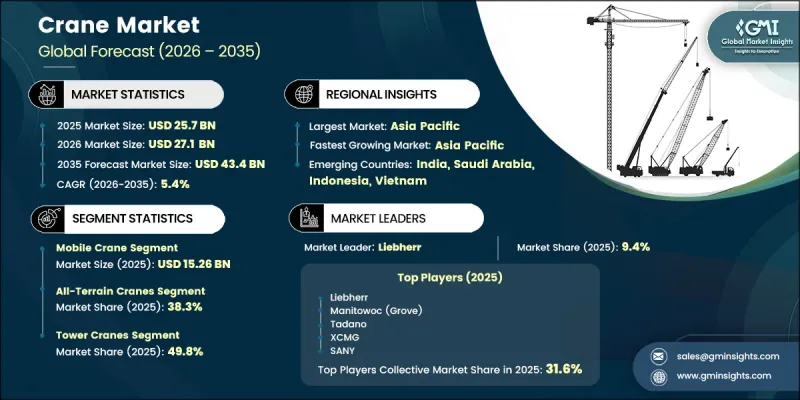
全球各地持續的基礎設施建設、活性化的工業建設活動以及對能源和物流項目的更高投資,共同推動了市場擴張。傳統建築需求以及可再生能源設施、製造工廠和大規模基礎設施建設中對重型起重設備日益成長的需求,共同推動了市場需求。此外,市場正經歷著起重機現代化進程的分階段轉型,營運商正逐步用混合動力和電動起重機取代老舊的柴油驅動系統,以提高效率並滿足日益嚴格的排放氣體法規。建築、石油天然氣、造船、物流和工業製造等多元化的終端用戶產業也為此強勁需求提供了支撐。廣泛的應用基礎有助於在整個商業週期中保持需求穩定,一個行業的放緩往往會被其他行業的成長所抵消。隨著全球都市化進程的加速和基礎設施網路的擴展,起重機在複雜的建築環境中仍然是物料輸送和專案執行的關鍵設備。
| 市場範圍 | |
|---|---|
| 開始年份 | 2025 |
| 預測期 | 2026-2035 |
| 上市時的市場規模 | 257億美元 |
| 預計金額 | 434億美元 |
| 複合年成長率 | 5.4% |
預計到2025年,行動式起重機市佔率將達到59.5%,銷售額將達到152.6億美元。預計到2035年,該細分市場將以5.2%的複合年成長率成長。移動式起重機憑藉其柔軟性、易於部署以及對各種建築和工業應用的廣泛適應性,持續保持主導地位。由於其安裝時間短、可在多個工地高效使用,移動式起重機深受承包商和租賃服務提供者的青睞,使其成為快速變化的專案環境中的實用解決方案。
預計到2025年,全地形起重機市佔率將達到38.3%,市場規模將達到58.4億美元,並在2035年之前以5.2%的複合年成長率成長。該細分市場兼具在公共道路上的機動性和高起重能力的優勢,廣泛應用於基礎設施、工業和能源相關項目。對可在都市區和偏遠施工現場作業的高柔軟性起重解決方案的需求不斷成長,持續推動全地形起重機在各種施工環境中的應用。
亞太地區起重機市場預計到2025年將達到103.6億美元,市佔率為40.4%,並以6.5%的複合年成長率成長至2035年的194.6億美元。該地區的成長主要得益於大規模的基礎建設、快速的城市擴張和強勁的產業投資活動。中國仍然是領先的國內市場,這得益於其龐大的國內製造業產能和持續的基礎設施建設項目,這些都推動了對先進起重設備的需求。
目錄
第1章:調查方法和範圍
第2章執行摘要
第3章 行業洞察
- 產業生態系分析
- 供應商情況
- 成本結構
- 利潤率
- 每個階段增加的價值
- 垂直整合趨勢
- 顛覆者
- 影響產業的因素
- 促進因素
- 基礎建設投資增加
- 可再生能源的擴張
- 工業和物流領域的成長
- 產業潛在風險與挑戰
- 高昂的擁有成本
- 供應鏈和原物料價格波動
- 對勞動力的規章制度與限制
- 市場機遇
- 基礎設施現代化計劃
- 可再生能源和離岸風力發電項目
- 電氣化和智慧起重機技術
- 促進因素
- 成長潛力分析
- 技術與創新展望
- 最新技術
- 新興技術
- 價格分析
- 對過去價格趨勢的分析
- 依球員類型分類的定價策略(高級球員、超值球員、成本加成球員)
- 監理情勢
- 北美洲
- 起重機和吊運設備的 OSHA 標準
- ASME B30.5 - 移動式和機車起重機
- NCCCO起重機操作員認證
- CSA Z150 - 移動式起重機安全標準
- 歐洲
- 歐盟機械法規
- 歐盟第五階段排放氣體標準
- EN 13000 - 起重機安全標準
- LOLER-起重設備相關法規
- 亞太地區
- GB/T 14560 - 行動式起重機安全標準(中國)
- CCMA起重機型式認可(中國)
- JCMA安全標準(日本)
- DGFASLI起重機安全規章(印度)
- AS 2550.5 - 起重機操作安全(澳洲)
- 拉丁美洲
- NR-11 和 NR-12 機械安全法規(巴西)
- NOM-009-STPS 起重設備法規(墨西哥)
- 中東和非洲
- OSHAD起重作業規格(阿拉伯聯合大公國)
- 沙烏地阿美公司起重設備標準
- 南非起重機相關法規 (SANS)
- 北美洲
- 波特的分析
- PESTLE分析
- 專利分析
- 貿易數據分析
- 進出口量及進口額趨勢
- 主要貿易路線及關稅的影響
- 成本細分分析
- 人工智慧和生成式人工智慧對市場的影響
- 利用人工智慧改造現有經營模式
- 按細分市場分類的生成式人工智慧用例和部署藍圖
- 風險、限制和監管考量
- 生產能力和生產情況
- 設備產能:按地區和主要生產商分類
- 運轉率和擴張計劃
- 預測假設和情境分析
- 基本案例下推動複合年成長率的關鍵宏觀經濟和產業變量
- 樂觀情境:宏觀經濟與產業的順風
- 悲觀情景:宏觀經濟放緩或產業逆風
第4章 競爭情勢
- 介紹
- 企業市佔率分析
- 北美洲
- 歐洲
- 亞太地區
- 拉丁美洲
- 中東和非洲
- 競爭定位矩陣
- 主要進展
- 併購
- 夥伴關係和聯盟
- 新產品發布
- 業務拓展計劃及資金籌措
- 按公司規模進行基準測試
- 排名分類標準與遴選標準
- 按銷售額、地區和創新能力分類的層級定位矩陣。
第5章 市場估計與預測:依類型分類,2022-2035年
- 移動式起重機
- 固定起重機
第6章 市場估價與預測:依移動式起重機類型分類,2022-2035年
- 類型
- 全地形起重機
- 不足200噸
- 200-500噸
- 超過500噸
- 履帶式起重機
- 不到50噸
- 50-250噸
- 250-450噸
- 超過450噸
- 用於崎嶇地形的起重機
- 不到50噸
- 50-165噸
- 超過165噸
- 卡車積載型起重機
- 不到6噸
- 7-20噸
- 21-80噸
- 超過80噸
- 吊掛式起重機
- 不到10噸
- 10-25噸
- 超過25噸
- 全地形起重機
- 推進方法
- 內燃機(ICE)
- 混合動力/電動
- 目的
- 建築和採礦
- 公共產業
- 製造業
- 運輸/海運
- 石油和天然氣/能源
- 其他
- 最終用戶
- 基礎建設公司
- 工業和製造設施
- 能源和公共產業公司
- 起重機租賃服務公司
- 其他
第7章 市場估價與預測:依固定式起重機類型分類,2022-2035年
- 類型
- 塔式起重機
- 5噸或以下
- 6-20噸
- 21-50噸
- 51-80噸
- 超過80噸
- 高架起重機
- 25噸或以下
- 26噸至50噸
- 51噸至80噸
- 超過80噸
- 僵腿鶴
- 25噸或以下
- 26噸至50噸
- 51噸至80噸
- 超過80噸
- 單軌起重機
- 25噸或以下
- 26噸至50噸
- 51噸至80噸
- 超過80噸
- 塔式起重機
- 目的
- 建築/施工
- 港口、物流、造船
- 工業製造/倉儲業
- 能源和採礦
- 其他
- 最終用戶
- 建設公司和房地產開發商
- 運輸/物流/港口營運商
- 工業製造公司
- 政府、地方當局、能源營業單位
- 起重機租賃公司
- 其他
第8章 市場估計與預測:依地區分類,2022-2035年
- 北美洲
- 美國
- 加拿大
- 歐洲
- 英國
- 德國
- 法國
- 義大利
- 西班牙
- 比利時
- 荷蘭
- 瑞典
- 俄羅斯
- 亞太地區
- 中國
- 印度
- 日本
- 澳洲
- 新加坡
- 韓國
- 越南
- 印尼
- 泰國
- 拉丁美洲
- 巴西
- 墨西哥
- 阿根廷
- 中東和非洲
- 南非
- 沙烏地阿拉伯
- UAE
- 土耳其
第9章:公司簡介
- 世界公司
- Cargotec(Hiab)
- Konecranes
- Liebherr
- Manitowoc(Grove)
- Palfinger
- SANY
- Tadano
- Terex
- XCMG
- Zoomlion
- 當地公司
- ABUS Kransysteme
- GH Cranes & Components
- Kobelco Construction Machinery
- Nucleon Crane
- Sennebogen
- Weihua Group
- 新興企業/顛覆者
- Action Construction Equipment(ACE)
- Bocker Maschinenwerke
- Furukawa UNIC
- Maeda Seisakusho
The Global Crane Market was valued at USD 25.7 billion in 2025 and is estimated to grow at a CAGR of 5.4% to reach USD 43.4 billion by 2035.
Market expansion is supported by sustained infrastructure development, rising industrial construction activity, and increasing investments in energy and logistics projects across global economies. Demand is being shaped by a combination of traditional construction requirements and the growing need for heavy lifting equipment in renewable energy installations, manufacturing facilities, and large-scale infrastructure development. The market is also witnessing a gradual shift toward modernized crane fleets, with operators replacing older diesel-powered systems with hybrid and electric alternatives to improve efficiency and meet tightening emission standards. Strong demand continuity is further supported by diversified end-use industries, which include construction, oil and gas, shipbuilding, logistics, and industrial manufacturing. This broad application base helps stabilize demand across economic cycles, ensuring that slowdowns in one sector are often balanced by growth in another. As global urbanization accelerates and infrastructure networks expand, cranes remain essential for material handling and project execution across complex construction environments.
| Market Scope | |
|---|---|
| Start Year | 2025 |
| Forecast Year | 2026-2035 |
| Start Value | $25.7 Billion |
| Forecast Value | $43.4 Billion |
| CAGR | 5.4% |
The mobile crane segment accounted for 59.5% share in 2025, generating USD 15.26 billion, and is projected to grow at a CAGR of 5.2% through 2035. This segment maintains its leading position due to its flexibility, ease of deployment, and suitability across a wide range of construction and industrial applications. Mobile cranes are widely preferred by contractors and rental service providers because they require minimal setup time and can be efficiently used across multiple job sites, making them a practical solution for dynamic project environments.
The all-terrain crane segment held 38.3% share in 2025, valued at USD 5.84 billion, and is forecast to grow at a CAGR of 5.2% through 2035. This segment benefits from its ability to combine on-road mobility with high lifting capacity, enabling use across infrastructure, industrial, and energy projects. Increasing demand for flexible lifting solutions capable of operating in both urban and remote project sites continues to support adoption across multiple construction environments.
Asia Pacific Crane Market accounted for 40.4% share in 2025, generating USD 10.36 billion, and is expected to grow at a CAGR of 6.5%, reaching USD 19.46 billion by 2035. Regional growth is driven by large-scale infrastructure development, rapid urban expansion, and strong industrial investment activity. China remains the dominant national market, supported by large domestic manufacturing capacity and continued infrastructure development programs that reinforce demand for advanced lifting equipment.
Major companies operating in the global crane market include Liebherr Group, XCMG Group, SANY Group Co., Ltd., Tadano Ltd., Zoomlion Heavy Industry Science and Technology Co., Ltd., Palfinger AG, and The Manitowoc Company (Grove). Companies operating in the crane market are focusing on technological innovation, electrification, and hybrid power systems to meet evolving environmental regulations and improve operational efficiency. Manufacturers are investing heavily in R&D to develop high-capacity cranes with advanced automation, telematics, and remote monitoring capabilities. Strategic partnerships with construction firms, energy developers, and rental service providers are helping expand market reach and ensure steady equipment utilization. Companies are also increasing production capacity and expanding regional manufacturing bases to improve supply chain efficiency and reduce lead times. Product portfolio diversification, including the development of all-terrain and specialized cranes for renewable energy projects, is strengthening competitiveness.
Table of Contents
Chapter 1 Methodology & Scope
- 1.1 Research approach
- 1.2 Quality Commitments
- 1.2.1 GMI AI policy & data integrity commitment
- 1.2.1.1 Source consistency protocol
- 1.2.1 GMI AI policy & data integrity commitment
- 1.3 Research Trail & Confidence Scoring
- 1.3.1 Research Trail Components
- 1.3.2 Scoring Components
- 1.4 Data Collection
- 1.4.1 Partial list of primary sources
- 1.5 Data mining sources
- 1.5.1 Paid sources
- 1.5.1.1 Sources, by region
- 1.5.1 Paid sources
- 1.6 Base estimates and calculations
- 1.6.1 Base year calculation
- 1.7 Forecast model
- 1.7.1 Quantified market impact analysis
- 1.7.1.1 Mathematical impact of growth parameters on forecast
- 1.7.1 Quantified market impact analysis
- 1.8 Research transparency addendum
- 1.8.1 Source attribution framework
- 1.8.2 Quality assurance metrics
- 1.8.3 Our commitment to trust
Chapter 2 Executive Summary
- 2.1 Industry 360° synopsis
- 2.2 Key market trends
- 2.2.1 Type
- 2.2.2 Mobile Crane
- 2.2.3 Fixed Crane
- 2.3 TAM Analysis, 2026-2035
- 2.4 CXO perspectives: Strategic imperatives
Chapter 3 Industry Insights
- 3.1 Industry ecosystem analysis
- 3.1.1 Supplier landscape
- 3.1.2 Cost structure
- 3.1.3 Profit margin
- 3.1.4 Value addition at each stage
- 3.1.5 Vertical integration trends
- 3.1.6 Disruptors
- 3.2 Industry impact forces
- 3.2.1 Growth drivers
- 3.2.1.1 Rising Infrastructure Investments
- 3.2.1.2 Renewable Energy Expansion
- 3.2.1.3 Industrial & Logistics Growth
- 3.2.2 Industry pitfalls & challenges
- 3.2.2.1 High Ownership Costs
- 3.2.2.2 Supply Chain & Raw Material Volatility
- 3.2.2.3 Regulatory & Workforce Constraints
- 3.2.3 Market opportunities
- 3.2.3.1 Infrastructure Modernization Programs
- 3.2.3.2 Renewable Energy & Offshore Wind Projects
- 3.2.3.3 Electrification & Smart Crane Technologies
- 3.2.1 Growth drivers
- 3.3 Growth potential analysis
- 3.4 Technology and Innovation landscape
- 3.4.1 Current technologies
- 3.4.2 Emerging technologies
- 3.5 Pricing Analysis (Driven by Primary Research)
- 3.5.1 Historical Price Trend Analysis
- 3.5.2 Pricing Strategy by Player Type (Premium / Value / Cost-plus)
- 3.6 Regulatory landscape
- 3.6.1 North America
- 3.6.1.1 OSHA Crane & Derrick Standards
- 3.6.1.2 ASME B30.5 - Mobile & Locomotive Cranes
- 3.6.1.3 NCCCO Crane Operator Certification
- 3.6.1.4 CSA Z150 - Safety Code on Mobile Cranes
- 3.6.2 Europe
- 3.6.2.1 EU Machinery Regulation
- 3.6.2.2 EU Stage V Emission Standards
- 3.6.2.3 EN 13000 - Crane Safety Standard
- 3.6.2.4 LOLER - Lifting Equipment Regulations
- 3.6.3 Asia-Pacific
- 3.6.3.1 GB/T 14560 - Mobile Crane Safety Standard (China)
- 3.6.3.2 CCMA Crane Type Certification (China)
- 3.6.3.3 JCMA Safety Standards (Japan)
- 3.6.3.4 DGFASLI Crane Safety Regulations (India)
- 3.6.3.5 AS 2550.5 - Cranes Safety in Use (Australia)
- 3.6.4 Latin America
- 3.6.4.1 NR-11 & NR-12 Machinery Safety Regulations (Brazil)
- 3.6.4.2 NOM-009-STPS Lifting Equipment Regulations (Mexico)
- 3.6.5 Middle East & Africa
- 3.6.5.1 OSHAD Lifting Operations Code (UAE)
- 3.6.5.2 Saudi Aramco Lifting Equipment Standards
- 3.6.5.3 South Africa Lifting Machinery Regulations (SANS)
- 3.6.1 North America
- 3.7 Porter's analysis
- 3.8 PESTEL analysis
- 3.9 Patent analysis (Driven by Primary Research)
- 3.10 Trade Data Analysis (Driven by paid database)
- 3.10.1 Import/export volume & value trends
- 3.10.2 Key trade corridors & tariff impact
- 3.11 Cost breakdown analysis
- 3.12 Impact of AI & generative AI on the market
- 3.12.1 AI Driven Disruption of Existing Business Models
- 3.12.2 GenAI Use Cases and Adoption Roadmap by Segment
- 3.12.3 Risks Limitations and Regulatory Considerations
- 3.13 Capacity & Production Landscape (Driven by Primary Research)
- 3.13.1 Installed Capacity by Region & Key Producer
- 3.13.2 Capacity Utilization Rates & Expansion Pipelines
- 3.14 Forecast assumptions & scenario analysis (Driven by Primary Research)
- 3.14.1 Base Case key macro & industry variables driving CAGR
- 3.14.2 Optimistic Scenarios Favorable Macro and Industry Tailwinds
- 3.14.3 Pessimistic Scenario Macroeconomic slowdown or industry headwinds
Chapter 4 Competitive Landscape, 2025
- 4.1 Introduction
- 4.2 Company market share analysis
- 4.2.1 North America
- 4.2.2 Europe
- 4.2.3 Asia-Pacific
- 4.2.4 Latin America
- 4.2.5 Middle East & Africa
- 4.3 Competitive positioning matrix
- 4.4 Key developments
- 4.4.1 Mergers & acquisitions
- 4.4.2 Partnerships & collaborations
- 4.4.3 New product launches
- 4.4.4 Expansion plans and funding
- 4.5 Company tier benchmarking
- 4.5.1 Tier classification criteria & qualifying thresholds
- 4.5.2 Tier positioning matrix by revenue, geography & innovation
Chapter 5 Market Estimates & Forecast, By Type, 2022 - 2035 ($Mn, Units)
- 5.1 Key trends
- 5.2 Mobile Crane
- 5.3 Fixed Crane
Chapter 6 Market Estimates & Forecast, By Mobile Crane, 2022 - 2035 ($Mn, Units)
- 6.1 Key trends
- 6.2 Type
- 6.2.1 All-terrain crane
- 6.2.1.1 Below 200 Tons
- 6.2.1.2 200 to 500 Tons
- 6.2.1.3 Above 500 Tons
- 6.2.2 Crawler crane
- 6.2.2.1 Below 50 Tons
- 6.2.2.2 50 to 250 Tons
- 6.2.2.3 250 to 450 Tons
- 6.2.2.4 Above 450 Tons
- 6.2.3 Rough terrain crane
- 6.2.3.1 Below 50 Tons
- 6.2.3.2 50 to 165 Tons
- 6.2.3.3 Above 165 Tons
- 6.2.4 Truck loader crane
- 6.2.4.1 Below 6 Tons
- 6.2.4.2 7 to 20 Tons
- 6.2.4.3 21 to 80 Tons
- 6.2.4.4 Above 80 Tons
- 6.2.5 Pick-and-carry crane
- 6.2.5.1 Below to 10 Tons
- 6.2.5.2 10-25 Tons
- 6.2.5.3 Above 25 Tons
- 6.2.1 All-terrain crane
- 6.3 Propulsion
- 6.3.1 ICE (Internal Combustion Engine)
- 6.3.2 Hybrid / Electric
- 6.4 Application
- 6.4.1 Construction & Mining
- 6.4.2 Utility
- 6.4.3 Manufacturing
- 6.4.4 Transport/Shipping
- 6.4.5 Oil & Gas/Energy
- 6.4.6 Others
- 6.5 End-User
- 6.5.1 Infrastructure Contractors
- 6.5.2 Industrial & Manufacturing Facilities
- 6.5.3 Energy & Utilities Companies
- 6.5.4 Crane Rental & Service Companies
- 6.5.5 Others
Chapter 7 Market Estimates & Forecast, By Fixed Crane, 2022 - 2035 ($Mn, Units)
- 7.1 Key trends
- 7.2 Type
- 7.2.1 Tower Crane
- 7.2.1.1 Below 5 Tons
- 7.2.1.2 6 to 20 Tons
- 7.2.1.3 21 to 50 Tons
- 7.2.1.4 51 to 80 Tons
- 7.2.1.5 Above 80 Tons
- 7.2.2 Gantry Crane
- 7.2.2.1 Below 25 Tons
- 7.2.2.2 26 Tons to 50 Tons
- 7.2.2.3 51 Tons to 80 Tons
- 7.2.2.4 Above 80 Tons
- 7.2.3 Stiffleg Crane
- 7.2.3.1 Up to 25 Tons
- 7.2.3.2 26 Tons to 50 Tons
- 7.2.3.3 51 Tons to 80 Tons
- 7.2.3.4 Above 80 Tons
- 7.2.4 Monorail Crane
- 7.2.4.1 Up to 25 Tons
- 7.2.4.2 26 Tons to 50 Tons
- 7.2.4.3 51 Tons to 80 Tons
- 7.2.4.4 Above 80 Tons
- 7.2.1 Tower Crane
- 7.3 Application
- 7.3.1 Building & Construction
- 7.3.2 Port, Logistics & Shipbuilding
- 7.3.3 Industrial Manufacturing & Warehousing
- 7.3.4 Energy & Mining
- 7.3.5 Others
- 7.4 End User
- 7.4.1 Construction Companies & Real Estate Developers
- 7.4.2 Transportation, Logistics & Port Operators
- 7.4.3 Industrial Manufacturing Enterprises
- 7.4.4 Government, Municipal & Energy Utilities
- 7.4.5 Crane Rental Companies
- 7.4.6 Others
Chapter 8 Market Estimates & Forecast, By Region, 2022 - 2035 ($Mn, Units)
- 8.1 North America
- 8.1.1 US
- 8.1.2 Canada
- 8.2 Europe
- 8.2.1 UK
- 8.2.2 Germany
- 8.2.3 France
- 8.2.4 Italy
- 8.2.5 Spain
- 8.2.6 Belgium
- 8.2.7 Netherlands
- 8.2.8 Sweden
- 8.2.9 Russia
- 8.3 Asia Pacific
- 8.3.1 China
- 8.3.2 India
- 8.3.3 Japan
- 8.3.4 Australia
- 8.3.5 Singapore
- 8.3.6 South Korea
- 8.3.7 Vietnam
- 8.3.8 Indonesia
- 8.3.9 Thailand
- 8.4 Latin America
- 8.4.1 Brazil
- 8.4.2 Mexico
- 8.4.3 Argentina
- 8.5 MEA
- 8.5.1 South Africa
- 8.5.2 Saudi Arabia
- 8.5.3 UAE
- 8.5.4 Turkey
Chapter 9 Company Profiles
- 9.1 Global Players
- 9.1.1 Cargotec (Hiab)
- 9.1.2 Konecranes
- 9.1.3 Liebherr
- 9.1.4 Manitowoc (Grove)
- 9.1.5 Palfinger
- 9.1.6 SANY
- 9.1.7 Tadano
- 9.1.8 Terex
- 9.1.9 XCMG
- 9.1.10 Zoomlion
- 9.2 Regional Players
- 9.2.1 ABUS Kransysteme
- 9.2.2 GH Cranes & Components
- 9.2.3 Kobelco Construction Machinery
- 9.2.4 Nucleon Crane
- 9.2.5 Sennebogen
- 9.2.6 Weihua Group
- 9.3 Emerging Players / Disruptors
- 9.3.1 Action Construction Equipment (ACE)
- 9.3.2 Bocker Maschinenwerke
- 9.3.3 Furukawa UNIC
- 9.3.4 Maeda Seisakusho

 2026-2034年全球硬腿起重機市場規模、佔有率、趨勢和成長分析報告全球固定式起重機市場規模、佔有率、趨勢和成長分析報告(2026-2034年)
 林業起重機市場規模、佔有率和成長分析:按產品類型、臂架類型、起重能力、最終用戶、分銷管道和地區分類-2026-2033年產業預測
 氫動力建築起重機市場分析及預測(至2035年):類型、產品、服務、技術、組件、應用、最終用戶、功能、安裝配置
 印度起重機市場:市場佔有率分析、產業趨勢與統計、成長預測(2026-2031)
 全地形起重機市場-2026-2032年全球市場預測起重機:市場佔有率分析、行業趨勢和統計數據、成長預測(2026-2031 年)
 固定式起重機市場商機、成長要素、產業趨勢分析及2026-2035年預測剛性腿起重機市場機會、成長要素、產業趨勢分析及 2026-2035 年預測。
 2026-2030年全球起重機市場