


 |
市場調查報告書
商品編碼
2120592
北美企業資源規劃:市場佔有率分析、產業趨勢與統計及成長預測(2026-2031 年)North America Enterprise Resource Planning - Market Share Analysis, Industry Trends & Statistics, Growth Forecasts (2026 - 2031) |
||||||

※ 本網頁內容可能與最新版本有所差異。詳細情況請與我們聯繫。
根據 Mordor Intelligence 預測,北美企業資源規劃 (ERP) 市場規模將從 2025 年的 244.3 億美元成長到 2026 年的 268.6 億美元,到 2031 年將達到 414.4 億美元,2026 年至 2031 年的複合年成長率為 9.06%。
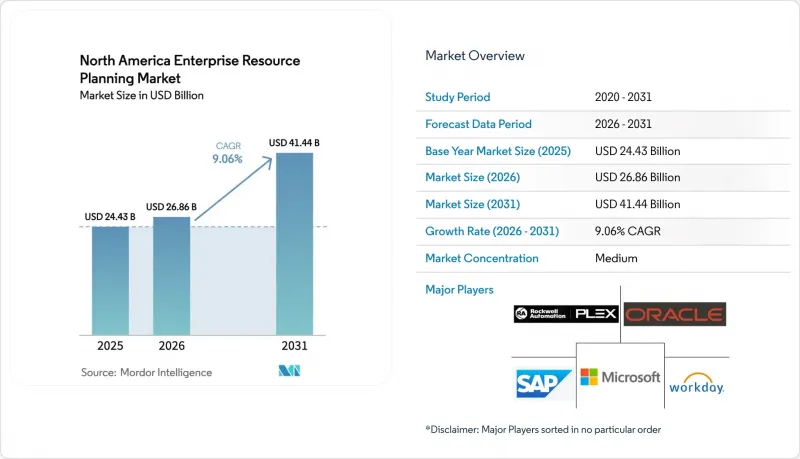
本報告按類型(雲端原生套件、行動優先ERP、其他)、產業(財務會計、其他)、部署模式(本地部署、雲端部署)、組織規模(大型企業、中小企業)、產業細分(製造業、其他)和國家進行細分。市場預測以美元(USD)計價。
北美企業資源規劃市場的趨勢與洞察
快速過渡到「雲端優先」ERP部署模式
憑藉訂閱式定價、每季自動更新的功能以及無需資本基礎設施,雲端套件已成為預設選擇。 SAP 的 S/4HANA 雲端公用版新增了用於發票匹配和需求預測的 AI 功能,並在 2024 年促成了 1200 項遷移。 Oracle 的 Fusion Cloud ERP 的 AI 代理程式模擬了公司間交易並偵測了支出異常,試點用戶每月結算時間縮短了 30%。微軟將 Copilot 整合到 Dynamics 365 Finance 中,使其能夠處理 40% 的重複性日記帳審核工作。 Workday 收購 Sana 後,也將對話式 AI 整合到整個 HCM(人力資源管理)流程中。根據《工業周刊》在 2024 年下半年對製造商進行的一項調查,90% 的受訪者表示計劃在 24 個月內升級到基於雲端的 ERP 系統,高於兩年前的 72%。
人工智慧嵌入式分析在即時決策的應用激增
透過將機器學習模型整合到事務性工作流程中,ERP 系統從靜態記錄轉變為主動洞察生成。 IBM 對 2500 家公司進行的一項調查發現,整合 AI 模型的公司 ERP 投資回報率提高了 27%,缺貨率降低了 18%,庫存過剩率降低了 22%。 SAP 和 Snowflake 的合作將使汽車製造商能夠將採購資料與外部半導體前置作業時間資訊整合,並即時調整生產計畫。 Workday 的「AI 閘道」能夠在保護資料駐留的同時存取大規模語言模型,滿足了日益嚴格的隱私權法規下的兩項基本要求。波士頓顧問公司 (BCG) 警告稱,將分析功能視為簡單的附加功能可能會導致資料提取過時和預測準確性下降。
初始成本及實施及變更管理相關的生命週期成本。
德勤2024年對300個專案進行的一項調查發現,中型企業部署五年內的總成本中位數為270萬美元,其中42%用於變更管理和資料清理。普華永道的一項調查發現,38%的專案超出預算25%,29%的專案延後了運作線日期,導致產品發布和收入成長延遲。隨著用戶數量的增加,持續上漲的訂閱費會對預算造成壓力。此外,供應商通常會對永久許可證收取年度維護費的18%至22%,這迫使財務長權衡生產力提升與持續支出之間的關係。
細分市場分析
邊緣運算和雙層架構正以9.45%的複合年成長率快速擴張,是ERP架構中成長最快的。這是因為企業正在將總部核心財務系統與輕量級的工廠或子公司實例整合,以處理本地合規性、貨幣和低延遲的現場數據。到2025年,雲端原生套件仍將佔支出的41.11%,這顯示人們對供應商管理的基礎設施普遍充滿信心。行動優先ERP仍然是一個小眾市場,採用率僅為12%左右,但它受到需要離線資料收集和GPS時間戳記的公共產業和現場服務提供者的青睞。另一方面,基於社交和協作的ERP則面臨困境,因為Teams和Slack的連接器現在提供了類似的基於聊天的核准流程。
NetSuite 2025 的雙向連接器顯著縮短了收購後的整合時間,而位於墨西哥加工廠的邊緣節點則透過在夜間將停機日誌複製到美國核心系統來防止廣域網路擁塞。 ISO 27001 和 SOC 2 認證正在影響監管嚴格的製藥和航太製造地對系統的選擇,促使企業在本地部署邊緣節點以儲存審計追蹤資訊。各供應商的專業化程度不一。 SAP 和 Oracle 在雲端原生和雙層解決方案方面主導,而像 ServiceMax 這樣的專業供應商則在面向工程師的行動領域細分市場擁有良好的業績記錄。
供應鏈和營運軟體的年成長率高達 10.61%,這主要得益於物聯網感測器、需求預測演算法以及縮短訂單到付款週期的供應商入口網站的廣泛應用。在 2025 年的支出預測中,財務和會計領域仍將佔最大佔有率,達到 32.59%。這是因為所有公司都需要總分類帳、應付帳款管理和法定報告,但如今,企業正在將額外的預算分配給高級計劃和排程、倉庫管理以及運輸最佳化。人工智慧驅動的需求預測已被證實可將預測誤差降低高達 50%,從而釋放先前作為安全庫存佔用的營運資金。 Workday 的對話式人工智慧正在簡化員工福利諮詢流程,這表明人力資本管理 (HCM) 也正在受益於嵌入式人工智慧。
生命科學領域的可追溯性要求日益提高,製造執行和品管模組的重要性也隨之提升。與最佳組合相比,整合到單一資料庫中可以減輕資料核對的負擔。隨著雲端供應商將預測模型和數位助理引入財務、營運和人力資本管理 (HCM) 系統,跨職能工作流程正在加速發展。這一趨勢推動了新授權的購買和系統擴展,鞏固了北美企業資源規劃 (ERP) 市場作為前台和後勤部門流程數位化基礎的地位。
其他福利
- Excel格式的市場預測(ME)表
- 3個月的分析師支持
目錄
第1章:引言
- 研究假設和市場定義
- 調查範圍
第2章:調查方法
第3章執行摘要
第4章 市場狀況
- 市場概覽
- 市場促進因素
- 快速過渡到「雲端優先」ERP部署模式
- 人工智慧嵌入式分析在即時決策的應用激增
- 實施雙層ERP系統,整合總部和子公司的營運。
- 中小企業對價格實惠、模組化的 SaaS 套件的需求日益成長。
- 因環境、社會及公司治理(ESG)相關報告義務而加速系統升級
- 邊緣運算和物聯網資料整合以實現封閉回路型運行
- 市場限制因素
- 初始成本及實施及變更管理相關的生命週期成本。
- 多租戶雲端中的網路安全和資料主權問題
- 北美地區ERP人才與專案管理能力短缺
- 本地部署環境支援週期縮短,有供應商鎖定風險。
- 產業價值鏈分析
- 監理情勢
- 技術展望
- 波特五力分析
- 宏觀經濟因素對市場的影響
第5章 市場規模與成長預測
- 按類型
- 雲端原生套件
- 行動優先的ERP
- 社交協作型企業資源規劃
- 雙層邊緣ERP
- 按部門
- 財會
- 供應鏈營運
- 人力資本管理
- 客戶關係與商務
- 生產執行和品質
- 按部署模式
- 現場
- 雲
- 按組織規模
- 大公司
- 中小企業
- 按行業細分
- 製造業
- 零售與電子商務
- BFSI
- 政府/公共部門
- IT/通訊
- 醫療保健和生命科學
- 其他行業領域
- 國家
- 美國
- 加拿大
- 墨西哥
第6章 競爭情勢
- 市場集中度
- 策略趨勢
- 市佔率分析
- 公司簡介
- SAP SE
- Oracle Corporation
- Microsoft Corporation
- Workday Inc.
- Infor Inc.
- Epicor Software Corporation
- IBM Corporation
- The Sage Group plc
- Plex Systems Inc.(Rockwell Automation Inc.)
- FinancialForce.com Inc.
- Unit4 NV
- Deltek Inc.
- Deacom Inc.
- Acumatica Inc.
- IFS AB
- Syspro USA Inc.
- QAD Inc.
- Oracle NetSuite
- SAP Business One
- Odoo SA
第7章 市場機會與未來展望
According to Mordor Intelligence, the North America enterprise resource planning market size is expected to increase from USD 24.43 billion in 2025 to USD 26.86 billion in 2026 and reach USD 41.44 billion by 2031, growing at a CAGR of 9.06% over 2026-2031.
This report is Segmented by Type (Cloud-Native Suite, Mobile-First ERP, and More), Business Function (Finance and Accounting, and More), Deployment Model (On-Premise and Cloud), Organization Size (Large Enterprises and Small and Medium Enterprises (SMEs)), Industry Vertical (Manufacturing, and More), and Country. The Market Forecasts are Provided in Terms of Value (USD).
North America Enterprise Resource Planning Market Trends and Insights
Rapid Shift Toward Cloud-First ERP Deployment Models
Subscription pricing, automated quarterly feature drops, and removal of capital infrastructure have elevated cloud suites to default status. SAP's S/4HANA Cloud Public Edition added generative AI for invoice matching and demand forecasting, triggering 1,200 migrations in 2024. Oracle's Fusion Cloud ERP AI agents replicate intercompany transactions and flag spend anomalies, slicing monthly close times by 30% in pilot users. Microsoft embedded Copilot into Dynamics 365 Finance to handle 40% of repetitive journal reviews, and Workday's Sana acquisition integrates conversational AI across HCM flows. Manufacturers surveyed by Industry Week in late 2024 revealed that 90% planned cloud-based ERP upgrades within 24 months, up from 72% two years earlier.
Surge in AI-Embedded Analytics for Real-Time Decision-Making
Embedding machine-learning models into transactional workflows shifts ERP from static record-keeping to proactive insight-generation. An IBM study of 2,500 enterprises found that firms integrating AI models achieved 27% higher ERP ROI, reducing stockouts by 18% and excess inventory by 22%. SAP's partnership with Snowflake lets automakers blend purchasing data with external chip lead-time signals to recalibrate production plans on the fly. Workday's AI Gateway protects data residency while opening access to large language models, a dual imperative as privacy rules tighten. BCG warns that treating analytics as a bolt-on risks stale data extracts and eroded forecast accuracy.
Up-Front and Life-Cycle Costs of Implementation and Change-Management
Deloitte's 2024 survey of 300 projects pegged the median five-year total cost at USD 2.7 million for mid-market rollouts, with 42% spent on change management and data cleansing. PwC found that 38% of projects were running 25% over budget and 29% were missing go-live dates, delaying product launches and revenue expansion. Ongoing subscription escalators can strain budgets as user counts grow, and vendors typically charge 18-22% for annual maintenance on perpetual licenses, forcing CFOs to weigh productivity gains against recurring spend.
Other drivers and restraints analyzed in the detailed report include:
- Two-Tier ERP Adoption to Harmonize HQ and Subsidiary Operations
- Rising SMB Demand for Affordable, Modular SaaS Suites
- Cyber-Security and Data-Sovereignty Concerns in Multitenant Clouds
For complete list of drivers and restraints, kindly check the Table Of Contents.
Segment Analysis
Edge and two-tier architectures are expanding at a 9.45% CAGR, the fastest pace among ERP architectures, as firms marry headquarters finance cores with lightweight plant-floor or subsidiary instances to handle local compliance, currencies, and low-latency shop-floor data. Cloud-native suites still held 41.11% of spending in 2025, indicating widespread confidence in vendor-managed infrastructure. Mobile-first ERP remains niche at roughly 12% penetration, favored by utilities and field-service fleets that need offline capture and GPS timestamping, while social and collaborative ERP has stalled because Teams and Slack connectors now provide comparable chat-based approval flows.
NetSuite's 2025 bidirectional connectors slash integration weeks for acquisitions, and edge nodes in Mexican maquiladoras replicate downtime logs to United States cores overnight, preventing WAN congestion. ISO 27001 and SOC 2 certifications shape type selection in regulated pharma or aerospace plants, prompting on-premises edge nodes to preserve audit trails on-site. Vendors differ in their specialties: SAP and Oracle dominate cloud-native and two-tier solutions, whereas specialists such as ServiceMax excel in technician-focused mobile niches.
Supply-chain and operations software is growing at 10.61% annually, driven by the adoption of IoT sensors, demand-sensing algorithms, and supplier portals that compress order-to-cash cycles. Finance and accounting retain the largest slice at 32.59% of 2025 spending because every firm needs general ledger, payables, and statutory reports, yet incremental budgets now fund advanced planning and scheduling, warehouse management, and transportation optimization. Found that AI-driven demand forecasting reduced forecast error by up to 50%, freeing up working capital previously tied up in safety stock. Workday's conversational AI streamlines benefits queries, demonstrating that HCM also benefits from embedded intelligence.
Traceability mandates in life sciences push manufacturing execution and quality modules higher, and convergence on a single database reduces reconciliation overhead compared with best-of-breed architectures. As cloud vendors infuse finance, operations, and HCM with predictive models and digital assistants, cross-functional workflows gain velocity. This dynamic drives new licenses and expansions, solidifying North America's enterprise resource planning market as the digital backbone for both front- and back-office processes.
Complete Report Scope:
- By Type
- Cloud-Native Suite
- Mobile-First ERP
- Social / Collaborative ERP
- Two-Tier / Edge ERP
- By Business Function
- Finance And Accounting
- Supply-Chain And Operations
- Human Capital Management
- Customer Relationship And Commerce
- Manufacturing Execution And Quality
- By Deployment Model
- On-Premise
- Cloud
- By Organization Size
- Large Enterprises
- Small And Medium Enterprises (SMEs)
- By Industry Vertical
- Manufacturing
- Retail And E-Commerce
- BFSI
- Government And Public Sector
- IT And Telecom
- Healthcare And Life Sciences
- Others Industry Vertical
- By Country
- United States
- Canada
- Mexico
List of Companies Covered in this Report:
- SAP SE
- Oracle Corporation
- Microsoft Corporation
- Workday Inc.
- Infor Inc.
- Epicor Software Corporation
- IBM Corporation
- The Sage Group plc
- Plex Systems Inc. (Rockwell Automation Inc.)
- FinancialForce.com Inc.
- Unit4 NV
- Deltek Inc.
- Deacom Inc.
- Acumatica Inc.
- IFS AB
- Syspro USA Inc.
- QAD Inc.
- Oracle NetSuite
- SAP Business One
- Odoo SA
Additional Benefits:
- The market estimate (ME) sheet in Excel format
- 3 months of analyst support
TABLE OF CONTENTS
1 INTRODUCTION
- 1.1 Study Assumptions and Market Definition
- 1.2 Scope of The Study
2 RESEARCH METHODOLOGY
3 EXECUTIVE SUMMARY
4 MARKET LANDSCAPE
- 4.1 Market Overview
- 4.2 Market Drivers
- 4.2.1 Rapid Shift Toward Cloud-First ERP Deployment Models
- 4.2.2 Surge In AI-Embedded Analytics For Real-Time Decision-Making
- 4.2.3 Two-Tier ERP Adoption To Harmonise HQ And Subsidiary Operations
- 4.2.4 Rising SMB Demand For Affordable, Modular SaaS Suites
- 4.2.5 ESG-Linked Reporting Mandates Accelerating System Upgrades
- 4.2.6 Edge/IoT Data Integration For Closed-Loop Operations
- 4.3 Market Restraints
- 4.3.1 Up-Front And Life-Cycle Costs Of Implementation And Change-Management
- 4.3.2 Cyber-Security And Data-Sovereignty Concerns In Multitenant Clouds
- 4.3.3 Shortage Of North America-Based ERP Talent And Project Bandwidth
- 4.3.4 Vendor Lock-In Risk Amid Shrinking On-Premise Support Windows
- 4.4 Industry Value-Chain Analysis
- 4.5 Regulatory Landscape
- 4.6 Technological Outlook
- 4.7 Porter's Five Forces Analysis
- 4.7.1 Bargaining Power Of Suppliers
- 4.7.2 Bargaining Power Of Buyers
- 4.7.3 Threat Of New Entrants
- 4.7.4 Threat Of Substitutes
- 4.7.5 Intensity Of Competitive Rivalry
- 4.8 Impact Of Macroeconomic Factors On The Market
5 MARKET SIZE AND GROWTH FORECASTS (VALUE)
- 5.1 By Type
- 5.1.1 Cloud-Native Suite
- 5.1.2 Mobile-First ERP
- 5.1.3 Social / Collaborative ERP
- 5.1.4 Two-Tier / Edge ERP
- 5.2 By Business Function
- 5.2.1 Finance And Accounting
- 5.2.2 Supply-Chain And Operations
- 5.2.3 Human Capital Management
- 5.2.4 Customer Relationship And Commerce
- 5.2.5 Manufacturing Execution And Quality
- 5.3 By Deployment Model
- 5.3.1 On-Premise
- 5.3.2 Cloud
- 5.4 By Organization Size
- 5.4.1 Large Enterprises
- 5.4.2 Small And Medium Enterprises (SMEs)
- 5.5 By Industry Vertical
- 5.5.1 Manufacturing
- 5.5.2 Retail And E-Commerce
- 5.5.3 BFSI
- 5.5.4 Government And Public Sector
- 5.5.5 IT And Telecom
- 5.5.6 Healthcare And Life Sciences
- 5.5.7 Others Industry Vertical
- 5.6 By Country
- 5.6.1 United States
- 5.6.2 Canada
- 5.6.3 Mexico
6 COMPETITIVE LANDSCAPE
- 6.1 Market Concentration
- 6.2 Strategic Moves
- 6.3 Market Share Analysis
- 6.4 Company Profiles (Includes Global Level Overview, Market Level Overview, Core Segments, Financials As Available, Strategic Information, Market Rank/Share For Key Companies, Products And Services, And Recent Developments)
- 6.4.1 SAP SE
- 6.4.2 Oracle Corporation
- 6.4.3 Microsoft Corporation
- 6.4.4 Workday Inc.
- 6.4.5 Infor Inc.
- 6.4.6 Epicor Software Corporation
- 6.4.7 IBM Corporation
- 6.4.8 The Sage Group plc
- 6.4.9 Plex Systems Inc. (Rockwell Automation Inc.)
- 6.4.10 FinancialForce.com Inc.
- 6.4.11 Unit4 NV
- 6.4.12 Deltek Inc.
- 6.4.13 Deacom Inc.
- 6.4.14 Acumatica Inc.
- 6.4.15 IFS AB
- 6.4.16 Syspro USA Inc.
- 6.4.17 QAD Inc.
- 6.4.18 Oracle NetSuite
- 6.4.19 SAP Business One
- 6.4.20 Odoo SA
7 MARKET OPPORTUNITIES AND FUTURE OUTLOOK
- 7.1 White-Space And Unmet-Need Assessment

 政府機構企業內容管理 (ECM):市場佔有率分析、行業趨勢和統計數據以及成長預測 (2026-2031)
 企業資源計畫 (ERP) 市場:按組件、ERP 類型、來源類型、部署模式、組織規模和產業分類-2026-2032 年全球市場預測學校企業資源規劃:市場佔有率分析、產業趨勢與統計、成長預測(2026-2031)
 2026-2030年全球企業資源規劃(ERP)軟體市場
 醫療技術和生物製藥領域醫療設備CMO/CDMO市場:依產品類型、服務類型、器材分類和地區分類教育產業企業資源規劃 (ERP) 軟體市場:按組件、授權類型、部署類型、組織規模和最終用戶分類 - 2026-2032 年全球預測
 先進製造市場預測至2034年:按技術、組件、部署模式、應用、產業和地區分類的全球分析
 2026年全球商業應用與開發市場報告2026年全球尖端材料與製造市場報告ERP供應商生態系統市場:市場佔有率分析、產業趨勢與統計、成長預測(2026-2031年)