


 |
市場調查報告書
商品編碼
2100552
學校企業資源規劃:市場佔有率分析、產業趨勢與統計、成長預測(2026-2031)Enterprise Resource Planning in Schools - Market Share Analysis, Industry Trends & Statistics, Growth Forecasts (2026 - 2031) |
||||||

※ 本網頁內容可能與最新版本有所差異。詳細情況請與我們聯繫。
學校企業資源規劃 (ERP) 市場預計將從 2025 年的 756.4 億美元成長到 2026 年的 843.5 億美元,然後在 2031 年達到 1455.4 億美元,2026 年至 2031 年的複合年成長率為 11.52%。
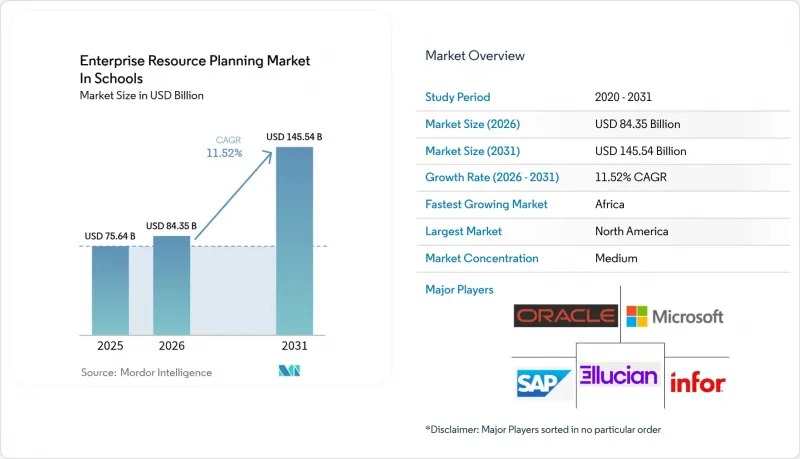
本報告按部署類型(本地部署、雲端部署、混合部署)、功能(管理、薪資核算等)、學校級別(幼兒園、小學等)、教育機構規模(小規模、中型、大型)和地區(北美、歐洲等)進行細分。市場預測以美元計價。
學校企業資源規劃(ERP)市場洞察與趨勢
透過學校運營整體持續可用的數據,實現快速決策。
整合的資料儲存庫將決策前置作業時間從數週縮短至數小時,財務委員會現在可以在年中進行專案間資金調撥,而無需事後審計。 Oracle 雲端 ERP 於 2024 年在美國學區實施,透過消除人工對帳的需求,將預算調整週期縮短了 40%。整合到 SAP S/4HANA 教育版中的預測儀表板會在每個會計季度結束前提醒學校預算超支情況,使採購團隊能夠凍結可自由支配的支出,從而避免年末虧損。擁有多個校區的中大規模學區正從校際整合中獲益最多,而校際整合先前曾減緩了他們的反應速度。
即時數據分析的實施
Power BI 與 Dynamics 365 的整合將原始交易日誌轉化為預測儀表板,揭示了諸如學生錯過早班車後輟學風險增加 30% 等關聯性。為了應對這一趨勢,一些學區調整了學校路線並延長了食堂開放時間。隨著分析技術推動 ERP 從單純的合規管理工具發展成為策略規劃引擎,學校董事會現在會在實際會議中模擬各種“假設情境”,例如新學年開學或關閉分校區。雖然 ISO 27001 框架並非強制性要求,但隨著家長要求提供分析流程匿名化的證據,它擴大被納入 RFP 清單中。
根據業務需求進行客製化是困難的。
現成的會計科目表範本通常與現有的薪資核算週期和區域報告代碼相衝突。 2024 年學校網路聯盟 (Consortium for School Networking) 的一項調查顯示,42% 的學區放棄了試點部署,因為必要的客製化會使他們的支援保證失效。每次升級都存在破壞自訂程式碼的風險。雖然 Tyler Technologies 現在提供了一個無需程式碼的工作流程建構器,但培訓仍然是小規模行政辦公室面臨的一大障礙。
細分市場分析
混合模式是成長最快的部署選項,複合年成長率高達 15.85%。相較之下,預計到 2025 年,學校導向的雲端 ERP 市場佔有率將達到 62.45%。混合解決方案符合德國和日本的資料主權法律,同時透過將敏感的學生識別資訊保留在本地伺服器上,並將匿名資料發送到雲端進行分析,從而在不犧牲可擴展性的前提下滿足這些法律要求。在英國,資料保護影響評估現已成為強制性要求,在將記錄遷移到外部部署之前,必須對資料進行評估,這迫使學區在將報告工作負載遷移到雲端的同時,將核心學生資訊系統 (SIS) 保留在本地。微軟的 Azure Stack for Education 允許 Dynamics 365 元件在本地運行,同時將元資料同步到雲端,這進一步印證了混合部署是最終解決方案的觀點。
混合生態系統還能降低故障風險。即使連線中斷,本地交易處理也能繼續進行。 Infor CloudSuite Education 提供加密 API,用於將財務資料傳輸到基於雲端的運輸管理儀表板,這展示了供應商如何從隱私角度分類工作負載。雖然在美國的大型學區,本地部署仍然是首選,但隨著伺服器更換週期的臨近,它們面臨預算方面的嚴格審查;而對於缺乏資料中心人員的小規模學校來說,純雲端部署正逐漸成為主流。
預計到2031年,交通管理軟體市場將以每年15.35%的速度成長,在學校ERP市場中表現優異,超越其他所有功能,儘管行政功能在2025年佔據了24.10%的市場佔有率。這項成長主要得益於基於GPS的路線最佳化,該技術能夠立即節省燃油成本,並滿足家長即時追蹤校車位置的需求。 Tyler Technologies將燃油成本直接整合到總分類帳(GL)中,使財務團隊能夠計算每位學生的交通成本,並確定可以合併的路線。
薪資核算和財務模組已被廣泛採用,升級帶來的收益與現有投資相比微乎其微,導致其發展速度較為緩慢。 PowerSchool 的整合平台 Kinjo 將課程規劃和採購流程連結起來,確保教材訂單與課程大綱保持一致。設施管理和餐飲服務業模組目前仍屬於小眾領域,但隨著學區將物聯網感測器整合到能源管理和食堂使用追蹤系統中,並利用 ERP 分析來預測菜單需求,預計這些模組將實現成長。
區域分析
非洲正以16.20%的複合年成長率引領全球成長,這主要得益於肯亞強制推行的每日行動考勤報告製度,以及南非新創公司提供的解決方案,這些方案將以成果為導向的教育模板與企業資源計畫(ERP)系統相結合。隨著援助機構將津貼與檢驗的電子記錄掛鉤,學校正逐步擺脫對桌面設備的依賴,轉而採用可離線運作且之後可重新同步的行動雲端解決方案。在非洲的採購週期中,以該地貨幣提供計量收費的供應商更具優勢,因為這可以幫助當地學區避免外匯風險。
預計到2025年,北美將佔據學校ERP市場33.65%的佔有率,但由於大多數學區的核心財務模組已經投入運作,市場擴張已趨於停滯。目前的成長主要由系統升級協議推動,而系統升級協議的推動則源自於GASB租賃法規和本地部署支援合約的終止。供應商正透過「遷移加速器」來凸顯自身優勢,這些加速器可以將歷史資料遷移到雲端帳簿,而不會造成長時間的停機。
在歐洲,向混合架構的轉型正在推進。在英國,資料保護影響評估是強制性的;在德國,跨境備份受到限制。在法國,國家教育入口網站強制要求透過API提供數據,迫使學校部署具有認證連接器的套件。印度為與國家入口網站整合的雲端ERP系統提供大量津貼,而中國則是出於資料主權的考慮,強調本地雲端或本地部署。日本和澳洲已發布互通性標準,將開放API作為強制性要求。拉丁美洲都市區的私立學校正在部署家長入口網站以吸引中產階級家庭,而公立學校系統則在預算允許的情況下逐步部署相關模組。在海灣國家,「智慧校園」計畫正在整合ERP系統和物聯網感測器,對參與區域競標的供應商的功能要求也越來越高。
其他好處:
- Excel格式的市場預測(ME)表
- 3個月的分析師支持
目錄
第1章:引言
- 研究假設和市場定義
- 調查範圍
第2章:調查方法
第3章執行摘要
第4章 市場狀況
- 市場概覽
- 市場促進因素
- 學校所有營運環節將獲得一致的數據,進而加快決策速度。
- 即時數據分析的實施
- 擴大教育軟體在教育環境的應用
- 混合式學習模式的興起正在加速對整合式ERP系統的需求。
- 政府強制要求學校財務報告透明化
- 基於 API 的微服務的普及使得 ERP 系統能夠進行模組化升級。
- 市場限制因素
- 根據業務需求進行客製化是困難的。
- 前期實施成本高
- 學生資訊系統中的資料隱私和合規性問題
- K-12學校缺乏精通ERP系統的行政人員
- 宏觀經濟因素對市場的影響
- 產業價值鏈分析
- 監理情勢
- 波特五力分析
- 技術展望
第5章 市場規模與成長預測
- 不同的發展
- 現場
- 雲
- 混合
- 按功能
- 管理
- 薪資核算
- 學術領域
- 金融
- 運輸
- 採購和庫存管理
- 其他功能
- 學校類型
- 學前班
- 小學
- 中等教育
- 高等中學教育
- 按機構規模
- 小規模學校(學生人數少於500人)
- 中型學校(500-2000名學生)
- 大型學校(超過2000名學生)
- 按地區
- 北美洲
- 美國
- 加拿大
- 墨西哥
- 南美洲
- 巴西
- 阿根廷
- 其他南美國家
- 歐洲
- 英國
- 德國
- 法國
- 西班牙
- 義大利
- 其他歐洲國家
- 亞太地區
- 中國
- 印度
- 日本
- 澳洲
- 韓國
- 其他亞太國家
- 中東和非洲
- 中東
- 沙烏地阿拉伯
- 阿拉伯聯合大公國
- 土耳其
- 其他中東國家
- 非洲
- 南非
- 肯亞
- 其他非洲國家
- 中東
- 北美洲
第6章 競爭情勢
- 市場集中度
- 策略趨勢
- 市佔率分析
- 公司簡介
- SAP SE
- Oracle Corporation
- Microsoft Corporation
- Infor Inc.
- Ellucian Company LP
- Blackbaud, Inc.
- Tyler Technologies, Inc.
- PowerSchool Holdings, Inc.
- Workday, Inc.
- Unit4 NV
- Harris School Solutions(N. Harris Computer Corporation)
- Tata Consultancy Services Limited
- Serosoft Solutions Pvt. Ltd.
- Foradian Technologies Pvt. Ltd.
- Focus School Software, LLC
- EduSys Pvt. Ltd.
- Kuali, Inc.
- SchoolTime Software Solutions Pvt. Ltd.
- OpenEduCat Inc.
- Infinite Campus
第7章 市場機會與未來展望
According to Mordor Intelligence, the enterprise resource planning market size in schools market size is expected to grow from USD 75.64 billion in 2025 to USD 84.35 billion in 2026 and is forecast to reach USD 145.54 billion by 2031 at 11.52% CAGR over 2026-2031.
This report is Segmented by Deployment (On-Premise, Cloud, and Hybrid), Function (Administration, Payroll, and More), School Level (Pre-Primary, Primary, and More), Institution Size (Small Schools, Medium Schools, and Large Schools), and Geography (North America, Europe, and More). The Market Forecasts are Provided in Terms of Value (USD).
Insights and Trends of Enterprise Resource Planning Market in Schools
Consistent Data Availability Across the School Business for Faster Decision Making
Unified data repositories are shrinking decision lead times from weeks to hours, enabling finance committees to shift cash among programs mid-year rather than conduct retrospective audits. Oracle Cloud ERP deployments in U.S. districts during 2024 trimmed budget-revision cycles by 40% once manual reconciliation disappeared. Predictive dashboards embedded in SAP S/4HANA Education flagged overruns before the fiscal quarter ended, letting purchasing teams freeze discretionary spend and avert year-end deficits. Medium and large districts with multiple campuses accrue the greatest gains because cross-site consolidation has historically delayed action.
Real-Time Data Analytics Adoption
Power BI integration with Dynamics 365 turns raw transaction logs into predictive dashboards that expose correlations such as the 30% higher dropout risk for students who miss morning buses, a pattern that pushed several districts to reroute transport and extend cafeteria hours. With analytics moving ERP from compliance ledger to strategic planning engine, boards now run what-if scenarios for opening new grade levels or closing satellite campuses during live sessions. ISO 27001 frameworks, while not mandated, increasingly appear on RFP checklists as parents demand evidence of anonymization in analytics pipelines.
Difficulties in Customization According to Business Needs
Off-the-shelf chart-of-accounts templates often clash with existing payroll cycles or local reporting codes. A 2024 Consortium for School Networking study showed 42% of districts halting pilots because required customizations voided support warranties. Each upgrade risks breaking bespoke code. Tyler Technologies now offers a no-code workflow builder, yet training remains a hurdle for small offices.
Other drivers and restraints analyzed in the detailed report include:
- Increasing Use of Education Software in Academics
- Emergence of Hybrid Learning Models Accelerating Integrated ERP Demand
- High Initial Implementation Costs
For complete list of drivers and restraints, kindly check the Table Of Contents.
Segment Analysis
Hybrid models represent the fastest-growing deployment option at a 15.85% CAGR, compared with the 62.45% cloud enterprise resource planning market in schools market share recorded in 2025. Hybrid solutions keep sensitive student identifiers on local servers while pushing anonymized data to cloud analytics, satisfying sovereignty laws in Germany and Japan without sacrificing scalability. The United Kingdom now demands data-protection impact assessments before any records move off-premise, pushing districts to store core SIS on-site and shift reporting workloads to the cloud. Microsoft's Azure Stack for Education allows Dynamics 365 components to run locally while syncing metadata to the cloud, reinforcing the end-state nature of hybrid deployments.
Hybrid ecosystems also lower failure risk; if connectivity drops, onsite transaction processing continues. Infor CloudSuite Education offers encrypted APIs to shuttle finance entries to cloud-based transportation dashboards, illustrating how vendors partition workloads along privacy lines. On-premise installations, still favored by large U.S. districts, face budget scrutiny as server refresh cycles approach, whereas pure-cloud adoption dominates small schools that lack data-center talent.
Transportation software is forecast to advance 15.35% yearly through 2031, outpacing all other functions even though administration held a 24.10% enterprise resource planning market in schools market share in 2025. The catalyst lies in GPS-based route optimization, which shows immediate fuel savings and satisfies parent demand for live bus tracking. Tyler Technologies integrates fuel costs directly into GL accounts, letting finance teams calculate per-student transportation expenses and identify routes eligible for consolidation.
Payroll and finance modules, though already widespread, evolve slowly because upgrades deliver marginal gains relative to sunk investments. PowerSchool's unified Kinjo platform blends lesson plans with purchasing flows so that textbook requisitions align with syllabus timelines. Facilities and food-service modules remain niche but grow when districts link IoT sensors for energy management or cafeteria counts, using ERP analytics to forecast menu demand.
Complete Report Scope:
- By Deployment
- On-Premise
- Cloud
- Hybrid
- By Function
- Administration
- Payroll
- Academics
- Finance
- Transportation
- Procurement and Inventory
- Other Functions
- By School Level
- Pre-Primary
- Primary
- Secondary
- Higher Secondary
- By Institution Size
- Small Schools (<500 Students)
- Medium Schools (500-2000 Students)
- Large Schools (>2000 Students)
- By Geography
- North America
- United States
- Canada
- Mexico
- South America
- Brazil
- Argentina
- Rest of South America
- Europe
- United Kingdom
- Germany
- France
- Spain
- Italy
- Rest of Europe
- Asia-Pacific
- China
- India
- Japan
- Australia
- South Korea
- Rest of Asia-Pacific
- Middle East and Africa
- Middle East
- Saudi Arabia
- United Arab Emirates
- Turkey
- Rest of Middle East
- Africa
- South Africa
- Kenya
- Rest of Africa
- Middle East
- North America
Geography Analysis
Africa leads global growth with a 16.20% CAGR, propelled by Kenya's mandate for daily mobile attendance submissions and South African startups bundling ERP with outcome-based education templates. Donor agencies funnel grants contingent on verified digital records, prompting schools to leapfrog desktops and adopt mobile-cloud solutions that work offline and resync later. The region's procurement cycles favor vendors offering pay-as-you-go models denominated in local currencies, hedging FX risk for rural districts.
North America held a 33.65% enterprise resource planning market in schools market share in 2025, but expansion has plateaued as most districts already run core finance modules. Growth now stems from replacement deals, driven by GASB lease rules and the sunset of on-premise support contracts. Vendors differentiate via migration accelerators that port historical data into cloud-hosted ledgers without extended downtime.
Europe converges on hybrid architectures; the United Kingdom demands data-protection impact assessments, and Germany restricts cross-border backups. France's national education portal mandates API submissions, pushing schools toward suites with certified connectors. India showers grants on cloud ERP linked to its national portal, while China leans on local-cloud or on-premise deployments, citing data sovereignty. Japan and Australia publish interoperability standards, making open APIs table stakes. Latin America's urban private schools deploy parent-facing portals to attract middle-class families, whereas public systems adopt modules incrementally as budgets allow. Gulf states bundle ERP with IoT sensors under "smart campus" programs, raising functionality expectations for vendors seeking regional tenders.
- SAP SE
- Oracle Corporation
- Microsoft Corporation
- Infor Inc.
- Ellucian Company L.P.
- Blackbaud, Inc.
- Tyler Technologies, Inc.
- PowerSchool Holdings, Inc.
- Workday, Inc.
- Unit4 N.V.
- Harris School Solutions (N. Harris Computer Corporation)
- Tata Consultancy Services Limited
- Serosoft Solutions Pvt. Ltd.
- Foradian Technologies Pvt. Ltd.
- Focus School Software, LLC
- EduSys Pvt. Ltd.
- Kuali, Inc.
- SchoolTime Software Solutions Pvt. Ltd.
- OpenEduCat Inc.
- Infinite Campus
Additional Benefits:
- The market estimate (ME) sheet in Excel format
- 3 months of analyst support
TABLE OF CONTENTS
1 INTRODUCTION
- 1.1 Study Assumptions and Market Definition
- 1.2 Scope of the Study
2 RESEARCH METHODOLOGY
3 EXECUTIVE SUMMARY
4 MARKET LANDSCAPE
- 4.1 Market Overview
- 4.2 Market Drivers
- 4.2.1 Consistent Data Availability Across the School Business for Faster Decision Making
- 4.2.2 Real-Time Data Analytics Adoption
- 4.2.3 Increasing Use of Education Software in Academics
- 4.2.4 Emergence of Hybrid Learning Models Accelerating Integrated ERP Demand
- 4.2.5 Government Mandates for Transparent School Financial Reporting
- 4.2.6 Proliferation of API-Based Microservices Enabling Modular ERP Upgrades
- 4.3 Market Restraints
- 4.3.1 Difficulties in Customization According to Business Needs
- 4.3.2 High Initial Implementation Costs
- 4.3.3 Data Privacy and Compliance Concerns in Student Information Systems
- 4.3.4 Shortage of ERP-Literate Administrative Staff in K-12 Schools
- 4.4 Impact of Macroeconomic Factors on the Market
- 4.5 Industry Value Chain Analysis
- 4.6 Regulatory Landscape
- 4.7 Porter's Five Forces Analysis
- 4.7.1 Bargaining Power of Suppliers
- 4.7.2 Bargaining Power of Buyers/Consumers
- 4.7.3 Threat of New Entrants
- 4.7.4 Threat of Substitute Products
- 4.7.5 Intensity of Competitive Rivalry
- 4.8 Technological Outlook
5 MARKET SIZE AND GROWTH FORECASTS (VALUE)
- 5.1 By Deployment
- 5.1.1 On-Premise
- 5.1.2 Cloud
- 5.1.3 Hybrid
- 5.2 By Function
- 5.2.1 Administration
- 5.2.2 Payroll
- 5.2.3 Academics
- 5.2.4 Finance
- 5.2.5 Transportation
- 5.2.6 Procurement and Inventory
- 5.2.7 Other Functions
- 5.3 By School Level
- 5.3.1 Pre-Primary
- 5.3.2 Primary
- 5.3.3 Secondary
- 5.3.4 Higher Secondary
- 5.4 By Institution Size
- 5.4.1 Small Schools (<500 Students)
- 5.4.2 Medium Schools (500-2000 Students)
- 5.4.3 Large Schools (>2000 Students)
- 5.5 By Geography
- 5.5.1 North America
- 5.5.1.1 United States
- 5.5.1.2 Canada
- 5.5.1.3 Mexico
- 5.5.2 South America
- 5.5.2.1 Brazil
- 5.5.2.2 Argentina
- 5.5.2.3 Rest of South America
- 5.5.3 Europe
- 5.5.3.1 United Kingdom
- 5.5.3.2 Germany
- 5.5.3.3 France
- 5.5.3.4 Spain
- 5.5.3.5 Italy
- 5.5.3.6 Rest of Europe
- 5.5.4 Asia-Pacific
- 5.5.4.1 China
- 5.5.4.2 India
- 5.5.4.3 Japan
- 5.5.4.4 Australia
- 5.5.4.5 South Korea
- 5.5.4.6 Rest of Asia-Pacific
- 5.5.5 Middle East and Africa
- 5.5.5.1 Middle East
- 5.5.5.1.1 Saudi Arabia
- 5.5.5.1.2 United Arab Emirates
- 5.5.5.1.3 Turkey
- 5.5.5.1.4 Rest of Middle East
- 5.5.5.2 Africa
- 5.5.5.2.1 South Africa
- 5.5.5.2.2 Kenya
- 5.5.5.2.3 Rest of Africa
- 5.5.5.1 Middle East
- 5.5.1 North America
6 COMPETITIVE LANDSCAPE
- 6.1 Market Concentration
- 6.2 Strategic Moves
- 6.3 Market Share Analysis
- 6.4 Company Profiles (includes Global Level Overview, Market Level Overview, Core Segments, Financials as Available, Strategic Information, Market Rank/Share for Key Companies, Products and Services, and Recent Developments)
- 6.4.1 SAP SE
- 6.4.2 Oracle Corporation
- 6.4.3 Microsoft Corporation
- 6.4.4 Infor Inc.
- 6.4.5 Ellucian Company L.P.
- 6.4.6 Blackbaud, Inc.
- 6.4.7 Tyler Technologies, Inc.
- 6.4.8 PowerSchool Holdings, Inc.
- 6.4.9 Workday, Inc.
- 6.4.10 Unit4 N.V.
- 6.4.11 Harris School Solutions (N. Harris Computer Corporation)
- 6.4.12 Tata Consultancy Services Limited
- 6.4.13 Serosoft Solutions Pvt. Ltd.
- 6.4.14 Foradian Technologies Pvt. Ltd.
- 6.4.15 Focus School Software, LLC
- 6.4.16 EduSys Pvt. Ltd.
- 6.4.17 Kuali, Inc.
- 6.4.18 SchoolTime Software Solutions Pvt. Ltd.
- 6.4.19 OpenEduCat Inc.
- 6.4.20 Infinite Campus
7 MARKET OPPORTUNITIES AND FUTURE OUTLOOK
- 7.1 White-Space and Unmet-Need Assessment

 政府機構企業內容管理 (ECM):市場佔有率分析、行業趨勢和統計數據以及成長預測 (2026-2031)北美企業資源規劃:市場佔有率分析、產業趨勢與統計及成長預測(2026-2031 年)
 企業資源計畫 (ERP) 市場:按組件、ERP 類型、來源類型、部署模式、組織規模和產業分類-2026-2032 年全球市場預測
 2026-2030年全球企業資源規劃(ERP)軟體市場
 醫療技術和生物製藥領域醫療設備CMO/CDMO市場:依產品類型、服務類型、器材分類和地區分類教育產業企業資源規劃 (ERP) 軟體市場:按組件、授權類型、部署類型、組織規模和最終用戶分類 - 2026-2032 年全球預測
 先進製造市場預測至2034年:按技術、組件、部署模式、應用、產業和地區分類的全球分析
 2026年全球商業應用與開發市場報告2026年全球尖端材料與製造市場報告ERP供應商生態系統市場:市場佔有率分析、產業趨勢與統計、成長預測(2026-2031年)