


 |
市場調查報告書
商品編碼
2118234
政府機構企業內容管理 (ECM):市場佔有率分析、行業趨勢和統計數據以及成長預測 (2026-2031)Government Enterprise Content Management (ECM) - Market Share Analysis, Industry Trends & Statistics, Growth Forecasts (2026 - 2031) |
||||||

※ 本網頁內容可能與最新版本有所差異。詳細情況請與我們聯繫。
據 Mordor Intelligence 稱,2025 年政府機構的企業內容管理 (ECM) 市場價值為 57.6 億美元,預計從 2026 年到 2031 年將以 12.30% 的複合年成長率成長,到 2031 年達到 114.3 億美元。
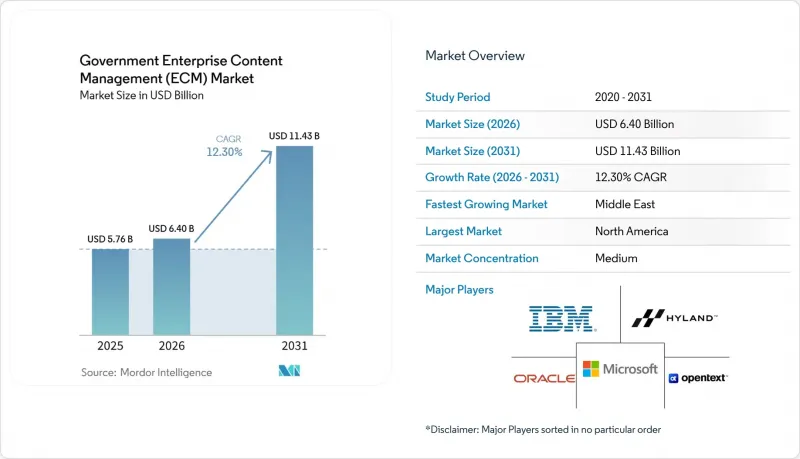
本報告按解決方案類型(文件管理、記錄管理、工作流程和業務流程管理、數位資產管理、Web內容管理等)、部署模式(本地部署、雲端部署、混合式部署)、企業規模(中小企業、大型企業)和地區進行細分。市場預測以美元(USD)計價。
全球政府機構企業內容管理 (ECM) 市場趨勢與洞察。
監理合規義務重新定義了內容管治標準
監管義務仍然是政府機構企業內容管理 (ECM) 市場需求的最主要促進因素,它將檔案管理從一次性軟體專案轉變為持續的營運必需品。美國國家檔案館 (NARA) 啟動了 2026 年聯邦報告週期,要求各機構在該週期內提交《檔案管理自評報告》、《聯邦電子檔案和電子郵件管理報告》以及《高級檔案官員年度報告》。此外,NARA 的 2024 年聯邦檔案報告強調了內容平台必須管理的規模差異:44% 的機構持有的永久性電子郵件和電子記錄不足 5 Terabyte,而有 5 個機構持有超過 100 Petabyte的數據。這些義務使得各機構越來越難以推遲合規儲存庫的實施,因為未能實施合規儲存庫的機構將面臨審計結果、法律風險以及代價高昂的檔案傳輸糾正延誤。歐洲也出現了類似的趨勢,對電子認證和信任服務的要求迫使政府機構專注於能夠處理經過認證的記錄和法律認可的數位簽章的系統。
政府部門非結構化資料的日益成長給傳統架構帶來了壓力。
政府機構的企業內容管理 (ECM) 市場也受益於非結構化政府資料的大量和複雜性。這些資料如今已不再局限於掃描文檔,還包括電子郵件、影片、聊天記錄和案件檔案。美國政府官員表示,到 2026 年,需要處理的數位記錄數量將迅速增加。美國國務院預測,未來幾年解密的外交電報數量將增加五倍,而聯邦存款保險公司 (FDIC) 則指出,需要進行自動化分類和生命週期管理的非結構化內容數量顯著增加。一項針對 240 多個政府機構的 2025 年基準調查發現,自 2018 年以來,與資訊自由請求相關的平均檔案大小增加了 438%,僅影片檔案就增加了 173%。這種負擔並非均勻分佈,因為積極推進人工智慧專案的機構也在產生訓練語料庫、推理日誌和審計追蹤,這又增加了需要管治的內容層級。英國的《人工智慧洞察框架》指出,管理非結構化資料對於有效營運和課責至關重要,這表明類似的管治需求正在美國以外的地區蔓延。
安全和隱私問題使雲端企業內容管理(ECM)的採用變得複雜。
儘管政府機構普遍支持基於雲端的現代化,但安全和隱私問題仍然阻礙著政府機構企業內容管理 (ECM) 市場的成長。美國國家檔案館 (NARA) 監察長辦公室在 2025 年進行的一項審計顯示,ERA 2.0 缺乏處理大規模資料集的技術能力,文件大小和安全設定的限制導致 71 Terabyte的已註冊非機密記錄被儲存在系統之外。此外,美國網路安全與基礎設施安全局 (CISA) 於 2025 年 1 月發布的關於零信任架構的指南將內容管治定位為一項企業安全挑戰,要求對所有交易實施基於身分的存取控制、持續檢驗和防篡改的稽核日誌。行動存取給現場工作人員和遠端辦公人員帶來了新的合規性挑戰,通常需要在將 ECM 擴展到固定辦公環境之外之前採取額外的控制措施。如果未能及早明確這些安全要求,可能會導致採購時間延長,並增加部署後糾正措施的成本。
細分市場分析
到2025年,檔案管理將佔政府機構企業內容管理(ECM)市場佔有率的26.44%,成為該類別中最大的解決方案類型。該領域之所以能保持領先地位,是因為檔案保存、遵守《資訊自由法》(FOIA)、訴訟延期以及審計追蹤要求仍然是聯邦、州和地方機構的基本營運需求。由於合規性的重要性,即使機構面臨預算限制,檔案管理也不太可能被推遲,而其他相關工具則不然。文件管理、工作流程和業務流程管理仍然佔據著相當大的支出,因為授權程序、津貼、合約和服務交付的數位化都依賴與受控儲存位置相連的結構化路由。
預計到2031年,案件管理將以12.67%的複合年成長率成長,成為政府機構企業內容管理(ECM)市場中成長最快的解決方案領域。這項成長需求源自於各機構日益需要以更結構化的方式處理其整體公共服務業務中的福利、執法、許可和司法工作流程。西非國家經濟共同體(ECOWAS)法院於2026年6月啟用了一套電子案件管理系統,這表明其正朝著大規模、安全的電子文件管理、文件處理和線上聽證會的方向發展。雖然網路內容管理、數位資產管理和其他專用工具的規模仍然相對較小,但隨著各機構整合平台並將人工智慧驅動的工作流程與管治強制執行的記錄相連接,它們與核心ECM的融合度日益提高。
區域分析
到2025年,北美將佔據政府機構企業內容管理(ECM)市場40.28%的佔有率,成為最大的區域叢集。這一區域主導地位源於美國聯邦政府龐大的記錄保存義務、眾多的機構數量以及提供已通過核准的雲端人工智慧解決方案的供應商數量的不斷成長。一項針對2025年聯邦政府人工智慧應用案例的調查涵蓋了56個機構,顯示這些機構已廣泛使用依賴管治強制內容層的人工智慧工具。加州在2026年6月全州範圍內推出了其生成式人工智慧平台Poppy,此前該平台已在70多個部門和2700多名員工中進行了先導計畫,這表明各州對安全內容管理的需求日益成長。 2026年3月, Oracle發布了美國聯邦機構的人工智慧資料平台,進一步鞏固了北美在投資以安全為重點的高價值內容平台方面最為活躍的地位。
歐洲是政府機構企業內容管理 (ECM) 的第二大市場,並持續受到嚴格的數位身分和公民資料要求的影響。該地區的公共機構繼續將內容管理決策與認證記錄的處理、隱私管理以及建立自主數位基礎設施的努力聯繫起來。法國跨部門的網路內容管理方法表明,多部門整合具有在公共部門 ECM 市場創造巨大機會的潛力。德國、英國和法國繼續引領該地區的採購,而東歐成員國正在根據歐盟更廣泛的數位服務目標推動數位轉型。
在面向政府機構的企業內容管理 (ECM) 市場中,中東地區預計到 2031 年將以 12.96% 的複合年成長率成長,成為該地區成長最快的市場。在阿拉伯聯合大公國 (阿拉伯聯合大公國),該國首批用於稅務審計、採購、客戶服務和技術支援的智慧體人工智慧工具已於 2026 年 5 月在政府機構投入使用。這催生了對增強管治的內容和審計追蹤的穩定需求。亞太地區也正透過諸如日本電子化政府文件管理系統現代化和開發用於政府的人工智慧內容數據等項目獲得發展動力。儘管南美洲和非洲在面向政府機構的企業內容管理 (ECM) 市場中所佔佔有率仍然較小,但數位政府策略的進展已顯示出向最成熟地區以外擴展的跡象。
其他好處:
- Excel格式的市場預測(ME)表
- 3個月的分析師支持
目錄
第1章:引言
- 研究假設和市場定義
- 調查範圍
第2章:調查方法
第3章執行摘要
第4章 市場狀況
- 市場概覽
- 市場促進因素
- 內容生命週期管治方面的監理合規要求
- 非結構化政府資料的數量呈現爆炸性成長。
- 向雲端原生企業內容管理 (ECM) 的轉型正在加速。
- 人工智慧驅動的內容智慧和超自動化
- 統一各機構的市民服務流程。
- 零信任內容安全性和可審計性要求
- 市場限制因素
- 雲端和行動企業內容管理中的安全和隱私問題
- 跨境資料儲存位置和主權限制
- 公共機構遺留儲存庫現代化改造所涉及的複雜性
- 採購摩擦源自於多個機構的整合和檢驗週期。
- 產業價值鏈分析
- 宏觀經濟因素對市場的影響
- 監理情勢
- 技術展望
- 波特五力分析
第5章 市場規模與成長預測
- 按解決方案類型
- 文件管理
- 記錄管理
- 工作流程和業務流程管理
- 個案管理
- 數位資產管理
- 網站內容管理
- 其他解決方案
- 部署模式
- 現場
- 雲
- 混合
- 按公司規模
- 小型企業
- 大公司
- 按地區
- 北美洲
- 美國
- 加拿大
- 墨西哥
- 南美洲
- 巴西
- 阿根廷
- 其他南美國家
- 歐洲
- 英國
- 德國
- 法國
- 其他歐洲國家
- 亞太地區
- 中國
- 日本
- 印度
- 韓國
- 澳洲
- 其他亞太國家
- 中東
- 阿拉伯聯合大公國
- 沙烏地阿拉伯
- 其他中東國家
- 非洲
- 南非
- 肯亞
- 其他非洲國家
- 北美洲
第6章 競爭情勢
- 市場集中度
- 策略趨勢
- 市佔率分析
- 公司簡介
- Microsoft Corporation
- OpenText Corporation
- IBM Corporation
- Oracle Corporation
- Hyland Software, Inc.
- Adobe Inc.
- Box, Inc.
- M-Files Corporation
- Laserfiche, Inc.
- DocuWare GmbH
- SAP SE
- Xerox Corporation
- Newgen Software Technologies Limited
- SER Group GmbH
- Fabasoft AG
- Alfresco Software, Inc.
- KnowledgeLake, Inc.
- iManage LLC
- Egnyte, Inc.
- Everteam Global Services
第7章 市場機會與未來展望
According to Mordor Intelligence, the government enterprise content management (ECM) market size was valued at USD 5.76 billion in 2025 and is forecast to reach USD 11.43 billion by 2031 at a CAGR of 12.30% from 2026 to 2031.
This report is Segmented by Solution Type (Document Management, Records Management, Workflow and Business Process Management, Digital Asset Management, Web Content Management, and More), Deployment Mode (On-Premises, Cloud, and Hybrid), Enterprise Size (Small and Medium Enterprises, and Large Enterprises), and Geography. The Market Forecasts are Provided in Terms of Value (USD).
Global Government Enterprise Content Management (ECM) Market Trends and Insights
Regulatory Compliance Mandates Redefine Content Governance Standards
Regulatory obligations remain the most durable demand driver in the Government Enterprise Content Management (ECM) market because they turn records control into a recurring operating need rather than a one-time software project. NARA opened the 2026 federal reporting cycle and required agencies to submit the Records Management Self-Assessment, the Federal Electronic Records and Email Management Report, and the Senior Agency Official for Records Management Annual Report in the same cycle. NARA's 2024 federal records report also showed that 44% of agencies held less than 5 terabytes of permanent email and electronic records, while 5 agencies held more than 100 petabytes, which highlights the scale differences that content platforms must manage. These obligations make compliant repositories harder to postpone because agencies without them face audit findings, legal exposure, and transfer backlogs that are costly to correct. The same pattern is evident in Europe, where electronic identification and trust service requirements keep government bodies focused on systems capable of processing authenticated records and legally recognized digital signatures.
Growth in Government Unstructured Data Volumes Strains Legacy Architectures
The Government Enterprise Content Management (ECM) market is also benefiting from the volume and complexity of unstructured government data, which now extends well beyond scanned documents to email, video, chat, and case records. U.S. agency officials said in 2026 that digital records workloads are rising rapidly, with the State Department expecting its cable declassification workload to grow fivefold in the coming years, and the FDIC describing a massive rise in unstructured content that requires automated categorization and lifecycle control. A 2025 benchmark covering more than 240 agencies found that the average file size tied to public records requests had grown 438% since 2018, and that video files alone were up 173%. The pressure is not evenly spread because agencies with active AI programs are also creating training corpora, inference logs, and audit trails that add new layers of governed content. The United Kingdom's AI insights framework described unstructured data management as vital to effective operations and accountability, indicating that the same governance need extends beyond the United States.
Security and Privacy Concerns Complicate Cloud ECM Adoption
Security and privacy concerns continue to slow the Government Enterprise Content Management (ECM) market, even as agencies support cloud modernization in principle. A 2025 audit by NARA's Office of Inspector General found that ERA 2.0 lacked the technical capability to ingest large datasets and that 71 terabytes of accessioned unclassified records were stored outside the system due to file-size and security configuration limits. CISA's zero-trust architecture guidance, issued in January 2025, also framed content governance as an enterprise security issue that requires identity-based access controls, continuous validation, and tamper-evident audit logs for every transaction. Mobile access adds another compliance layer for field staff and remote workers, so agencies often need additional controls before they can extend ECM beyond fixed office environments. When agencies do not map these security requirements early, procurement takes longer, and post-deployment remediation becomes more expensive.
Other drivers and restraints analyzed in the detailed report include:
- Shift to Cloud-Native ECM Deployments Unlocks Operational Scale
- AI-Driven Content Intelligence and Hyper-Automation Redefine Workflow Efficiency
- Legacy Repository Modernization Complexity Lengthens Procurement and Deployment Cycles
For complete list of drivers and restraints, kindly check the Table Of Contents.
Segment Analysis
Records management held 26.44% of the Government Enterprise Content Management (ECM) market share in 2025, making it the largest solution type in the category. The segment stayed in front because records retention, FOIA response, litigation hold, and audit trail requirements remain basic operating needs for federal, state, and local agencies. That compliance weight makes records management harder to delay than adjacent tools, even when agencies are under budget pressure. Document management, workflow, and business process management continue to capture meaningful spending because digitized permitting, grants, contracting, and service delivery all depend on structured routing tied to controlled storage.
Case management is projected to grow at a 12.67% CAGR through 2031, making it the fastest-growing solution area in the Government Enterprise Content Management (ECM) market. Demand is expanding because agencies need more structured handling of benefits, enforcement, permit processing, and judicial workflows across citizen-facing operations. The ECOWAS Community Court of Justice launched an electronic case management system in June 2026, which showed how public bodies are moving toward secure digital filing, document handling, and virtual hearings at scale. Web content management, digital asset management, and other specialized tools remain smaller, yet they are increasingly being pulled closer to core ECM as agencies consolidate platforms and connect AI-enabled workflows to governed records.
Complete Report Scope:
- By Solution Type
- Document Management
- Records Management
- Workflow and Business Process Management
- Case Management
- Digital Asset Management
- Web Content Management
- Other Solutions
- By Deployment Mode
- On-Premises
- Cloud
- Hybrid
- By Enterprise Size
- Small and Medium Enterprises
- Large Enterprises
- By Geography
- North America
- United States
- Canada
- Mexico
- South America
- Brazil
- Argentina
- Rest of South America
- Europe
- United Kingdom
- Germany
- France
- Rest of Europe
- Asia Pacific
- China
- Japan
- India
- South Korea
- Australia
- Rest of Asia Pacific
- Middle East
- United Arab Emirates
- Saudi Arabia
- Rest of Middle East
- Africa
- South Africa
- Kenya
- Rest of Africa
- North America
Geography Analysis
North America held 40.28% of the the Government Enterprise Content Management (ECM) market share in 2025, making it the largest regional cluster. The region's lead comes from the scale of U.S. federal records obligations, the size of its agency base, and the growing bench of vendors with approved cloud and AI offerings. The 2025 federal AI use case inventory covered 56 agencies and showed how widely agencies are already applying AI tools that depend on governed content layers. California expanded its Poppy generative AI platform statewide in June 2026 after a pilot that involved more than 70 departments and more than 2,700 employees, which points to broader state-level demand for secure content controls. Oracle also launched its AI Data Platform for U.S. federal agencies in March 2026, reinforcing North America as the most active zone for premium, security-led content platform spending.
Europe ranked as the second-largest region in the Government Enterprise Content Management (ECM) market and remains shaped by strict digital identity and citizen data requirements. Public bodies across the region continue to tie content management decisions to authenticated records handling, privacy control, and the push for sovereign digital infrastructure. France's shared web content management approach across ministries shows how multi-ministry consolidation can create large public sector ECM opportunities. Germany, the United Kingdom, and France continue to lead regional procurement, while Eastern European member states are advancing digitization in line with broader EU digital service goals.
The Middle East segment of the Government Enterprise Content Management (ECM) market size is projected to grow at 12.96% CAGR through 2031, which makes it the fastest-growing regional market. The UAE's first batch of agentic AI tools entered government use in May 2026 across tax audits, procurement, customer service, and technical support, which creates steady demand for governed content and audit trails. Asia Pacific is also building momentum through programs such as Japan's renewed electronic administrative document management system and its AI-ready content data buildout for government use. South America and Africa remain smaller positions in the Government Enterprise Content Management (ECM) market, yet digital government strategies show that adoption is widening beyond the most mature regions.
- Microsoft Corporation
- OpenText Corporation
- IBM Corporation
- Oracle Corporation
- Hyland Software, Inc.
- Adobe Inc.
- Box, Inc.
- M-Files Corporation
- Laserfiche, Inc.
- DocuWare GmbH
- SAP SE
- Xerox Corporation
- Newgen Software Technologies Limited
- SER Group GmbH
- Fabasoft AG
- Alfresco Software, Inc.
- KnowledgeLake, Inc.
- iManage LLC
- Egnyte, Inc.
- Everteam Global Services
Additional Benefits:
- The market estimate (ME) sheet in Excel format
- 3 months of analyst support
TABLE OF CONTENTS
1 INTRODUCTION
- 1.1 Study Assumptions and Market Definition
- 1.2 Scope of the Study
2 RESEARCH METHODOLOGY
3 EXECUTIVE SUMMARY
4 MARKET LANDSCAPE
- 4.1 Market Overview
- 4.2 Market Drivers
- 4.2.1 Regulatory Compliance Mandates for Content Lifecycle Governance
- 4.2.2 Explosion of Government Unstructured Data Volumes
- 4.2.3 Accelerated Shift to Cloud-Native ECM Deployments
- 4.2.4 AI-Driven Content Intelligence and Hyper-Automation
- 4.2.5 Citizen-Service Workflow Standardization Across Agencies
- 4.2.6 Zero-Trust Content Security and Auditability Requirements
- 4.3 Market Restraints
- 4.3.1 Security and Privacy Concerns in Cloud and Mobile ECM
- 4.3.2 Cross-Border Data Residency and Sovereignty Constraints
- 4.3.3 Legacy Repository Modernization Complexity in Public Agencies
- 4.3.4 Procurement Friction from Multi-Agency Integration and Validation Cycles
- 4.4 Industry Value Chain Analysis
- 4.5 Impact of Macroeconomic Factors on the Market
- 4.6 Regulatory Landscape
- 4.7 Technological Outlook
- 4.8 Porter's Five Forces Analysis
- 4.8.1 Bargaining Power of Suppliers
- 4.8.2 Bargaining Power of Buyers
- 4.8.3 Threat of New Entrants
- 4.8.4 Threat of Substitutes
- 4.8.5 Competitive Rivalry
5 MARKET SIZE AND GROWTH FORECASTS (VALUE)
- 5.1 By Solution Type
- 5.1.1 Document Management
- 5.1.2 Records Management
- 5.1.3 Workflow and Business Process Management
- 5.1.4 Case Management
- 5.1.5 Digital Asset Management
- 5.1.6 Web Content Management
- 5.1.7 Other Solutions
- 5.2 By Deployment Mode
- 5.2.1 On-Premises
- 5.2.2 Cloud
- 5.2.3 Hybrid
- 5.3 By Enterprise Size
- 5.3.1 Small and Medium Enterprises
- 5.3.2 Large Enterprises
- 5.4 By Geography
- 5.4.1 North America
- 5.4.1.1 United States
- 5.4.1.2 Canada
- 5.4.1.3 Mexico
- 5.4.2 South America
- 5.4.2.1 Brazil
- 5.4.2.2 Argentina
- 5.4.2.3 Rest of South America
- 5.4.3 Europe
- 5.4.3.1 United Kingdom
- 5.4.3.2 Germany
- 5.4.3.3 France
- 5.4.3.4 Rest of Europe
- 5.4.4 Asia Pacific
- 5.4.4.1 China
- 5.4.4.2 Japan
- 5.4.4.3 India
- 5.4.4.4 South Korea
- 5.4.4.5 Australia
- 5.4.4.6 Rest of Asia Pacific
- 5.4.5 Middle East
- 5.4.5.1 United Arab Emirates
- 5.4.5.2 Saudi Arabia
- 5.4.5.3 Rest of Middle East
- 5.4.6 Africa
- 5.4.6.1 South Africa
- 5.4.6.2 Kenya
- 5.4.6.3 Rest of Africa
- 5.4.1 North America
6 COMPETITIVE LANDSCAPE
- 6.1 Market Concentration
- 6.2 Strategic Moves
- 6.3 Market Share Analysis
- 6.4 Company Profiles (includes Global Level Overview, Market Level Overview, Core Segments, Financials as available, Strategic Information, Market Rank/Share, Products and Services, Recent Developments)
- 6.4.1 Microsoft Corporation
- 6.4.2 OpenText Corporation
- 6.4.3 IBM Corporation
- 6.4.4 Oracle Corporation
- 6.4.5 Hyland Software, Inc.
- 6.4.6 Adobe Inc.
- 6.4.7 Box, Inc.
- 6.4.8 M-Files Corporation
- 6.4.9 Laserfiche, Inc.
- 6.4.10 DocuWare GmbH
- 6.4.11 SAP SE
- 6.4.12 Xerox Corporation
- 6.4.13 Newgen Software Technologies Limited
- 6.4.14 SER Group GmbH
- 6.4.15 Fabasoft AG
- 6.4.16 Alfresco Software, Inc.
- 6.4.17 KnowledgeLake, Inc.
- 6.4.18 iManage LLC
- 6.4.19 Egnyte, Inc.
- 6.4.20 Everteam Global Services
7 MARKET OPPORTUNITIES AND FUTURE OUTLOOK
- 7.1 White-Space and Unmet-Need Assessment

 北美企業資源規劃:市場佔有率分析、產業趨勢與統計及成長預測(2026-2031 年)
 企業資源計畫 (ERP) 市場:按組件、ERP 類型、來源類型、部署模式、組織規模和產業分類-2026-2032 年全球市場預測學校企業資源規劃:市場佔有率分析、產業趨勢與統計、成長預測(2026-2031)
 2026-2030年全球企業資源規劃(ERP)軟體市場
 醫療技術和生物製藥領域醫療設備CMO/CDMO市場:依產品類型、服務類型、器材分類和地區分類教育產業企業資源規劃 (ERP) 軟體市場:按組件、授權類型、部署類型、組織規模和最終用戶分類 - 2026-2032 年全球預測
 先進製造市場預測至2034年:按技術、組件、部署模式、應用、產業和地區分類的全球分析
 2026年全球商業應用與開發市場報告2026年全球尖端材料與製造市場報告ERP供應商生態系統市場:市場佔有率分析、產業趨勢與統計、成長預測(2026-2031年)