


 |
市場調查報告書
商品編碼
2120366
瀝青:市場佔有率分析、產業趨勢與統計、成長預測(2026-2031)Bitumen - Market Share Analysis, Industry Trends & Statistics, Growth Forecasts (2026 - 2031) |
||||||

※ 本網頁內容可能與最新版本有所差異。詳細情況請與我們聯繫。
根據 Mordor Intelligence 預測,瀝青市場將從 2025 年的 1.3395 億噸成長到 2026 年的 1.409 億噸,到 2031 年將達到 1.8137 億噸,2026 年至 2031 年的複合年成長率為 5.19%。
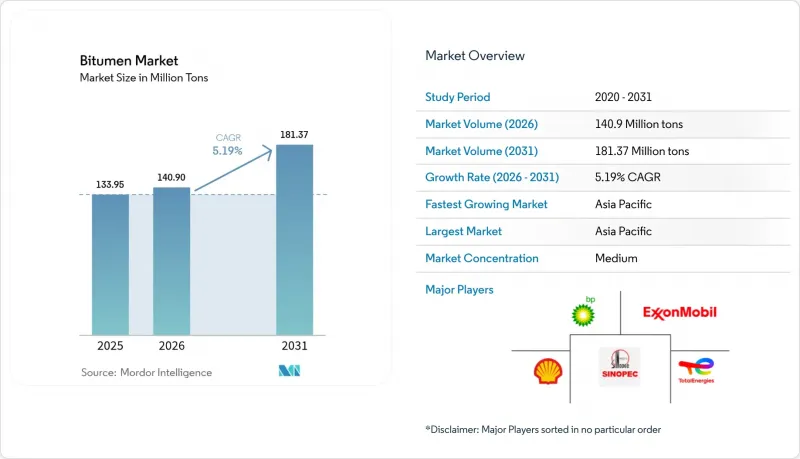
本報告按產品類型(針入度等級、氧化等級、乳化瀝青、聚合物改質瀝青及其他)、應用領域(道路建設、屋頂材料、黏合劑和密封劑及其他)以及地區(亞太地區、北美地區、歐洲地區、南美地區、中東和非洲地區)進行細分。市場預測以噸為單位。
全球瀝青市場趨勢及洞察
道路及高速公路維修及維修成本增加
世界各國政府正在將預算從新建設重新分配到道路維護,導致透水黏合劑和特殊路面處理材料的消耗量穩定成長。美國《基礎設施投資與就業法案》已啟動超過6萬個建設項目,僅魁北克省就在其2025-2026會計年度預算中累計358.68億加元用於道路改善。各機構體認到,每投入1美元用於及時維護,未來的重組成本就能減少4-7加元,進而形成維護需求的良性循環。德國5000億歐元的現代化基金將20%的資金用於資產最佳化,並納入了韌性標準,進一步提升了氣候適應瀝青的規格。隨著路面管理系統的日趨成熟,採購模式正從週期性的需求高峰轉向可預測的多年期契約,從而穩定了瀝青市場的整體需求。
大規模機場跑道擴建項目
跑道工程需要高品質的接合材料,以承受高輪載、剪切應力和噴射機燃料洩漏。海灣地區和亞洲的樞紐機場正引領一波資本投資浪潮,預計2030年將達到7,300億美元,能源基礎設施和航空業的擴張緊密相連。法蘭克福機場為期兩年的試驗路段採用腰果殼生物瀝青,清楚展現了航空公司在不犧牲性能的前提下轉型為低碳材料的趨勢。儘管銷售量仍然有限,且價格溢價高達15-25%,但採用苯乙烯-丁二烯-苯乙烯(SBS)改性的聚合物瀝青正在提升該領域的盈利。能夠獲得符合國際民航組織(ICAO)標準的配方設計認證的供應商,將更有機會簽訂長期框架協議,從而加強其在瀝青市場的垂直整合策略。
對鋪路工程中溫室氣體(GHG)和多環芳烴(PAH)的排放制定嚴格規定。
監管機構正在收緊揮發性有機化合物 (VOC) 和多環芳烴 (PAH) 的暴露限值。在加拿大,到 2025 年 10 月,將禁止使用 PAH 含量超過 1000 ppm 的煤焦油基密封劑,這將有效地淘汰傳統產品類型,並迫使對配方進行重新評估。結合氣相層析法和監督學習的預測分析技術現在可以識別引起異味的烷烴,從而為符合監管要求提供途徑,但也導致小規模生產商的分析成本增加。此外,許多組織正在推薦溫拌技術,該技術可將鋪設溫度降低多達 40 度C,從而減少現場排放並縮小熱拌瀝青的使用範圍,進而限制瀝青市場的成長。
細分市場分析
到2025年,滲透型瀝青將佔瀝青市場佔有率的66.52%,預計到2031年將以5.62%的複合年成長率成長,這主要得益於其與傳統熱拌瀝青攪拌站的兼容性以及廣泛的耐候性。氧化型瀝青則用於防水和屋頂等特定應用領域,其優異的氧化穩定性使其價格更高。全球整體瀝青乳液的銷售量已達800萬噸,由於其能夠降低能耗和工作場所排放,因此在碎石封層和微表面處理施工中越來越受歡迎。
技術創新主要集中在黏度控制和環保添加劑方面。添加1%的聚磷酸鹽可以提高高溫穩定性,但濃度超過2%可能會降低儲存穩定性。生物基因改質劑,例如來自伊朗的天然瀝青,可以提高黏度和熱塑性,延長使用壽命,並減少對合成聚合物的依賴。雖然這些漸進式改進保持了針入度等級的優勢,但瀝青市場正逐漸將價值重心轉向特種配方。
區域分析
預計到2025年,亞太地區將以45.10%的市佔率佔據領先地位,並在2031年之前繼續維持6.31%的複合年成長率,這主要得益於中國、印度和東南亞地區協調一致的基礎設施發展計畫。中國2023年原油日煉量達1,480萬桶,這將支撐國內瀝青供應和出口能力。
在北美,強勁的道路維修預算與不斷變化的環境法規之間正尋求平衡。 《通膨友好型基礎設施法案》(IIJA)計畫正在穩定需求,而加拿大即將實施的多環芳烴(PAH)法規正在加速乳化瀝青和低溫製程的轉變。在歐洲,煉油廠的合理化進程正在推進,部分煉油廠的關閉導致區域供應短缺,同時也為生物基替代品創造了市場機會。歐洲瀝青市場噸位可能略有下降,但預計其以金額為準將有所成長,因為特種瀝青的表現優於通用瀝青。
中東利用其豐富的原料和戰略性航運路線向亞洲供應石油。預計到2030年,沿岸地區生產商與亞洲買家之間的貿易額將達到6,820億美元,貿易範圍不僅包括原油,還包括成品油所需的粘合劑和改質劑。
非洲和南美洲仍是新興市場,其特點是間歇性的大型企劃推動了需求的激增。隨著這些地區基礎設施投資的擴大,擁有靈活物流系統和快速部署能力的供應商將能夠提升其市場佔有率。
其他好處:
- Excel格式的市場預測(ME)表
- 3個月的分析師支持
目錄
第1章:引言
- 研究的先決條件
- 調查範圍
第2章:調查方法
第3章執行摘要
第4章 市場狀況
- 市場概覽
- 市場促進因素
- 道路及高速公路維修及維修成本增加
- 大規模機場跑道擴建計劃
- 新興經濟體政府主導的基礎設施獎勵策略
- 向聚合物改質瀝青過渡,打造耐氣候路面
- 透過引入再生瀝青路面(RAP)促進循環經濟
- 市場限制因素
- 對鋪路工程中溫室氣體(GHG)和多環芳烴(PAH)的排放制定嚴格規定。
- 原油價格波動正在影響原料的獲利能力。
- 城市計畫中混凝土和複合材料路面的比例不斷增加
- 價值鏈分析
- 原料分析
- 波特五力模型
第5章 市場規模與成長預測
- 依產品類型
- 穿透等級
- 氧化等級
- 瀝青乳液
- 聚合物改質瀝青
- 其他產品(黏度等級、稀釋等級和高性能等級)
- 透過使用
- 道路建設
- 屋頂材料
- 黏合劑和密封劑
- 其他應用(例如石油和天然氣行業的塗層、水道襯裡、儲罐基礎和鐵路安定器處理)
- 按地區
- 北美洲
- 美國
- 加拿大
- 墨西哥
- 南美洲
- 巴西
- 阿根廷
- 哥倫比亞
- 其他南美國家
- 歐洲
- 德國
- 英國
- 法國
- 義大利
- 其他歐洲國家
- 亞太地區
- 中國
- 印度
- 日本
- 韓國
- ASEAN
- 其他亞太國家
- 中東和非洲
- 沙烏地阿拉伯
- 南非
- 其他中東和非洲國家
- 北美洲
第6章 競爭情勢
- 市場集中度
- 策略性舉措(併購/合資/協議)
- 市佔率和排名分析
- 公司簡介
- BMI Group Holdings UK Limited
- BP plc
- China Petroleum and Chemical Corporation(Sinopec)
- ENEOS Corporation
- Exxon Mobil Corporation
- Hindustan Petroleum Corporation Limited
- Indian Oil Corporation Ltd
- Kraton Corporation
- Mangalore Refinery and Petrochemicals Limited
- Marathon Petroleum Corporation
- Nynas AB
- Rosneft
- Shell plc
- Suncor Energy Inc.
- The Bouygues Group
- TotalEnergies
第7章 市場機會與未來展望
According to Mordor Intelligence, the bitumen market size is expected to grow from 133.95 Million tons in 2025 to 140.9 Million tons in 2026 and is forecast to reach 181.37 Million tons by 2031 at 5.19% CAGR over 2026-2031.
This report is Segmented by Product Type (Penetration Grade, Oxidized Grade, Bitumen Emulsions, Polymer-Modified Bitumen, and Other Products), Application (Road Construction, Roofing, Adhesives and Sealants, and Other Applications), and Geography (Asia-Pacific, North America, Europe, South America, and Middle-East and Africa). The Market Forecasts are Provided in Terms of Volume (Tons).
Global Bitumen Market Trends and Insights
Increasing Road and Highway Rehabilitation Spend
Governments are reallocating budgets from new builds toward preservation, leading to steady recurrent consumption of penetration-grade binders and specialty surface treatments. The U.S. Infrastructure Investment and Jobs Act has already launched more than 60,000 construction projects, and Quebec alone earmarked CAD 35.868 billion for roads in its 2025-2026 budget. Agencies recognize that every dollar invested in timely preservation avoids USD 4-7 in future reconstruction costs, locking in a virtuous cycle of maintenance demand. Germany's EUR 500 billion modernization fund assigns 20% to asset optimization, embedding resilience criteria that further elevate specifications for climate-adaptive bitumen grades. As pavement management systems mature, procurement shifts from cyclical surges to predictable multi-year contracts, stabilizing volume offtake across the bitumen market.
Large-Scale Airport Runway Expansion Programs
Runway projects require premium binders that tolerate high wheel loads, shear stresses, and jet-fuel spills. Gulf and Asian hubs are leading a USD 730 billion capex wave through 2030, intertwining energy infrastructure with aviation build-outs. Frankfurt Airport's two-year test strip using cashew-shell bio-bitumen illustrates airlines' push for lower-carbon materials without performance sacrifice. Polymer-modified grades with styrene-butadiene-styrene command price premiums of 15-25%, lifting segment profitability even though volumes remain modest. Suppliers capable of certifying mix designs to International Civil Aviation Organization standards are positioned to capture long-run framework agreements, reinforcing vertical integration strategies within the bitumen market.
Stringent GHG and PAH Emission Regulations on Paving Operations
Regulators are tightening exposure limits for volatile organic compounds and polycyclic aromatic hydrocarbons. Canada will prohibit coal-tar sealants exceeding 1,000 ppm PAHs by October 2025, effectively removing a traditional product class and forcing reformulations. Predictive analytics using gas chromatography coupled with supervised learning now pinpoint odor-causing alkanes, offering compliance pathways but raising analytical costs that smaller producers must absorb. Agencies also favor warm-mix technologies that lower placement temperatures by up to 40 °C, reducing on-site emissions and tightening the operating envelope for hot-mix asphalt, thereby constraining volume expansion in the bitumen market.
Other drivers and restraints analyzed in the detailed report include:
- Government Infrastructure Stimulus in Emerging Economies
- Shift to Polymer-Modified Bitumen for Climate-Resilient Pavements
- Crude-Oil Price Volatility Impacting Feedstock Economics
For complete list of drivers and restraints, kindly check the Table Of Contents.
Segment Analysis
Penetration-grade binders held 66.52% of the bitumen market share in 2025 and are projected to grow at a 5.62% CAGR through 2031, sustained by compatibility with conventional hot-mix plants and broad climatic tolerance. Oxidized grades occupy niche waterproofing and roofing roles where oxidation stability justifies premium pricing. Bitumen emulsions, totaling 8 million tons globally, are gaining favor for chip seals and microsurfacing because they reduce energy use and lower work-zone emissions.
Innovation centers on viscosity control and ecological additives. Polyphosphoric acid at 1% dosage improves high-temperature stability, though concentrations beyond 2% can undermine storage stability. Bio-based modifiers such as Iranian natural asphalt enhance viscosity and thermoplasticity, extending service life and reducing reliance on synthetic polymers. These incremental gains sustain penetration-grade primacy but gradually shift value toward specialty formulations inside the bitumen market.
Complete Report Scope:
- By Product Type
- Penetration Grade
- Oxidized Grade
- Bitumen Emulsions
- Polymer-Modified Bitumen
- Other Products (Viscosity Grade, Cutback, and Performance Grade)
- By Application
- Road Construction
- Roofing
- Adhesives and Sealants
- Other Applications (Coatings in Sectors such as Oil and Gas, Canal Lining, Tank Foundation, Railway Ballast Treatment, and Others)
- By Geography
- North America
- United States
- Canada
- Mexico
- South America
- Brazil
- Argentina
- Colombia
- Rest of South America
- Europe
- Germany
- United Kingdom
- France
- Italy
- Rest of Europe
- Asia-Pacific
- China
- India
- Japan
- South Korea
- ASEAN
- Rest of Asia-Pacific
- Middle East and Africa
- Saudi Arabia
- South Africa
- Rest of Middle East and Africa
- North America
Geography Analysis
Asia-Pacific led with 45.10% share in 2025 and is advancing at a 6.31% CAGR to 2031, anchored by synchronized infrastructure programs across China, India, and Southeast Asia. China's processing of 14.8 million barrels per day of crude in 2023 underpins both domestic asphalt supply and export capabilities.
North America balances robust rehabilitation budgets with evolving environmental mandates. The IIJA pipeline stabilizes demand, but Canada's impending PAH restrictions catalyze a shift to emulsions and cold processes. Europe confronts refinery rationalization; closures tighten regional supply yet open market space for bio-based alternatives. The bitumen market size in Europe could contract marginally in tonnage yet expand in value as specialty grades outpace generic ones.
The Middle East leverages abundant feedstock and strategic shipping lanes to supply Asia. Trade between Gulf producers and Asian buyers is forecast to touch USD 682 billion by 2030, with finished binders and modifiers joining crude flows.
Africa and South America remain emergent, characterized by episodic megaprojects that create demand surges. Suppliers attuned to flexible logistics and rapid deployment can gain traction as these regions scale connectivity investments.
- BMI Group Holdings UK Limited
- BP p.l.c.
- China Petroleum and Chemical Corporation (Sinopec)
- ENEOS Corporation
- Exxon Mobil Corporation
- Hindustan Petroleum Corporation Limited
- Indian Oil Corporation Ltd
- Kraton Corporation
- Mangalore Refinery and Petrochemicals Limited
- Marathon Petroleum Corporation
- Nynas AB
- Rosneft
- Shell plc
- Suncor Energy Inc.
- The Bouygues Group
- TotalEnergies
Additional Benefits:
- The market estimate (ME) sheet in Excel format
- 3 months of analyst support
TABLE OF CONTENTS
1 Introduction
- 1.1 Study Assumptions
- 1.2 Scope of the Study
2 Research Methodology
3 Executive Summary
4 Market Landscape
- 4.1 Market Overview
- 4.2 Market Drivers
- 4.2.1 Increasing road and highway rehabilitation spend
- 4.2.2 Large-scale airport runway expansion programs
- 4.2.3 Government infrastructure stimulus in emerging economies
- 4.2.4 Shift to polymer-modified bitumen for climate-resilient pavements
- 4.2.5 Circular-economy push for reclaimed asphalt pavement (RAP) adoption
- 4.3 Market Restraints
- 4.3.1 Stringent GHG and PAH emission regulations on paving operations
- 4.3.2 Crude-oil price volatility impacting feedstock economics
- 4.3.3 Rising share of concrete and composite pavements in urban projects
- 4.4 Value Chain Analysis
- 4.5 Feedstock Analysis
- 4.6 Porter's Five Forces
- 4.6.1 Bargaining Power of Suppliers
- 4.6.2 Bargaining Power of Buyers
- 4.6.3 Threat of New Entrants
- 4.6.4 Threat of Substitutes
- 4.6.5 Degree of Competition
5 Market Size and Growth Forecasts (Volume)
- 5.1 By Product Type
- 5.1.1 Penetration Grade
- 5.1.2 Oxidized Grade
- 5.1.3 Bitumen Emulsions
- 5.1.4 Polymer-Modified Bitumen
- 5.1.5 Other Products (Viscosity Grade, Cutback, and Performance Grade)
- 5.2 By Application
- 5.2.1 Road Construction
- 5.2.2 Roofing
- 5.2.3 Adhesives and Sealants
- 5.2.4 Other Applications (Coatings in Sectors such as Oil and Gas, Canal Lining, Tank Foundation, Railway Ballast Treatment, and Others)
- 5.3 By Geography
- 5.3.1 North America
- 5.3.1.1 United States
- 5.3.1.2 Canada
- 5.3.1.3 Mexico
- 5.3.2 South America
- 5.3.2.1 Brazil
- 5.3.2.2 Argentina
- 5.3.2.3 Colombia
- 5.3.2.4 Rest of South America
- 5.3.3 Europe
- 5.3.3.1 Germany
- 5.3.3.2 United Kingdom
- 5.3.3.3 France
- 5.3.3.4 Italy
- 5.3.3.5 Rest of Europe
- 5.3.4 Asia-Pacific
- 5.3.4.1 China
- 5.3.4.2 India
- 5.3.4.3 Japan
- 5.3.4.4 South Korea
- 5.3.4.5 ASEAN
- 5.3.4.6 Rest of Asia-Pacific
- 5.3.5 Middle East and Africa
- 5.3.5.1 Saudi Arabia
- 5.3.5.2 South Africa
- 5.3.5.3 Rest of Middle East and Africa
- 5.3.1 North America
6 Competitive Landscape
- 6.1 Market Concentration
- 6.2 Strategic Moves (MandA/JV/Agreements)
- 6.3 Market Share (%)/Ranking Analysis
- 6.4 Company Profiles (includes Global level Overview, Market level overview, Core Segments, Financials as available, Strategic Information, Market Rank/Share for key companies, Products and Services, and Recent Developments)
- 6.4.1 BMI Group Holdings UK Limited
- 6.4.2 BP p.l.c.
- 6.4.3 China Petroleum and Chemical Corporation (Sinopec)
- 6.4.4 ENEOS Corporation
- 6.4.5 Exxon Mobil Corporation
- 6.4.6 Hindustan Petroleum Corporation Limited
- 6.4.7 Indian Oil Corporation Ltd
- 6.4.8 Kraton Corporation
- 6.4.9 Mangalore Refinery and Petrochemicals Limited
- 6.4.10 Marathon Petroleum Corporation
- 6.4.11 Nynas AB
- 6.4.12 Rosneft
- 6.4.13 Shell plc
- 6.4.14 Suncor Energy Inc.
- 6.4.15 The Bouygues Group
- 6.4.16 TotalEnergies
7 Market Opportunities and Future Outlook
- 7.1 White-space and Unmet-Need Assessment

 歐洲瀝青:市場佔有率分析、產業趨勢與統計、成長預測(2026-2031 年)非洲瀝青市場:市場佔有率分析、產業趨勢與統計、成長預測(2026-2031)瀝青乳化劑:市場佔有率分析、產業趨勢與統計、成長預測(2026-2031)
 瀝青乳化劑市場報告:趨勢、預測及競爭分析(至2035年)
 2035年環保道路路面技術市場分析與預測:按類型、產品類型、服務、技術、應用、材料類型、製程、最終用戶和解決方案分類
 瀝青市場:全球市場預測,2026-2032年
 環保瀝青市場報告:按原料、等級、應用和地區分類(2026-2034 年)
 瀝青市場:按產品類型、應用和地區分類
 全球瀝青市場規模、佔有率、趨勢和成長分析報告(2026-2034年)瀝青乳化劑市場規模、佔有率、成長及全球產業分析:按類型、應用和地區分類,並預測至2026-2034年