


 |
市場調查報告書
商品編碼
2119643
歐洲瀝青:市場佔有率分析、產業趨勢與統計、成長預測(2026-2031 年)Europe Bitumen - Market Share Analysis, Industry Trends & Statistics, Growth Forecasts (2026 - 2031) |
||||||

※ 本網頁內容可能與最新版本有所差異。詳細情況請與我們聯繫。
據 Mordor Intelligence 稱,歐洲瀝青市場預計到 2026 年價值 98.3 億美元,高於 2025 年的 94.8 億美元,預計到 2031 年將達到 118.1 億美元。
預計 2026 年至 2031 年的複合年成長率為 3.73%。
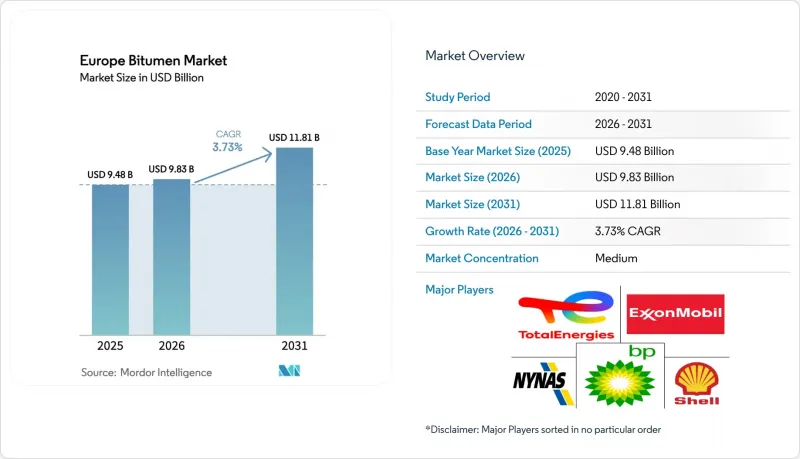
本報告按產品類型(鋪路級、硬質級等)、應用領域(道路建設、防水和屋頂工程等)、最終用戶行業(公共基礎設施、住宅、商業和工業建設)以及地區(德國、英國、義大利、法國、西班牙等)進行細分。市場預測以美元計價。
歐洲瀝青市場趨勢與洞察
歐盟27國加大對道路維修及新建高速公路的投入。
歐盟交通管理部門已累計70億歐元(77億美元)用於2024年的道路現代化改造,光是德國每年就花費28億歐元(30.8億美元)進行高速公路維修。修訂後的泛歐交通網路(TEN-T)法規中包含的強制性條款將需求預期延長至2050年。競標規範越來越要求採用聚合物改質黏合劑,以延長維護週期,從而推動了歐洲瀝青市場的優質化趨勢。承包商受益於多年支出計畫的確定性,這些計畫確立了基準噸位需求,並有助於從擁有強大物流基礎的供應商處採購。
大型卡車負載容量的不斷提高,正在加速聚合物改質黏合劑的採用。
自2019年以來,貨運量激增23%,主要幹道的軸荷已接近44噸的極限,因此,道路管理部門正日益強制要求使用SBS改性瀝青,這種瀝青能夠將抗車轍性能提高30%至40%。現場試驗證實,與傳統路面材料相比,SBS改質瀝青的使用壽命可延長高達80%,因此其平均溢價15%至20%也是合理的。 EN 14023標準規定了統一的性能標準,在德國和法國,日交通量超過1萬輛的高速公路必須使用聚合物改質瀝青(PMB)。這種結構性轉變是推動歐洲瀝青市場聚合物改質產品快速成長的主要動力。
加強瀝青廠二氧化碳/多環芳烴排放法規
修訂後的工業排放指令將多環芳烴(PAH)排放限值降低了40%,並擴大了二氧化碳(CO2)報告要求。業者估計,每個工廠的氧化和過濾設備維修成本在200萬至500萬歐元(220萬至550萬美元)之間。小規模的瀝青攪拌站可能難以承擔維修,這可能導致運作能下降,並迫使一些生產商退出歐洲瀝青市場。獲得最尖端科技(BAT)認證的領先者正利用合規性作為競爭優勢,贏得注重碳排放的競標。
細分市場分析
聚合物改質瀝青(PMB)正處於成長最快的階段,預計到2031年將以4.27%的複合年成長率成長,儘管到2025年,傳統路面瀝青仍將佔據歐洲瀝青市場54.85%的佔有率。在貨運走廊,能夠延緩車轍和疲勞的接合材料需求旺盛,而隨著EN 14023標準的實施,優質化正在加速,該標準確保了跨境品質的一致性。隨著物流效率的提高,地中海樞紐的前置作業時間縮短,歐洲PMB瀝青市場規模也隨之擴大。因此,具備SBS和碎橡膠改質能力的供應商累積訂單儲備充足。
生物瀝青創新正乘著溫拌瀝青混合料的浪潮蓬勃發展。半溫拌瀝青混合料中木質素的替代率已接近5%,而利用廢棄食用油進行的環氧化試驗也生產了符合耐久性要求的接合材料。硬質和氧化級瀝青仍屬於小眾市場,但對於工業塗料和防水墊層至關重要。瀝青乳液適用於低溫再生和噴淋密封,尤其是在道路管理部門將再生瀝青路面(RAP)的使用比例上限提高到50%的情況下。因此,歐洲瀝青產業正在拓展產品線,以滿足市場對兼具永續性和高性能的高階產品的需求。
其他好處:
- Excel格式的市場預測(ME)表
- 三個月的分析師支持
目錄
第1章:引言
- 研究假設和市場定義
- 調查範圍
第2章:調查方法
第3章執行摘要
第4章 市場狀況
- 市場概覽
- 市場促進因素
- 歐盟27國在道路維修和新建高速公路方面的支出都在增加。
- 隨著大型卡車負載容量的不斷提高,聚合物改質黏合劑的應用正在加速。
- 零能耗建築對高檔防水卷材的需求正在激增。
- 俄羅斯進口禁令造成的供應缺口正由地中海地區的過剩產品填補,降低了西北歐的成本。
- 為了實現「Fit-For-55」的脫碳目標,正在迅速過渡到溫拌瀝青(WMA)。
- 市場限制因素
- 加強瀝青廠二氧化碳和多環芳烴排放法規
- 在使用壽命較長的公路工程中,混凝土和複合路面的佔有率正在擴大。
- 對區域性乳化劑卡特爾的反壟斷罰款推高了合規成本。
- 價值鏈分析
- 監理情勢
- 波特五力模型
第5章 市場規模與成長預測
- 依產品類型
- 鋪路等級
- 硬級
- 氧化等級
- 瀝青乳液
- 聚合物改質瀝青(PMB)
- 其他等級(稀釋瀝青、水晶瀝青、生物瀝青)
- 透過使用
- 道路建設
- 防水和屋頂材料
- 黏合劑和密封劑
- 工業和特殊應用(塗層、水道壁襯裡、管線包覆)
- 按最終用途類別
- 公共基礎設施
- 住宅建築
- 商業和工業建築
- 按地區
- 德國
- 英國
- 義大利
- 法國
- 西班牙
- 北歐國家
- 中歐/東歐
- 其他歐洲國家
第6章 競爭情勢
- 市場集中度
- 策略趨勢
- 市佔率和排名分析
- 公司簡介
- Bitumina Group
- BP Plc
- Colas Group(Bouygues)
- Eurovia(Vinci Group)
- Exxon Mobil Corporation
- Gazprom Neft
- Icopal/BMI Group
- KRATON CORPORATION
- Nynas AB
- Orlen Lietuva
- Puma Energy
- Shell Plc
- Sika AG
- STRABAG SE
- Suncor Energy Inc.
- TotalEnergies
第7章 市場機會與未來展望
According to Mordor Intelligence, Europe bitumen market size in 2026 is estimated at USD 9.83 billion, growing from 2025 value of USD 9.48 billion with 2031 projections showing USD 11.81 billion, growing at 3.73% CAGR over 2026-2031.
This report is Segmented by Product Type (Paving Grade, Hard Grade, and More), Application (Road Construction, Waterproofing and Roofing, and More), End-Use Sector (Public Infrastructure, Residential Building, and Commercial and Industrial Building), and Geography (Germany, United Kingdom, Italy, France, Spain, and More). The Market Forecasts are Provided in Terms of Value (USD).
Europe Bitumen Market Trends and Insights
Growing Road-Rehabilitation and Greenfield Highway Spending Across EU-27
EU transport authorities earmarked EUR 7 billion (USD 7.7 billion) in 2024 for road modernization, with Germany alone spending EUR 2.8 billion (USD 3.08 billion) each year on motorway upgrades. Mandates embedded in the revised TEN-T regulation stretch demand visibility to 2050. Tender specifications increasingly call for polymer-modified binders that lengthen maintenance cycles, reinforcing premiumization trends across the Europe bitumen market. Contractors benefit from certainty in multi-year spending plans that lock in baseline tonnage requirements and tilt procurement toward suppliers with robust logistics footprints.
Accelerating Adoption of Polymer-Modified Binders for Heavier Truck Loads
Freight tonnage jumped 23% since 2019 and axle weights now approach the 44-ton limit along major corridors, prompting road agencies to specify SBS-modified binders known to raise rutting resistance by 30-40%. Field trials confirm service-life gains of up to 80% relative to conventional paving grade, validating price premiums that average 15-20%. EN 14023 provides a harmonized performance benchmark, while Germany and France codify mandatory PMB use on motorways exceeding 10,000 vehicles daily. This structural shift underpins the fastest expansion track for polymer-modified products within the Europe bitumen market.
Heightened CO2 / PAH Emission Regulations on Asphalt Plants
The revised Industrial Emissions Directive ratcheted PAH limits down 40% and expanded CO2 reporting duties. Operators estimate EUR 2-5 million (USD 2.2-5.5 million) per facility for oxidation and filtration retrofits. Smaller batch plants may struggle to fund upgrades, trimming available capacity and pushing some producers out of the Europe bitumen market. Early movers with best-available-technology status leverage compliance as a competitive moat and capture carbon-conscious tender lots.
Other drivers and restraints analyzed in the detailed report include:
- Surging Demand for Premium Waterproofing Membranes in Zero-Energy Buildings
- Mediterranean Surplus Filling Supply Gap After Russia Ban, Lowering NW Europe Costs
- Concrete and Composite Pavements Winning Share in Long-Life Motorway Projects
For complete list of drivers and restraints, kindly check the Table Of Contents.
Segment Analysis
Polymer-modified bitumen underpins the fastest trajectory, charting a 4.27% CAGR through 2031, although conventional paving grade still accounts for 54.85% of the Europe bitumen market share in 2025. Premiumization accelerates because freight corridors demand binders that postpone rutting and fatigue, while EN 14023 assures buyers of cross-border consistency. The Europe bitumen market size tied to PMB climbed in tandem with logistics efficiencies that shorten lead times from Mediterranean hubs. Suppliers with integrated SBS and crumb-rubber modification capacity therefore record superior order backlogs.
Bio-bitumen innovations ride on the warm-mix wave. Lignin substitution rates near 5% in half-warm mixes, and used-cooking-oil epoxidation trials produce binders that hit durability targets. Hard and oxidized grades remain niche yet critical for industrial coatings and waterproofing mats. Bitumen emulsions find relevance in cold recycling and spray seals, especially where road agencies lift reclaimed asphalt pavement (RAP) thresholds to 50%. The Europe bitumen industry thus stretches its product ladder to capture both sustainability and performance premiums.
Complete Report Scope:
- By Product Type
- Paving Grade
- Hard Grade
- Oxidized Grade
- Bitumen Emulsions
- Polymer-Modified Bitumen (PMB)
- Other Grades (Cutback, Crystal, Bio-bitumen)
- By Application
- Road Construction
- Waterproofing and Roofing
- Adhesives and Sealants
- Industrial and Specialty (Coating, Canal Lining, Pipe Wrap)
- By End-Use Sector
- Public Infrastructure
- Residential Building
- Commercial and Industrial Building
- By Geography
- Germany
- United Kingdom
- Italy
- France
- Spain
- NORDIC Countries
- Central and Eastern Europe
- Rest of Europe
List of Companies Covered in this Report:
- Bitumina Group
- BP Plc
- Colas Group (Bouygues)
- Eurovia (Vinci Group)
- Exxon Mobil Corporation
- Gazprom Neft
- Icopal / BMI Group
- KRATON CORPORATION
- Nynas AB
- Orlen Lietuva
- Puma Energy
- Shell Plc
- Sika AG
- STRABAG SE
- Suncor Energy Inc.
- TotalEnergies
Additional Benefits:
- The market estimate (ME) sheet in Excel format
- 3 months of analyst support
TABLE OF CONTENTS
1 Introduction
- 1.1 Study Assumptions and Market Definition
- 1.2 Scope of the Study
2 Research Methodology
3 Executive Summary
4 Market Landscape
- 4.1 Market Overview
- 4.2 Market Drivers
- 4.2.1 Growing Road-Rehabilitation and Greenfield Highway Spending Across EU-27
- 4.2.2 Accelerating Adoption of Polymer-Modified Binders for Heavier Truck Loads
- 4.2.3 Surging Demand for Premium Waterproofing Membranes in Zero-Energy Buildings
- 4.2.4 Mediterranean Surplus Filling Supply Gap After Russia Ban, Lowering NW Europe Costs
- 4.2.5 Rapid Shift Toward Warm-Mix Asphalt (WMA) to Meet Fit-For-55 Decarbonisation Targets
- 4.3 Market Restraints
- 4.3.1 Heightened CO2 / PAH Emission Regulations on Asphalt Plants
- 4.3.2 Concrete and Composite Pavements Winning Share in Long-Life Motorway Projects
- 4.3.3 Antitrust Fines on Regional Emulsion Cartels Inflating Compliance Costs
- 4.4 Value Chain Analysis
- 4.5 Regulatory Landscape
- 4.6 Porter's Five Forces
- 4.6.1 Bargaining Power of Suppliers
- 4.6.2 Bargaining Power of Buyers
- 4.6.3 Threat of New Entrants
- 4.6.4 Threat of Substitutes
- 4.6.5 Degree of Competition
5 Market Size and Growth Forecasts (Value)
- 5.1 By Product Type
- 5.1.1 Paving Grade
- 5.1.2 Hard Grade
- 5.1.3 Oxidized Grade
- 5.1.4 Bitumen Emulsions
- 5.1.5 Polymer-Modified Bitumen (PMB)
- 5.1.6 Other Grades (Cutback, Crystal, Bio-bitumen)
- 5.2 By Application
- 5.2.1 Road Construction
- 5.2.2 Waterproofing and Roofing
- 5.2.3 Adhesives and Sealants
- 5.2.4 Industrial and Specialty (Coating, Canal Lining, Pipe Wrap)
- 5.3 By End-Use Sector
- 5.3.1 Public Infrastructure
- 5.3.2 Residential Building
- 5.3.3 Commercial and Industrial Building
- 5.4 By Geography
- 5.4.1 Germany
- 5.4.2 United Kingdom
- 5.4.3 Italy
- 5.4.4 France
- 5.4.5 Spain
- 5.4.6 NORDIC Countries
- 5.4.7 Central and Eastern Europe
- 5.4.8 Rest of Europe
6 Competitive Landscape
- 6.1 Market Concentration
- 6.2 Strategic Moves
- 6.3 Market Share (%)/Ranking Analysis
- 6.4 Company Profiles (includes Global level Overview, Market level overview, Core Segments, Financials as available, Strategic Information, Market Rank/Share, Products and Services, Recent Developments)
- 6.4.1 Bitumina Group
- 6.4.2 BP Plc
- 6.4.3 Colas Group (Bouygues)
- 6.4.4 Eurovia (Vinci Group)
- 6.4.5 Exxon Mobil Corporation
- 6.4.6 Gazprom Neft
- 6.4.7 Icopal / BMI Group
- 6.4.8 KRATON CORPORATION
- 6.4.9 Nynas AB
- 6.4.10 Orlen Lietuva
- 6.4.11 Puma Energy
- 6.4.12 Shell Plc
- 6.4.13 Sika AG
- 6.4.14 STRABAG SE
- 6.4.15 Suncor Energy Inc.
- 6.4.16 TotalEnergies
7 Market Opportunities and Future Outlook
- 7.1 White-space and Unmet-Need Assessment

 非洲瀝青市場:市場佔有率分析、產業趨勢與統計、成長預測(2026-2031)瀝青乳化劑:市場佔有率分析、產業趨勢與統計、成長預測(2026-2031)
 瀝青乳化劑市場報告:趨勢、預測及競爭分析(至2035年)
 2035年環保道路路面技術市場分析與預測:按類型、產品類型、服務、技術、應用、材料類型、製程、最終用戶和解決方案分類
 瀝青市場:全球市場預測,2026-2032年瀝青:市場佔有率分析、產業趨勢與統計、成長預測(2026-2031)
 環保瀝青市場報告:按原料、等級、應用和地區分類(2026-2034 年)
 瀝青市場:按產品類型、應用和地區分類
 全球瀝青市場規模、佔有率、趨勢和成長分析報告(2026-2034年)瀝青乳化劑市場規模、佔有率、成長及全球產業分析:按類型、應用和地區分類,並預測至2026-2034年