


 |
市場調查報告書
商品編碼
2119201
瀝青乳化劑:市場佔有率分析、產業趨勢與統計、成長預測(2026-2031)Bitumen Emulsifiers - Market Share Analysis, Industry Trends & Statistics, Growth Forecasts (2026 - 2031) |
||||||

※ 本網頁內容可能與最新版本有所差異。詳細情況請與我們聯繫。
據 Mordor Intelligence 稱,瀝青乳化劑市場預計在 2025 年達到 6372 萬美元,預計在預測期(2026-2031 年)內將以 5.91% 的複合年成長率成長,從 2026 年的 6624 萬美元成長到 2031 年的 8827 萬美元。
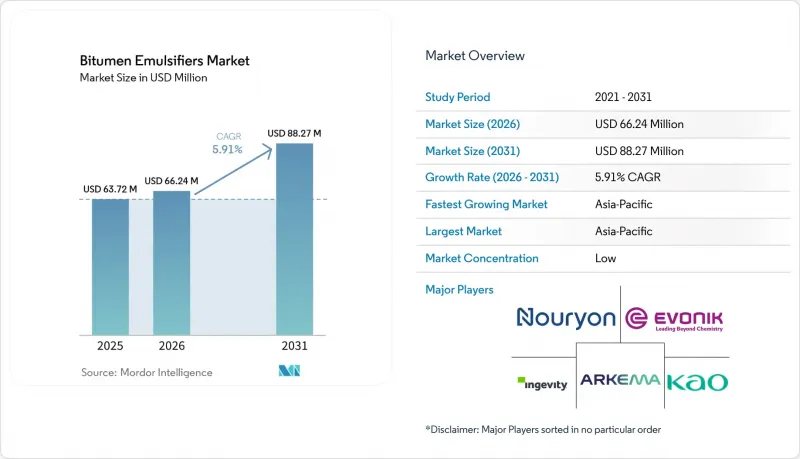
本報告按產品類型(陽離子乳化劑、陰離子乳化劑、其他)、固化類型(快速固化、中速固化、其他)、應用領域(表面處理、其他)、終端用戶產業(道路和高速公路建設、其他)以及地區(亞太地區、北美地區、歐洲地區、南美地區、中東和非洲)進行細分。市場預測以美元計價。
全球瀝青乳化劑市場趨勢及洞察
增加對道路基礎建設和公路養護的投資。
亞太和北美地區政府主導的道路建設計畫支撐了瀝青乳化劑的短期需求。在道路養護工作中,乳化劑應用於表面處理、黏層、霧封層和微表面處理等製程。印度國家公路管理局(NHAI)報告稱,在2025-2026會計年度,國家公路建設里程達5313公里,資本支出達24,436.2億印度盧比(約290億美元)。 2025年,中國交通運輸業的固定資產投資達3.67兆元(約5,505億美元)。如此規模的計畫既支持新建道路,也支持現有道路的養護。隨著公共機構將路面養護列為優先事項,瀝青乳化劑市場將從中受益。
預計2025年,中國將新建6.75萬公里農村公路,使其農村公路總里程達到471萬公里。由於長途運輸成本高且柔軟性有限,使用熱拌瀝青攪拌站難以滿足農村公路的維護需求。因此,冷拌乳化瀝青系統較適合偏遠地區的日常養護。此外,即使在已建成的公路網中,也出現了將預算用於維護而非全面重建的趨勢。這一趨勢推動了對用於碎石封層、霧封層和微表面處理等特殊等級瀝青的需求。在養護預算成長速度超過新建設成本的地區,瀝青乳化劑市場將從中受益。
擴大冷拌瀝青、稀漿封層和微表面處理技術的應用。
冷拌瀝青系統比熱拌瀝青系統耗能更低。一項2025年的同行評審研究報告顯示,冷拌瀝青的能耗為80兆焦/噸,而熱拌瀝青的能耗為279兆焦/噸。研究也指出,冷拌瀝青在其生命週期內可減少42.7%的溫室氣體排放。此外,冷拌瀝青的施工成本約為每公里12,193美元,與同等規模的熱拌瀝青相比,材料成本降低了57%。這些成本和環境上的差異促使地方政府機構重新檢視其規範。如果這些系統被納入預算有限的養護計畫中,瀝青乳化劑市場也將從中受益。
在賓州第三區,2020年至2024年間,超過229英里的道路透過微表面處理進行了養護。本計畫於2025年3月榮獲國際稀漿定序協會(ISSA)頒發的「路面養護卓越獎」。冷拌養護的預測模型可望降低現場施工性能的不確定性。相關研究表明,基於人工智慧的養護動力學建模技術將在2026年至2027年間進一步發展。改良的養護控制將使高流量路段(先前採用熱拌瀝青養護)能夠採用熱拌瀝青配方。這將帶動瀝青乳化劑市場對慢凝型和中凝型瀝青的需求。
瀝青乳液技術在發展中國家道路市場的應用有限
在道路市場發展中,往往缺乏持續規範、生產和應用乳化瀝青的技術能力。這限制了基礎設施建設支出轉化為對乳化劑的需求。儘管道路網路不斷擴展,但承包商缺乏相關知識、設備可用性低以及對規範變更的抵觸情緒阻礙了乳化瀝青的推廣應用。此外,乳化瀝青對溫度敏感,且保存期限比稀釋瀝青短,因此需要合適的儲存和配送系統。這些要求減緩了乳化瀝青在東南亞和非洲部分地區的應用。當地供應鏈無法提供穩定的交付和可靠的現場支援時,營運方面的挑戰尤其突出。
這些限制因素不僅限於乳化劑化學性質的選擇。承包商還需要可靠的物流系統、訓練有素的工人以及允許使用乳化劑進行維護的規範。建立這樣的系統可能需要數年時間。在這些支援基礎設施到位之前,瀝青乳化劑市場無法充分利用道路投資所帶來的潛力。然而,擴建地方道路仍然是一個實際的應用案例,因為對於偏遠地區的計畫而言,運輸熱拌瀝青的成本可能很高。市場發展將取決於技術服務、承包商培訓和本地供應網路。隨著運輸和製造方面的法規日益嚴格,遵守監管要求正成為一項更大的挑戰。
細分市場分析
到2025年,陽離子乳化劑將佔據瀝青乳化劑市場57.14%的佔有率,成為該市場中最大的產品類型。這一地位反映了帶正電荷的界面活性劑與帶負電荷的骨材之間良好的相容性,而骨材主要用於道路建設,這為承包商提供了廣泛的配方選擇。陽離子乳化劑廣泛應用於標準道路施工,而基於羧酸或樹脂氧化的陰離子乳化劑則應用於歐洲石灰石骨材市場,並且在基於松香和妥爾油的配方中也越來越受到關注。非離子乳化劑在寒冷氣候、防水和屋頂應用上具有柔軟性,尤其適用於基材表面電荷波動較大的情況。產品選擇取決於骨材的特性、氣候條件、施工方法以及最終乳液所需的施工性能。
預計到2031年,兩性乳化劑和特殊乳化劑的複合年成長率將達到7.34%。這些產品的需求主要源自於其能夠穩定高苯乙烯-丁二烯-苯乙烯(SBS)含量的聚合物改質乳液,而標準陽離子界面活性劑在高聚合物濃度下往往不穩定。一項2026年關於木質素的研究表明,生物基因改質劑能夠提供穩定的陽離子乳化,兼具功能性乳化劑和生物聚合物改質劑的作用。儘管陽離子化學品的整體需求依然強勁,但兩性乳化劑和生物基特種乳化劑在滿足嚴苛的鋪路條件方面具有更高的利潤潛力。這為瀝青乳化劑市場創造了明顯的優質市場機會。
截至2025年,按固化類型分類,快凝型乳化劑佔了37.82%的市場。這類乳化劑廣泛應用於噴灑式路面處理流程,例如碎石封層、黏層、透層和霧封層,這些工藝需要在骨材集料前快速固化。中凝型和慢凝型乳化劑則適用於冷拌瀝青、稀漿封層和微表面處理處,較長的可操作時間有助於在拌合和攤舖過程中實現骨材的充分覆蓋和顆粒填充。每種固化類型對應不同的可操作時間,使施工人員能夠根據天氣、骨材特性、設備和交通法規要求調整混合料的性能。由於固化性能的多樣性,瀝青乳化劑市場在從快速修補到長期冷拌應用等各個領域都發揮著重要作用。
預計到2031年,速凝乳化劑的複合年成長率將達到6.81%。這類產品專為需要在幾分鐘內恢復交通的項目而設計,在都市區道路養護中,其重要性日益凸顯,因為夜間車道封閉4-6小時的情況十分常見。這些項目需要可預測的混合、快速分解和固化,以便在早晨交通恢復前完成,尤其是在封閉時間過長會擾亂商業活動的情況下。雖然速凝產品可以滿足部分需求,但速凝技術更適合嚴格的交通恢復要求。隨著城市擴大預防性養護和夜間施工計劃,預計該市場將持續成長。
區域分析
預計到2025年,亞太地區將佔全球市場規模的48.53%,並在2031年之前以6.68%的複合年成長率成長。 2025年,中國交通基礎建設投資達3.67兆元(約5,400億美元),支撐超過550萬公里的公路網。印度在2025會計年度將進口其瀝青需求的35%至36%,並且越來越容易受到影響煉油相關中間產品的供應中斷的影響。日本和韓國是成熟的、以維護主導的市場,支撐著對快速黏合劑和聚合物改質瀝青的需求。預計偏遠地區的道路維護將進一步推動亞太地區瀝青乳化劑市場的發展。
北美市場由路面養護工程和道路養護合約支撐。 2024年7月,諾力昂(Nouryon)與布倫塔格特種材料公司(Brenntag Specialties)簽署了美國銷售瀝青添加劑的協議。科拉斯(Colas)透過米勒集團(The Miller Group)在加拿大達勒姆地區獲得了為期七年的道路養護契約,該合約於2026年8月生效。此類多年合約使服務於綜合道路承包商的供應商能夠更好地預測需求,並支持對養護材料的持續需求。
歐洲市場受老化的道路基礎設施、環境產品聲明 (EPD) 要求以及脫碳努力的影響。在南美洲,熱帶氣候非常適宜採用能夠縮短交通恢復時間的養護方法,這為道路開發項目帶來了成長潛力。隨著道路現代化擴展到傳統沿岸地區基礎設施項目之外,中東和非洲正在成為新的需求區域。在這些地區,瀝青乳化劑的滲透路徑各不相同,物流、規格和承包商培訓仍然是決定性因素。
其他好處
- Excel格式的市場預測(ME)表
- 3個月的分析師支持
目錄
第1章:引言
- 研究假設和市場定義
- 調查範圍
第2章:調查方法
第3章執行摘要
第4章 市場狀況
- 市場概覽
- 市場促進因素
- 增加對道路基礎建設和公路養護的投資。
- 擴大冷拌瀝青、稀漿封層和微表面處理技術的應用。
- 對聚合物改質劑和高性能瀝青乳液的需求日益成長
- 嚴格的環境法規旨在促進低排放量道路建設材料的廣泛應用
- 擴大乳化劑技術的應用,採用生物基和可再生原料。
- 市場限制因素
- 瀝青乳液技術在發展中國家道路市場的應用有限
- 在大型基礎設施項目中與傳統熱拌瀝青的競爭
- 特種化學品生產和運輸中監管合規的挑戰
- 價值鏈分析
- 波特五力分析
第5章 市場規模與成長預測
- 依產品類型
- 陽離子乳化劑
- 陰離子乳化劑
- 非離子乳化劑
- 兩性乳化劑和特殊乳化劑
- 按固化類型
- 快速設定型
- 中心裝訂類型
- 慢凝型
- 特快列車
- 透過使用
- 表面處理
- 碎石密封
- 黏層
- 透層
- 霧封
- 混合物
- 冷拌瀝青
- 漿液密封
- 微表面處理
- 室溫現場再生
- 全層播放
- 防水和屋頂
- 工業塗料和黏合劑
- 抑塵和土壤穩定
- 表面處理
- 按最終用戶行業分類
- 道路和高速公路建設
- 機場基礎設施
- 建築/施工
- 工業基礎設施
- 其他終端用戶產業
- 按地區
- 亞太地區
- 中國
- 印度
- 日本
- 韓國
- 其他亞太國家
- 北美洲
- 美國
- 加拿大
- 墨西哥
- 歐洲
- 德國
- 英國
- 法國
- 義大利
- 俄羅斯
- 其他歐洲國家
- 南美洲
- 巴西
- 阿根廷
- 其他南美國家
- 中東和非洲
- 沙烏地阿拉伯
- 南非
- 其他中東和非洲國家
- 亞太地區
第6章 競爭情勢
- 市場集中度
- 策略趨勢
- 市佔率和排名分析
- 公司簡介
- Arkema
- BASF
- Colas
- Croda International Plc
- Evonik Industries AG
- Ingevity
- Kao Corporation
- Macismo International Ltd
- Marathon Petroleum LP
- McAsphalt Industries Limited
- Nouryon
- Opal Paints Products Pvt. Ltd.
- Petrochem Specialities
- T-Pave International Pte Ltd
- Zydex Group
第7章 市場機會與未來展望
According to Mordor Intelligence, the bitumen emulsifiers market size was estimated at USD 63.72 million in 2025 and is estimated to grow from USD 66.24 million in 2026 to USD 88.27 million by 2031, at a CAGR of 5.91% during the forecast period (2026-2031).
This report is Segmented by Product Type (Cationic Emulsifiers, Anionic Emulsifiers, and More), Setting Type (Rapid Setting, Medium Setting, and More), Application (Surface Treatment and More), End-User Industry (Road and Highway Construction and More), and Geography (Asia-Pacific, North America, Europe, South America, and Middle-East and Africa). The Market Forecasts are Provided in Terms of Value (USD).
Global Bitumen Emulsifiers Market Trends and Insights
Increasing Road Infrastructure Development and Highway Maintenance Investments
Government-backed road programs across Asia-Pacific and North America are supporting near-term demand for bitumen emulsifiers. Maintenance work uses emulsifiers across surface treatments, tack coats, fog seals, and microsurfacing applications. India's National Highways Authority of India (NHAI) completed 5,313 km of national highways in 2025-26 and reported capital expenditure of INR 244,362 crore (USD 29 billion). China's transport fixed-asset investment reached CNY 3.67 trillion (USD 550.5 billion) in 2025. The scale of these programs supports both new road construction and the maintenance of existing assets. The bitumen emulsifiers market benefits when public agencies prioritize pavement preservation.
China added 67,500 km of rural roads in 2025, bringing its rural road network to 4.71 million km. Rural roads are difficult to serve with hot-mix plants because transport distances raise costs and reduce flexibility. Cold-applied emulsion systems are therefore suitable for routine maintenance in remote locations. Mature road networks are also directing more spending toward preservation rather than full reconstruction. This pattern favors specialty grades used in chip seals, fog seals, and microsurfacing. The bitumen emulsifiers market stands to benefit where maintenance budgets grow faster than greenfield construction spending.
Growing Adoption of Cold-Mix Asphalt, Slurry Seal, and Micro Surfacing Technologies
Cold-mix asphalt systems consume less energy than hot-mix asphalt systems. A 2025 peer-reviewed study reported energy use of 80 MJ/t for cold-mix asphalt and 279 MJ/t for hot-mix asphalt. The same study reported a 42.7% reduction in life-cycle greenhouse gas emissions for cold-mix asphalt. It also benchmarked cold-mix asphalt construction cost at USD 12,193 per km, with material costs 57% lower than comparable hot-mix alternatives. These cost and environmental differences are encouraging municipal agencies to reconsider specifications. The bitumen emulsifiers market benefits when these systems are adopted for budget-constrained maintenance programs.
Pennsylvania's District 3 preserved more than 229 miles of roadway through microsurfacing from 2020 to 2024. The program received the International Slurry Surfacing Association's Excellence in Pavement Preservation Award in March 2025. Predictive modeling for cold-mix curing is expected to reduce uncertainty around field performance. The cited study identifies further development of AI-based modeling for curing kinetics during 2026-27. Better curing control can support use on higher-traffic routes that have historically retained hot-mix specifications. This creates demand for slow-setting and medium-setting formulations in the bitumen emulsifiers market.
Limited Adoption of Bitumen Emulsion Technologies in Developing Road Markets
Developing road markets often lack the technical capacity to consistently specify, produce, and apply bitumen emulsions. This limits the conversion of infrastructure spending into demand for emulsifiers. Contractor familiarity, plant availability, and specification inertia can suppress adoption even as road networks expand. Emulsions also require suitable storage and distribution because they are temperature-sensitive and have shorter shelf lives than cutback bitumen. These requirements slow adoption across parts of Southeast Asia and Africa. The operational challenge is significant where local supply chains cannot provide regular delivery and reliable field support.
The constraint is not limited to the choice of emulsifier chemistry. Contractors also need reliable logistics, trained crews, and specifications that recognize emulsion-based maintenance methods. These capabilities can take several years to establish. The bitumen emulsifiers market cannot fully capture the potential implied by road investment until this supporting infrastructure is in place. Rural road expansion still creates a practical use case because remote projects can face high hot-mix transport costs. Market development will depend on technical service, contractor training, and local supply networks. Regulatory requirements pose an additional compliance challenge as transport and manufacturing rules become more demanding.
Other drivers and restraints analyzed in the detailed report include:
- Rising Demand for Polymer-Modified and High-Performance Bitumen Emulsions
- Stringent Environmental Regulations Promoting Low-Emission Road Construction Materials
- Competition for Conventional Hot Mix Asphalt in Large-Scale Infrastructure Projects
For complete list of drivers and restraints, kindly check the Table Of Contents.
Segment Analysis
Cationic emulsifiers held 57.14% of product-type share in 2025, making them the largest product class in the bitumen emulsifiers market. Their position reflects the compatibility between positively charged surfactants and the predominantly negatively charged aggregates used in road construction, which gives contractors a broadly applicable formulation route. Cationic systems serve standard road applications, while anionic emulsifiers based on carboxylic-acid or resin-acid chemistry are used in European limestone-aggregate markets and are receiving attention in formulations based on pine rosin and tall oil. Non-ionic emulsifiers offer flexibility in cold-climate, waterproofing, and roofing applications where substrate surface charge varies. Product selection depends on aggregate behavior, climate, application method, and the required workability of the finished emulsion.
Amphoteric and specialty emulsifiers are forecast to grow at a 7.34% CAGR through 2031. Demand for these grades is driven by their ability to stabilize polymer-modified emulsions with high styrene-butadiene-styrene (SBS) content, where standard cationic surfactants become unreliable at elevated polymer concentrations. Research from 2026 on lignin indicates that bio-based modifiers can provide stable cationic emulsification and combine a functional emulsifier role with a biopolymeric modifier role. Overall demand remains strongest for cationic chemistry, while margin potential is concentrated in amphoteric and bio-based specialty grades that address demanding pavement conditions. This creates distinct premium opportunities within the bitumen emulsifiers market.
Rapid-setting emulsifiers accounted for 37.82% of the setting-type share in 2025. They are widely used in spray surface treatments, including chip seals, tack coats, prime coats, and fog seals, because these applications require a fast break after application before aggregate trafficking. Medium-setting and slow-setting products support cold-mix asphalt, slurry seal, and microsurfacing, where longer workability helps achieve appropriate aggregate coverage and interparticle packing during mixing and laying. Each setting class serves a distinct operating window, allowing contractors to match formulation behavior with weather, aggregate properties, equipment, and traffic-control requirements. This range of setting behavior gives the bitumen emulsifiers market a role across both rapid preservation work and longer-duration cold-mix applications.
Quick-setting emulsifiers are forecast to grow at a 6.81% CAGR through 2031. They are designed for projects where a surface must open to traffic within minutes, a requirement that is increasingly relevant for urban maintenance during overnight lane closures lasting 4-6 hours. These programs require predictable mixing, rapid breaking, and curing before morning traffic returns, particularly when closures cannot be extended without disrupting commercial activity. Rapid-setting products address some of these needs, but quick-setting chemistry more closely matches strict return-to-traffic requirements. Growth will be supported as cities expand their preventive maintenance and overnight work programs.
Complete Report Scope:
- By Product Type
- Cationic Emulsifiers
- Anionic Emulsifiers
- Non-ionic Emulsifiers
- Amphoteric and Specialty Emulsifiers
- By Setting Type
- Rapid Setting
- Medium Setting
- Slow Setting
- Quick Setting
- By Application
- Surface Treatment
- Chip Seal
- Tack Coat
- Prime Coat
- Fog Seal
- Mixing
- Cold Mix Asphalt
- Slurry Seal
- Micro-surfacing
- Cold In-place Recycling
- Full-depth Reclamation
- Waterproofing and Roofing
- Industrial Coatings and Adhesives
- Dust Suppression and Soil Stabilization
- Surface Treatment
- By End-User Industry
- Road and Highway Construction
- Airport Infrastructure
- Building and Construction
- Industrial Infrastructure
- Other End-User Industries
- By Geography
- Asia-Pacific
- China
- India
- Japan
- South Korea
- Rest of Asia-Pacific
- North America
- United States
- Canada
- Mexico
- Europe
- Germany
- United Kingdom
- France
- Italy
- Russia
- Rest of Europe
- South America
- Brazil
- Argentina
- Rest of South America
- Middle-East and Africa
- Saudi Arabia
- South Africa
- Rest of Middle-East and Africa
- Asia-Pacific
Geography Analysis
Asia-Pacific accounted for 48.53% of global market value in 2025 and is forecast to grow at a CAGR of 6.68% through 2031. China's CNY 3.67 trillion (USD 0.54 trillion) in transport investment in 2025 supported a total road network exceeding 5.5 million km. India imported 35-36% of its bitumen requirement in FY25, increasing exposure to supply disruptions affecting refinery-linked intermediates. Japan and South Korea are mature, maintenance-led markets that support demand for quick-setting and polymer-modified grades. Remote road maintenance needs further support for the bitumen emulsifiers market across the Asia-Pacific region.
North America is supported by pavement preservation programs and road maintenance contracting. In July 2024, Nouryon entered a distribution agreement with Brenntag Specialties for asphalt additives in the United States. Through The Miller Group, Colas secured a seven-year road maintenance contract in the Durham region of Canada, which began in August 2026. Multi-year contracts of this nature improve demand visibility for suppliers serving integrated road contractors, supporting continued demand for preservation materials.
Europe's market is shaped by aging road assets, environmental product declaration requirements, and decarbonization commitments. South America has growth potential for road programs, as tropical-climate conditions favor fast return-to-traffic maintenance methods. The Middle-East and Africa are emerging demand areas as road modernization expands beyond traditional Gulf infrastructure projects. In these regions, the bitumen emulsifiers market follows a different adoption path, as logistics, specifications, and contractor training remain decisive factors.
- Arkema
- BASF
- Colas
- Croda International Plc
- Evonik Industries AG
- Ingevity
- Kao Corporation
- Macismo International Ltd
- Marathon Petroleum LP
- McAsphalt Industries Limited
- Nouryon
- Opal Paints Products Pvt. Ltd.
- Petrochem Specialities
- T-Pave International Pte Ltd
- Zydex Group
Additional Benefits:
- The market estimate (ME) sheet in Excel format
- 3 months of analyst support
TABLE OF CONTENTS
1 Introduction
- 1.1 Study Assumptions and Market Definition
- 1.2 Scope of the Study
2 Research Methodology
3 Executive Summary
4 Market Landscape
- 4.1 Market Overview
- 4.2 Market Drivers
- 4.2.1 Increasing Road Infrastructure Development and Highway Maintenance Investments
- 4.2.2 Growing Adoption of Cold Mix Asphalt, Slurry Seal, and Micro-surfacing Technologies
- 4.2.3 Rising Demand for Polymer-Modified and High-Performance Bitumen Emulsions
- 4.2.4 Stringent Environmental Regulations Promoting Low-Emission Road Construction Materials
- 4.2.5 Growing Use of Bio-based and Renewable Feedstock Emulsifier Technologies
- 4.3 Market Restraints
- 4.3.1 Limited Adoption of Bitumen Emulsion Technologies in Developing Road Markets
- 4.3.2 Competition from Conventional Hot Mix Asphalt in Large-Scale Infrastructure Projects
- 4.3.3 Regulatory Compliance Challenges for Specialty Chemical Manufacturing and Transportation
- 4.4 Value Chain Analysis
- 4.5 Porter's Five Forces Analysis
- 4.5.1 Threat of New Entrants
- 4.5.2 Bargaining Power of Suppliers
- 4.5.3 Bargaining Power of Buyers
- 4.5.4 Threat of Substitutes
- 4.5.5 Competitive Rivalry
5 Market Size and Growth Forecasts (Value)
- 5.1 By Product Type
- 5.1.1 Cationic Emulsifiers
- 5.1.2 Anionic Emulsifiers
- 5.1.3 Non-ionic Emulsifiers
- 5.1.4 Amphoteric and Specialty Emulsifiers
- 5.2 By Setting Type
- 5.2.1 Rapid Setting
- 5.2.2 Medium Setting
- 5.2.3 Slow Setting
- 5.2.4 Quick Setting
- 5.3 By Application
- 5.3.1 Surface Treatment
- 5.3.1.1 Chip Seal
- 5.3.1.2 Tack Coat
- 5.3.1.3 Prime Coat
- 5.3.1.4 Fog Seal
- 5.3.2 Mixing
- 5.3.2.1 Cold Mix Asphalt
- 5.3.2.2 Slurry Seal
- 5.3.2.3 Micro-surfacing
- 5.3.2.4 Cold In-place Recycling
- 5.3.2.5 Full-depth Reclamation
- 5.3.3 Waterproofing and Roofing
- 5.3.4 Industrial Coatings and Adhesives
- 5.3.5 Dust Suppression and Soil Stabilization
- 5.3.1 Surface Treatment
- 5.4 By End-User Industry
- 5.4.1 Road and Highway Construction
- 5.4.2 Airport Infrastructure
- 5.4.3 Building and Construction
- 5.4.4 Industrial Infrastructure
- 5.4.5 Other End-User Industries
- 5.5 By Geography
- 5.5.1 Asia-Pacific
- 5.5.1.1 China
- 5.5.1.2 India
- 5.5.1.3 Japan
- 5.5.1.4 South Korea
- 5.5.1.5 Rest of Asia-Pacific
- 5.5.2 North America
- 5.5.2.1 United States
- 5.5.2.2 Canada
- 5.5.2.3 Mexico
- 5.5.3 Europe
- 5.5.3.1 Germany
- 5.5.3.2 United Kingdom
- 5.5.3.3 France
- 5.5.3.4 Italy
- 5.5.3.5 Russia
- 5.5.3.6 Rest of Europe
- 5.5.4 South America
- 5.5.4.1 Brazil
- 5.5.4.2 Argentina
- 5.5.4.3 Rest of South America
- 5.5.5 Middle-East and Africa
- 5.5.5.1 Saudi Arabia
- 5.5.5.2 South Africa
- 5.5.5.3 Rest of Middle-East and Africa
- 5.5.1 Asia-Pacific
6 Competitive Landscape
- 6.1 Market Concentration
- 6.2 Strategic Moves
- 6.3 Market Share (%)/Ranking Analysis
- 6.4 Company Profiles (includes Global Overview, Market Overview, Core Segments, Financials as available, Strategic Information, Products and Services, and Recent Developments)
- 6.4.1 Arkema
- 6.4.2 BASF
- 6.4.3 Colas
- 6.4.4 Croda International Plc
- 6.4.5 Evonik Industries AG
- 6.4.6 Ingevity
- 6.4.7 Kao Corporation
- 6.4.8 Macismo International Ltd
- 6.4.9 Marathon Petroleum LP
- 6.4.10 McAsphalt Industries Limited
- 6.4.11 Nouryon
- 6.4.12 Opal Paints Products Pvt. Ltd.
- 6.4.13 Petrochem Specialities
- 6.4.14 T-Pave International Pte Ltd
- 6.4.15 Zydex Group
7 Market Opportunities and Future Outlook
- 7.1 White-Space and Unmet-Need Assessment

 歐洲瀝青:市場佔有率分析、產業趨勢與統計、成長預測(2026-2031 年)非洲瀝青市場:市場佔有率分析、產業趨勢與統計、成長預測(2026-2031)
 瀝青乳化劑市場報告:趨勢、預測及競爭分析(至2035年)
 2035年環保道路路面技術市場分析與預測:按類型、產品類型、服務、技術、應用、材料類型、製程、最終用戶和解決方案分類
 瀝青市場:全球市場預測,2026-2032年瀝青:市場佔有率分析、產業趨勢與統計、成長預測(2026-2031)
 環保瀝青市場報告:按原料、等級、應用和地區分類(2026-2034 年)
 瀝青市場:按產品類型、應用和地區分類
 全球瀝青市場規模、佔有率、趨勢和成長分析報告(2026-2034年)瀝青乳化劑市場規模、佔有率、成長及全球產業分析:按類型、應用和地區分類,並預測至2026-2034年