


 |
市場調查報告書
商品編碼
2120285
汽車資訊娛樂系統:市場佔有率分析、產業趨勢與統計、成長預測(2026-2031)Automotive Infotainment Systems - Market Share Analysis, Industry Trends & Statistics, Growth Forecasts (2026 - 2031) |
||||||

※ 本網頁內容可能與最新版本有所差異。詳細情況請與我們聯繫。
據 Mordor Intelligence 稱,汽車資訊娛樂系統市場預計在 2026 年達到 285.1 億美元,預計在預測期(2026-2031 年)內將以 6.11% 的複合年成長率成長,到 2031 年達到 383.5 億美元。
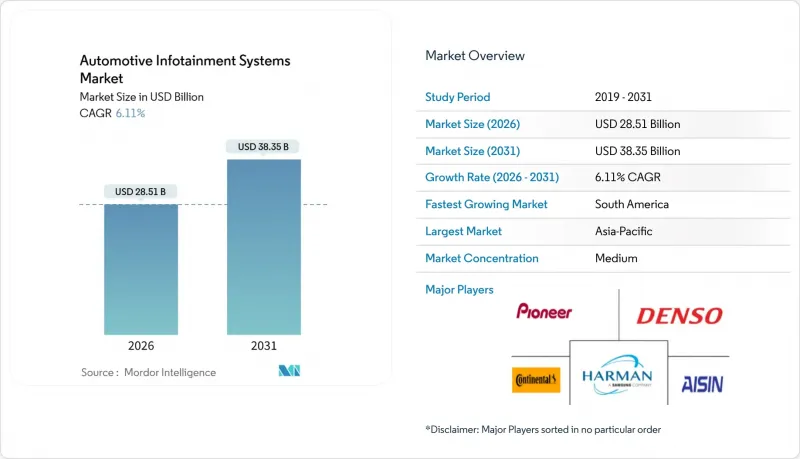
本報告按安裝類型(儀錶板整合式資訊娛樂系統和後座資訊娛樂系統)、車輛類型(乘用車等)、組件(顯示/觸控螢幕模組等)、驅動系統(內燃機車輛等)、連接方式、作業系統、銷售管道和地區進行細分。市場預測以價值(美元)及銷售量(台)兩種單位呈現。
全球汽車資訊娛樂系統市場趨勢及洞察
消費者對互聯服務的需求以及5G的部署
全球五分之二的車主正在考慮更換品牌,以尋求更好的資訊娛樂使用者體驗,而在德國,這一比例接近一半。 AT&T 將於 2025 年開始為豐田和Lexus汽車提供 5G 連接,實現即時路線重劃、雲端語音助理和低延遲 V2X通訊。網路切片技術允許在向後座椅同時傳輸 4K影片的同時,為安全相關的通訊預留頻寬,這是 4G LTE 難以實現的。通用汽車 (GM) 正在其 2025 年和 2026 年車型中原生整合 Apple Music,並提供八年免費串流媒體服務,以增強品牌忠誠度。
向軟體定義車輛和數位駕駛座過渡
透過空中下載 (OTA) 方式,軟體定義架構顯著降低了功能延遲,從而實現了更快的更新。豐田的下一代 RAV4 將採用 Arene 平台,並計劃持續進行更新。同時,BMW的「作業系統 X」預計將在不久的將來應用於其「新等級」車型,使該公司能夠更好地掌控數據及其貨幣化。隨著原始設備製造商 (OEM) 擴大主導用戶介面層的開發,一級供應商正將重心轉向中間件服務。產業預測顯示,未來幾年汽車軟體收入將顯著成長,其中資訊娛樂、互聯和安全將佔據很大一部分成長佔有率。缺乏軟體人才規模化能力的供應商將面臨被市場淘汰的風險,尤其是在硬體日益同質化的背景下。
入門車型中的成本意識
新興市場的價格敏感型買家通常會為了將價格控制在15,000美元以下而犧牲觸控螢幕和互聯功能。在印度,馬蒂鈴木奧拓的入門車型配備的是類比儀表,這限制了高階車載資訊娛樂系統的普及。來自中國的新興參與企業加劇了價格競爭,迫使老牌製造商要么承擔資訊娛樂系統的成本,要么接受市場佔有率下滑的現實。售價在150美元到300美元之間的安卓車載資訊娛樂系統雖然能提供部分解決方案,但與車輛的深度整合度不足。互聯功能的緩慢普及也阻礙了應用商店生態系統所必需的網路效應的形成。
細分市場分析
在汽車資訊娛樂系統市場,到2025年,整合於儀錶板的單元將佔據73.27%的市場佔有率,但預計到2031年,後排座椅安裝的市場佔有率將以6.13%的複合年成長率成長。豪華汽車製造商正透過引入8K顯示器和雲端遊戲來為其高昂的價格辯護,並將後排座椅改造為生活空間。 BMW的31.3吋「戲院螢幕」和賓士的雙螢幕MBUX後座系統清晰地展現了身臨其境型娛樂的趨勢,這種娛樂方式僅在車輛停放或自動駕駛模式下運作。供應商正致力於開發模組化架構,在前排和後排區域之間共用GPU和內存,以減少昂貴半導體的重複使用。
第二個趨勢是監管方面的。聯合國歐洲經濟委員會(UNECE)強制規定,駕駛側顯示器必須顯示必要的安全訊息,這鞏固了儀錶板顯示器的主導地位,而後排座椅內容仍為可選配置。旗艦車型的後排座椅系統售價高達每套3000至5000美元,儘管總銷量不及前排顯示螢幕,但它們構成了一個盈利豐厚的細分市場。串流媒體服務供應商也正在進軍這一細分市場,Xbox雲端遊戲計畫於2025年與LG合作,實現在主機車型上的部署,這將進一步推動汽車資訊娛樂系統市場的成長。
到2025年,乘用車將佔據汽車資訊娛樂系統市場81.31%的佔有率,鞏固其大眾市場地位。輕型商用車(LCV)市場預計將以6.18%的複合年成長率成長,物流公司正優先考慮遠端資訊處理、電子日誌記錄和駕駛員培訓。印度新創公司Euler Motors為其電動送貨車配備了10英寸的Chimera主機,該主機整合了地理圍欄和預測性維護儀錶板功能,這表明輕型商用車的資訊娛樂系統正在從娛樂轉向對業務運營至關重要的車隊管理軟體。
商用車領域面臨環境方面的挑戰。車隊營運商要求硬體符合 MIL-STD-810 標準,以承受振動和灰塵,即使這只會略微增加組件成本。然而,訂閱費用居高不下,車隊營運商願意每月支付 30 至 50 美元,用於能夠降低油耗和保險費用的連網服務。如果原始設備製造商 (OEM) 能夠將他們在乘用車使用者介面方面的專業知識與商用車的耐用性相結合,就能獲得額外收入,並鞏固汽車資訊娛樂系統市場。
到2025年,主機和網域控制器的銷售額佔比將達到43.43%,而作業系統軟體和應用程式預計到2031年將以6.27%的複合年成長率成長。 BMW基於Android開源專案自主研發的作業系統「X作業系統」清楚地展現了其從硬體銷售轉變為持續授權收入的策略。更大、更高解析度的顯示器繼續推動硬體的提升銷售——例如,Volvo2026款XC60的顯示器像素密度提高了1/50——但軟體才是利潤成長的主要驅動力。
硬體商品化正促使一級供應商加快對中介軟體的投資。 Elektrobit、BlackBerry QNX 和 Wind River 等公司正透過基於高通和恩智浦 SoC 建構的虛擬機器管理程式和安全通訊協定堆疊獲得收入。隨著汽車資訊娛樂系統市場向軟體定義價值轉型,缺乏強大程式碼組合的供應商可能面臨利潤率下降甚至被市場淘汰的風險。
區域分析
到2025年,亞太地區將佔據全球汽車資訊娛樂系統市場38.77%的佔有率。這主要得益於中國新能源汽車的大規模生產以及印度聯網汽車的快速普及。 2025年初,日本將推出多款搭載豐田「Arene」多媒體系統的乘用車,而韓國現代摩比斯將發布全像抬頭顯示器,凸顯該地區一體化的汽車生態系統。台積電和三星將在半導體供應領域佔據主導地位,但圍繞台灣的緊張局勢可能會擾亂供應鏈。同時,越南等東南亞國家雖然目前市場佔有率較小,但對中國汽車製造商提供的功能豐富的車載資訊娛樂系統越來越感興趣。
預計南美洲將最快成長,到2031年複合年成長率將達到6.17%,這主要得益於巴西將於2024年強制實施的eCall系統,該系統要求所有新車都必須具備蜂窩網路連接功能。預計到2025年,阿根廷的車輛註冊市場將面臨來自中國品牌的激烈競爭,這些品牌將利用先進的資訊娛樂功能挑戰傳統汽車製造商。儘管存在支付方式的區域差異和外匯波動等挑戰,但具有前瞻性的汽車製造商可以透過本地化內容、收費和雲端服務,將互聯功能轉化為穩定的收入來源。
歐洲和北美作為成熟的市場,依然充滿活力。歐洲國家,尤其是德國、英國和法國,在軟體定義駕駛座(SD-C)的普及應用方面處於領先地位,這得益於通用安全法規II(General Safety Regulation II)下高級駕駛輔助系統(ADAS)的日益普及。美國正利用5G部署和快速成長的電動車市場(2024年電動車銷售成長已充分證明這一點),透過整合串流資訊娛樂等功能來提升顧客忠誠度。加拿大密切關注美國的趨勢,而成長則集中在中東和非洲的阿拉伯聯合大公國和沙烏地阿拉伯。土耳其和南非尤其正在推動緊急呼叫(eCall)法規,預計互聯互通的優勢將在全部區域進一步擴大。
其他好處:
- Excel格式的市場預測(ME)表
- 3個月的分析師支持
目錄
第1章:引言
- 研究假設和市場定義
- 調查範圍
第2章:調查方法
第3章執行摘要
第4章 市場狀況
- 市場概覽
- 市場促進因素
- 消費者對互聯服務的需求以及5G的部署
- 向軟體定義車輛和數位駕駛座過渡
- 將以ADAS為中心的HMI整合到資訊娛樂主機中
- 新興市場關於電子呼叫和資料登錄的強制性法規
- 雲端原生技術最新趨勢:實現“按需功能”
- 車載電子商務/應用程式商店獲利
- 市場限制因素
- 入門車型對成本的敏感性
- 網路安全與責任風險
- 汽車SoC供應鏈的波動性
- 有關維修權和資料所有權的法律法規
- 價值供應鏈分析
- 監理情勢
- 技術展望
- 波特五力模型
第5章 市場規模與成長預測
- 按安裝類型
- 儀錶板整合式資訊娛樂系統
- 後座資訊娛樂系統
- 按車輛類型
- 搭乘用車
- 輕型商用車
- 中型和重型商用車輛
- 按組件
- 顯示/觸控螢幕模組
- 主機/網域控制器
- 作業系統軟體和應用程式
- 連接IC和天線模組
- 依推進類型
- 內燃機車
- 電池式電動車
- 油電混合車
- 按代分類的連結性
- 4G LTE
- 5G
- 傳統 2G/3G
- 透過作業系統
- 基於 Linux 的(AAOS、AGL 等)
- QNX
- Android Automotive OS
- 其他(專有開發、即時作業系統)
- 按銷售管道
- OEM設備
- 售後市場
- 按地區
- 北美洲
- 美國
- 加拿大
- 其他北美國家
- 南美洲
- 巴西
- 阿根廷
- 其他南美國家
- 歐洲
- 德國
- 英國
- 法國
- 義大利
- 西班牙
- 其他歐洲國家
- 亞太地區
- 中國
- 印度
- 日本
- 韓國
- 其他亞太國家
- 中東和非洲
- 阿拉伯聯合大公國
- 沙烏地阿拉伯
- 南非
- 土耳其
- 其他中東和非洲國家
- 北美洲
第6章 競爭情勢
- 市場集中度
- 策略趨勢
- 市佔率分析
- 公司簡介
- Harman International Industries Inc.
- Robert Bosch GmbH
- Continental AG
- Denso Corporation
- Visteon Corporation
- Panasonic Corporation
- Aptiv plc
- Mitsubishi Electric Corporation
- Alpine Electronics Inc.
- JVCKenwood Corporation
- Pioneer Corporation
- Faurecia SE(Clarion Electronics)
- Qualcomm Technologies Inc.
- Nvidia Corporation
- NXP Semiconductors NV
第7章 市場機會與未來展望
According to Mordor Intelligence, the automotive infotainment systems market size is estimated at USD 28.51 billion in 2026, and is expected to reach USD 38.35 billion by 2031, at a CAGR of 6.11% during the forecast period (2026-2031).
This report is Segmented by Installation Type (In-Dash Infotainment and Rear-Seat Infotainment), Vehicle Type (Passenger Cars and More), Component (Display / Touch-Screen Module and More), Propulsion (ICE Vehicles and More), Connectivity Generation, Operating System, Sales Channel, and Geography. Market Forecasts are Provided in Terms of Value (USD) and Volume (Units).
Global Automotive Infotainment Systems Market Trends and Insights
Consumer Demand for Connected Services and 5G Roll-out
Two-fifths of global car owners would consider switching brands for a better infotainment user experience, rising to nearly half in Germany. AT&T began delivering 5G connectivity to Toyota and Lexus vehicles in 2025, enabling real-time rerouting, cloud voice assistants, and low-latency V2X messaging . Network slicing reserves bandwidth for safety traffic while simultaneously streaming 4K video to rear seats, a capability 4G LTE struggles to match. General Motors embedded Apple Music natively across 2025 and 2026 models, offering eight years of free streaming to encourage brand loyalty.
Shift Toward Software-Defined Vehicles and Digital Cockpits
Through over-the-air delivery, software-defined architectures have significantly reduced the feature lag, enabling much faster updates. Toyota's upcoming RAV4, leveraging the Arene platform, is set for continuous updates. Meanwhile, BMW's Operating System X will make its debut on the Neue Klasse in the near future, allowing the automaker to maintain control over data and its monetization. As OEMs increasingly take charge of developing the user-interface layer, Tier-1 suppliers are shifting their focus towards middleware services. Industry projections indicate that automotive software revenue will experience substantial growth in the coming years, with infotainment, connectivity, and security taking a significant share. Suppliers lacking the ability to scale their software talent face the risk of displacement, especially as hardware edges closer to commoditization.
Cost Sensitivity in Entry-Level Models
Price-conscious buyers in emerging markets often forgo touchscreens and connectivity to hit sub-USD 15,000 price points. In India, base trims of the Maruti Suzuki Alto ship with analog clusters, limiting the installed base for premium head units. Chinese entrants intensify price pressure, forcing incumbents to absorb infotainment costs or risk share erosion. Aftermarket Android head units priced at USD 150-300 offer partial remedies but lack deep vehicle integration. The delay in connected adoption restrains network effects vital for app-store ecosystems.
Other drivers and restraints analyzed in the detailed report include:
- Integration of ADAS-Centric HMI Into Infotainment Head Units
- Mandatory eCall and Data-Logging Regulations in Emerging Markets
- Cybersecurity and Liability Risks
For complete list of drivers and restraints, kindly check the Table Of Contents.
Segment Analysis
The automotive infotainment systems market registered a 73.27% dominance for in-dash units in 2025, yet rear-seat installations are projected to post a 6.13% CAGR through 2031. Luxury OEMs deploy 8K screens and cloud gaming to transform back seats into living spaces and justify up-market pricing. BMW's 31.3-inch Theatre Screen and Mercedes-Benz's dual-screen MBUX rear system illustrate the move toward immersive entertainment that operates only when parked or in autonomous mode. Suppliers focus on modular architectures that share GPUs and memory between front and rear zones to curb duplication of costly silicon.
A second trend is regulatory. UNECE dictates that driver-facing displays show mandatory safety visuals, cementing in-dash primacy, while rear-seat content remains discretionary. Rear-seat setups command higher per-unit revenue-USD 3,000-5,000 in flagship models-creating a profitable niche even though overall volumes trail front displays. Streaming providers align with this niche; Xbox Cloud Gaming leveraged LG partnerships in 2025 to reach vehicle cabins without onboard consoles, supporting the growth trajectory of the automotive infotainment systems market.
Passenger cars accounted for 81.31% of the automotive infotainment systems market size in 2025, reinforcing their mass-market status. Light commercial vehicles are forecast to clock a 6.18% CAGR as logistics firms prioritize telematics, electronic logging, and driver coaching. Indian start-up Euler Motors has equipped its electric delivery vans with a 10-inch Chimera head unit that integrates geofencing and predictive maintenance dashboards, signaling a shift in LCV infotainment from entertainment to mission-critical fleet software.
The commercial segment experiences ruggedization challenges. Fleets demand MIL-STD-810-rated hardware to withstand vibration and dust, which adds minimal cost to components. Yet subscription attach rates are higher; fleet operators willingly pay USD 30-50 per month for connected services that shave fuel use and insurance premiums. OEMs that harmonize passenger-car user-interface learnings with fleet durability stand to gain incremental revenue and strengthen the automotive infotainment systems market.
Head units and domain controllers contributed 43.43% to 2025 revenue, but operating-system software and apps are projected to increase at a 6.27% CAGR through 2031. BMW's in-house Operating System X, built on the Android Open Source Project, illustrates the strategic shift from hardware to recurring licenses. Larger, higher-resolution screens still generate hardware upsell-Volvo's 2026 XC60 display boosts pixel density by one-fifth-yet software dominates incremental margin.
Hardware commoditization spurs tier-1 suppliers to invest in middleware. Elektrobit, BlackBerry QNX, and Wind River monetize hypervisors and secure communication stacks that sit atop SoCs from Qualcomm or NXP. As the automotive infotainment systems market transitions toward software-defined value, suppliers lacking deep code portfolios could face margin compression or displacement.
Complete Report Scope:
- By Installation Type
- In-dash Infotainment
- Rear-seat Infotainment
- By Vehicle Type
- Passenger Cars
- Light Commercial Vehicles
- Medium and Heavy Commercial Vehicles
- By Component
- Display / Touch-screen Module
- Head Unit / Domain Controller
- Operating-System Software & Apps
- Connectivity ICs & Antenna Modules
- By Propulsion Type
- Internal-Combustion Engine Vehicles
- Battery Electric Vehicles
- Hybrid Electric Vehicles
- By Connectivity Generation
- 4G LTE
- 5G
- Legacy 2G/3G
- By Operating System
- Linux-Based (AAOS, AGL, etc.)
- QNX
- Android Automotive OS
- Others (Proprietary, RTOS)
- By Sales Channel
- OEM-Installed
- Aftermarket
- By Geography
- North America
- United States
- Canada
- Rest of North America
- South America
- Brazil
- Argentina
- Rest of South America
- Europe
- Germany
- United Kingdom
- France
- Italy
- Spain
- Rest of Europe
- Asia Pacific
- China
- India
- Japan
- South Korea
- Rest of Asia Pacific
- Middle East and Africa
- United Arab Emirates
- Saudi Arabia
- South Africa
- Turkey
- Rest of Middle East and Africa
- North America
Geography Analysis
Asia Pacific held 38.77% of the automotive infotainment systems market in 2025, driven by China's substantial production of new-energy vehicles and India's swift embrace of connected cars. In early 2025, Japan rolled out a considerable number of passenger vehicles featuring Toyota's Arene multimedia, while South Korea's Hyundai Mobis showcased holographic head-up displays, highlighting the region's integrated automotive ecosystem. While TSMC and Samsung dominate the semiconductor supply, tensions surrounding Taiwan present potential disruptions. Meanwhile, Southeast Asian nations like Vietnam, though currently modest players, are becoming increasingly receptive to Chinese OEMs offering competitive, feature-rich infotainment systems.
South America is projected to register the fastest growth at a 6.17% CAGR through 2031 as Brazil's 2024 eCall requirement forces cellular connectivity into every new vehicle. In 2025, Argentina's vehicle registrations grapple with aggressive Chinese brands, leveraging advanced infotainment features to challenge established players. Despite hurdles like regional payment fragmentation and currency fluctuations, savvy OEMs can turn connectivity into a steady revenue stream by localizing content, billing, and cloud services.
Europe and North America, while established, remain vibrant. European nations, led by Germany, the UK, and France, are at the forefront of deploying software-defined cockpits, spurred by the General Safety Regulation II's push for ADAS visualization. The U.S. is capitalizing on the 5G rollout and a burgeoning electric vehicle market-evident from the growing EV sales in 2024-integrating features like streaming infotainment for enhanced customer loyalty. Canada is closely following U.S. trends, while the Middle East and Africa see growth concentrated in the UAE and Saudi Arabia. Notably, Turkey and South Africa are gearing up for eCall regulations, promising to amplify connectivity benefits throughout the region.
- Harman International Industries Inc.
- Robert Bosch GmbH
- Continental AG
- Denso Corporation
- Visteon Corporation
- Panasonic Corporation
- Aptiv plc
- Mitsubishi Electric Corporation
- Alpine Electronics Inc.
- JVCKenwood Corporation
- Pioneer Corporation
- Faurecia SE (Clarion Electronics)
- Qualcomm Technologies Inc.
- Nvidia Corporation
- NXP Semiconductors N.V.
Additional Benefits:
- The market estimate (ME) sheet in Excel format
- 3 months of analyst support
TABLE OF CONTENTS
1 Introduction
- 1.1 Study Assumptions & Market Definition
- 1.2 Scope of the Study
2 Research Methodology
3 Executive Summary
4 Market Landscape
- 4.1 Market Overview
- 4.2 Market Drivers
- 4.2.1 Consumer Demand for Connected Services & 5G Roll-out
- 4.2.2 Shift toward Software-Defined Vehicles & Digital Cockpits
- 4.2.3 Integration of ADAS-Centric HMI into Infotainment Head Units
- 4.2.4 Mandatory eCall & Data-Logging Regulations in Emerging Markets
- 4.2.5 Cloud-Native Updates Enabling Feature-on-Demand
- 4.2.6 In-Car E-commerce / App-Store Monetisation
- 4.3 Market Restraints
- 4.3.1 Cost Sensitivity in Entry-Level Models
- 4.3.2 Cyber-security & Liability Risks
- 4.3.3 Automotive SoC Supply-Chain Volatility
- 4.3.4 Right-to-Repair & Data-Ownership Legislation
- 4.4 Value / Supply-Chain Analysis
- 4.5 Regulatory Landscape
- 4.6 Technological Outlook
- 4.7 Porter's Five Forces
- 4.7.1 Bargaining Power of Suppliers
- 4.7.2 Bargaining Power of Buyers
- 4.7.3 Threat of New Entrants
- 4.7.4 Threat of Substitutes
- 4.7.5 Competitive Rivalry
5 Market Size & Growth Forecasts (Value (USD) and Volume (Units))
- 5.1 By Installation Type
- 5.1.1 In-dash Infotainment
- 5.1.2 Rear-seat Infotainment
- 5.2 By Vehicle Type
- 5.2.1 Passenger Cars
- 5.2.2 Light Commercial Vehicles
- 5.2.3 Medium and Heavy Commercial Vehicles
- 5.3 By Component
- 5.3.1 Display / Touch-screen Module
- 5.3.2 Head Unit / Domain Controller
- 5.3.3 Operating-System Software & Apps
- 5.3.4 Connectivity ICs & Antenna Modules
- 5.4 By Propulsion Type
- 5.4.1 Internal-Combustion Engine Vehicles
- 5.4.2 Battery Electric Vehicles
- 5.4.3 Hybrid Electric Vehicles
- 5.5 By Connectivity Generation
- 5.5.1 4G LTE
- 5.5.2 5G
- 5.5.3 Legacy 2G/3G
- 5.6 By Operating System
- 5.6.1 Linux-Based (AAOS, AGL, etc.)
- 5.6.2 QNX
- 5.6.3 Android Automotive OS
- 5.6.4 Others (Proprietary, RTOS)
- 5.7 By Sales Channel
- 5.7.1 OEM-Installed
- 5.7.2 Aftermarket
- 5.8 By Geography
- 5.8.1 North America
- 5.8.1.1 United States
- 5.8.1.2 Canada
- 5.8.1.3 Rest of North America
- 5.8.2 South America
- 5.8.2.1 Brazil
- 5.8.2.2 Argentina
- 5.8.2.3 Rest of South America
- 5.8.3 Europe
- 5.8.3.1 Germany
- 5.8.3.2 United Kingdom
- 5.8.3.3 France
- 5.8.3.4 Italy
- 5.8.3.5 Spain
- 5.8.3.6 Rest of Europe
- 5.8.4 Asia Pacific
- 5.8.4.1 China
- 5.8.4.2 India
- 5.8.4.3 Japan
- 5.8.4.4 South Korea
- 5.8.4.5 Rest of Asia Pacific
- 5.8.5 Middle East and Africa
- 5.8.5.1 United Arab Emirates
- 5.8.5.2 Saudi Arabia
- 5.8.5.3 South Africa
- 5.8.5.4 Turkey
- 5.8.5.5 Rest of Middle East and Africa
- 5.8.1 North America
6 Competitive Landscape
- 6.1 Market Concentration
- 6.2 Strategic Moves
- 6.3 Market Share Analysis
- 6.4 Company Profiles (includes Global Level Overview, Market Level Overview, Core Segments, Financials as Available, Strategic Information, Market Rank/Share for Key Companies, Products and Services, SWOT Analysis, and Recent Developments)
- 6.4.1 Harman International Industries Inc.
- 6.4.2 Robert Bosch GmbH
- 6.4.3 Continental AG
- 6.4.4 Denso Corporation
- 6.4.5 Visteon Corporation
- 6.4.6 Panasonic Corporation
- 6.4.7 Aptiv plc
- 6.4.8 Mitsubishi Electric Corporation
- 6.4.9 Alpine Electronics Inc.
- 6.4.10 JVCKenwood Corporation
- 6.4.11 Pioneer Corporation
- 6.4.12 Faurecia SE (Clarion Electronics)
- 6.4.13 Qualcomm Technologies Inc.
- 6.4.14 Nvidia Corporation
- 6.4.15 NXP Semiconductors N.V.
7 Market Opportunities & Future Outlook
- 7.1 White-space & Unmet-need Assessment

 亞太地區汽車資訊娛樂系統:市場佔有率分析、產業趨勢與統計及成長預測(2026-2031)歐洲汽車資訊娛樂系統:市場佔有率分析、產業趨勢與統計及成長預測(2026-2031)
 汽車資訊娛樂系統市場:按組件、連接方式、使用者介面、安裝類型、顯示尺寸、功能、車輛類型、銷售管道和最終用戶分類-2026-2032年全球市場預測
 汽車AIOS市場(2026年)
 全球汽車資訊娛樂市場規模、佔有率、趨勢和成長分析報告(2026-2034)2026-2034年全球電動汽車資訊娛樂系統市場規模、佔有率、趨勢及成長分析報告人工智慧定義車輛(AIDV)OEM廠商部署策略研究報告(2026年)
 2026年全球幼鮭養殖系統市場報告美國後座娛樂市場,2026-2032年2026年全球電動車資訊娛樂市場報告