


 |
市場調查報告書
商品編碼
2115062
亞太地區汽車資訊娛樂系統:市場佔有率分析、產業趨勢與統計及成長預測(2026-2031)Asia Pacific Automotive Infotainment Systems - Market Share Analysis, Industry Trends & Statistics, Growth Forecasts (2026 - 2031) |
||||||

※ 本網頁內容可能與最新版本有所差異。詳細情況請與我們聯繫。
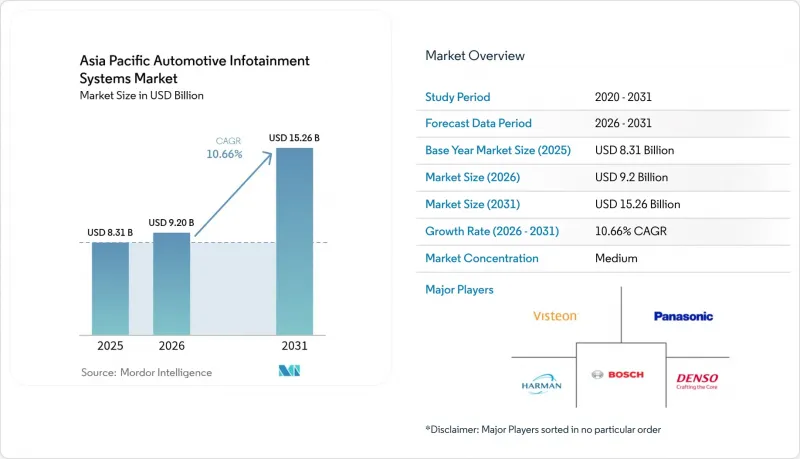
據 Mordor Intelligence 稱,亞太地區汽車資訊娛樂系統市場在 2025 年的價值為 83.1 億美元,預計到 2031 年將達到 152.6 億美元,而 2026 年為 92 億美元,預測期(2026-2031 年)的複合成長率為 10.6%。
本報告按安裝類型(例如,整合於儀錶板的資訊娛樂系統)、車輛類型(例如,乘用車)、組件(例如,顯示器、主機)、動力系統(例如,內燃機)、連接方式(4G、5G、2G/3G)、作業系統(例如,Linux)、銷售管道(OEM 和售後市場)以及國家/地區進行細分。市場預測以以金額為準。
亞太地區汽車資訊娛樂系統市場趨勢及洞察。
對聯網汽車服務的需求日益成長
如今,車隊營運商和叫車平台不再僅僅將車載資訊娛樂系統視為一種車載奢侈品,而是將其視為提升營運效率的關鍵工具。車載資訊系統整合能夠實現更有效率的路線規劃,提供駕駛員行為洞察,並支援預測性維護。所有這些都有助於顯著降低油耗。在印度和韓國等市場,基於使用量的保險試點計畫透過提供個人化獎勵,推動了連網車載主機的普及。此外,基於雲端的交通預測技術的應用,使得車載資訊娛樂系統無需內建地圖,從而簡化了操作流程。因此,材料清單(BOM) 的總成本降低,提高了成本效益。
向具備OTA升級功能的軟體定義車輛過渡。
2024年,大眾汽車集團(中國)為其眾多車型推出了OTA空中升級功能。同時,現代和起亞計劃將OTA升級擴展到其計劃在隔年發布的大多數車型。此外,BMW的iDrive 9.0系統整合了虛擬機器管理程序,可實現駕駛座系統的獨立更新。這些縮短迭代周期的進步,不僅推動了訂閱式收入的成長,也降低了與車輛召回相關的成本。
價格敏感型市場中零件成本高昂
顯示模組、連接積體電路和系統單晶片 (SoC) 佔據了資訊娛樂系統物料清單 (BOM) 的大部分。印度大規模生產汽車市場的成本限制迫使汽車製造商 (OEM) 使用簡化的車載資訊娛樂系統主機以維持價格競爭力。此外,東南亞國協徵收的進口關稅也大幅提高了半導體的整體成本。同時,印度的國內製造能力仍然有限,主要集中在線束生產和基礎組裝工作。
細分市場分析
預計到2025年,整合於儀錶板的後排娛樂系統將佔總銷量的77.65%,而後排娛樂系統的銷量正以12.04%的複合年成長率成長。大陸集團的曲面多區域顯示器減輕了線纜重量,並允許每位乘客單獨使用串流媒體服務。儘管在中國和韓國,專職司機文化正在加速推動後排娛樂系統的需求,但在對成本較為敏感的印度和東南亞國協,整合於儀錶板的後排娛樂系統仍然佔據主導地位。蔚來等高階電動車品牌現在已將後排螢幕作為標準配置,這項曾經是豪華車專屬的功能如今已成為中階車型的標配。
車內螢幕面積的不斷擴大,使得精準廣告投放成為可能,並為汽車製造商的應用程式商店開闢了新的收入來源。因此,在亞太地區的汽車資訊娛樂系統市場,後排顯示器的日益普及正在影響供應商的產品藍圖,並推動著模組化網域控制器的發展,這些控制器可以獨立驅動多個顯示器。這將成為2031年市場差異化的關鍵領域。
輕型商用車的複合年成長率 (CAGR) 為 11.55%,並且正在利用車載資訊娛樂系統進行路線最佳化和駕駛員分析。 Mahindra 的 Treo Zor 整合了一個可透過車載觸控螢幕存取的車隊 API,這展示了物流營運商如何將資訊娛樂系統轉變為關鍵任務儀錶板。
車隊採購商優先考慮運作和整體擁有成本 (TCO),因此耐環境腐蝕的螢幕、遠端診斷和 FOTA 功能至關重要。原始設備製造商 (OEM) 在採購時提供打包式、分級的 SaaS 計劃,並承諾簽訂多年資料合約。亞太地區的汽車資訊娛樂系統市場正在創造除展示室銷售之外的持續收入,這為供應商策略性地專注於輕型商用車 (LCV) 市場奠定了基礎。
到2025年,顯示器將佔據43.28%的價值佔有率,屆時OLED將在高階市場取代LCD。三星顯示器的汽車OLED顯示器擁有100,000:1的對比度,支援擴增實境(AR)疊加顯示器和微秒響應速度。然而,作業系統軟體和應用程式正以13.18%的複合年成長率推動成長,預示著利潤率格局將發生轉變。
如今,網域控制器將駕駛座、儀錶叢集和後排座椅的邏輯整合到單一SoC中,顯著降低了組件成本。隨著訂閱經營模式的興起,與傳統行動電話平台相比,OEM廠商在應用程式商店收入中所佔佔有率越來越大。因此,亞太地區汽車資訊娛樂系統市場中那些已從單純專注於硬體轉向提供端到端軟體生命週期服務的供應商正日益受益。
其他好處:
- Excel格式的市場預測(ME)表
- 3個月的分析師支持
目錄
第1章:引言
- 研究假設和市場定義
- 調查範圍
第2章:調查方法
第3章執行摘要
第4章 市場狀況
- 市場概覽
- 市場促進因素
- 對聯網汽車服務的需求日益成長
- OEM廠商與主要科技公司之間的平台合作
- 監理義務(eCall、遠端資訊處理)
- 區域性OTT和導航生態系(東協)
- 低成本SoC在入門級車輛中的廣泛應用。
- 向具備OTA升級功能的軟體定義車輛過渡。
- 市場限制因素
- 在價格敏感的市場中,物料清單成本較高
- 軟體分散化與網路安全風險
- 半導體供應衝擊導致主機供不應求
- 在大都會圈以外,5G網路覆蓋範圍並不均衡。
- 價值供應鏈分析
- 監理情勢
- 技術展望
- 波特五力模型
第5章 市場規模與成長預測
- 按安裝類型
- 儀錶板整合式資訊娛樂系統
- 後座資訊娛樂系統
- 車輛類型
- 搭乘用車
- 輕型商用車
- 中型和重型商用車輛
- 按組件
- 顯示/觸控螢幕模組
- 主機/網域控制器
- 作業系統軟體和應用程式
- 連接IC和天線模組
- 依推進類型
- 內燃機車
- 油電混合車
- 電池式電動車
- 按代分類的連結性
- 4G LTE
- 5G
- 傳統 2G/3G
- 透過作業系統
- 基於Linux的(AAOS、AGL等)
- QNX
- Android Automotive OS
- 其他(專有開發、即時作業系統)
- 按銷售管道
- OEM設備
- 售後市場
- 國家
- 中國
- 日本
- 印度
- 韓國
- 澳洲
- 其他亞太國家
第6章 競爭情勢
- 市場集中度
- 策略趨勢
- 市佔率分析
- 公司簡介
- Panasonic Corporation
- Harman International Inc.(Samsung)
- Denso Corporation
- Robert Bosch GmbH
- Visteon Corporation
- Continental AG
- Alpine Electronics Inc.
- JVCKenwood Corporation
- Mitsubishi Electric Corporation
- Aptiv PLC
- Hyundai Mobis
- Garmin Ltd.
- Sony Group Corporation
- BlackBerry QNX
第7章 市場機會與未來展望
According to Mordor Intelligence, the Asia-Pacific automotive infotainment system market size was valued at USD 8.31 billion in 2025 and estimated to grow from USD 9.2 billion in 2026 to reach USD 15.26 billion by 2031, at a CAGR of 10.66% during the forecast period (2026-2031).
This report is Segmented by Installation Type (In-Dash Infotainment, and More), Vehicle Type (Passenger Cars, and More), Component (Display, Head Unit, and More), Propulsion (Internal Combustion Engine, and More), Connectivity (4G, 5G, and 2G/3G), Operating System (Linux, and Others), Sales Channel (OEM and Aftermarket), and Country. The Market Forecasts in Value (USD).
Asia Pacific Automotive Infotainment Systems Market Trends and Insights
Growing Demand for Connected-Car Services
Fleet operators and ride-hailing aggregators now view infotainment as a critical tool for enhancing operational efficiency rather than a mere cabin luxury. The integration of telematics enables more efficient routing, provides insights into driver behavior, and supports predictive maintenance, all of which contribute to noticeable reductions in fuel consumption. In markets such as India and South Korea, usage-based insurance pilots are encouraging the adoption of connectivity-enabled head units by offering tailored incentives. Furthermore, the use of cloud-based traffic prediction has streamlined operations by eliminating the need for embedded maps, thereby reducing the overall Bill of Materials (BOM) and improving cost efficiency.
Shift to OTA-Upgradeable, Software-Defined Vehicles
In 2024, Volkswagen Group China introduced over-the-air (OTA) updates for a significant number of vehicles . At the same time, Hyundai and Kia plan to extend OTA updates to the majority of their upcoming models for the following year. Furthermore, BMW's iDrive 9.0 incorporates hypervisors to enable independent updates for cockpit systems. These advancements in faster iteration cycles are driving growth in subscription-based revenue streams while simultaneously reducing costs associated with vehicle recalls.
High BOM Cost in Price-Sensitive Markets
Display modules, connectivity ICs, and SoCs account for a major portion of the infotainment bill of materials. Due to cost constraints in India's mass-market cars, original equipment manufacturers are compelled to ship head units with simplified features to maintain affordability. Furthermore, import tariffs imposed by ASEAN countries significantly increase the overall cost of semiconductors. Meanwhile, local manufacturing capabilities in India remain limited, focusing primarily on the production of wiring harnesses and performing basic assembly tasks.
Other drivers and restraints analyzed in the detailed report include:
- OEM-Tech Giant Platform Partnerships
- Low-Cost SoC Penetration in Entry-Level Cars
- Patchy 5G Coverage Outside Metro Areas
For complete list of drivers and restraints, kindly check the Table Of Contents.
Segment Analysis
Rear-seat entertainment revenue is climbing at 12.04% CAGR, even as in-dash units dominated 77.65% of 2025 sales. Curved multi-zone displays from Continental reduce wiring weight and enable independent streaming for passengers. Chauffeur-driven cultures in China and South Korea accelerate demand, whereas cost-sensitive India and ASEAN remain in-dash centric. Premium EV brands, such as NIO, now bundle rear-seat screens as a baseline, moving a former luxury feature into mid-segment expectations.
Greater cabin screen real estate supports targeted advertising, unlocking fresh revenue for OEM app stores. The Asia-Pacific Automotive Infotainment System market, therefore, sees rear-seat uptake influencing supplier roadmaps toward modular domain controllers that independently power multiple displays-a critical differentiation frontier heading to 2031.
Passenger cars account for 71.78% of revenue, yet they are pivoting to subscription models for navigation and ADAS upgrades. Light commercial vehicles deliver 11.55% CAGR, leveraging telematics-enabled infotainment for route optimization and driver analytics. Mahindra's Treo Zor embeds fleet APIs accessible via cabin touchscreens, illustrating how logistics operators convert infotainment into a mission-critical dashboard.
Fleet buyers prioritize uptime and TCO, so ruggedized screens, remote diagnostics, and FOTA are vital. OEMs offer tiered SaaS plans that are packaged at the time of purchase, locking in multi-year data contracts. The Asia-Pacific Automotive Infotainment System market accrues incremental recurring revenue beyond the showroom, underpinning strategic focus on LCVs for suppliers.
Displays secured a 43.28% value share in 2025, as OLEDs replace LCDs in premium tiers. Samsung Display's 100,000:1-contrast automotive OLED enables augmented-reality overlays and microsecond response times. Yet, operating-system software and apps lead growth at a 13.18% CAGR, signaling a margin migration.
Domain controllers now integrate cockpit, cluster, and rear-seat logic into a single SoC, significantly reducing the bill of materials. With the shift to subscription-based economics, original equipment manufacturers retain a larger share of app-store revenues compared to traditional phone platforms. Consequently, the Asia-Pacific Automotive Infotainment System market increasingly benefits suppliers that adapt from focusing solely on hardware delivery to offering end-to-end software lifecycle services.
Complete Report Scope:
- By Installation Type
- In-dash Infotainment
- Rear-seat Infotainment
- By Vehicle Type
- Passenger Cars
- Light Commercial Vehicles
- Medium and Heavy Commercial Vehicles
- By Component
- Display / Touch-screen Module
- Head Unit / Domain Controller
- Operating-System Software and Apps
- Connectivity ICs and Antenna Modules
- By Propulsion Type
- Internal-Combustion Engine Vehicles
- Hybrid Electric Vehicles
- Battery Electric Vehicles
- By Connectivity Generation
- 4G LTE
- 5G
- Legacy 2G/3G
- By Operating System
- Linux-Based (AAOS, AGL, etc.)
- QNX
- Android Automotive OS
- Others (Proprietary, RTOS)
- By Sales Channel
- OEM-Installed
- Aftermarket
- By Country
- China
- Japan
- India
- South Korea
- Australia
- Rest of Asia-Pacific
List of Companies Covered in this Report:
- Panasonic Corporation
- Harman International Inc. (Samsung)
- Denso Corporation
- Robert Bosch GmbH
- Visteon Corporation
- Continental AG
- Alpine Electronics Inc.
- JVCKenwood Corporation
- Mitsubishi Electric Corporation
- Aptiv PLC
- Hyundai Mobis
- Garmin Ltd.
- Sony Group Corporation
- BlackBerry QNX
Additional Benefits:
- The market estimate (ME) sheet in Excel format
- 3 months of analyst support
TABLE OF CONTENTS
1 Introduction
- 1.1 Study Assumptions and Market Definition
- 1.2 Scope of the Study
2 Research Methodology
3 Executive Summary
4 Market Landscape
- 4.1 Market Overview
- 4.2 Market Drivers
- 4.2.1 Growing Demand for Connected-Car Services
- 4.2.2 OEM-Tech Giant Platform Partnerships
- 4.2.3 Regulatory Mandates (ecall, Telematics)
- 4.2.4 Localized OTT and Navigation Ecosystems (ASEAN)
- 4.2.5 Low-Cost Soc Penetration in Entry-Level Cars
- 4.2.6 Shift to OTA-Upgradeable, Software-Defined Vehicles
- 4.3 Market Restraints
- 4.3.1 High BOM Cost in Price-Sensitive Markets
- 4.3.2 Software Fragmentation and Cybersecurity Risks
- 4.3.3 Head-Unit Shortages from Chip Supply Shocks
- 4.3.4 Patchy 5G Coverage Outside Metro Areas
- 4.4 Value / Supply-Chain Analysis
- 4.5 Regulatory Landscape
- 4.6 Technological Outlook
- 4.7 Porter's Five Forces
- 4.7.1 Threat of New Entrants
- 4.7.2 Bargaining Power of Suppliers
- 4.7.3 Bargaining Power of Buyers
- 4.7.4 Threat of Substitutes
- 4.7.5 Competitive Rivalry
5 Market Size and Growth Forecasts
- 5.1 By Installation Type
- 5.1.1 In-dash Infotainment
- 5.1.2 Rear-seat Infotainment
- 5.2 By Vehicle Type
- 5.2.1 Passenger Cars
- 5.2.2 Light Commercial Vehicles
- 5.2.3 Medium and Heavy Commercial Vehicles
- 5.3 By Component
- 5.3.1 Display / Touch-screen Module
- 5.3.2 Head Unit / Domain Controller
- 5.3.3 Operating-System Software and Apps
- 5.3.4 Connectivity ICs and Antenna Modules
- 5.4 By Propulsion Type
- 5.4.1 Internal-Combustion Engine Vehicles
- 5.4.2 Hybrid Electric Vehicles
- 5.4.3 Battery Electric Vehicles
- 5.5 By Connectivity Generation
- 5.5.1 4G LTE
- 5.5.2 5G
- 5.5.3 Legacy 2G/3G
- 5.6 By Operating System
- 5.6.1 Linux-Based (AAOS, AGL, etc.)
- 5.6.2 QNX
- 5.6.3 Android Automotive OS
- 5.6.4 Others (Proprietary, RTOS)
- 5.7 By Sales Channel
- 5.7.1 OEM-Installed
- 5.7.2 Aftermarket
- 5.8 By Country
- 5.8.1 China
- 5.8.2 Japan
- 5.8.3 India
- 5.8.4 South Korea
- 5.8.5 Australia
- 5.8.6 Rest of Asia-Pacific
6 Competitive Landscape
- 6.1 Market Concentration
- 6.2 Strategic Moves
- 6.3 Market Share Analysis
- 6.4 Company Profiles {(Includes Global level Overview, Market level overview, Core Segments, Financials as available, Strategic Information, Market Rank/Share for key companies, Products and Services, and Recent Developments)}
- 6.4.1 Panasonic Corporation
- 6.4.2 Harman International Inc. (Samsung)
- 6.4.3 Denso Corporation
- 6.4.4 Robert Bosch GmbH
- 6.4.5 Visteon Corporation
- 6.4.6 Continental AG
- 6.4.7 Alpine Electronics Inc.
- 6.4.8 JVCKenwood Corporation
- 6.4.9 Mitsubishi Electric Corporation
- 6.4.10 Aptiv PLC
- 6.4.11 Hyundai Mobis
- 6.4.12 Garmin Ltd.
- 6.4.13 Sony Group Corporation
- 6.4.14 BlackBerry QNX
7 Market Opportunities and Future Outlook

 汽車資訊娛樂系統:市場佔有率分析、產業趨勢與統計、成長預測(2026-2031)歐洲汽車資訊娛樂系統:市場佔有率分析、產業趨勢與統計及成長預測(2026-2031)
 汽車資訊娛樂系統市場:按組件、連接方式、使用者介面、安裝類型、顯示尺寸、功能、車輛類型、銷售管道和最終用戶分類-2026-2032年全球市場預測
 汽車AIOS市場(2026年)
 全球汽車資訊娛樂市場規模、佔有率、趨勢和成長分析報告(2026-2034)2026-2034年全球電動汽車資訊娛樂系統市場規模、佔有率、趨勢及成長分析報告人工智慧定義車輛(AIDV)OEM廠商部署策略研究報告(2026年)
 2026年全球幼鮭養殖系統市場報告美國後座娛樂市場,2026-2032年2026年全球電動車資訊娛樂市場報告