


 |
市場調查報告書
商品編碼
2115832
歐洲汽車資訊娛樂系統:市場佔有率分析、產業趨勢與統計及成長預測(2026-2031)Europe Automotive Infotainment Systems - Market Share Analysis, Industry Trends & Statistics, Growth Forecasts (2026 - 2031) |
||||||

※ 本網頁內容可能與最新版本有所差異。詳細情況請與我們聯繫。
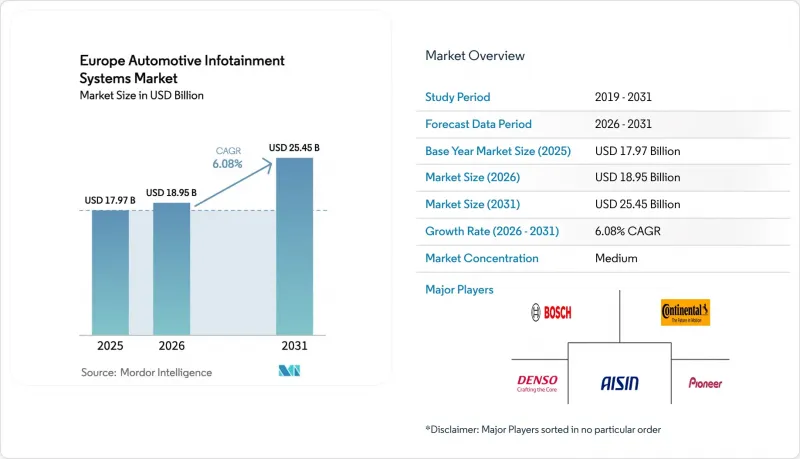
據 Mordor Intelligence 稱,2025 年歐洲汽車資訊娛樂系統市值為 179.7 億美元,預計到 2031 年將達到 254.5 億美元,而 2026 年為 189.5 億美元,預測期(2026-2031 年)的複合年成長率為 6.08%。
本報告按安裝類型(例如,整合於儀錶板的資訊娛樂系統)、車輛類型(例如,乘用車)、組件(例如,顯示器/觸控螢幕模組)、動力系統(例如,內燃機車輛)、連接方式(例如,傳統的 2G/3G)、操作系統、銷售管道和地區(例如,德國)進行細分。市場預測以美元計價。
歐洲汽車資訊娛樂系統市場趨勢與洞察
歐盟強制要求使用 eCall 和安全遠端資訊處理技術(2018/858 號條例)
歐盟第2018/858號法規強制要求在歐盟境內銷售的所有新乘用車和輕型商用車上安裝自動緊急呼叫模組,並規定了資訊娛樂系統的最低規格,包括4G調變解調器和GNSS接收器。儘管該法規的實施工作於2024年完成,但汽車製造商已迅速將這項強制模組擴展為一項盈利來源,並在同一硬體上疊加了預測性維護警報、保險遠端資訊處理和被盜車輛追蹤等功能。目前,大陸集團和博世提供白牌「遠端資訊處理即服務 (TaaS)」軟體包,汽車製造商可以將其以自有品牌部署到其移動出行應用程式中。歐盟委員會2025年的評估顯示,農村地區的緊急應變時間縮短了40%,證實了歐洲汽車資訊娛樂系統市場對始終線上駕駛座的接受度正在不斷提高。
電動車的日益普及推動了節能型車載資訊娛樂系統的發展。
到2025年,電池式電動車(BEV)將在歐盟新註冊乘用車中佔據相當大的佔有率,駕駛座的功能重點也將從娛樂轉向能源管理。如今,資訊娛樂系統整合了電池熱模型、充電站可用性和續航里程最佳化路線導航等功能。大眾汽車的ID.Software 4.0利用網路切片技術確保5G頻寬,並持續更新充電器資料。此次升級使2025年第四季與充電相關的申訴減少了28%。 BMW汽車於2026年在荷蘭啟動的試驗計畫將允許駕駛員透過資訊娛樂系統安排電池充電時間,從而提供離峰時段充電折扣。這將駕駛座重新定義為能源管理主機,提升歐洲汽車資訊娛樂系統市場的客戶參與度。
大型OLED/Mini-LED顯示器和高效能運算SoC高成本
LG Display為賓士的MBUX Hyperscreen資訊娛樂系統提供先進的軟性P-OLED面板,該系統應用於EQS和其他電動車,可實現覆蓋整個儀錶板的曲面全景顯示設計。 NVIDIA的DRIVE Orin SoC晶片使每個螢幕的成本增加了500美元,因此目前僅在高階車型上應用。大眾等主流品牌為了維持利潤率,將2025年的螢幕升級限制在10吋以內,阻礙了高階螢幕在歐洲汽車資訊娛樂系統市場的普及。
細分市場分析
即使到了2025年,在強制性eCall互聯功能的推動下,整合於儀錶板的車載資訊娛樂系統仍將佔據72.13%的銷量佔有率,但個位數的成長率表明其同質化程度正在加深。隨著硬體向通用網域控制器靠攏,供應商之間的競爭不再是螢幕大小,而是整合成本。同時,後座車載資訊娛樂系統正透過與Disney+和Xbox雲端遊戲等內容平台的合作來凸顯自身優勢,加速了歐洲車載資訊娛樂系統市場軟體訂閱模式的普及。
預計到2031年,後排資訊娛樂系統市場將以14.27%的複合年成長率成長。高階汽車製造商正利用電池式電動車(BEV)的長軸距優勢,透過配備雙11吋觸控螢幕、無線耳機和遊戲模式等功能,打造如同休息室般的舒適體驗。在德國、中國和中東,僱用專職駕駛人的商務人士正在推動這一高階市場需求;而在西班牙和法國,以家庭為導向的MPV車型正在擴大目標市場。
預計到2025年,乘用車將維持86.42%的市場佔有率,歐盟新註冊量將達到1,090萬輛,而電池式電動車(BEV)車型預計將以每年38.56%的速度成長。節能介面將顯示電池溫度狀態、再生煞車效率評分和智慧充電提示,進一步提升駕駛座在歐洲汽車資訊娛樂系統市場的重要性。
儘管商用貨車的銷量落後於其他車型,但它們在車隊最佳化方面正加速採用遠端資訊處理技術。歐盟委員會提案將eCall系統擴展至3.5噸以上的卡車,預計將提振未來的需求。中型卡車司機要求整合數位式行車記錄器和即時負載容量分析功能,這迫使資訊娛樂系統供應商提供更耐用的人機互動介面(HMI)產品。乘用車預計將在2031年之前保持其市場主導地位,但輕型商用車的數位化正在使整個歐洲汽車資訊娛樂系統產業的收入來源更加多元化。
到2025年,顯示模組的收入佔比將達到48.29%,但其複合年成長率低於作業系統軟體和應用程式16.84%的成長率。目前,汽車製造商正在整合應用程式商店、雲端遊戲和按需功能解鎖等功能,將駕駛座打造成為整個歐洲汽車資訊娛樂系統市場永續的收入來源。
網域控制器的商品化正在壓縮硬體利潤率。高通和恩智浦正在向Vistaon SmartCore客戶交付承包參考板,可將物料清單 (BOM) 降低18%。訂閱套餐、高級導航和車載卡拉OK等服務產生的毛利率超過70%,雖然螢幕仍然是絕對的收入來源,但盈利中心正在向軟體轉移。
其他好處:
- Excel格式的市場預測(ME)表
- 3個月的分析師支持
目錄
第1章:引言
- 研究假設和市場定義
- 調查範圍
第2章:調查方法
第3章執行摘要
第4章 市場狀況
- 市場概覽
- 市場促進因素
- 歐盟關於 eCall 和安全遠端資訊處理的強制規定(2018/858 號條例)
- 電動車的快速普及推動了節能型資訊娛樂系統的發展。
- 5G獨立組網系統和網路切片在車載資料中的部署
- 消費者對智慧型手機式數位駕駛座的需求日益成長
- 開放閘道器API能夠實現服務提供者之間的QoS協定。
- 中國製造的入門級電池式電動車正在推動多功能、低成本車載資訊娛樂系統(IVI)的普及。
- 市場限制因素
- 大型OLED/Mini-LED顯示器和高效能運算SoC高成本
- 根據聯合國歐洲經濟委員會R155/R156網路規則的合規負擔
- 歐洲電動車普及和互聯互通方面存在的南北差異
- 依賴亞洲半導體供應會暴露與前置作業時間相關的風險。
- 價值供應鏈分析
- 監理情勢
- 技術展望
- 波特五力模型
第5章 市場規模與成長預測
- 按安裝類型
- 儀錶板整合式資訊娛樂系統
- 後座資訊娛樂系統
- 車輛類型
- 搭乘用車
- 輕型商用車
- 中型和大型商用車輛
- 按組件
- 顯示/觸控螢幕模組
- 主機/網域控制器
- 作業系統軟體和應用程式
- 連接IC和天線模組
- 依推進類型
- 內燃機車
- 油電混合車
- 電池式電動車
- 按代分類的連結性
- 傳統 2G/3G
- 4G LTE
- 5G
- 透過作業系統
- 基於Linux的(AAOS、AGL等)
- QNX
- Android Automotive OS
- 其他(專有開發、即時作業系統)
- 按銷售管道
- 由原廠設備製造商 (OEM) 安裝
- 售後市場
- 國家
- 德國
- 英國
- 法國
- 義大利
- 西班牙
- 俄羅斯
- 其他歐洲國家
第6章 競爭情勢
- 市場集中度
- 策略趨勢
- 市佔率分析
- 公司簡介
- Continental AG
- Robert Bosch GmbH
- Harman International(Samsung)
- AISIN CORPORATION
- Visteon Corporation
- Panasonic Automotive Systems
- Alpine Electronics
- Denso Corporation
- Aptiv PLC
- LG Electronics
- Valeo SA
- Faurecia Clarion Electronics
- Pioneer Corporation
- Samsung Electronics(Exynos Auto)
- Qualcomm Technologies Inc.
- NVIDIA Corporation(Automotive)
- STMicroelectronics
- NXP Semiconductors
- Renesas Electronics Corp.
- TomTom NV
- Garmin Ltd.
第7章 市場機會與未來展望
According to Mordor Intelligence, the european automotive infotainment systems market size was valued at USD 17.97 billion in 2025 and estimated to grow from USD 18.95 billion in 2026 to reach USD 25.45 billion by 2031, at a CAGR of 6.08% during the forecast period (2026-2031).
This report is Segmented by Installation Type (In-Dash Infotainment and More), Vehicle Type (Passenger Cars and More), Component (Display/Touch-Screen Module and More), Propulsion (Internal Combustion Engine Vehicles and More), Connectivity (Legacy 2G/3G and More), Operating System, Sales Channel, and Geography (Germany, and More). Market Forecasts are Provided in Value (USD).
Europe Automotive Infotainment Systems Market Trends and Insights
EU eCall and Safety Telematics Mandate (Reg. 2018/858)
Regulation 2018/858 compels every new passenger car and light commercial vehicle sold in the EU to embed an automatic emergency-call module, anchoring baseline infotainment specifications to include 4G modems and GNSS receivers. Enforcement concluded in 2024, but original equipment manufacturers quickly expanded the mandated module into a revenue hub that layers predictive maintenance alerts, insurance telematics, and stolen-vehicle tracking onto the same hardware. Continental and Bosch now market white-label telematics-as-a-service packages that original equipment manufacturers rebrand inside their own mobility apps. A 2025 Commission assessment showed emergency-response times in rural areas fell 40%, reinforcing consumer acceptance of always-connected cockpits across the European automotive infotainment systems market.
Surge in EV Adoption Driving Energy-Aware Infotainment
Battery electric vehicles captured a significant share of EU passenger registrations in 2025, shifting cockpit priorities from entertainment to energy stewardship. Infotainment systems now integrate battery-thermal modeling, charging-station availability, and range-optimized routing. Volkswagen's ID.Software 4.0 reserves 5G bandwidth via network slicing to keep charger data current, an upgrade that cut charging-related complaints 28% in Q4 2025. BMW's 2026 Dutch pilot offers off-peak charging discounts when drivers let infotainment schedule battery sessions, recasting the cockpit as an energy-management console and strengthening stickiness inside the European automotive infotainment systems market.
High Cost of Large OLED/Mini-LED Displays and HPC SoCs
LG Display has been supplying advanced flexible P-OLED panels for Mercedes-Benz's MBUX Hyperscreen infotainment system used in EQS and other electric vehicles, supporting curved panoramic display designs across the dashboard. NVIDIA's DRIVE Orin SoC adds USD 500 per unit, limiting adoption to luxury trims. Mainstream brands such as Volkswagen capped display upgrades at 10 inches in 2025 to preserve margins, restraining premium-screen rollouts in the European automotive infotainment systems market.
Other drivers and restraints analyzed in the detailed report include:
- 5G Stand-Alone Roll-Out and Network Slicing for In-Car Data
- Rising Consumer Demand for Smartphone-Like Digital Cockpits
- Compliance Burden From UNECE R155/R156 Cyber Rules
For complete list of drivers and restraints, kindly check the Table Of Contents.
Segment Analysis
In-dash units still held 72.13% revenue share in 2025, upheld by mandatory eCall connectivity, but single-digit growth underscores commoditization. Suppliers compete on integration cost, not screen size, as hardware converges on shared domain controllers. Rear-seat systems instead differentiate through content deals with Disney+ or Xbox Cloud Gaming, accelerating software subscriptions inside the European automotive infotainment systems market.
The rear-seat infotainment segment will climb at a 14.27% CAGR through 2031. Luxury original equipment manufacturers exploit long battery electric vehicle wheelbases to mount dual 11-inch touchscreens, wireless headsets, and gaming modes, delivering a lounge atmosphere. Chauffeur-driven executives in Germany, China, and the Middle East sustain this premium, while family-oriented MPVs in Spain and France expand addressable volumes.
Passenger cars retained 86.42% share in 2025, anchored by 10.9 million EU registrations, yet battery electric vehicle variants of these cars will grow 38.56% a year. Energy-aware interfaces now display battery thermal state, regenerative-brake scores, and intelligent charging tips, features that elevate cockpit centrality within the European automotive infotainment systems market.
Commercial vans lag volumes but fast-track telematics for fleet optimization. The European Commission's proposal to extend eCall to more than 3.5-ton trucks enlarges future demand. Medium-duty drivers require digital tachograph integration and real-time load analytics, nudging infotainment suppliers to tailor rugged HMI variants. Passenger-car dominance persists through 2031, yet light commercial vehicle digitization diversifies revenue streams across the European automotive infotainment systems industry.
Display modules represented 48.29% of 2025 revenue, but their CAGR trails 16.84% growth in operating-system software and apps. Original equipment manufacturers now embed app stores, cloud gaming, and feature-on-demand unlocks, turning the cockpit into a persistent revenue engine across the European automotive infotainment systems market.
Domain controller commoditization compresses hardware margins. Qualcomm and NXP ship turnkey reference boards that slash BOM by 18% for Visteon SmartCore customers. Subscription bundles, premium navigation, or in-car karaoke, generate >70% gross margin, shifting profitability toward software even while screens remain the largest absolute pool.
Complete Report Scope:
- By Installation Type
- In-dash Infotainment
- Rear-seat Infotainment
- By Vehicle Type
- Passenger Cars
- Light Commercial Vehicles
- Medium and Heavy Commercial Vehicles
- By Component
- Display/Touch-Screen Module
- Head Unit/Domain Controller
- Operating-System Software and Apps
- Connectivity ICs and Antenna Modules
- By Propulsion Type
- Internal Combustion Engine Vehicles
- Hybrid Electric Vehicles
- Battery Electric Vehicles
- By Connectivity Generation
- Legacy 2G/3G
- 4G LTE
- 5G
- By Operating System
- Linux-Based (AAOS, AGL, etc.)
- QNX
- Android Automotive OS
- Others (Proprietary, RTOS)
- By Sales Channel
- Original Equipment Manufacturer (OEM) Installed
- Aftermarket
- By Country
- Germany
- United Kingdom
- France
- Italy
- Spain
- Russia
- Rest of Europe
List of Companies Covered in this Report:
- Continental AG
- Robert Bosch GmbH
- Harman International (Samsung)
- AISIN CORPORATION
- Visteon Corporation
- Panasonic Automotive Systems
- Alpine Electronics
- Denso Corporation
- Aptiv PLC
- LG Electronics
- Valeo SA
- Faurecia Clarion Electronics
- Pioneer Corporation
- Samsung Electronics (Exynos Auto)
- Qualcomm Technologies Inc.
- NVIDIA Corporation (Automotive)
- STMicroelectronics
- NXP Semiconductors
- Renesas Electronics Corp.
- TomTom N V
- Garmin Ltd.
Additional Benefits:
- The market estimate (ME) sheet in Excel format
- 3 months of analyst support
TABLE OF CONTENTS
1 Introduction
- 1.1 Study Assumptions and Market Definition
- 1.2 Scope of the Study
2 Research Methodology
3 Executive Summary
4 Market Landscape
- 4.1 Market Overview
- 4.2 Market Drivers
- 4.2.1 EU eCall and Safety Telematics Mandate (Reg. 2018/858)
- 4.2.2 Surge in Electric Vehicle Adoption Driving Energy-Aware Infotainment
- 4.2.3 5G Stand-Alone Roll-out and Network Slicing for In-Car Data
- 4.2.4 Rising Consumer Demand for Smartphone-Like Digital Cockpits
- 4.2.5 Open Gateway APIs Unlocking Cross-Operator QoS Contracts
- 4.2.6 Chinese Entry-Level Battery Electric Vehicles Forcing Feature-Rich Low-Cost IVI
- 4.3 Market Restraints
- 4.3.1 High Cost of Large OLED/Mini-LED Displays and HPC SoCs
- 4.3.2 Compliance Burden from UNECE R155/R156 Cyber Rules
- 4.3.3 North-South Electric Vehicle and Connectivity Adoption Divide Across Europe
- 4.3.4 Asian Semiconductor Supply Dependency Exposes Lead-Time Risk
- 4.4 Value/Supply-Chain Analysis
- 4.5 Regulatory Landscape
- 4.6 Technological Outlook
- 4.7 Porter's Five Forces
- 4.7.1 Threat of New Entrants
- 4.7.2 Bargaining Power of Suppliers
- 4.7.3 Bargaining Power of Buyers
- 4.7.4 Threat of Substitutes
- 4.7.5 Competitive Rivalry
5 Market Size and Growth Forecasts (Value in USD)
- 5.1 By Installation Type
- 5.1.1 In-dash Infotainment
- 5.1.2 Rear-seat Infotainment
- 5.2 By Vehicle Type
- 5.2.1 Passenger Cars
- 5.2.2 Light Commercial Vehicles
- 5.2.3 Medium and Heavy Commercial Vehicles
- 5.3 By Component
- 5.3.1 Display/Touch-Screen Module
- 5.3.2 Head Unit/Domain Controller
- 5.3.3 Operating-System Software and Apps
- 5.3.4 Connectivity ICs and Antenna Modules
- 5.4 By Propulsion Type
- 5.4.1 Internal Combustion Engine Vehicles
- 5.4.2 Hybrid Electric Vehicles
- 5.4.3 Battery Electric Vehicles
- 5.5 By Connectivity Generation
- 5.5.1 Legacy 2G/3G
- 5.5.2 4G LTE
- 5.5.3 5G
- 5.6 By Operating System
- 5.6.1 Linux-Based (AAOS, AGL, etc.)
- 5.6.2 QNX
- 5.6.3 Android Automotive OS
- 5.6.4 Others (Proprietary, RTOS)
- 5.7 By Sales Channel
- 5.7.1 Original Equipment Manufacturer (OEM) Installed
- 5.7.2 Aftermarket
- 5.8 By Country
- 5.8.1 Germany
- 5.8.2 United Kingdom
- 5.8.3 France
- 5.8.4 Italy
- 5.8.5 Spain
- 5.8.6 Russia
- 5.8.7 Rest of Europe
6 Competitive Landscape
- 6.1 Market Concentration
- 6.2 Strategic Moves
- 6.3 Market Share Analysis
- 6.4 Company Profiles (Includes Global Level Overview, Market Level Overview, Core Segments, Financials as Available, Strategic Information, Market Rank/Share for Key Companies, Products and Services, SWOT Analysis, and Recent Developments)
- 6.4.1 Continental AG
- 6.4.2 Robert Bosch GmbH
- 6.4.3 Harman International (Samsung)
- 6.4.4 AISIN CORPORATION
- 6.4.5 Visteon Corporation
- 6.4.6 Panasonic Automotive Systems
- 6.4.7 Alpine Electronics
- 6.4.8 Denso Corporation
- 6.4.9 Aptiv PLC
- 6.4.10 LG Electronics
- 6.4.11 Valeo SA
- 6.4.12 Faurecia Clarion Electronics
- 6.4.13 Pioneer Corporation
- 6.4.14 Samsung Electronics (Exynos Auto)
- 6.4.15 Qualcomm Technologies Inc.
- 6.4.16 NVIDIA Corporation (Automotive)
- 6.4.17 STMicroelectronics
- 6.4.18 NXP Semiconductors
- 6.4.19 Renesas Electronics Corp.
- 6.4.20 TomTom N V
- 6.4.21 Garmin Ltd.
7 Market Opportunities and Future Outlook
- 7.1 White-Space and Unmet-Need Assessment

 汽車資訊娛樂系統:市場佔有率分析、產業趨勢與統計、成長預測(2026-2031)亞太地區汽車資訊娛樂系統:市場佔有率分析、產業趨勢與統計及成長預測(2026-2031)
 汽車資訊娛樂系統市場:按組件、連接方式、使用者介面、安裝類型、顯示尺寸、功能、車輛類型、銷售管道和最終用戶分類-2026-2032年全球市場預測
 汽車AIOS市場(2026年)
 全球汽車資訊娛樂市場規模、佔有率、趨勢和成長分析報告(2026-2034)2026-2034年全球電動汽車資訊娛樂系統市場規模、佔有率、趨勢及成長分析報告人工智慧定義車輛(AIDV)OEM廠商部署策略研究報告(2026年)
 2026年全球幼鮭養殖系統市場報告美國後座娛樂市場,2026-2032年2026年全球電動車資訊娛樂市場報告