


 |
市場調查報告書
商品編碼
2119877
印度資料中心網路:市場佔有率分析、產業趨勢與統計及成長預測(2026-2031 年)India Data Center Networking - Market Share Analysis, Industry Trends & Statistics, Growth Forecasts (2026 - 2031) |
||||||

※ 本網頁內容可能與最新版本有所差異。詳細情況請與我們聯繫。
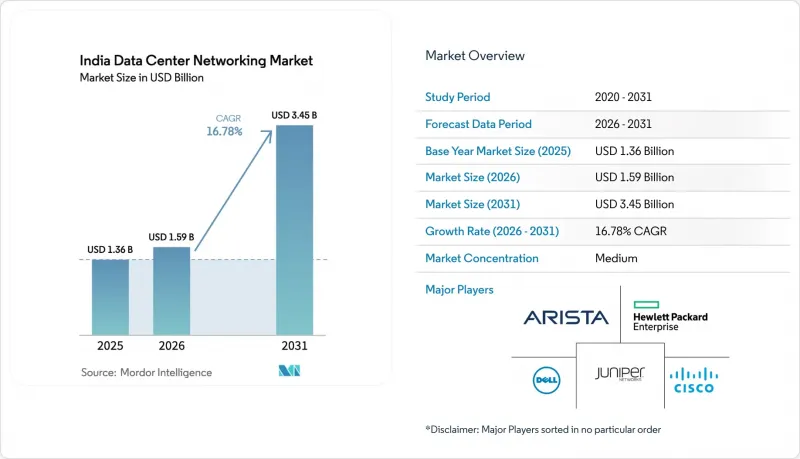
據 Mordor Intelligence 稱,2025 年印度資料中心網路市值為 13.6 億美元,預計到 2031 年將達到 34.5 億美元,而 2026 年為 15.9 億美元,預測期(2026-2031 年)的複合年成長率為 16.78%。
本報告按組件(按產品、按服務)、最終用戶(IT和電信、銀行、金融服務和保險、其他最終用戶)、資料中心類型(託管、超大規模資料中心業者/雲端服務供應商、其他)和頻寬(10GbE以下、25-40GbE、其他)對產業進行分類。市場預測以美元計價。
印度資料中心網路市場的趨勢與洞察
國內企業集團加速興建超大規模園區
印度企業集團正投資數十億美元部署覆蓋全國的超大規模網路,透過將容量分散到新興的二線和三線城市,緩解人口稠密的大都會圈的土地短缺壓力。 Adani ConneX 承諾部署 10 吉瓦的 IT 負載,ST Telemedia Global Data Centres累計新增 550 兆瓦,這些都證實了遠超傳統標準的供電管道的存在。這些資料中心園區需要超高密度的葉脊式網路架構、軟體定義疊加層以及能夠支援線速加密的園區到邊緣光纖骨幹網路。此外,區域電網的顯著電壓波動要求營運商提供透明的電力和冷卻遙測數據。因此,能夠整合交換、光纖通訊和基於意圖的自動化技術的供應商將在現階段的印度資料中心網路市場中獲得戰略優勢。
根據 2023 年《數位個人資料保護法》,資料必須在地化。
該法律強制要求在印度境內處理高度敏感的個人數據,迫使跨國雲端服務和軟體即服務 (SaaS) 供應商在印度境內複製整個工作負載。隨著企業從跨境連結轉向國內可用區,這項在地化法規進一步加速了印度整體資料中心市場的成長,導致印度境內東西向流量激增。由於以前透過海底光纜傳輸的工作負載現在都留在印度境內,延遲限制變得更加嚴格,這需要城市級互連和高吞吐量加密。在金融服務和醫療保健行業,監管機構強制要求在園區網路傳輸中進行加密,推動了對支援 MACsec 的交換器和零信任分段引擎的需求。
二級資料中心集群長期電力供不應求。
在二線城市,頻繁的電壓波動和持續數小時的電壓驟降迫使營運商過度安裝柴油發電機和能源儲存系統,導致每兆瓦的資本支出增加高達22%。高速光纖通訊和人工智慧最佳化交換機的引入,使得機架功率密度超過20千瓦,電池運作和變壓器容量的選擇至關重要。 「國家寬頻計畫」撥款1000億美元用於電網升級,但其實施時間表已被推遲到2030年以後,這持續給投資者帶來風險。因此,一些超大規模資料中心業者正在採用模組化微電網架構並連接到太陽能,但發電量的波動使網路容量規劃變得更加複雜。
細分市場分析
2025年,產品銷售額達9.8532億美元,佔總支出的72.45%。這主要得益於400GbE葉脊交換器的大規模訂單。印度資料中心網路市場的服務額達到3.7468億美元,預計到2031年將以20.7%的複合年成長率成長,這主要得益於企業將整合、測試和生命週期管理外包。部署和整合工作佔服務銷售額的一半以上,因為人工智慧架構需要精確的時間控制和無損佇列調優。對於缺乏內部三層和四層專業知識的中型雲端服務供應商而言,託管網路服務極具吸引力。思科和英偉達在端到端人工智慧架構方面的聯合創新,正是「硬體+服務」模式的典範,該模式能夠顯著縮短部署時間。
產品供應商正同步整合遙測代理以促進預測性維護,模糊硬體和軟體之間的界限。在PLI補貼下本地生產的可現場更換的光學模組縮短了備件物流週期,為電力受限的二級站點提供了關鍵優勢。在預測期內,與零信任分段和基於意圖的編配相關的專業服務預計將超越傳統的故障維修合約。
預計到2025年,IT與通訊產業將維持36.02%的市場佔有率,主要得益於5G回程傳輸升級和雲端可用區部署帶來的高容量交換器需求成長。同時,製造業預計將以19.6%的複合年成長率成長,主要得益於工業4.0資料湖、數位孿生技術以及電子組裝相關的生產獎勵。汽車和半導體製造廠目前正在其工廠內部署確定性乙太網路環網,從而推動了對低延遲匯聚交換器的新需求。銀行和金融服務業正在穩步推動升級,以滿足資料主權準則的要求,而醫療保健產業則正在加速部署遠端ICU和機器人手術工作流程,這些流程需要加密的400GbE上行鏈路。應用情境的多樣性降低了印度資料中心網路市場的集中度風險,並促使供應商提供行業特定的範本。
其他好處
- Excel格式的市場預測(ME)表
- 3個月的分析師支持
目錄
第1章:引言
- 研究假設和市場定義
- 調查範圍
第2章:調查方法
第3章執行摘要
第4章 市場狀況
- 市場概覽
- 市場促進因素
- 國內大型企業集團(阿達尼、信實、STT)加速興建超大規模園區
- 根據2023年《數位個人資料保護法》,資料必須在地化。
- 印度雲端存取點快速遷移至 400GbE 和 800GbE 的計劃
- 用於 5G 和 ONDC 商業流量的低延遲邊緣節點
- 國內製造與PLI相關的光學模組和交換設備
- 適用於 Gen-AI 模型訓練叢集的AI 最佳化織物
- 市場限制因素
- 二級資料中心集群長期電力供不應求。
- 大型資料中心園區獲得環境與林業部 (MoEF) 的長期週期批准。
- 主要大都會圈CCIE/JNCIE等級人才短缺
- 由於盧比貶值導致進口光學模組價格上漲,資本投資增加
- 產業價值鏈分析
- 監理情勢
- 技術展望
- 波特五力模型
- 評估宏觀經濟趨勢對市場的影響
第5章 市場規模與成長預測
- 按組件
- 產品
- 乙太網路切換器
- 路由器
- 儲存區域網路(SAN)
- 應用傳遞控制器(ADC)
- 網路安全設備
- 軟體定義網路 (SDN) 控制器
- 光連接模組
- 服務
- 安裝與整合
- 培訓和諮詢
- 支援與維護
- 主機服務
- 產品
- 最終用戶
- 資訊科技/通訊
- 銀行、金融服務和保險(BFSI)
- 政府/國防
- 媒體與娛樂
- 醫療保健和生命科學
- 製造業和工業
- 其他最終用戶
- 依資料中心類型
- 搭配
- 超大規模資料中心業者雲端服務供應商
- 邊緣微資料中心
- 頻寬
- 10GbE 或更低
- 25~40GbE
- 50~100GbE
- 超過 100GbE
第6章 競爭情勢
- 市場集中度
- 策略趨勢
- 市佔率分析
- 公司簡介
- Cisco Systems Inc.
- VMware Inc.
- NVIDIA Corporation
- Dell Technologies Inc.
- NEC Corporation
- International Business Machines Corporation
- HP Enterprise Company LP
- Schneider Electric SE
- Fujitsu Limited
- Keysight Technologies Inc.
- Arista Networks Inc.
- Juniper Networks Inc.
- Broadcom Inc.(incl. Brocade)
- Extreme Networks Inc.
- Huawei Technologies Co. Ltd.
- Lenovo Group Ltd.
- NetApp Inc.
- CommScope Holding Co. Inc.
- AdaniConneX Pvt. Ltd.
- Sify Technologies Ltd.
第7章 市場機會與未來展望
According to Mordor Intelligence, the India data center networking market size was valued at USD 1.36 billion in 2025 and is estimated to grow from USD 1.59 billion in 2026 to reach USD 3.45 billion by 2031, at a CAGR of 16.78% during the forecast period (2026-2031).
This report Segments the Industry Into Components (By Product, by Services), End-Users (IT and Telecommunication, BFSI, Other End-Users). Data-Center Type(Colocation, Hyperscalers/Cloud Service Providers, and More), and Bandwidth (<=10 GbE, 25-40 GbE, and More). The Market Forecasts are Provided in Terms of Value (USD).
India Data Center Networking Market Trends and Insights
Accelerated hyperscale campus build-outs by domestic conglomerates
Indian conglomerates have earmarked multibillion-dollar capital outlays to deploy nationwide hyperscale grids, alleviating land-scarcity pressures in crowded metros by distributing capacity across emerging tier-2 and tier-3 cities. Adani ConneX's pledge to install 10 GW of IT load and ST Telemedia Global Data Centres' plan to add 550 MW underline a supply pipeline that far exceeds historical norms. These campuses require ultra-dense leaf-spine fabrics, software-defined overlays, and campus-to-edge optical backbones capable of line-rate encryption. Operators also demand transparent telemetry for power and cooling because regional grids experience wider voltage swings. Vendors able to bundle switching, optics, and intent-based automation, therefore, gain a strategic edge in this phase of the India data center networking market.
Mandatory data-localization under Digital Personal Data Protection Act 2023
The Act enforces in-country processing for sensitive personal data, forcing multinational cloud and SaaS providers to replicate complete workloads inside India. The localisation rule drives a sharp uptick in intra-India east-west traffic as enterprises migrate from cross-border links to domestic availability zones, reinforcing growth momentum across the wider data center market in India. Latency ceilings tighten because workloads that formerly traversed submarine cables now stay within sovereign borders, requiring city-level interconnects and high-throughput encryption. In financial services and healthcare, regulators also mandate in-flight encryption across campus fabrics, spurring demand for MACsec-enabled switches and zero-trust segmentation engines.
Chronic power-supply deficits in tier-2 DC clusters
Frequent voltage fluctuations and multi-hour brownouts in second-tier cities compel operators to over-provision diesel generation and energy-storage systems, adding as much as 22% to capex per MW. High-speed optics and AI-optimized switches push rack power density above 20 kW, making battery runtime and transformer sizing critical. Although the National Broadband Mission earmarks USD 100 billion for grid upgrades, execution schedules stretch beyond the 2030 horizon, perpetuating risk for investors. Consequently, some hyperscalers adopt modular microgrid architectures with solar PV, but energy-yield variability complicates network capacity planning.
Other drivers and restraints analyzed in the detailed report include:
- Rapid 400 GbE / 800 GbE migration timelines in Indian cloud PoPs
- Low-latency edge nodes for 5G and ONDC commerce traffic
- Scarcity of CCIE/JNCIE-level talent outside top metros
For complete list of drivers and restraints, kindly check the Table Of Contents.
Segment Analysis
Products contributed USD 985.32 million in revenue during 2025, equal to 72.45% of total spend, underpinned by large orders for 400 GbE-capable leaf and spine switches. The India data center networking market size for Services reached USD 374.68 million and is projected to expand 20.7% CAGR through 2031 as enterprises outsource integration, testing, and lifecycle management. Installation and integration workstreams represent over half of Services revenue because AI-ready fabrics require precision timing and lossless queue tuning. Managed network services appeal to mid-market cloud providers that lack in-house Layer-3/Layer-4 expertise. Cisco's co-innovation with NVIDIA on end-to-end AI fabrics exemplifies a hardware-plus-services model that compresses deployment timelines.
Product vendors are simultaneously embedding telemetry agents to ease predictive maintenance, thereby blurring hardware-software boundaries. Field-replaceable optics produced locally under PLI subsidies shorten spares logistics, a decisive advantage in power-constrained tier-2 sites. Over the forecast period, professional services linked to zero-trust segmentation and intent-based orchestration will outpace traditional break-fix contracts.
IT & Telecommunications retained 36.02% share in 2025 as 5G backhaul upgrades and cloud availability-zone rollouts consumed high-capacity switches. Manufacturing, however, is set to log a 19.6% CAGR, propelled by Industry 4.0 data lakes, digital twins, and PLI incentives for electronics assembly. Automotive and semiconductor fabs now deploy deterministic Ethernet rings inside plants, driving fresh demand for low-latency aggregation switches. Banking and Financial Services continue steady upgrades to meet data-sovereignty guidelines, while Healthcare accelerates adoption of tele-ICU and robotic surgery workflows requiring encrypted 400 GbE uplinks. The diversity of use cases reduces concentration risk within the India data center networking market and spurs vendors to offer vertical-specific templates.
Complete Report Scope:
- By Component
- Products
- Ethernet Switches
- Routers
- Storage Area Network (SAN)
- Application Delivery Controllers (ADC)
- Network Security Appliances
- Software-Defined Networking (SDN) Controllers
- Optical Interconnects
- Services
- Installation and Integration
- Training and Consulting
- Support and Maintenance
- Managed Network Services
- Products
- By End-User
- IT and Telecommunications
- Banking, Financial Services and Insurance (BFSI)
- Government and Defense
- Media and Entertainment
- Healthcare and Life Sciences
- Manufacturing and Industrial
- Other End-Users
- By Data-Center Type
- Colocation
- Hyperscalers/Cloud Service Providers
- Edge/Micro Data Centers
- By Bandwidth
- Less Than equals to 10 GbE
- 25-40 GbE
- 50-100 GbE
- Greater Than 100 GbE
List of Companies Covered in this Report:
- Cisco Systems Inc.
- VMware Inc.
- NVIDIA Corporation
- Dell Technologies Inc.
- NEC Corporation
- International Business Machines Corporation
- HP Enterprise Company LP
- Schneider Electric SE
- Fujitsu Limited
- Keysight Technologies Inc.
- Arista Networks Inc.
- Juniper Networks Inc.
- Broadcom Inc. (incl. Brocade)
- Extreme Networks Inc.
- Huawei Technologies Co. Ltd.
- Lenovo Group Ltd.
- NetApp Inc.
- CommScope Holding Co. Inc.
- AdaniConneX Pvt. Ltd.
- Sify Technologies Ltd.
Additional Benefits:
- The market estimate (ME) sheet in Excel format
- 3 months of analyst support
TABLE OF CONTENTS
1 INTRODUCTION
- 1.1 Study Assumptions and Market Definition
- 1.2 Scope of the Study
2 RESEARCH METHODOLOGY
3 EXECUTIVE SUMMARY
4 MARKET LANDSCAPE
- 4.1 Market Overview
- 4.2 Market Drivers
- 4.2.1 Accelerated hyperscale campus build-outs by domestic conglomerates (Adani, Reliance, STT)
- 4.2.2 Mandatory data-localisation under the Digital Personal Data Protection Act 2023
- 4.2.3 Rapid 400 GbE / 800 GbE migration timelines in Indian cloud PoPs
- 4.2.4 Low-latency edge nodes for 5G and ONDC commerce traffic
- 4.2.5 PLI-linked local manufacturing of optical and switching gear
- 4.2.6 AI-optimised fabrics for Gen-AI model training clusters
- 4.3 Market Restraints
- 4.3.1 Chronic power-supply deficits in tier-2 DC clusters
- 4.3.2 Long-cycle MoEF clearances for large DC campuses
- 4.3.3 Scarcity of CCIE / JNCIE-level talent outside top metros
- 4.3.4 Heightened capex due to rupee depreciation on imported optics
- 4.4 Industry Value Chain Analysis
- 4.5 Regulatory Landscape
- 4.6 Technological Outlook
- 4.7 Porter's Five Forces
- 4.7.1 Threat of New Entrants
- 4.7.2 Bargaining Power of Buyers
- 4.7.3 Bargaining Power of Suppliers
- 4.7.4 Threat of Substitutes
- 4.7.5 Intensity of Competitive Rivalry
- 4.8 Assessment of the Impact on Macro Economic Trends on the Market
5 MARKET SIZE AND GROWTH FORECASTS (VALUE)
- 5.1 By Component
- 5.1.1 Products
- 5.1.1.1 Ethernet Switches
- 5.1.1.2 Routers
- 5.1.1.3 Storage Area Network (SAN)
- 5.1.1.4 Application Delivery Controllers (ADC)
- 5.1.1.5 Network Security Appliances
- 5.1.1.6 Software-Defined Networking (SDN) Controllers
- 5.1.1.7 Optical Interconnects
- 5.1.2 Services
- 5.1.2.1 Installation and Integration
- 5.1.2.2 Training and Consulting
- 5.1.2.3 Support and Maintenance
- 5.1.2.4 Managed Network Services
- 5.1.1 Products
- 5.2 By End-User
- 5.2.1 IT and Telecommunications
- 5.2.2 Banking, Financial Services and Insurance (BFSI)
- 5.2.3 Government and Defense
- 5.2.4 Media and Entertainment
- 5.2.5 Healthcare and Life Sciences
- 5.2.6 Manufacturing and Industrial
- 5.2.7 Other End-Users
- 5.3 By Data-Center Type
- 5.3.1 Colocation
- 5.3.2 Hyperscalers/Cloud Service Providers
- 5.3.3 Edge/Micro Data Centers
- 5.4 By Bandwidth
- 5.4.1 Less Than equals to 10 GbE
- 5.4.2 25-40 GbE
- 5.4.3 50-100 GbE
- 5.4.4 Greater Than 100 GbE
6 COMPETITIVE LANDSCAPE
- 6.1 Market Concentration
- 6.2 Strategic Moves
- 6.3 Market Share Analysis
- 6.4 Company Profiles (includes Global level Overview, Market level overview, Core Segments, Financials as available, Strategic Information, Market Rank/Share for key companies, Products and Services, and Recent Developments)
- 6.4.1 Cisco Systems Inc.
- 6.4.2 VMware Inc.
- 6.4.3 NVIDIA Corporation
- 6.4.4 Dell Technologies Inc.
- 6.4.5 NEC Corporation
- 6.4.6 International Business Machines Corporation
- 6.4.7 HP Enterprise Company LP
- 6.4.8 Schneider Electric SE
- 6.4.9 Fujitsu Limited
- 6.4.10 Keysight Technologies Inc.
- 6.4.11 Arista Networks Inc.
- 6.4.12 Juniper Networks Inc.
- 6.4.13 Broadcom Inc. (incl. Brocade)
- 6.4.14 Extreme Networks Inc.
- 6.4.15 Huawei Technologies Co. Ltd.
- 6.4.16 Lenovo Group Ltd.
- 6.4.17 NetApp Inc.
- 6.4.18 CommScope Holding Co. Inc.
- 6.4.19 AdaniConneX Pvt. Ltd.
- 6.4.20 Sify Technologies Ltd.
7 MARKET OPPORTUNITIES AND FUTURE OUTLOOK
- 7.1 White-space and Unmet-Need Assessment

 全球資料中心網路市場規模、佔有率、趨勢和成長分析報告(2026-2034)
 北美資料中心網路:市場佔有率分析、產業趨勢與統計及成長預測(2026-2031 年)南美洲資料中心網路:市場佔有率分析、產業趨勢與統計及成長預測(2026-2031 年)德國資料中心網路:市場佔有率分析、產業趨勢與統計及成長預測(2026-2031 年)歐洲資料中心網路:市場佔有率分析、產業趨勢與統計及成長預測(2026-2031 年)泰國資料中心網路:市場佔有率分析、產業趨勢與統計及成長預測(2026-2031)美國資料中心網路:市場佔有率分析、產業趨勢與統計及成長預測(2026-2031 年)義大利資料中心網路:市場佔有率分析、產業趨勢與統計及成長預測(2026-2031 年)英國資料中心網路:市場佔有率分析、產業趨勢與統計及成長預測(2026-2031 年)資料中心網路:市場佔有率分析、產業趨勢與統計、成長預測(2026-2031)