


 |
市場調查報告書
商品編碼
2119791
德國資料中心網路:市場佔有率分析、產業趨勢與統計及成長預測(2026-2031 年)Germany Data Center Networking - Market Share Analysis, Industry Trends & Statistics, Growth Forecasts (2026 - 2031) |
||||||

※ 本網頁內容可能與最新版本有所差異。詳細情況請與我們聯繫。
根據Mordor Intelligence預測,德國資料中心網路市場規模預計在2026年達到11.1億美元,高於2025年的10.5億美元。預計到2031年將達到14.3億美元,2026年至2031年的複合年成長率為5.32%。
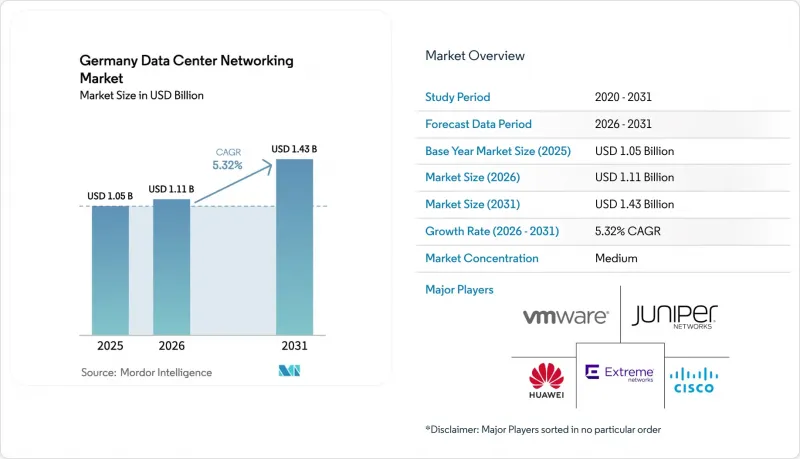
本報告按組件(產品和服務)、最終用戶(IT和電信、銀行、金融服務和保險 (BFSI)、政府和國防、其他)、資料中心類型(託管、超大規模資料中心業者和雲端服務供應商、邊緣和微型資料中心)以及頻寬(10GbE 以下、25-40GbE、其他)進行細分。市場預測以美元計價。
德國資料中心網路市場的趨勢與洞察
超大規模雲端和託管網站的擴展
超大規模資料中心業者正在透過指定支援 800G 的光纖網路和用於人工智慧訓練的 InfiniBand叢集來改變採購流程。光是 AWS 就在法蘭克福地區投資了 94.4 億美元,迫使交換器供應商提供高密度水冷平台。像 Digital Realty 這樣的託管服務供應商正在透過建造人工智慧專用機房來應對這項挑戰,吸引那些需要具備多租戶隔離功能的高級互連的企業租戶。這些平行投資正在將設備生命週期縮短至四年以內,並在二線都會區創造協同效應。
政府的Gigabit戰略正在加速光纖和 5G 的部署。
柏林的「Gigabit戰略」計畫投資170億歐元(約199.3億美元)用於建設全國光纖和5G基礎設施,並強制要求資料中心所有者採用高容量互連技術以支援區域回程傳輸流量。符合BSI C5安全法規是津貼的必要條件,這推動了對在歐洲設有生產線的供應商的需求。此外,光纖密度的提高將支援基於軟體定義疊加網路的分散式邊緣節點,使新的區域設施能夠連接到法蘭克福網際網路交換中心。
FLAP-D中的電網限制和高昂的電力成本
法蘭克福的電力上限迫使營運商將人工智慧負載分散到多個小規模的機房,導致連接埠數量和佈線距離增加。能源效率法案規定到2030年PUE上限為1.3,迫使買家採用更昂貴、低功耗的ASIC晶片和水光學模組,延長投資回報期。此外,可再生能源的採購也面臨空間限制,因為太陽能和風能設備佔據了原本可用於增設機架的土地。
細分市場分析
至2025年,產品將佔德國資料中心網路市場75.30%的佔有率。交換器升級正向400G和800G平台遷移,隨著液冷通道設計的普及,光連接模組的採用率也不斷提高。隨著營運商集中管理城域邊緣網路,SDN控制器授權的數量也在增加。服務領域預計將以5.61%的複合年成長率成長,這得益於與AI叢集最佳化和IPv6遷移相關的持續收入成長。託管網路服務正在彌合技能差距,而整合專家則將私人5G小區連接到核心資料中心網路。隨著企業重組團隊以因應以GPU為中心的流量模式,培訓計畫也正在實施中。這些因素將導致2025年後服務支出增加,儘管預計到2030年,硬體支出仍將主導德國資料中心網路市場。
到2025年,IT與通訊產業將繼續佔據德國資料中心網路市場佔有率的35.20%,這主要得益於電信業者升級其核心路由器以支援5G,以及雲端服務供應商擴展其人工智慧區域。遵守DORA(資料保護規範)正在提升金融資料中心交換器層級的網路分段和遙測能力。製造業和工業業預計將超越其他所有行業,實現6.05%的複合年成長率。特斯拉超級工廠等設施中的私有5G網路正在生產線旁創建微型資料中心,每個資料中心都需要低延遲的網路架構。工廠正在整合OT感測器網路和IT分析,這需要確定性流量工程和冗餘邊緣聚合層,推高了每平方公尺的支出。
其他好處
- Excel格式的市場預測(ME)表
- 3個月的分析師支持
目錄
第1章:引言
- 研究假設和市場定義
- 調查範圍
第2章:調查方法
第3章執行摘要
第4章 市場狀況
- 市場概覽
- 市場促進因素
- 擴大超大規模雲端和託管服務的部署。
- 政府的Gigabit戰略正在加速光纖和 5G 的部署。
- 人工智慧/機器學習流量的激增正在推動 400G/800G 交換器的升級。
- 擴大邊緣資料中心在物聯網和低延遲領域的應用。
- 強制回收廢熱導致了液冷設備的廣泛應用。
- 歐盟主權人工智慧津貼將用於資助 InfiniBand 集群。
- 市場限制因素
- FLAP-D中的電網限制和高昂的電力成本
- 認證網路自動化工程師短缺
- 資料主權(BSI C5)限制了海外採用白盒架構。
- 由於光纖原料短缺,工程建設延誤。
- 供應鏈分析
- 監理情勢
- 技術展望
- 波特五力分析
- 對影響市場的宏觀經濟因素進行評估
第5章 市場規模與成長預測
- 按組件
- 產品
- 乙太網路切換器
- 路由器
- 儲存區域網路(SAN)
- 應用傳遞控制器(ADC)
- 網路安全設備
- 軟體定義網路 (SDN) 控制器
- 光連接模組
- 服務
- 安裝與整合
- 培訓和諮詢
- 支援與維護
- 主機服務
- 產品
- 最終用戶
- 資訊科技/通訊
- 銀行、金融服務和保險(BFSI)
- 政府/國防
- 媒體與娛樂
- 醫療保健和生命科學
- 製造業和工業
- 其他
- 依資料中心類型
- 搭配
- 超大規模資料中心業者雲端服務供應商
- 邊緣微資料中心
- 頻寬
- 10GbE 或更低
- 25~40GbE
- 50~100GbE
- 超過 100GbE
第6章 競爭情勢
- 市場集中度
- 策略趨勢
- 市佔率分析
- 公司簡介
- Cisco Systems Inc.
- Juniper Networks Inc.
- VMware Inc.
- Huawei Technologies Co. Ltd.
- Extreme Networks Inc.
- NVIDIA Corp.(Cumulus Networks)
- Dell Technologies Inc.
- NEC Corporation
- IBM Corporation
- Intel Corporation
- Arista Networks Inc.
- Broadcom Inc.
- Hewlett Packard Enterprise(Aruba)
- Nokia Corporation
- ADVA Optical Networking SE
- FS.COM GmbH
- Giax GmbH
- Lenovo Group Ltd.
- NetApp Inc.
- Super Micro Computer Inc.
第7章 市場機會與未來展望
According to Mordor Intelligence, Germany data center networking market size in 2026 is estimated at USD 1.11 billion, growing from 2025 value of USD 1.05 billion with 2031 projections showing USD 1.43 billion, growing at 5.32% CAGR over 2026-2031.
This report is Segmented by Component (Product and Services), End User( IT and Telecommunications, Banking, Financial Services and Insurance (BFSI), Government and Defense and More), Data Center Type (Colocation, Hyperscalers/Cloud Service Providers, Edge/Micro Data Centers), by Bandwidth (<=10 GbE, 25-40 GbE and More). The Market Forecasts are Provided in Terms of Value (USD).
Germany Data Center Networking Market Trends and Insights
Expansion of hyperscale cloud and colocation footprints
Hyperscalers are reshaping procurement cycles by specifying 800G-ready fabrics and InfiniBand clusters for AI training. AWS alone committed USD 9.44 billion to its Frankfurt region, pushing switch vendors to deliver high-density, liquid-cooling-compatible platforms. Colocation operators such as Digital Realty respond with AI-focused halls, drawing enterprise tenants that then require premium interconnects capable of multi-tenant segmentation. These parallel investments compress equipment lifecycles to under four years and create multiplier effects in secondary metros.
Government Gigabit Strategy accelerating fiber and 5G rollout
Berlin's Gigabit Strategy funds EUR 17 billion (USD 19.93 billion) for nationwide fiber and 5G, obliging data-center owners to adopt higher-capacity interconnects that sustain rural back-haul traffic.Grants stipulate adherence to BSI C5 security rules, steering demand toward vendors with European manufacturing lines. Fiber densification also enables distributed edge nodes that rely on software-defined overlays to link new regional facilities with Frankfurt's internet exchanges.
Energy-grid constraints and high electricity costs in FLAP-D
Frankfurt's power caps force operators to distribute AI loads across multiple smaller halls, inflating port counts and cabling runs. The Energy Efficiency Act sets a PUE ceiling of 1.3 by 2030, pushing buyers toward higher-price, low-watt ASICs and liquid-cooled optics that lengthen ROI horizons. Renewable-power sourcing adds spatial constraints because solar or wind adjuncts consume land that could host additional racks.
Other drivers and restraints analyzed in the detailed report include:
- Surging AI/ML traffic driving 400G/800G switch refresh
- Rising edge-data-center deployments for IoT/low latency
- Shortage of certified network-automation engineers
For complete list of drivers and restraints, kindly check the Table Of Contents.
Segment Analysis
Products held 75.30% of Germany data center networking market share in 2025 of Germany data center networking market size. Switch refresh programs shift toward 400G and 800G platforms, and optical interconnect uptake scales with liquid-cooling aisle designs. SDN controller licenses rise as operators centralize management for metro-edge fabrics. Services are forecast to expand at a 5.61% CAGR, adding recurring revenue streams tied to AI-cluster optimisation and IPv6 migration. Managed Network Services absorb the skills gap, while integration specialists link private-5G cells to core data-center fabrics. Training programs see uptake as enterprises re-tool teams for GPU-centric traffic patterns. This mix elevates service spend from 2025 onward, yet hardware outlays remain dominant through 2030 in the Germany data center networking market.
IT and Telecommunications continued to command 35.20% of Germany data center networking market share in 2025, anchored by carriers upgrading core routers for 5G and cloud providers scaling AI regions. DORA compliance bolsters switch-level segmentation and telemetry in financial data centers.Manufacturing and Industrial is projected to register 6.05% CAGR, outpacing all peers. Private 5G at facilities like Tesla's Gigafactory creates micro-data-centers adjacent to production lines, each demanding low-latency fabrics. Factories integrate OT sensor grids with IT analytics, necessitating deterministic traffic engineering and redundant edge aggregation layers that lift spending per square meter.
Complete Report Scope:
- By Component
- Products
- Ethernet Switches
- Routers
- Storage Area Network (SAN)
- Application Delivery Controllers (ADC)
- Network Security Appliances
- Software-Defined Networking (SDN) Controllers
- Optical Interconnects
- Services
- Installation and Integration
- Training and Consulting
- Support and Maintenance
- Managed Network Services
- Products
- By End-User
- IT and Telecommunications
- Banking, Financial Services and Insurance (BFSI)
- Government and Defense
- Media and Entertainment
- Healthcare and Life Sciences
- Manufacturing and Industrial
- Other End-Users
- By Data-Center Type
- Colocation
- Hyperscalers/Cloud Service Providers
- Edge/Micro Data Centers
- By Bandwidth
- Less than 10 GbE
- 25-40 GbE
- 50-100 GbE
- Greater Than 100 GbE
List of Companies Covered in this Report:
- Cisco Systems Inc.
- Juniper Networks Inc.
- VMware Inc.
- Huawei Technologies Co. Ltd.
- Extreme Networks Inc.
- NVIDIA Corp. (Cumulus Networks)
- Dell Technologies Inc.
- NEC Corporation
- IBM Corporation
- Intel Corporation
- Arista Networks Inc.
- Broadcom Inc.
- Hewlett Packard Enterprise (Aruba)
- Nokia Corporation
- ADVA Optical Networking SE
- FS.COM GmbH
- Giax GmbH
- Lenovo Group Ltd.
- NetApp Inc.
- Super Micro Computer Inc.
Additional Benefits:
- The market estimate (ME) sheet in Excel format
- 3 months of analyst support
TABLE OF CONTENTS
1 INTRODUCTION
- 1.1 Study Assumptions and Market Definition
- 1.2 Scope of the Study
2 RESEARCH METHODOLOGY
3 EXECUTIVE SUMMARY
4 MARKET LANDSCAPE
- 4.1 Market Overview
- 4.2 Market Drivers
- 4.2.1 Expansion of hyperscale cloud and colocation footprints
- 4.2.2 Government Gigabit Strategy accelerating fiber and 5G rollout
- 4.2.3 Surging AI/ML traffic driving 400G/800G switch refresh
- 4.2.4 Rising edge-data-center deployments for IoT/low latency
- 4.2.5 Mandatory waste-heat-reuse rules boosting liquid-cooled gear
- 4.2.6 EU sovereign-AI grants funding InfiniBand clusters
- 4.3 Market Restraints
- 4.3.1 Energy-grid constraints and high electricity costs in FLAP-D
- 4.3.2 Shortage of certified network-automation engineers
- 4.3.3 Data-sovereignty (BSI C5) limits foreign white-box adoption
- 4.3.4 Optical-fiber raw-material shortages delaying builds
- 4.4 Supply-Chain Analysis
- 4.5 Regulatory Landscape
- 4.6 Technological Outlook
- 4.7 Porter's Five Forces Analysis
- 4.7.1 Threat of New Entrants
- 4.7.2 Bargaining Power of Buyers
- 4.7.3 Bargaining Power of Suppliers
- 4.7.4 Threat of Substitutes
- 4.7.5 Intensity of Competitive Rivalry
- 4.8 Assessment of Macroeconomic Factors on the Market
5 MARKET SIZE and GROWTH FORECASTS (VALUE)
- 5.1 By Component
- 5.1.1 Products
- 5.1.1.1 Ethernet Switches
- 5.1.1.2 Routers
- 5.1.1.3 Storage Area Network (SAN)
- 5.1.1.4 Application Delivery Controllers (ADC)
- 5.1.1.5 Network Security Appliances
- 5.1.1.6 Software-Defined Networking (SDN) Controllers
- 5.1.1.7 Optical Interconnects
- 5.1.2 Services
- 5.1.2.1 Installation and Integration
- 5.1.2.2 Training and Consulting
- 5.1.2.3 Support and Maintenance
- 5.1.2.4 Managed Network Services
- 5.1.1 Products
- 5.2 By End-User
- 5.2.1 IT and Telecommunications
- 5.2.2 Banking, Financial Services and Insurance (BFSI)
- 5.2.3 Government and Defense
- 5.2.4 Media and Entertainment
- 5.2.5 Healthcare and Life Sciences
- 5.2.6 Manufacturing and Industrial
- 5.2.7 Other End-Users
- 5.3 By Data-Center Type
- 5.3.1 Colocation
- 5.3.2 Hyperscalers/Cloud Service Providers
- 5.3.3 Edge/Micro Data Centers
- 5.4 By Bandwidth
- 5.4.1 Less than 10 GbE
- 5.4.2 25-40 GbE
- 5.4.3 50-100 GbE
- 5.4.4 Greater Than 100 GbE
6 COMPETITIVE LANDSCAPE
- 6.1 Market Concentration
- 6.2 Strategic Moves
- 6.3 Market Share Analysis
- 6.4 Company Profiles (includes Global Overview, Market-level Overview, Core Segments, Financials, Strategic Information, Market Rank/Share, Products and Services, Recent Developments)
- 6.4.1 Cisco Systems Inc.
- 6.4.2 Juniper Networks Inc.
- 6.4.3 VMware Inc.
- 6.4.4 Huawei Technologies Co. Ltd.
- 6.4.5 Extreme Networks Inc.
- 6.4.6 NVIDIA Corp. (Cumulus Networks)
- 6.4.7 Dell Technologies Inc.
- 6.4.8 NEC Corporation
- 6.4.9 IBM Corporation
- 6.4.10 Intel Corporation
- 6.4.11 Arista Networks Inc.
- 6.4.12 Broadcom Inc.
- 6.4.13 Hewlett Packard Enterprise (Aruba)
- 6.4.14 Nokia Corporation
- 6.4.15 ADVA Optical Networking SE
- 6.4.16 FS.COM GmbH
- 6.4.17 Giax GmbH
- 6.4.18 Lenovo Group Ltd.
- 6.4.19 NetApp Inc.
- 6.4.20 Super Micro Computer Inc.
7 MARKET OPPORTUNITIES and FUTURE OUTLOOK
- 7.1 White-space and Unmet-Need Assessment

 全球資料中心網路市場規模、佔有率、趨勢和成長分析報告(2026-2034)
 北美資料中心網路:市場佔有率分析、產業趨勢與統計及成長預測(2026-2031 年)南美洲資料中心網路:市場佔有率分析、產業趨勢與統計及成長預測(2026-2031 年)印度資料中心網路:市場佔有率分析、產業趨勢與統計及成長預測(2026-2031 年)歐洲資料中心網路:市場佔有率分析、產業趨勢與統計及成長預測(2026-2031 年)泰國資料中心網路:市場佔有率分析、產業趨勢與統計及成長預測(2026-2031)美國資料中心網路:市場佔有率分析、產業趨勢與統計及成長預測(2026-2031 年)義大利資料中心網路:市場佔有率分析、產業趨勢與統計及成長預測(2026-2031 年)英國資料中心網路:市場佔有率分析、產業趨勢與統計及成長預測(2026-2031 年)資料中心網路:市場佔有率分析、產業趨勢與統計、成長預測(2026-2031)