


 |
市場調查報告書
商品編碼
2119783
南美洲資料中心網路:市場佔有率分析、產業趨勢與統計及成長預測(2026-2031 年)South America Data Center Networking - Market Share Analysis, Industry Trends & Statistics, Growth Forecasts (2026 - 2031) |
||||||

※ 本網頁內容可能與最新版本有所差異。詳細情況請與我們聯繫。
根據 Mordor Intelligence 預測,南美洲資料中心網路市場規模將從 2025 年的 8.8 億美元成長到 2026 年的 9.8 億美元,然後在 2031 年達到 16.8 億美元,2026 年至 2031 年的複合年成長率為 11.38%。
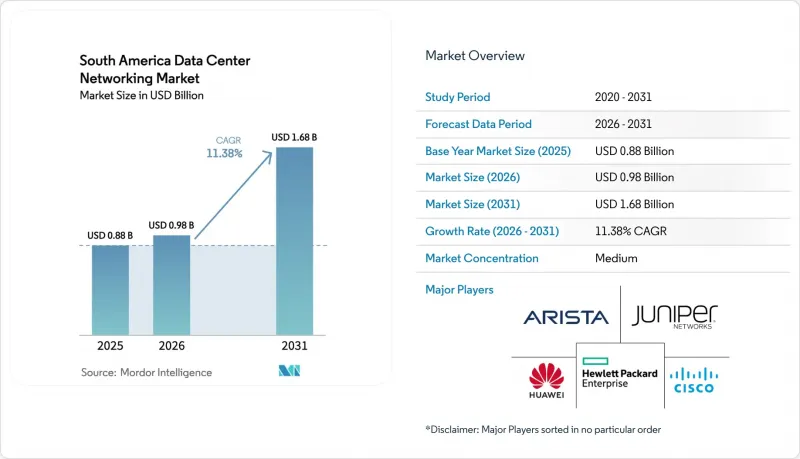
本報告按組件(產品和服務)、最終用戶(IT和電信、銀行、金融服務和保險 (BFSI)、政府和國防、其他)、資料中心類型(託管、超大規模資料中心業者和雲端服務供應商、邊緣和微型資料中心)、頻寬(10GbE 以下、25-40GbE、其他)以及國家/地區進行細分。市場預測以美元 (USD) 計價。
南美洲資料中心網路市場趨勢與洞察
對雲端儲存和可靠應用效能的需求日益成長。
企業正將關鍵業務工作負載遷移到雲端平台,這提高了本地設施的吞吐量和延遲要求。義大利伊塔烏銀行計劃在2028年前將所有核心系統遷移到雲端,這正反映了這種需求的激增,促使電信業者部署新的400G和800G線路。 Cirion Technologies已在聖保羅和聖地牙哥之間展示了1.6Tb/s的單載波波長傳輸,證明光纖骨幹網路能夠充分應對人工智慧時代的流量。在需要即時同步本機和雲端儲存庫的混合部署中,儲存效能同樣至關重要。
企業網路攻擊事件增多
目前,拉丁美洲企業每周遭受2,569次網路攻擊,比全球平均高出40%。為了應對這項挑戰,資訊安全(CISO)們正在加速部署新一代防火牆、安全SD-WAN和人工智慧驅動的威脅分析工具。哥倫比亞保險公司Mutual Ser EPS已在其50多個營運多重雲端應用的分店部署了Fortinet的FortiGate設備,以增強安全性。預算分配也在快速變化,該地區一半的企業每年在網路安全措施方面投入1,000萬美元至4,900萬美元。
網路複雜性
混合雲端疊加、東西向微隔離和邊緣突發流量正在暴露技能差距。部署基於意圖的控制器的企業正面臨著多廠商API激增的困境,這給原本就人手不足的網路營運中心(NOC)團隊帶來了沉重負擔。缺乏訓練有素的員工導致400G部署計畫延期,對諮詢服務的依賴性增強,並限制了自動化程度的提升。
細分市場分析
到2025年,產品收入將佔總收入的75.63%,這反映出交換器、路由器、光收發器和安全設備等產品的大量支出,這些產品構成了所有資料中心網路市場部署的基礎。乙太網路葉脊式網路升級週期正從25G/100G轉向400G級別,而模組化路由器透過整合SR-MPLS簡化了底層自動化。供應商正在調整藍圖,使其與商用晶片的創新保持一致,以滿足在融合乙太網路上運行RDMA的AI叢集的延遲要求。服務業務正以11.49%的複合年成長率成長,這主要得益於託管SDN控制器、生命週期自動化以及針對缺乏內部技能的企業的細粒度零信任疊加網路。 OEM諮詢部門透過提供包含DevNet式培訓的「網路即代碼」藍圖,縮短了部署前置作業時間。區域性 MSP 透過提供符合 ISO 27001 標準的多重雲端連線切換和託管發現與回應服務,開發利基市場,確保在異質環境中的合規性。
2025年,隨著電信業者在雲端虛擬化核心網路切片,以及OTT影片平台在近邊緣節點上進行快取,IT和電信業維持了36.89%的營收佔有率。銀行業維護多區域、雙活資料存儲,以支援即時結算指令,並增加了對加密100G MAC-sec連接埠的需求。然而,製造業和工業領域的複合年成長率最高,達11.88%。這主要歸因於工業4.0維修中對確定性乙太網路、時間敏感型網路以及連接PLC和霧伺服器的專用5G閘道器的需求。一個礦業聯盟展示了一種強大的光環,該光環能夠承受高振動的地下環境,並透過思科URWB鏈路遠端傳輸數據,往返時間(RTT)小於10毫秒。一家汽車工廠正在主導先導計畫,以確保CAN總線數位孿生體中與供應商無關的遙測數據,並將數據傳輸到雲端的AI品管引擎。
其他好處
- Excel格式的市場預測(ME)表
- 3個月的分析師支持
目錄
第1章:引言
- 研究假設和市場定義
- 調查範圍
第2章:調查方法
第3章執行摘要
第4章 市場狀況
- 市場概覽
- 市場促進因素
- 對雲端儲存和可靠應用效能的需求日益成長。
- 企業網路攻擊事件增多
- 世界各地的雲端服務供應商正在快速建置超大規模資料中心。
- 海底電纜登陸點的快速增加使得創建低延遲沿海樞紐成為可能。
- 巴西的可再生能源激勵措施用於升級綠色電網
- 透過引入開放式網路(白盒+SONiC),資本支出(CAPEX)將會減少。
- 市場限制因素
- 網路複雜性
- 高額進口關稅及對先進設備的投資
- 缺乏精通自動化技術的網路工程師
- 南美國家資料主權法規的差異
- 供應鏈分析
- 監理情勢
- 技術展望
- 波特五力分析
- 宏觀經濟因素評估
第5章 市場規模與成長預測
- 按組件
- 產品
- 乙太網路切換器
- 路由器
- 儲存區域網路(SAN)
- 應用傳遞控制器(ADC)
- 網路安全設備
- 軟體定義網路 (SDN) 控制器
- 光連接模組
- 服務
- 安裝與整合
- 培訓和諮詢
- 支援與維護
- 主機服務
- 產品
- 最終用戶
- 資訊科技/通訊
- 銀行、金融服務和保險(BFSI)
- 政府/國防
- 媒體與娛樂
- 醫療保健和生命科學
- 製造業和工業
- 其他
- 依資料中心類型
- 搭配
- 超大規模資料中心業者雲端服務供應商
- 邊緣微資料中心
- 頻寬
- 10GbE 或更低
- 25~40GbE
- 50~100GbE
- 超過 100GbE
- 國家
- 巴西
- 墨西哥
- 阿根廷
- 南美洲其他地區
第6章 競爭情勢
- 市場集中度
- 策略趨勢
- 市佔率分析
- 公司簡介
- Cisco Systems Inc.
- Huawei Technologies Co. Ltd.
- Juniper Networks Inc.
- Hewlett Packard Enterprise Development LP
- Arista Networks Inc.
- Dell Technologies Inc.(Dell EMC)
- Extreme Networks Inc.
- Fortinet Inc.
- VMware Inc.
- NEC Corporation
- TP-Link Corporation Ltd.
- A10 Networks Inc.
- Radware Ltd.
- Moxa Inc.
- EdgeCore Networks Corp.
- Nokia Corp.
- FiberHome Telecommunication Technologies Co. Ltd.
- Check Point Software Technologies Ltd.
- Palo Alto Networks Inc.
- Ciena Corp.
- Mellanox Technologies Ltd.(NVIDIA)
- Super Micro Computer Inc.
- Ubiquiti Inc.
- NetScout Systems Inc.
- F5 Inc.
第7章 市場機會與未來展望
According to Mordor Intelligence, the South America data center networking market size is expected to grow from USD 0.88 billion in 2025 to USD 0.98 billion in 2026 and is forecast to reach USD 1.68 billion by 2031 at 11.38% CAGR over 2026-2031.
This report is Segmented by Component (Product and Services), End User( IT and Telecommunications, Banking, Financial Services and Insurance (BFSI), Government and Defense and More), Data Center Type (Colocation, Hyperscalers/Cloud Service Providers, Edge/Micro Data Centers), by Bandwidth (<=10 GbE, 25-40 GbE and More) and by Country. The Market Forecasts are Provided in Terms of Value (USD).
South America Data Center Networking Market Trends and Insights
Increasing need for cloud storage and reliable application performance
Enterprises are shifting mission-critical workloads to cloud platforms, which raises throughput and latency requirements inside regional facilities. Banco Itau's program to move all core systems to the cloud by 2028 typifies the demand spike, prompting carriers to light new 400G and 800G links. Cirion Technologies has already demonstrated a 1.6 Tb/s single-carrier wavelength between Sao Paulo and Santiago, proving that optical backbones can stay ahead of AI-era traffic. Storage performance is equally vital for hybrid deployments that synchronize on-premises and cloud repositories in real time.
Rising cyber-attacks among enterprises
Latin-American companies now record 2,569 attacks per week-40% above the global average-pushing CISOs to buy next-generation firewalls, secure SD-WAN, and AI-augmented threat analytics. Mutual Ser EPS, a Colombian insurer, adopted Fortinet's FortiGate appliances to harden more than 50 branch locations that run multi-cloud applications. Budgets are shifting fast; half of regional firms allocate between USD 10 million and USD 49 million annually to cybersecurity controls
Increasing network complexity
Hybrid-cloud overlays, east-west microsegmentation, and edge bursts expose skill gaps. Enterprises deploying intent-based controllers face multi-vendor API sprawl that strains thin NOC teams. Lack of trained staff delays 400G adoption schedules, inflates consulting reliance, and limits achievable automation depth.
Other drivers and restraints analyzed in the detailed report include:
- Proliferation of hyperscale data-center builds by global cloud providers
- Surge in submarine-cable landings enabling low-latency coastal hubs
- High import tariffs & CAPEX for advanced equipment
For complete list of drivers and restraints, kindly check the Table Of Contents.
Segment Analysis
Products anchored 75.63% of 2025 revenue, reflecting heavy outlays on switches, routers, optical transponders, and security appliances that form the bedrock of every data center networking market deployment. Ethernet leaf-spine upgrade cycles shift from 25G/100G toward 400G class, while modular routers integrate SR-MPLS for simplified underlay automation. Vendors synchronize switch ASIC roadmaps with merchant-silicon breakthroughs to meet latency budgets of AI clusters running RDMA over Converged Ethernet.Services expand at an 11.49% CAGR, fueled by managed SDN controllers, lifecycle automation, and white-glove zero-trust overlays for enterprises lacking in-house skill sets. Consulting arms of OEMs bundle network-as-code blueprints plus DevNet-style training that compress deployment lead times. Regional MSPs carve niches by delivering multicloud connectivity hand-offs and ISO 27001-aligned managed detection and response, ensuring compliance across heterogeneous domiciles.
IT & Telecommunications kept a 36.89% revenue lead in 2025 as telco clouds virtualized core network slices and OTT video platforms cached near-edge nodes. Banking retained multi-region active-active data stores to satisfy instant-payment directives, lifting demand for encrypted 100G MAC-sec ports. Yet Manufacturing & Industrial registers the fastest 11.88% CAGR as Industry 4.0 retrofits call for deterministic Ethernet, Time-Sensitive Networking, and private 5G gateways linking PLCs to fog servers. Mining consortia run tele-remote haulage over Cisco URWB links under 10 ms RTT, demonstrating ruggedized optical rings that survive high-vibration pits. Automotive plants spearhead open networking pilots that enforce vendor-agnostic telemetry on CAN-bus digital twins feeding cloud AI quality-control engines.
Complete Report Scope:
- By Component
- Products
- Ethernet Switches
- Routers
- Storage Area Network (SAN)
- Application Delivery Controllers (ADC)
- Network Security Appliances
- Software-Defined Networking (SDN) Controllers
- Optical Interconnects
- Services
- Installation and Integration
- Training and Consulting
- Support and Maintenance
- Managed Network Services
- Products
- By End-User
- IT and Telecommunications
- Banking, Financial Services and Insurance (BFSI)
- Government and Defense
- Media and Entertainment
- Healthcare and Life Sciences
- Manufacturing and Industrial
- Other End-Users
- By Data-Center Type
- Colocation
- Hyperscalers/Cloud Service Providers
- Edge/Micro Data Centers
- By Bandwidth
- Less than or Equal to 10 GbE
- 25-40 GbE
- 50-100 GbE
- Greater than 100 GbE
- By Country
- Brazil
- Mexico
- Argentina
- Rest of South America
List of Companies Covered in this Report:
- Cisco Systems Inc.
- Huawei Technologies Co. Ltd.
- Juniper Networks Inc.
- Hewlett Packard Enterprise Development LP
- Arista Networks Inc.
- Dell Technologies Inc. (Dell EMC)
- Extreme Networks Inc.
- Fortinet Inc.
- VMware Inc.
- NEC Corporation
- TP-Link Corporation Ltd.
- A10 Networks Inc.
- Radware Ltd.
- Moxa Inc.
- EdgeCore Networks Corp.
- Nokia Corp.
- FiberHome Telecommunication Technologies Co. Ltd.
- Check Point Software Technologies Ltd.
- Palo Alto Networks Inc.
- Ciena Corp.
- Mellanox Technologies Ltd. (NVIDIA)
- Super Micro Computer Inc.
- Ubiquiti Inc.
- NetScout Systems Inc.
- F5 Inc.
Additional Benefits:
- The market estimate (ME) sheet in Excel format
- 3 months of analyst support
TABLE OF CONTENTS
1 INTRODUCTION
- 1.1 Study Assumptions and Market Definition
- 1.2 Scope of the Study
2 RESEARCH METHODOLOGY
3 EXECUTIVE SUMMARY
4 MARKET LANDSCAPE
- 4.1 Market Overview
- 4.2 Market Drivers
- 4.2.1 Increasing need for cloud storage and reliable application performance
- 4.2.2 Rising cyber-attacks among enterprises
- 4.2.3 Proliferation of hyperscale data-center builds by global cloud providers
- 4.2.4 Surge in submarine-cable landings enabling low-latency coastal hubs
- 4.2.5 Brazil's renewable-energy incentives for green networking upgrades
- 4.2.6 Adoption of open networking (white-box + SONiC) cutting CAPEX
- 4.3 Market Restraints
- 4.3.1 Increasing network complexity
- 4.3.2 High import tariffs and CAPEX for advanced equipment
- 4.3.3 Shortage of automation-skilled network engineers
- 4.3.4 Fragmented data-sovereignty regulations across South America
- 4.4 Supply-Chain Analysis
- 4.5 Regulatory Landscape
- 4.6 Technological Outlook
- 4.7 Porter's Five Forces Analysis
- 4.7.1 Threat of New Entrants
- 4.7.2 Bargaining Power of Buyers
- 4.7.3 Bargaining Power of Suppliers
- 4.7.4 Threat of Substitutes
- 4.7.5 Intensity of Competitive Rivalry
- 4.8 Assessment of Macroeconomic Factors
5 MARKET SIZE and GROWTH FORECASTS
- 5.1 By Component
- 5.1.1 Products
- 5.1.1.1 Ethernet Switches
- 5.1.1.2 Routers
- 5.1.1.3 Storage Area Network (SAN)
- 5.1.1.4 Application Delivery Controllers (ADC)
- 5.1.1.5 Network Security Appliances
- 5.1.1.6 Software-Defined Networking (SDN) Controllers
- 5.1.1.7 Optical Interconnects
- 5.1.2 Services
- 5.1.2.1 Installation and Integration
- 5.1.2.2 Training and Consulting
- 5.1.2.3 Support and Maintenance
- 5.1.2.4 Managed Network Services
- 5.1.1 Products
- 5.2 By End-User
- 5.2.1 IT and Telecommunications
- 5.2.2 Banking, Financial Services and Insurance (BFSI)
- 5.2.3 Government and Defense
- 5.2.4 Media and Entertainment
- 5.2.5 Healthcare and Life Sciences
- 5.2.6 Manufacturing and Industrial
- 5.2.7 Other End-Users
- 5.3 By Data-Center Type
- 5.3.1 Colocation
- 5.3.2 Hyperscalers/Cloud Service Providers
- 5.3.3 Edge/Micro Data Centers
- 5.4 By Bandwidth
- 5.4.1 Less than or Equal to 10 GbE
- 5.4.2 25-40 GbE
- 5.4.3 50-100 GbE
- 5.4.4 Greater than 100 GbE
- 5.5 By Country
- 5.5.1 Brazil
- 5.5.2 Mexico
- 5.5.3 Argentina
- 5.5.4 Rest of South America
6 COMPETITIVE LANDSCAPE
- 6.1 Market Concentration
- 6.2 Strategic Moves
- 6.3 Market Share Analysis
- 6.4 Company Profiles (includes Global level Overview, Market level overview, Core Segments, Financials as available, Strategic Information, Market Rank/Share for key companies, Products and Services, and Recent Developments)
- 6.4.1 Cisco Systems Inc.
- 6.4.2 Huawei Technologies Co. Ltd.
- 6.4.3 Juniper Networks Inc.
- 6.4.4 Hewlett Packard Enterprise Development LP
- 6.4.5 Arista Networks Inc.
- 6.4.6 Dell Technologies Inc. (Dell EMC)
- 6.4.7 Extreme Networks Inc.
- 6.4.8 Fortinet Inc.
- 6.4.9 VMware Inc.
- 6.4.10 NEC Corporation
- 6.4.11 TP-Link Corporation Ltd.
- 6.4.12 A10 Networks Inc.
- 6.4.13 Radware Ltd.
- 6.4.14 Moxa Inc.
- 6.4.15 EdgeCore Networks Corp.
- 6.4.16 Nokia Corp.
- 6.4.17 FiberHome Telecommunication Technologies Co. Ltd.
- 6.4.18 Check Point Software Technologies Ltd.
- 6.4.19 Palo Alto Networks Inc.
- 6.4.20 Ciena Corp.
- 6.4.21 Mellanox Technologies Ltd. (NVIDIA)
- 6.4.22 Super Micro Computer Inc.
- 6.4.23 Ubiquiti Inc.
- 6.4.24 NetScout Systems Inc.
- 6.4.25 F5 Inc.
7 MARKET OPPORTUNITIES and FUTURE OUTLOOK
- 7.1 White-Space and Unmet-Need Assessment

 全球資料中心網路市場規模、佔有率、趨勢和成長分析報告(2026-2034)
 北美資料中心網路:市場佔有率分析、產業趨勢與統計及成長預測(2026-2031 年)印度資料中心網路:市場佔有率分析、產業趨勢與統計及成長預測(2026-2031 年)德國資料中心網路:市場佔有率分析、產業趨勢與統計及成長預測(2026-2031 年)歐洲資料中心網路:市場佔有率分析、產業趨勢與統計及成長預測(2026-2031 年)泰國資料中心網路:市場佔有率分析、產業趨勢與統計及成長預測(2026-2031)美國資料中心網路:市場佔有率分析、產業趨勢與統計及成長預測(2026-2031 年)義大利資料中心網路:市場佔有率分析、產業趨勢與統計及成長預測(2026-2031 年)英國資料中心網路:市場佔有率分析、產業趨勢與統計及成長預測(2026-2031 年)資料中心網路:市場佔有率分析、產業趨勢與統計、成長預測(2026-2031)