


 |
市場調查報告書
商品編碼
2119782
北美資料中心網路:市場佔有率分析、產業趨勢與統計及成長預測(2026-2031 年)North America Data Center Networking - Market Share Analysis, Industry Trends & Statistics, Growth Forecasts (2026 - 2031) |
||||||

※ 本網頁內容可能與最新版本有所差異。詳細情況請與我們聯繫。
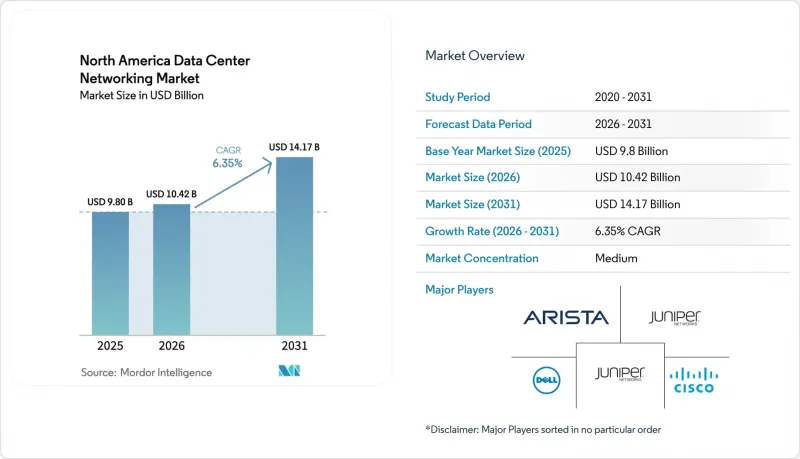
據 Mordor Intelligence 稱,北美資料中心網路市場預計到 2026 年價值將達到 104.2 億美元,高於 2025 年的 98 億美元,預計到 2031 年將達到 141.7 億美元。
預計 2026 年至 2031 年的複合年成長率為 6.35%。
本報告按組件(按產品、按服務)、最終用戶(IT和電信、銀行、金融服務和保險以及其他最終用戶)、資料中心類型(託管、超大規模資料中心業者/雲端服務供應商等)和頻寬(10 GbE以下、25-40 GbE等)對產業進行細分。市場預測以美元計價。
北美資料中心網路市場趨勢與洞察
AI/ML 工作負載正在推動 400G/800G 交換器的普及。
對使用數千個GPU進行模型訓練的需求,使得可用於人工智慧架構的網路投資加倍,迫使營運商從100G架構升級到400G和800G葉脊式架構。 Arista預計,到2025年,隨著客戶部署針對分散式學習最佳化的超低延遲乙太網路架構,其人工智慧中心網路收入將達到15億美元。博通的102.4Tbps Tomahawk 6晶片是下一代交換器的基礎,每個叢集可互連超過一百萬個加速器。超乙太網路聯盟正在最終確定擁塞感知協議,以簡化深度學習中常見的all-reduce、all-gather和collective操作。矽光電進一步緩解了延遲和功耗的限制,而台灣的晶圓代工廠網路正在崛起,成為橫向擴展的關鍵供應鏈中心。
日益嚴峻的網路安全威脅促使網路升級。
在CISA發布報告指出針對託管服務供應商的有組織攻擊正在蔓延至下游租戶之後,零信任架構的採用正在加速推進。摩根大通等領先的金融機構已重構資料中心之間的加密通道,並升級防火牆以滿足不斷變化的合規性要求。基於人工智慧的威脅偵測引擎現已整合到核心交換器中,可在不到一秒的時間內實現異常隔離。醫療保健機構正在將這些控制措施擴展到處理受保護醫療資訊的邊緣節點,並整合晶片級安全啟動和遙測技術以滿足HIPAA(健康保險流通與責任法案)的要求。
併網延誤會延長施工週期。
在美國,超過2,600吉瓦的發電容量尚未併網,這可能導致維吉尼亞北部等擁塞地區的資料中心投入運作延遲長達七年。這種電力積壓威脅到20%的規劃設施,並可能使維吉尼亞的電力消耗量在2033年翻倍。營運商正在透過在現場安裝可再生能源設施和部署微電網來應對這項挑戰。谷歌斥資200億美元,將其園區與太陽能和風能發電廠連接起來,以避免電網瓶頸。
細分市場分析
在北美資料中心網路市場,構成超大規模網路架構基礎的產品(主要是乙太網路切換器、路由器和光連接模組)仍佔據71.25%的市場佔有率。然而,隨著企業將設計、監控和生命週期支援外包給託管服務供應商,服務領域預計將以10.85%的複合年成長率成長。隨著400G/800G的部署,安裝和整合工作量激增,而託管網路服務正在減輕那些缺乏內部必要技能的企業的營運複雜性。這種向服務的轉變反映了IT基礎設施中計量收費模式的興起。
隨著部署基礎設施的日趨成熟,對利用AIOps進行預防性保養和故障排除的需求也日益成長。此外,AI驅動的架構調優和矽光電的實施需要專業知識,從而帶動了培訓和諮詢收入的成長。儘管硬體在北美資料中心網路市場的絕對支出中仍然佔據主導地位,但服務領域的成長速度預計將超過產品領域。
IT和通訊業佔據北美資料中心網路市場36.90%的佔有率,反映出雲端服務和內容供應商不斷升級其骨幹網路。醫療保健和生命科學產業以8.85%的複合年成長率位居榜首,這主要得益於遠端醫療的擴張、基因組數據的激增以及日益嚴格的合規要求。醫院集團目前正在接收Petabyte級影像資料集,並依靠加密且高度可靠的互連網路來支援遠端手術。
銀行業、金融服務業和保險業仍然佔據著相當大的市場佔有率,它們正透過全光子骨幹網路進行現代化改造,從而實現核心系統的即時遷移,停機時間不到一秒。在媒體和娛樂產業,由於高位元率串流媒體的需求,預算正在增加;而工業企業則在升級系統,以支援邊緣工業4.0分析。因此,北美資料中心網路產業正積極參與各產業,力求透過低延遲資料流實現競爭優勢。
其他好處:
- Excel格式的市場預測(ME)表
- 3個月的分析師支持
目錄
第1章:引言
- 研究假設和市場定義
- 調查範圍
第2章:調查方法
第3章執行摘要
第4章 市場狀況
- 市場概覽
- 市場促進因素
- 對雲端儲存和低延遲應用程式效能的需求日益成長。
- 網路安全威脅日益加劇,促使網路升級。
- AI/ML 工作負載推動了 400/800 GbE 交換器的普及。
- 隨著5G部署的進行,邊緣資料中心的數量也迅速成長。
- 大規模現場發電以實現高密度園區建設
- 各州的稅收優惠政策正在加速硬體更換週期。
- 市場限制因素
- 網路複雜性和跨多個供應商的互通性問題
- 對下一代光纖通訊設備和 800 GbE 交換器進行了大量資本投資。
- 由於併網延誤,施工工期延長。
- 光收發器供應鏈供不應求
- 價值供應鏈分析
- 監理情勢
- 技術展望
- 波特五力模型
- 評估宏觀經濟趨勢對市場的影響
第5章 市場規模與成長預測
- 按組件
- 產品
- 乙太網路切換器
- 路由器
- 儲存區域網路(SAN)
- 應用傳遞控制器(ADC)
- 網路安全設備
- 軟體定義網路 (SDN) 控制器
- 光連接模組
- 服務
- 安裝與整合
- 培訓和諮詢
- 支援與維護
- 主機服務
- 產品
- 最終用戶
- IT/通訊
- 銀行、金融服務和保險(BFSI)
- 政府/國防
- 媒體與娛樂
- 醫療保健和生命科學
- 製造業和工業
- 其他最終用戶
- 依資料中心類型
- 搭配
- 超大規模資料中心業者雲端服務供應商/雲端服務供應商
- 邊緣/微型資料中心
- 頻寬
- 10 GbE 或更低
- 25~40 GbE
- 50~100 GbE
- 超過 100 GbE
- 國家
- 美國
- 加拿大
- 墨西哥
第6章 競爭情勢
- 市場集中度
- 策略趨勢
- 市佔率分析
- 公司簡介
- Cisco Systems, Inc.
- Broadcom Inc.
- Juniper Networks, Inc.
- Arista Networks, Inc.
- Dell Technologies Inc.
- Hewlett Packard Enterprise Company
- Extreme Networks, Inc.
- NVIDIA Corporation(incl. Cumulus Networks)
- VMware, Inc.
- Fortinet, Inc.
- F5, Inc.
- Radware Ltd.
- A10 Networks, Inc.
- NEC Corporation
- Lenovo Group Limited
- Ciena Corporation
- IBM Corporation
- Oracle Corporation
- Array Networks, Inc.
- Infinera Corporation
第7章 市場機會與未來展望
According to Mordor Intelligence, North America data center networking market size in 2026 is estimated at USD 10.42 billion, growing from 2025 value of USD 9.8 billion with 2031 projections showing USD 14.17 billion, growing at 6.35% CAGR over 2026-2031.
This report Segments the Industry Into Components (By Product, by Services), End-Users (IT & Telecommunication, BFSI, Other End-Users). Data-Center Type(Colocation, Hyperscalers/Cloud Service Providers, and More). And Bandwidth(<=10 GbE, 25-40 GbE, and More). The Market Forecasts are Provided in Terms of Value (USD).
North America Data Center Networking Market Trends and Insights
AI/ML Workloads Driving Adoption of 400 G/800 G Switching
Demand for model training on thousands of GPUs has doubled the addressable network spend for AI fabric, pushing operators to jump from 100 G to 400 G and 800 G leaf-spine designs. Arista expects its AI-center networking revenue to reach USD 1.5 billion in 2025 as customers deploy ultra-low-latency Ethernet fabrics optimised for distributed learning. Broadcom's 102.4 Tbps Tomahawk 6 silicon underpins next-generation switches that interconnect more than 1 million accelerators per cluster. The Ultra Ethernet Consortium is finalising congestion-aware protocols that streamline all-reduce, all-gather, and collective ops typical in deep learning. Silicon photonics further narrows latency and power envelopes, with Taiwan's foundry network emerging as a critical scale-out supply base.
Rising Cybersecurity Threats Prompting Network Upgrades
Zero-trust adoption has accelerated after CISA reported coordinated attacks on managed service providers that ripple through downstream tenants. Financial majors such as J.P. Morgan have rebuilt inter-data-center encrypted channels and refreshed firewalls to satisfy evolving compliance requirements. AI-based threat-detection engines now sit inline on core switches, allowing sub-second anomaly isolation. Healthcare operators extend these controls to edge pods carrying protected health information, incorporating chip-level secure boot and telemetry to meet HIPAA mandates.
Power-Grid Interconnection Delays Lengthening Build Cycles
More than 2,600 GW of generation await grid interconnection in the United States, slowing data-center energisation by up to seven years in congested locales such as Northern Virginia. The backlog threatens 20% of planned facilities and could double Virginia's electricity consumption by 2033. Operators respond by co-locating on-site renewables or adopting micro-grids; Google's USD 20 billion programme pairs campuses with solar and wind parks that bypass transmission bottlenecks.
Other drivers and restraints analyzed in the detailed report include:
- Increasing Need for Cloud Storage and Low-Latency Application Performance
- Edge Data-Center Proliferation Alongside 5G Roll-outs
- High Capex for Next-Gen Optics and 800 GbE Switches
For complete list of drivers and restraints, kindly check the Table Of Contents.
Segment Analysis
Products still account for 71.25% of the North America data center networking market, anchored by Ethernet switches, routers and optical interconnects that underpin hyperscale fabrics. Services, however, are forecast to climb at an 10.85% CAGR as firms outsource design, monitoring and lifecycle support to managed providers. Installation and integration tasks balloon with 400 G/800 G rollouts, while managed network services absorb operational complexity for enterprises lacking in-house skillsets. This pivot toward services echoes the rise of consumption-based models across IT infrastructure.
A maturing installed base amplifies demand for proactive maintenance and AIOps-driven troubleshooting. Training and consulting revenues also rise because AI fabric tuning and silicon-photonic deployments require specialised expertise. The North America data center networking market size for services is set to outpace products in incremental growth even though hardware will continue to dominate absolute spend.
IT and telecommunications dominate with 36.90% share of the North America data center networking market, reflecting constant backbone upgrades by cloud and content providers. Healthcare and life sciences record the fastest 8.85% CAGR owing to telehealth expansion, genomics data spikes and strict compliance mandates. Hospital groups now ingest petabyte-scale imaging datasets and rely on encrypted, ultra-reliable interconnects for remote surgery support.
Banking, financial services and insurance remain sizeable, modernising with all-photonic backbones that allow live core-system migrations under one-second downtime nttdata. Media & entertainment budgets climb with high-bit-rate streaming, while industrial firms upgrade to enable Industry 4.0 analytics at the edge. The North America data center networking industry thus touches every vertical seeking competitive differentiation through low-latency data flows.
Complete Report Scope:
- By Component
- Products
- Ethernet Switches
- Routers
- Storage Area Network (SAN)
- Application Delivery Controllers (ADC)
- Network Security Appliances
- Software-Defined Networking (SDN) Controllers
- Optical Interconnects
- Services
- Installation and Integration
- Training and Consulting
- Support and Maintenance
- Managed Network Services
- Products
- By End-User
- IT and Telecommunications
- Banking, Financial Services and Insurance (BFSI)
- Government and Defense
- Media and Entertainment
- Healthcare and Life Sciences
- Manufacturing and Industrial
- Other End-Users
- By Data-Center Type
- Colocation
- Hyperscalers/Cloud Service Providers
- Edge/Micro Data Centers
- By Bandwidth
- Less Than equals to 10 GbE
- 25-40 GbE
- 50-100 GbE
- Greater than 100 GbE
- By Country
- United States
- Canada
- Mexico
List of Companies Covered in this Report:
- Cisco Systems, Inc.
- Broadcom Inc.
- Juniper Networks, Inc.
- Arista Networks, Inc.
- Dell Technologies Inc.
- Hewlett Packard Enterprise Company
- Extreme Networks, Inc.
- NVIDIA Corporation (incl. Cumulus Networks)
- VMware, Inc.
- Fortinet, Inc.
- F5, Inc.
- Radware Ltd.
- A10 Networks, Inc.
- NEC Corporation
- Lenovo Group Limited
- Ciena Corporation
- IBM Corporation
- Oracle Corporation
- Array Networks, Inc.
- Infinera Corporation
Additional Benefits:
- The market estimate (ME) sheet in Excel format
- 3 months of analyst support
TABLE OF CONTENTS
1 INTRODUCTION
- 1.1 Study Assumptions and Market Definition
- 1.2 Scope of the Study
2 RESEARCH METHODOLOGY
3 EXECUTIVE SUMMARY
4 MARKET LANDSCAPE
- 4.1 Market Overview
- 4.2 Market Drivers
- 4.2.1 Increasing need for cloud storage and low-latency application performance
- 4.2.2 Rising cybersecurity threats prompting network upgrades
- 4.2.3 AI / ML workloads driving adoption of 400/800 GbE switching
- 4.2.4 Edge data-center proliferation alongside 5G roll-outs
- 4.2.5 Utility-scale on-site generation unlocking high-density campuses
- 4.2.6 State-level tax incentives accelerating hardware refresh cycles
- 4.3 Market Restraints
- 4.3.1 Network complexity and multi-vendor interoperability issues
- 4.3.2 High capex for next-gen optics and 800 GbE switches
- 4.3.3 Power-grid interconnection delays lengthening build cycles
- 4.3.4 Optical transceiver supply-chain shortages
- 4.4 Value / Supply-Chain Analysis
- 4.5 Regulatory Landscape
- 4.6 Technological Outlook
- 4.7 Porter's Five Forces
- 4.7.1 Threat of New Entrants
- 4.7.2 Bargaining Power of Buyers/Consumers
- 4.7.3 Bargaining Power of Suppliers
- 4.7.4 Threat of Substitute Products
- 4.7.5 Intensity of Competitive Rivalry
- 4.8 Assessment of the Impact on Macro Economic Trends on the Market
5 MARKET SIZE and GROWTH FORECASTS (VALUE)
- 5.1 By Component
- 5.1.1 Products
- 5.1.1.1 Ethernet Switches
- 5.1.1.2 Routers
- 5.1.1.3 Storage Area Network (SAN)
- 5.1.1.4 Application Delivery Controllers (ADC)
- 5.1.1.5 Network Security Appliances
- 5.1.1.6 Software-Defined Networking (SDN) Controllers
- 5.1.1.7 Optical Interconnects
- 5.1.2 Services
- 5.1.2.1 Installation and Integration
- 5.1.2.2 Training and Consulting
- 5.1.2.3 Support and Maintenance
- 5.1.2.4 Managed Network Services
- 5.1.1 Products
- 5.2 By End-User
- 5.2.1 IT and Telecommunications
- 5.2.2 Banking, Financial Services and Insurance (BFSI)
- 5.2.3 Government and Defense
- 5.2.4 Media and Entertainment
- 5.2.5 Healthcare and Life Sciences
- 5.2.6 Manufacturing and Industrial
- 5.2.7 Other End-Users
- 5.3 By Data-Center Type
- 5.3.1 Colocation
- 5.3.2 Hyperscalers/Cloud Service Providers
- 5.3.3 Edge/Micro Data Centers
- 5.4 By Bandwidth
- 5.4.1 Less Than equals to 10 GbE
- 5.4.2 25-40 GbE
- 5.4.3 50-100 GbE
- 5.4.4 Greater than 100 GbE
- 5.5 By Country
- 5.5.1 United States
- 5.5.2 Canada
- 5.5.3 Mexico
6 COMPETITIVE LANDSCAPE
- 6.1 Market Concentration
- 6.2 Strategic Moves
- 6.3 Market Share Analysis
- 6.4 Company Profiles (includes Global level overview, Market level overview, Core segments, Financials as available, Strategic information, Market rank/share for key companies, Products and Services, and Recent developments)
- 6.4.1 Cisco Systems, Inc.
- 6.4.2 Broadcom Inc.
- 6.4.3 Juniper Networks, Inc.
- 6.4.4 Arista Networks, Inc.
- 6.4.5 Dell Technologies Inc.
- 6.4.6 Hewlett Packard Enterprise Company
- 6.4.7 Extreme Networks, Inc.
- 6.4.8 NVIDIA Corporation (incl. Cumulus Networks)
- 6.4.9 VMware, Inc.
- 6.4.10 Fortinet, Inc.
- 6.4.11 F5, Inc.
- 6.4.12 Radware Ltd.
- 6.4.13 A10 Networks, Inc.
- 6.4.14 NEC Corporation
- 6.4.15 Lenovo Group Limited
- 6.4.16 Ciena Corporation
- 6.4.17 IBM Corporation
- 6.4.18 Oracle Corporation
- 6.4.19 Array Networks, Inc.
- 6.4.20 Infinera Corporation
7 MARKET OPPORTUNITIES and FUTURE OUTLOOK
- 7.1 White-space and unmet-need assessment

 全球資料中心網路市場規模、佔有率、趨勢和成長分析報告(2026-2034)
 南美洲資料中心網路:市場佔有率分析、產業趨勢與統計及成長預測(2026-2031 年)印度資料中心網路:市場佔有率分析、產業趨勢與統計及成長預測(2026-2031 年)德國資料中心網路:市場佔有率分析、產業趨勢與統計及成長預測(2026-2031 年)歐洲資料中心網路:市場佔有率分析、產業趨勢與統計及成長預測(2026-2031 年)泰國資料中心網路:市場佔有率分析、產業趨勢與統計及成長預測(2026-2031)美國資料中心網路:市場佔有率分析、產業趨勢與統計及成長預測(2026-2031 年)義大利資料中心網路:市場佔有率分析、產業趨勢與統計及成長預測(2026-2031 年)英國資料中心網路:市場佔有率分析、產業趨勢與統計及成長預測(2026-2031 年)資料中心網路:市場佔有率分析、產業趨勢與統計、成長預測(2026-2031)