


 |
市場調查報告書
商品編碼
2119876
泰國資料中心網路:市場佔有率分析、產業趨勢與統計及成長預測(2026-2031)Thailand Data Center Networking - Market Share Analysis, Industry Trends & Statistics, Growth Forecasts (2026 - 2031) |
||||||

※ 本網頁內容可能與最新版本有所差異。詳細情況請與我們聯繫。
據 Mordor Intelligence 稱,泰國資料中心網路市場預計到 2026 年價值 5.4086 億美元,高於 2025 年的 4.9 億美元,預計到 2031 年將達到 8.8632 億美元。
預計從 2026 年到 2031 年,其複合年成長率將達到 10.38%。
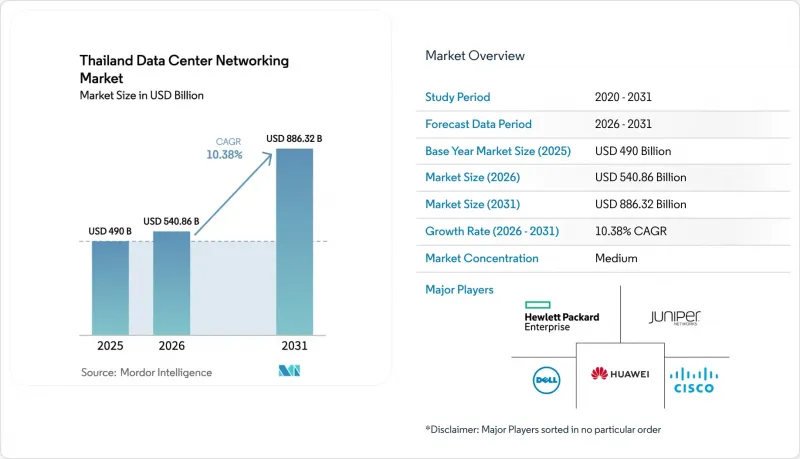
本報告按組件(按產品、按服務)、最終用戶(IT和電信、銀行、金融服務和保險、其他最終用戶)、資料中心類型(託管、超大規模資料中心業者/雲端服務供應商、其他)和頻寬(10GbE以下、25-40GbE、其他)對產業進行分類。市場預測以美元計價。
泰國資料中心網路市場趨勢與洞察
雲端優先和超大規模部署
超大規模雲端服務供應商正在擴展其 400GbE 和 800GbE 網路架構,以滿足東部經濟走廊地區人工智慧和即時分析的迫切需求。微軟、AWS 和Google已宣布僅在 2025 年就將總合超過 60 億美元的容量,推動這些設施與對等區域營運商之間持續升級。由此產生的高階口密度脊交換器和連貫光學模組的需求正逐漸滲透到企業藍圖中。 Ciena 等廠商已部署了 8192 插槽的連貫路由器,實現了每個通道 800 Gbit/s 的傳輸速度,同時將功耗降低了 30%。當地領先的銀行正在私有雲端區域內複製這些架構,以確保其即時支付系統的延遲低於 1 毫秒。
泰國4.0數位經濟舉措
公共部門的數位轉型需要穩定、低延遲的網路,從地方醫院到稅務機關都離不開它。要實現2027年全國寬頻覆蓋的目標,需要在區級層級部署數百個微型資料中心,每個資料中心都透過軟體定義廣域網路(SD-WAN)連線。個人資料保護法的實施加速了對加密東西向流量可視性和零信任分段的需求,並將防火牆處理容量要求推高至超過1Tb/s的水平。
先進網路設備需要高額資本投入
在5MW的設施中部署典型的800GbE葉脊式網路配置需要超過400萬美元的資本投資,這對泰國的中型服務供應商而言難以負擔。此外,由於當地銀行對快速過時的光學模組的殘值風險持續持謹慎態度,租賃選擇也十分有限。
細分市場分析
固定配置脊交換器和連貫光學模組的活躍訂單將推動產品銷售額在2025年佔總收入的63.65%。泰國資料中心網路市場預計到2031年將達到5.1427億美元,複合年成長率(CAGR)為8.12%,主要受交換器向伺服器升級週期的驅動。同時,專業服務、託管網路營運和培訓的複合年成長率達到11.78%,這主要得益於企業內部DevSecOps人才的短缺。企業選擇託管服務以實現全天候監控和基於意圖的變更管理,從而將平均修復時間(MTTR)縮短至30分鐘以內。供應商正在將生命週期支援與服務捆綁在一起,以確保韌體符合個人資料保護法。對服務等級協定(SLA)下服務的需求源於監管處罰,如果因停機導致資料洩露,罰款可能超過年收入的3%。
在泰國資料中心網路市場,利用人工智慧遙測技術的主動維護服務正日益普及。營運商將串流感測器資料整合到預測模型中,以提前20天預防線路卡故障。在建造邊緣站點時,空間和冷卻方面的限制通常需要客製化拓撲結構,從而導致對諮詢和設計服務的需求增加。遠端現場服務在海外雲端服務供應商中也越來越普遍,這些供應商在曼谷託管硬體,但缺乏現場工程師。
2025年,IT與通訊產業佔據泰國資料中心網路市場佔有率的34.74%。這主要得益於5G回程傳輸密度的不斷提高以及OTT內容快取節點的普及。同時,醫療健康生命科學產業預計到2031年將以12.96%的複合年成長率成長,這主要得益於醫院影像檔案的數位化以及遠距ICU平台的採用。假設電子健康報銷獎勵持續有效,到2031年,泰國醫療保健產業的資料中心網路市場規模可望達到1.1234億美元。高解析度電腦斷層掃描每次檢查會產生1-2TB的數據,因此在醫院園區部署邊緣儲存和100GbE互連至關重要。
羅勇府一家製藥實驗室正在利用400GbE叢集來建構空氣間隙資料中心。銀行、金融和保險(BFSI)產業仍然是一個高價值的垂直市場,對支援即時支付和詐欺分析的確定性、低延遲網路有著持續的需求。政府機構正在擴展安全的廣域網路覆蓋範圍,以滿足網路安全法的要求。媒體和娛樂公司正在利用安裝在旅遊景點的自適應位元率編碼節點,而製造業則正在經營私有的5G MEC中心,以實現數位孿生技術。
其他好處
- Excel格式的市場預測(ME)表
- 3個月的分析師支持
目錄
第1章:引言
- 研究假設和市場定義
- 調查範圍
第2章:調查方法
第3章執行摘要
第4章 市場狀況
- 市場概覽
- 市場促進因素
- 雲端優先和超大規模部署
- 泰國4.0數位經濟舉措
- 由於降低營運成本的壓力,網路自動化進程加快。
- 東協數位入口網站和跨境交通走廊
- 曼谷以外地區OTT影片和電競的邊緣流量
- 透過ERC綠色能源獎勵激勵資料中心
- 市場限制因素
- 先進網路設備需要高額資本投入
- 缺乏 SDN/DevNet 技能
- 海底電纜登陸許可審核延誤。
- 不斷上漲的電費和即將到來的碳排放稅
- 價值供應鏈分析
- 監理情勢
- 技術展望
- 波特五力模型
- 評估宏觀經濟趨勢對市場的影響
第5章 市場規模與成長預測
- 按組件
- 產品
- 乙太網路切換器
- 路由器
- 儲存區域網路(SAN)
- 應用傳遞控制器(ADC)
- 網路安全設備
- 軟體定義網路 (SDN) 控制器
- 光連接模組
- 服務
- 安裝與整合
- 培訓和諮詢
- 支援與維護
- 主機服務
- 產品
- 最終用戶
- 資訊科技/通訊
- 銀行、金融服務和保險(BFSI)
- 政府/國防
- 媒體與娛樂
- 醫療保健和生命科學
- 製造業和工業
- 其他最終用戶
- 依資料中心類型
- 搭配
- 超大規模資料中心業者雲端服務供應商
- 邊緣微資料中心
- 頻寬
- 10GbE 或更低
- 25~40GbE
- 50~100GbE
- 超過 100GbE
第6章 競爭情勢
- 市場集中度
- 策略趨勢
- 市佔率分析
- 公司簡介
- Cisco Systems Inc.
- Huawei Technologies Co. Ltd.
- Juniper Networks Inc.
- Dell Technologies Inc.
- Hewlett Packard Enterprise(HPE)
- NVIDIA Corp.(Cumulus Networks)
- NEC Corporation
- IBM Corporation
- VMware Inc.
- Broadcom Inc.
- Schneider Electric SE
- Arista Networks Inc.
- Extreme Networks Inc.
- Fortinet Inc.
- F5 Inc.
- Edge-core Networks Corp.
- Super Micro Computer Inc.
- Nokia Corp.
- CommScope Holding Co.
- A10 Networks Inc.
第7章 市場機會與未來展望
According to Mordor Intelligence, Thailand data center networking market size in 2026 is estimated at USD 540.86 million, growing from 2025 value of USD 490 million with 2031 projections showing USD 886.32 million, growing at 10.38% CAGR over 2026-2031.
This report Segments the Industry Into Components (By Product, by Services), End-Users (IT & Telecommunication, BFSI, Other End-Users). Data-Center Type(Colocation, Hyperscalers/Cloud Service Providers, and More). And Bandwidth(<=10 GbE, 25-40 GbE, and More). The Market Forecasts are Provided in Terms of Value (USD).
Thailand Data Center Networking Market Trends and Insights
Cloud-first and hyperscale build-outs
Hyperscale cloud providers are scaling 400 GbE and 800 GbE fabrics to support AI and real-time analytics requirements concentrated in the Eastern Economic Corridor. Microsoft, AWS, and Google collectively announced more than USD 6 billion of incremental capacity in 2025 alone, triggering a steady upgrade cycle among regional carriers that peer with these facilities. The resulting demand for high-port-density spine switches and coherent optics is cascading into enterprise roadmaps. Vendors such as Ciena introduced 8192-slot coherent routers that deliver 800 Gbit/s per channel while consuming 30% less power. Large local banks are mirroring these architectures inside private cloud zones to keep latency below 1 ms for real-time payment rails.
Thailand 4.0 digital-economy initiatives
Public-sector digitalization mandates stable, low-latency networking from provincial hospitals to revenue-collection offices. Universal broadband targets by 2027 require hundreds of micro data centers at the sub-district level, each linked by software-defined WAN overlays. The Personal Data Protection Act is accelerating demand for encrypted east-west traffic visibility and zero-trust segmentation, pushing firewall throughput requirements above 1 Tb/s.
High capex for advanced networking gear
A typical 800 GbE leaf-spine deployment for a 5 MW facility can exceed USD 4 million in capital outlay, placing it beyond the reach of Thailand's mid-sized service providers. Leasing options are limited because local banks remain cautious about residual-value risk on rapidly obsoleting optical modules.
Other drivers and restraints analyzed in the detailed report include:
- OPEX-reduction pressure spurring network automation
- ASEAN Digital Gateway and cross-border traffic corridors
- Shortage of SDN / DevNet skill sets
For complete list of drivers and restraints, kindly check the Table Of Contents.
Segment Analysis
Products dominated 63.65% of 2025 revenue thanks to brisk orders for fixed-configuration spine switches and coherent optics. The Thailand data center networking market size for products is projected to reach USD 514.27 million by 2031 at an 8.12% CAGR, sustained by switch-to-server refresh cycles. In parallel, professional services, managed network operations, and training recorded a 11.78% CAGR, benefiting from scarce in-house DevSecOps talent. Enterprises choose managed services to obtain 24/7 monitoring and intent-based change control, cutting mean-time-to-repair below 30 minutes. Vendors bundle lifecycle support to guarantee firmware compliance under the Personal Data Protection Act. Demand for SLA-bound services stems from regulatory penalties that can exceed 3% of annual revenue for downtime-induced data breaches.
The Thailand data center networking market is also witnessing expanded consumption of proactive maintenance services that harness AI-driven telemetry. Operators ingest streaming sensor data into predictive models that pre-empt line-card failures up to 20 days in advance. Consulting and design services are in demand during edge-site build-outs, where space and cooling constraints call for custom topologies. Remote hands services gain traction among overseas cloud providers co-locating hardware in Bangkok but lacking resident engineers.
IT & telecommunications held 34.74% of Thailand data center networking market share in 2025, driven by 5G backhaul densification and OTT content caching nodes. Yet healthcare & life sciences will post a 12.96% CAGR through 2031 as hospitals digitalize imaging archives and deploy tele-ICU platforms. The Thailand data center networking market size for healthcare could top USD 112.34 million by 2031, assuming continued e-health reimbursement incentives. High-resolution CT scans generate 1-2 TB per session, pushing edge storage and 100 GbE interconnect mandates inside hospital campuses.
Pharmaceutical labs in Rayong are building air-gapped data centers for genome analytics using 400 GbE clusters. BFSI remains a high-value vertical with sustained appetite for deterministic low-latency networks supporting real-time settlement and fraud analytics. Government agencies expand secure WAN overlays that meet Cyber Security Act stipulations. Media & entertainment companies leverage adaptive bitrate encoding nodes placed in tourist hotspots, while manufacturing outfits operate private 5G MEC hubs enabling digital twins.
Complete Report Scope:
- By Component
- Products
- Ethernet Switches
- Routers
- Storage Area Network (SAN)
- Application Delivery Controllers (ADC)
- Network Security Appliances
- Software-Defined Networking (SDN) Controllers
- Optical Interconnects
- Services
- Installation and Integration
- Training and Consulting
- Support and Maintenance
- Managed Network Services
- Products
- By End-User
- IT and Telecommunications
- Banking, Financial Services and Insurance (BFSI)
- Government and Defense
- Media and Entertainment
- Healthcare and Life Sciences
- Manufacturing and Industrial
- Other End-Users
- By Data-Center Type
- Colocation
- Hyperscalers/Cloud Service Providers
- Edge/Micro Data Centers
- By Bandwidth
- Less Than equals to 10 GbE
- 25-40 GbE
- 50-100 GbE
- Greater Than 100 GbE
List of Companies Covered in this Report:
- Cisco Systems Inc.
- Huawei Technologies Co. Ltd.
- Juniper Networks Inc.
- Dell Technologies Inc.
- Hewlett Packard Enterprise (HPE)
- NVIDIA Corp. (Cumulus Networks)
- NEC Corporation
- IBM Corporation
- VMware Inc.
- Broadcom Inc.
- Schneider Electric SE
- Arista Networks Inc.
- Extreme Networks Inc.
- Fortinet Inc.
- F5 Inc.
- Edge-core Networks Corp.
- Super Micro Computer Inc.
- Nokia Corp.
- CommScope Holding Co.
- A10 Networks Inc.
Additional Benefits:
- The market estimate (ME) sheet in Excel format
- 3 months of analyst support
TABLE OF CONTENTS
1 INTRODUCTION
- 1.1 Study Assumptions and Market Definition
- 1.2 Scope of the Study
2 RESEARCH METHODOLOGY
3 EXECUTIVE SUMMARY
4 MARKET LANDSCAPE
- 4.1 Market Overview
- 4.2 Market Drivers
- 4.2.1 Cloud-first and hyperscale build-outs
- 4.2.2 Thailand 4.0 digital-economy initiatives
- 4.2.3 OPEX-reduction pressure spurring network automation
- 4.2.4 ASEAN Digital Gateway and cross-border traffic corridors
- 4.2.5 OTT video / e-sports edge-traffic outside Bangkok
- 4.2.6 ERC green-energy credit incentives for data centers
- 4.3 Market Restraints
- 4.3.1 High capex for advanced networking gear
- 4.3.2 Shortage of SDN / DevNet skill sets
- 4.3.3 Delays in subsea-cable landing permits
- 4.3.4 Rising electricity tariffs and looming carbon tax
- 4.4 Value / Supply-Chain Analysis
- 4.5 Regulatory Landscape
- 4.6 Technological Outlook
- 4.7 Porter's Five Forces
- 4.7.1 Threat of New Entrants
- 4.7.2 Bargaining Power of Buyers/Consumers
- 4.7.3 Bargaining Power of Suppliers
- 4.7.4 Threat of Substitute Products
- 4.7.5 Intensity of Competitive Rivalry
- 4.8 Assessment of the Impact on Macro Economic Trends on the Market
5 MARKET SIZE AND GROWTH FORECASTS (VALUE)
- 5.1 By Component
- 5.1.1 Products
- 5.1.1.1 Ethernet Switches
- 5.1.1.2 Routers
- 5.1.1.3 Storage Area Network (SAN)
- 5.1.1.4 Application Delivery Controllers (ADC)
- 5.1.1.5 Network Security Appliances
- 5.1.1.6 Software-Defined Networking (SDN) Controllers
- 5.1.1.7 Optical Interconnects
- 5.1.2 Services
- 5.1.2.1 Installation and Integration
- 5.1.2.2 Training and Consulting
- 5.1.2.3 Support and Maintenance
- 5.1.2.4 Managed Network Services
- 5.1.1 Products
- 5.2 By End-User
- 5.2.1 IT and Telecommunications
- 5.2.2 Banking, Financial Services and Insurance (BFSI)
- 5.2.3 Government and Defense
- 5.2.4 Media and Entertainment
- 5.2.5 Healthcare and Life Sciences
- 5.2.6 Manufacturing and Industrial
- 5.2.7 Other End-Users
- 5.3 By Data-Center Type
- 5.3.1 Colocation
- 5.3.2 Hyperscalers/Cloud Service Providers
- 5.3.3 Edge/Micro Data Centers
- 5.4 By Bandwidth
- 5.4.1 Less Than equals to 10 GbE
- 5.4.2 25-40 GbE
- 5.4.3 50-100 GbE
- 5.4.4 Greater Than 100 GbE
6 COMPETITIVE LANDSCAPE
- 6.1 Market Concentration
- 6.2 Strategic Moves
- 6.3 Market Share Analysis
- 6.4 Company Profiles (includes Global level Overview, Market level overview, Core Segments, Financials as available, Strategic Information, Market Rank/Share for key companies, Products and Services, and Recent Developments)
- 6.4.1 Cisco Systems Inc.
- 6.4.2 Huawei Technologies Co. Ltd.
- 6.4.3 Juniper Networks Inc.
- 6.4.4 Dell Technologies Inc.
- 6.4.5 Hewlett Packard Enterprise (HPE)
- 6.4.6 NVIDIA Corp. (Cumulus Networks)
- 6.4.7 NEC Corporation
- 6.4.8 IBM Corporation
- 6.4.9 VMware Inc.
- 6.4.10 Broadcom Inc.
- 6.4.11 Schneider Electric SE
- 6.4.12 Arista Networks Inc.
- 6.4.13 Extreme Networks Inc.
- 6.4.14 Fortinet Inc.
- 6.4.15 F5 Inc.
- 6.4.16 Edge-core Networks Corp.
- 6.4.17 Super Micro Computer Inc.
- 6.4.18 Nokia Corp.
- 6.4.19 CommScope Holding Co.
- 6.4.20 A10 Networks Inc.
7 MARKET OPPORTUNITIES and FUTURE OUTLOOK
- 7.1 White-space and Unmet-need Assessment

 全球資料中心網路市場規模、佔有率、趨勢和成長分析報告(2026-2034)
 北美資料中心網路:市場佔有率分析、產業趨勢與統計及成長預測(2026-2031 年)南美洲資料中心網路:市場佔有率分析、產業趨勢與統計及成長預測(2026-2031 年)印度資料中心網路:市場佔有率分析、產業趨勢與統計及成長預測(2026-2031 年)德國資料中心網路:市場佔有率分析、產業趨勢與統計及成長預測(2026-2031 年)歐洲資料中心網路:市場佔有率分析、產業趨勢與統計及成長預測(2026-2031 年)美國資料中心網路:市場佔有率分析、產業趨勢與統計及成長預測(2026-2031 年)義大利資料中心網路:市場佔有率分析、產業趨勢與統計及成長預測(2026-2031 年)英國資料中心網路:市場佔有率分析、產業趨勢與統計及成長預測(2026-2031 年)資料中心網路:市場佔有率分析、產業趨勢與統計、成長預測(2026-2031)