


 |
市場調查報告書
商品編碼
2119816
亞太地區基油:市場佔有率分析、產業趨勢與統計及成長預測(2026-2031)Asia Pacific Base Oil - Market Share Analysis, Industry Trends & Statistics, Growth Forecasts (2026 - 2031) |
||||||

※ 本網頁內容可能與最新版本有所差異。詳細情況請與我們聯繫。
據 Mordor Intelligence 稱,亞太基油市場在 2025 年的價值為 1742 萬噸,預計到 2031 年將從 2026 年的 1775 萬噸成長到 1949 萬噸,在預測期(2026-2031 年)內的複合成長到 1.89%。
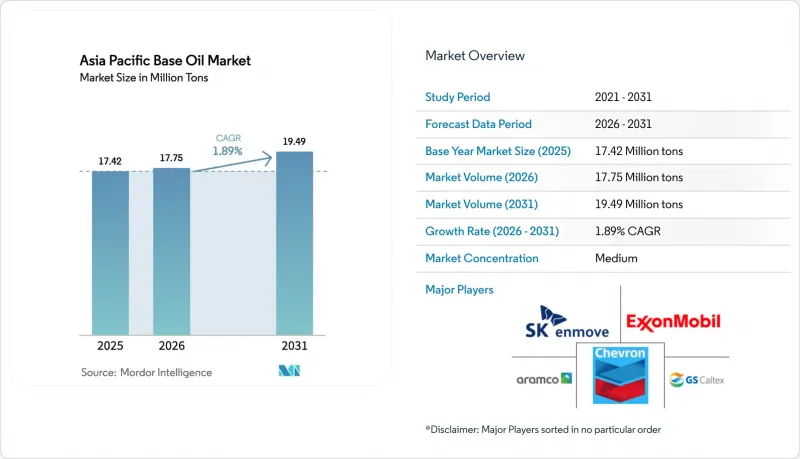
本報告按類型(I類、II類、III類、IV類及其他類型)、應用(機油、變速箱油/齒輪油、金屬加工潤滑油、液壓油、潤滑脂及其他)及地區(中國、印度、日本、韓國、東協及其他亞太地區)進行細分。市場預測以噸為單位。
亞太基油市場趨勢與洞察
由於排放氣體法規更加嚴格,基油正從 I 類轉向 II 類。
印度的BS VI排放標準和中國的「國六」排放標準將硫含量限制在10ppm以內,迫使調和商逐步淘汰I類基油,轉而使用更清潔的II類基礎油。埃克森美孚的新加坡雷吉亞德昇級計畫於2025年9月新增了2萬桶/日的II類基礎油產能,以滿足此需求。日本JASO GLV-2超高黏度指數基礎油標準正在推動混合動力汽車採用III類基礎油。印度農村地區和中國內陸地區在價格敏感型細分市場仍然依賴I類基礎油,形成一條平行的供應鏈,這種情況將持續到2028年。中型煉油商正在加快加氫裂解裝置的維修以保持競爭力,但現金流限制了沿海資產的升級改造。
中國和印度對高性能汽車潤滑油的需求不斷成長
預計到2024年,中國汽車產量將達到3,020萬輛,其中渦輪增壓引擎的產量佔比超過60%,高於2020年的45%。由於渦輪增壓引擎在高溫下運行,汽車製造商通常會指定使用II類或III類機油以防止氧化。預計到2025會計年度,印度乘用車銷售量將達到420萬輛,其中SUV佔新車註冊量的48%。像Mart Suzuki這樣的汽車製造商在工廠內為引擎加註符合API SP標準的機油,這限制了售後市場只能使用高級機油。這種趨勢正在縮小I類機油的潛在需求,目前I類機油主要用於大型柴油車輛。
電動車的加速普及將抑制內燃機潤滑油的長期需求。
電池式電動車(BEV)所需的潤滑油比汽油動力車少70%。這一趨勢在中國最為顯著,預計到2024年,中國電動車銷量將達到950萬輛,佔乘用車銷量的35%。預計到2024年,泰國電動車的價格將與汽油車持平,印度的摩托車電動化率也快速成長。雖然內燃機(ICE)在商用卡車和非公路用車輛領域仍佔據主導地位,但乘用車對潤滑油的需求將持續下降,這將限制亞太地區基油市場的長期成長。
細分市場分析
2025年,受排放氣體法規對低硫基礎油需求的推動,II類基礎油將佔亞太地區基油市場的38.05%。預計亞太地區III類基油市場將以3.30%的複合年成長率成長,成為所有等級基礎油中成長最快的,這主要得益於渦輪增壓器和混合動力傳動系統的需求。埃克森美孚的新產品EHC 340 MAX是一款超重質II類基礎油,目標客戶是先前依賴亮滑油料供應。 Ⅱ類和III類基礎油之間的利潤率差距已縮小至每噸150-200美元,這使得調和商能夠在不增加過多成本負擔的情況下轉換應用領域。
目前,傳統的I類油產能主要服務於重型柴油車和工業潤滑油等細分市場,但其市場佔有率持續下降。隨著印度石油公司帕尼帕特工廠的維修和印度斯坦石油公司LOBS設施的升級,到2026年,相當一部分I類油加工將轉為II類和III類油加工,屆時這一趨勢將加速。四類聚對苯二酚(PAO)產量佔全部區域總產量的不到5%,但在航太領域仍維持較高的溢價;V類環烷烴油在特種應用領域需求穩定。儘管如果新建氫氣加工設施的運作超過對高品質產品的需求,仍存在供應過剩的風險,但中國內陸煉油廠的合理化改造可能會在2029年前淘汰一些獲利能力的I類油資產。
其他好處
- Excel格式的市場預測(ME)表
- 3個月的分析師支持
目錄
第1章:引言
- 研究假設和市場定義
- 調查範圍
第2章:調查方法
第3章執行摘要
第4章 市場狀況
- 市場概覽
- 市場促進因素
- 隨著排放氣體法規的日益嚴格,基油的使用正從 I 類轉向 II 類。
- 中國和印度對高性能汽車潤滑油的需求不斷成長
- OEM廠商主導的延長換油週期正在推動高階III類和IV類品牌的發展。
- 透過循環經濟政策採用精煉基油
- 摩托車外送車輛的快速成長正在加速低黏度機油的普及應用。
- 市場限制因素
- 電動車的加速普及正在抑制內燃機潤滑油的長期需求。
- 重型鋼材(SN 500 和 BS)持續供過於求,導致價格下跌。
- 認知上的品質障礙限制了再生基油的普及
- 價值鏈分析
- 波特五力模型
第5章 市場規模與成長預測
- 按類型
- 第一組
- 第二組
- 第三組
- 第四組
- 其他類型(第五組,環烷油)
- 透過使用
- 機油
- 變速箱油/齒輪油
- 金屬加工用潤滑液
- 油壓
- 潤滑脂
- 其他用途(食品、加工油)
- 按地區
- 中國
- 印度
- 日本
- 韓國
- ASEAN
- 亞太其他地區
第6章 競爭情勢
- 市場集中度
- 策略趨勢
- 市佔率和排名分析
- 公司簡介
- Chevron Corporation
- CNOOC
- Ergon, Inc.
- Exxon Mobil Corporation
- GS Caltex Corporation
- HP Lubricants
- Indian Oil Corporation Ltd.
- Neste
- Petronas Lubricants International
- Phillips 66 Company
- Repsol
- Saudi Arabian Oil Co.
- Sinopec Corp
- SK On Co., Ltd.
第7章 市場機會與未來展望
According to Mordor Intelligence, the Asia Pacific base oil market size was valued at 17.42 million tons in 2025 and is estimated to grow from 17.75 million tons in 2026 to reach 19.49 million tons by 2031, at a CAGR of 1.89% during the forecast period (2026-2031).
This report is Segmented by Type (Group I, Group II, Group III, Group IV, and Other Types), Application (Engine Oils, Transmission and Gear Oils, Metalworking Fluids, Hydraulic Fluids, Greases, and Other Applications), and Geography (China, India, Japan, South Korea, ASEAN Countries, and Rest of Asia-Pacific). The Market Forecasts are Provided in Terms of Volume (Tons).
Asia Pacific Base Oil Market Trends and Insights
Growing Shift from Group I to Group II Base Stocks Due to Tightening Emission Norms
India's BS VI and China 6 standards limit sulfur to 10 ppm, forcing blenders to abandon Group I stocks for cleaner Group II alternatives. ExxonMobil's Singapore Resid Upgrade Project added 20,000 barrels per day of Group II capacity in September 2025 to serve this demand. Japan's JASO GLV-2 spec for ultra-high-viscosity-index oils is pushing Group III adoption in hybrids. Rural India and inland China still rely on Group I for price-sensitive segments, creating a parallel supply chain that will persist until 2028. Mid-tier refiners are fast-tracking hydrocracker revamps to stay relevant, yet cash-flow constraints limit upgrades to coastal assets.
Rising Demand for High-Performance Automotive Lubricants in China and India
China produced 30.2 million vehicles in 2024, with turbocharged engines exceeding 60% of output, up from 45% in 2020. Turbocharged units run hotter, so OEMs specify Group II or Group III oils to prevent oxidation. India's passenger-vehicle sales reached 4.2 million units in fiscal 2025, with SUVs claiming 48% of registrations. Carmakers such as Maruti Suzuki pre-fill engines with API SP oils, locking the aftermarket into premium grades. This preference compresses the addressable pool for Group I stocks, which now serve mostly heavy-duty diesel fleets.
Accelerating EV Penetration Curbing Long-Term ICE-Lubricant Demand
Battery-electric vehicles need 70% less lubricant than gasoline cars, a reality most visible in China, where EV sales reached 9.5 million units in 2024, equal to 35% of passenger-car volume. Thailand hit EV price parity in 2024, and India's two-wheeler electrification rate is scaling fast. Commercial trucks and off-highway gear remain ICE-dominated, but passenger-car lubricant pools will continue shrinking, setting a ceiling on long-term Asia Pacific Base Oil market growth.
Other drivers and restraints analyzed in the detailed report include:
- OEM-Driven Drain-Interval Extensions Favouring Premium Group III/IV Stocks
- Adoption of Re-Refined Base Oils Under Circular-Economy Policies
- Persistent Oversupply in Heavy Grades (SN 500/Bright Stock) Depressing Prices
For complete list of drivers and restraints, kindly check the Table Of Contents.
Segment Analysis
Group II held 38.05% of the Asia Pacific base oil market in 2025, owing to emission-driven demand for low-sulfur stocks. The Asia Pacific Base Oil market size for Group III is forecast to expand at a 3.30% CAGR, the fastest among all grades, propelled by turbocharged and hybrid powertrain requirements. ExxonMobil's new EHC 340 MAX extra-heavy Group II grade targets sectors that once relied on bright stock. Petronas and Pertamina's planned 800-tons-per-day Group III plant in Indonesia will deepen regional supply diversity. Margin gaps between Group II and Group III have narrowed to USD 150-200 per ton, encouraging blenders to switch applications without prohibitive cost penalties.
Legacy Group I capacity now supports niche heavy-duty diesel and industrial fluids, but continues to lose share. Indian Oil Corporation's Panipat revamp and HPCL's LOBS upgrades will convert significant Group I throughput into Group II and Group III by 2026, accelerating the trend. Group IV PAO remains below 5% of regional volume yet commands premium pricing in aerospace, while Group V naphthenics serve stable specialty segments. Overcapacity risks persist if new hydrofinish units outpace high-grade demand, but refinery rationalization in inland China may remove marginal Group I assets by 2029.
Complete Report Scope:
- ByType
- Group I
- Group II
- Group III
- Group IV
- Other Types (Grouo V, Naphthenic Oil)
- By Application
- Engine Oils
- Transmission and Gear Oils
- Metalworking Fluids
- Hydraulic Fluids
- Greases
- Other Applications (Food-grade, Process Oils)
- By Geography
- China
- India
- Japan
- South Korea
- ASEAN Countries
- Rest of Asia-Pacific
List of Companies Covered in this Report:
- Chevron Corporation
- CNOOC
- Ergon, Inc.
- Exxon Mobil Corporation.
- GS Caltex Corporation
- HP Lubricants
- Indian Oil Corporation Ltd.
- Neste
- Petronas Lubricants International
- Phillips 66 Company
- Repsol
- Saudi Arabian Oil Co.
- Sinopec Corp
- SK On Co., Ltd.
Additional Benefits:
- The market estimate (ME) sheet in Excel format
- 3 months of analyst support
TABLE OF CONTENTS
1 Introduction
- 1.1 Study Assumptions and Market Definition
- 1.2 Scope of the Study
2 Research Methodology
3 Executive Summary
4 Market Landscape
- 4.1 Market Overview
- 4.2 Market Drivers
- 4.2.1 Growing shift from Group I to Group II base stocks due to tightening emission norms
- 4.2.2 Rising demand for high-performance automotive lubricants in China and India
- 4.2.3 OEM-driven drain-interval extensions favouring premium Group III/IV stocks
- 4.2.4 Adoption of re-refined base oils under circular-economy policies
- 4.2.5 Surge in two-wheeler delivery fleets accelerating low-viscosity engine-oil uptake
- 4.3 Market Restraints
- 4.3.1 Accelerating EV penetration curbing long-term ICE-lubricant demand
- 4.3.2 Persistent oversupply in heavy grades (SN 500/BS) depressing prices
- 4.3.3 Quality-perception barriers limiting re-refined base-oil adoption
- 4.4 Value Chain Analysis
- 4.5 Porter's Five Forces
- 4.5.1 Bargaining Power of Suppliers
- 4.5.2 Bargaining Power of Buyers
- 4.5.3 Threat of New Entrants
- 4.5.4 Threat of Substitutes
- 4.5.5 Degree of Competition
5 Market Size and Growth Forecasts (Volume)
- 5.1 ByType
- 5.1.1 Group I
- 5.1.2 Group II
- 5.1.3 Group III
- 5.1.4 Group IV
- 5.1.5 Other Types (Grouo V, Naphthenic Oil)
- 5.2 By Application
- 5.2.1 Engine Oils
- 5.2.2 Transmission and Gear Oils
- 5.2.3 Metalworking Fluids
- 5.2.4 Hydraulic Fluids
- 5.2.5 Greases
- 5.2.6 Other Applications (Food-grade, Process Oils)
- 5.3 By Geography
- 5.3.1 China
- 5.3.2 India
- 5.3.3 Japan
- 5.3.4 South Korea
- 5.3.5 ASEAN Countries
- 5.3.6 Rest of Asia-Pacific
6 Competitive Landscape
- 6.1 Market Concentration
- 6.2 Strategic Moves
- 6.3 Market Share/Ranking Analysis
- 6.4 Company Profiles (includes Global level Overview, Market level overview, Core Segments, Financials as available, Strategic Information, Products and Services, and Recent Developments)
- 6.4.1 Chevron Corporation
- 6.4.2 CNOOC
- 6.4.3 Ergon, Inc.
- 6.4.4 Exxon Mobil Corporation.
- 6.4.5 GS Caltex Corporation
- 6.4.6 HP Lubricants
- 6.4.7 Indian Oil Corporation Ltd.
- 6.4.8 Neste
- 6.4.9 Petronas Lubricants International
- 6.4.10 Phillips 66 Company
- 6.4.11 Repsol
- 6.4.12 Saudi Arabian Oil Co.
- 6.4.13 Sinopec Corp
- 6.4.14 SK On Co., Ltd.
7 Market Opportunities and Future Outlook
- 7.1 White-space and unmet-need assessment
- 7.2 Growing Awareness on Renewable Base-Oils

 基油:市場佔有率分析、產業趨勢與統計、成長預測(2026-2031)
 基油市場:2026-2032年全球市場預測(依產品等級、基油類型、應用類型、終端用戶產業及銷售管道)
 切削液市場規模、佔有率和成長分析:按流體技術化學分類、加工應用、終端用戶產業和地區分類-2026-2033年產業預測
 高性能工業潤滑油市場預測至2034年-按產品類型、基礎油、劑型、通路、應用、最終用戶和地區分類的全球分析再生基礎油:市場佔有率分析、產業趨勢與統計、成長預測(2026-2031)
 基礎油市場規模、佔有率、成長及全球產業分析:按類型、應用和地區的洞察,2026-2034年的預測
 基油市場分析及預測(至2035年):類型、產品、應用、技術、最終用戶、形態、材質類型、製程、設備
 基礎油市場報告:按類型、組別、應用和地區分類(2026-2034年)
 2026年全球基油市場報告
 全球基礎油市場按類別、應用和地區分類-預測(至2030年)