


 |
市場調查報告書
商品編碼
2119790
義大利資料中心網路:市場佔有率分析、產業趨勢與統計及成長預測(2026-2031 年)Italy Data Center Networking - Market Share Analysis, Industry Trends & Statistics, Growth Forecasts (2026 - 2031) |
||||||

※ 本網頁內容可能與最新版本有所差異。詳細情況請與我們聯繫。
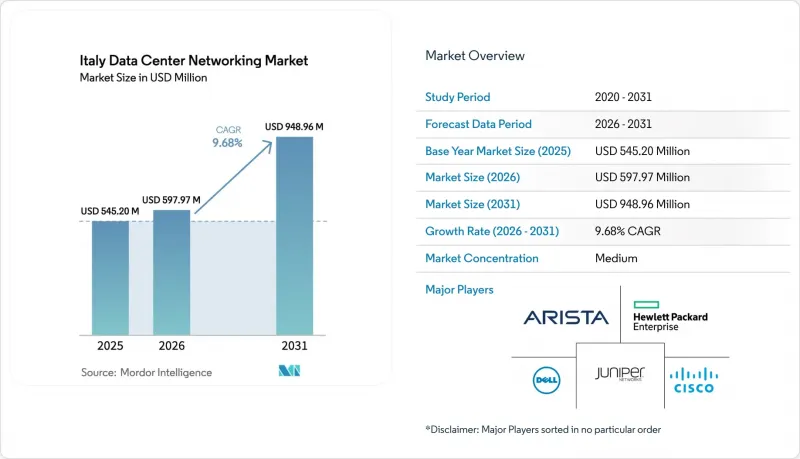
根據 Mordor Intelligence 預測,義大利資料中心網路市場規模將從 2025 年的 5.452 億美元成長到 2026 年的 5.9797 億美元,然後在 2031 年達到 9.4896 億美元,2026 年至 2031 年的複合年成長率為 9.68%。
本報告按組件(產品、服務)、最終用戶(IT與電信、銀行、金融服務與保險(BFSI)、其他)、資料中心類型(託管、超大規模資料中心業者資料中心與雲端服務供應商、其他)以及頻寬(10GbE以下、25-40GbE、其他)對產業進行分類。市場預測以美元計價。
義大利資料中心網路市場的趨勢與洞察
擴大雲端儲存的使用範圍並增強超大規模環境
全球雲端服務供應商正在米蘭和羅馬快速建立主權雲端區域,以服務義大利乃至整個歐洲的工作負載。谷歌與義大利電信(TIM)的合作、微軟即將推出的Azure區域以及AWS的擴張,都需要100G/400G乙太網路葉脊式架構、光交叉連接器以及能夠編配大規模多租戶流量的軟體定義疊加控制器。 Apto在米蘭南部投資34億美元興建的五棟園區,清楚展現了湧入義大利資料中心網路市場的超大規模投資規模。隨著公共部門資料集從本地遷移到認證設施,耗資9.5億歐元的國家雲端舉措進一步提升了對主權、安全互連的需求。
邊緣運算和物聯網流量的爆炸性成長。
在工業4.0激勵政策的推動下,義大利製造商在2022年投資71億歐元用於先進的數位化機械設備。即時控制迴路(由時間敏感網路、Gigabit乙太現場匯流排和微模組化資料中心實現)正在推動東西向流量的激增,而這些流量無法到達超大規模核心資料中心。 Cellnex與Everynet合作部署全國範圍的LoRaWAN網路,以及Open Fiber的邊緣POP戰略,透過緊湊型100G交換路由器,實現了對安全性、網路分段和監控至關重要的「最後一公里」連接。這些發展凸顯了邊緣運算如何將義大利的資料中心網路市場與區域產業叢集緊密連結。
熟練的網路專家短缺
只有46%的義大利人具備基本的數位技能,遠低於歐盟平均水平,導致長期人才短缺。 2023年1月至2024年8月期間,義大利發布了約18.4萬個與資訊通訊技術(ICT)相關的職缺,但包括網路自動化工程師、滲透測試員和站點可靠性工程師(SRE)在內的許多職位仍然空缺。根據「新技能計畫」(Piano Nuove Competenze),預計到2028年,將有多達360萬名勞工需要提升其數位技能。對於資料中心營運商而言,人才短缺導致薪資飆升、實施週期延長以及對託管服務的依賴性增強,從而減緩了義大利資料中心網路市場採用尖端架構的速度。
細分市場分析
到2025年,產品支出將佔總支出的71.60%,主要集中在乙太網路切換器、路由器和新一代防火牆上,這些設備構成了義大利託管機房和雲端園區的實體骨幹。僅交換硬體一項,義大利資料中心網路市場預計到2025年將接近2.927億美元。這主要得益於超大規模資料中心業者資料中心對100G ToR平台的需求,以及配備冗餘AC/DC電源的緊湊型1U邊緣交換器的部署。隨著ACN強制要求在所有邊界點進行線上檢測,安全設備市場也不斷擴大。
儘管服務板塊規模較小,但由於人員短缺迫使營運商將設計、部署和全天候網路營運中心 (NOC) 管理外包,其複合年成長率 (CAGR) 仍高達 12.02%。託管 SD-WAN、網路即服務 (NaaS) 和生命週期最佳化合約包含諮詢、人員配備增加和人工智慧驅動的監控服務。託管租戶對高階交叉連接配置和微隔離審計的需求日益成長,義大利資料中心網路市場的業務收益成長速度超過了硬體成長速度。
預計到2025年,IT與通訊產業將佔義大利資料中心網路市場31.85%的佔有率。這主要得益於電信業者對核心網路的升級以及5G回程傳輸密度的提升。然而,醫療保健與生命科學產業預計將超越其他所有產業,到2031年將以13.12%的複合年成長率成長。這主要得益於遠端醫療、PACS影像歸檔和醫療物聯網閘道等技術的發展,這些技術需要確定性強且低延遲的互連。此外,利用通用人工智慧(GenAI)的診斷工具將流量集中在GPU叢集上,進一步增加了交換器連接埠的數量。
銀行業和保險業保持著中等個位數的成長,這得益於PSD2和DORA法規強制要求交易級日誌記錄和主動-主動災難復原拓撲結構。製造業也緊隨其後,將支援TSN的機器人與25G工業乙太網整合,並在工廠內部署霧運算節點。各行各業的安全需求正朝著零信任網路存取的方向發展,這使得義大利的資料中心網路產業能夠在多個客戶群中應用深層封包檢測和持續保障框架。
其他好處
- Excel格式的市場預測(ME)表
- 3個月的分析師支持
目錄
第1章:引言
- 研究假設和市場定義
- 調查範圍
第2章:調查方法
第3章執行摘要
第4章 市場狀況
- 市場概覽
- 市場促進因素
- 擴大雲端儲存的使用範圍並增強超大規模環境
- 資料備份需求日益成長,以及GDPR強制規定的更長資料保留期限。
- 邊緣運算和物聯網流量的爆炸性成長。
- 開放式網路(白盒、SONiC)簡介
- PNRR 為公共部門數位基礎設施提供資金
- 水冷式高頻寬織物
- 市場限制因素
- 熟練的網路專家短缺
- 向 100G/400G 過渡需要大量資本投資
- 影響總擁有成本的能源價格波動
- ASIC供應鏈中斷
- 價值供應鏈分析
- 監理情勢
- 技術展望
- 波特五力模型
- 評估宏觀經濟趨勢對市場的影響
第5章 市場規模與成長預測
- 按組件
- 產品
- 乙太網路切換器
- 路由器
- 儲存區域網路(SAN)
- 應用傳遞控制器(ADC)
- 網路安全設備
- 軟體定義網路 (SDN) 控制器
- 光連接模組
- 服務
- 安裝與整合
- 培訓和諮詢
- 支援與維護
- 主機服務
- 產品
- 最終用戶
- 資訊科技/通訊
- 銀行、金融服務和保險(BFSI)
- 政府/國防
- 媒體與娛樂
- 醫療保健和生命科學
- 製造業和工業
- 其他
- 依資料中心類型
- 搭配
- 超大規模資料中心業者雲端服務供應商
- 邊緣微資料中心
- 頻寬
- 10GbE 或更低
- 25~40GbE
- 50~100GbE
- 超過 100GbE
第6章 競爭情勢
- 市場集中度
- 策略趨勢
- 市佔率分析
- 公司簡介
- Cisco Systems Inc.
- Dell Technologies Inc.
- NEC Corporation
- International Business Machines Corporation(IBM)
- Hewlett Packard Enterprise Company(HPE)
- Schneider Electric SE
- ALE International SAS(Alcatel-Lucent Enterprise)
- Microsoft Corporation
- Fujitsu Limited
- Oracle Corporation
- Arista Networks Inc.
- Juniper Networks Inc.
- Huawei Technologies Co., Ltd.
- Broadcom Inc.
- NVIDIA Corporation(Mellanox)
- Extreme Networks Inc.
- Ciena Corporation
- CommScope Holding Company Inc.
- Fortinet Inc.
- NetApp Inc.
- VMware Inc.
- Nokia Corporation(Nuage Networks)
- Super Micro Computer, Inc.
第7章 市場機會與未來展望
According to Mordor Intelligence, the Italy data center networking market size is expected to grow from USD 545.20 million in 2025 to USD 597.97 million in 2026 and is forecast to reach USD 948.96 million by 2031 at 9.68% CAGR over 2026-2031.
This report Segments the Industry Into Components (By Product, by Services), End-Users (IT & Telecommunication, BFSI, and More), Data-Center Type(Colocation, Hyperscalers/Cloud Service Providers, and More), and Bandwidth(<=10 GbE, 25-40 GbE, and More). The Market Forecasts are Provided in Terms of Value (USD).
Italy Data Center Networking Market Trends and Insights
Increasing utilization of cloud storage and hyperscale build-outs
Global cloud providers are racing to establish sovereign cloud regions in Milan and Rome to serve both Italian and pan-European workloads. Google's partnership with TIM, Microsoft's forthcoming Azure region, and AWS's footprint expansion all require 100 G/400 G Ethernet leaf-spine fabrics, optical cross-connects, and software-defined overlay controllers capable of orchestrating multi-tenant traffic at scale. Apto's USD 3.4 billion, five-building campus south of Milan highlights the depth of hyperscale capital flowing into the Italy data center networking market. The national cloud initiative, funded at EUR 950 million, further boosts demand for sovereign, secure interconnects as public-sector datasets migrate off-prem to accredited facilities.
Edge computing & IoT traffic explosion
Industry 4.0 incentives helped Italian manufacturers spend EUR 7.1 billion on advanced digital machinery in 2022. Real-time control loops-enabled by Time-Sensitive Networking, Gigabit Ethernet field buses, and micro-modular data centers-generate a surge of east-west traffic that never reaches hyperscale cores. Cellnex's partnership with Everynet to deploy national LoRaWAN coverage and Open Fiber's edge-pop strategy delivers last-mile links that must be secured, segmented, and monitored via compact 100 G switch-routers. These deployments underscore how edge computing keeps the Italy data center networking market anchored to regional industrial clusters.
Shortage of skilled networking professionals
Only 46% of Italians possess basic digital skills, well below the EU average, creating a perennial talent deficit. Roughly 184,000 ICT vacancies were posted between January 2023 and August 2024, yet many roles-network automation engineers, penetration testers, SREs-remain unfilled. The Piano Nuove Competenze forecasts that up to 3.6 million workers will require digital upskilling by 2028. For data-center operators, the scarcity inflates salaries, extends deployment timelines, and increases reliance on managed services, tempering the pace at which the Italy data center networking market can adopt bleeding-edge architectures.
Other drivers and restraints analyzed in the detailed report include:
- PNRR funding for public-sector digital infra
- Open networking (white-box, SONiC) adoption
- High capex for 100 G/400 G migration
For complete list of drivers and restraints, kindly check the Table Of Contents.
Segment Analysis
Products account for 71.60% of 2025 spending, anchored by Ethernet switches, routers and next-generation firewalls that form the physical backbone of Italy's colocation and cloud campuses. The Italy data center networking market size for switching hardware alone approaches USD 292.7 million in 2025, buoyed by hyperscaler demand for 100 G ToR platforms and by the roll-out of compact 1 U edge switches with redundant AC/DC feeds. Security appliances also expand as the ACN mandates inline inspection at every demarcation point.
Services, though smaller, are growing at 12.02% CAGR because the talent shortage compels operators to outsource design, deployment, and 24X7 NOC management. Managed SD-WAN, NaaS and lifecycle-optimization contracts bundle consulting, staff augmentation and AI-driven monitoring. Colocation tenants increasingly request white-glove cross-connect provisioning and micro-segmentation audits, elevating services revenue faster than hardware in the Italy data center networking market.
IT & Telecommunications held 31.85% share of the Italy data center networking market size in 2025, supported by carrier core upgrades and 5G backhaul densification. Nevertheless, healthcare and life sciences will outpace every other vertical at 13.12% CAGR through 2031, propelled by telemedicine, PACS image archiving and medical IoT gateways that demand deterministic, low-latency interconnects. GenAI-driven diagnostic tools push traffic toward GPU clusters, further lifting switch port counts.
Banks and insurers sustain mid-single-digit growth as PSD2 and DORA rules compel transaction-level logging and active-active DR topologies. Manufacturing follows closely, integrating TSN-enabled robots with 25 G industrial Ethernet and deploying fog nodes inside plants. Each vertical's security obligations converge on zero-trust network access, helping the Italy data center networking industry embed deep-packet inspection and continuous-assurance frameworks across multiple customer segments.
Complete Report Scope:
- By Component
- Products
- Ethernet Switches
- Routers
- Storage Area Network (SAN)
- Application Delivery Controllers (ADC)
- Network Security Appliances
- Software-Defined Networking (SDN) Controllers
- Optical Interconnects
- Services
- Installation and Integration
- Training and Consulting
- Support and Maintenance
- Managed Network Services
- Products
- By End-User
- IT and Telecommunications
- Banking, Financial Services and Insurance (BFSI)
- Government and Defense
- Media and Entertainment
- Healthcare and Life Sciences
- Manufacturing and Industrial
- Other End-Users
- By Data-Center Type
- Colocation
- Hyperscalers/Cloud Service Providers
- Edge/Micro Data Centers
- By Bandwidth
- Less Than equals to 10 GbE
- 25-40 GbE
- 50-100 GbE
- Greater than 100 GbE
List of Companies Covered in this Report:
- Cisco Systems Inc.
- Dell Technologies Inc.
- NEC Corporation
- International Business Machines Corporation (IBM)
- Hewlett Packard Enterprise Company (HPE)
- Schneider Electric SE
- ALE International SAS (Alcatel-Lucent Enterprise)
- Microsoft Corporation
- Fujitsu Limited
- Oracle Corporation
- Arista Networks Inc.
- Juniper Networks Inc.
- Huawei Technologies Co., Ltd.
- Broadcom Inc.
- NVIDIA Corporation (Mellanox)
- Extreme Networks Inc.
- Ciena Corporation
- CommScope Holding Company Inc.
- Fortinet Inc.
- NetApp Inc.
- VMware Inc.
- Nokia Corporation (Nuage Networks)
- Super Micro Computer, Inc.
Additional Benefits:
- The market estimate (ME) sheet in Excel format
- 3 months of analyst support
TABLE OF CONTENTS
1 INTRODUCTION
- 1.1 Study Assumptions & Market Definition
- 1.2 Scope of the Study
2 RESEARCH METHODOLOGY
3 EXECUTIVE SUMMARY
4 MARKET LANDSCAPE
- 4.1 Market Overview
- 4.2 Market Drivers
- 4.2.1 Increasing utilization of cloud storage & hyperscale build-outs
- 4.2.2 Rising need for data backup & GDPR-driven retention
- 4.2.3 Edge computing & IoT traffic explosion
- 4.2.4 Open networking (white-box, SONiC) adoption
- 4.2.5 PNRR funding for public-sector digital infra
- 4.2.6 Liquid-cooling-ready high-bandwidth fabrics
- 4.3 Market Restraints
- 4.3.1 Shortage of skilled networking professionals
- 4.3.2 High capex for 100G/400G migration
- 4.3.3 Energy-price volatility impacting TCO
- 4.3.4 ASIC supply-chain disruptions
- 4.4 Value / Supply-Chain Analysis
- 4.5 Regulatory Landscape
- 4.6 Technological Outlook
- 4.7 Porter's Five Forces
- 4.7.1 Threat of New Entrants
- 4.7.2 Bargaining Power of Buyers
- 4.7.3 Bargaining Power of Suppliers
- 4.7.4 Threat of Substitutes
- 4.7.5 Intensity of Competitive Rivalry
- 4.8 Assessment of the Impact on Macro Economic Trends on the Market
5 MARKET SIZE and GROWTH FORECASTS (VALUE)
- 5.1 By Component
- 5.1.1 Products
- 5.1.1.1 Ethernet Switches
- 5.1.1.2 Routers
- 5.1.1.3 Storage Area Network (SAN)
- 5.1.1.4 Application Delivery Controllers (ADC)
- 5.1.1.5 Network Security Appliances
- 5.1.1.6 Software-Defined Networking (SDN) Controllers
- 5.1.1.7 Optical Interconnects
- 5.1.2 Services
- 5.1.2.1 Installation and Integration
- 5.1.2.2 Training and Consulting
- 5.1.2.3 Support and Maintenance
- 5.1.2.4 Managed Network Services
- 5.1.1 Products
- 5.2 By End-User
- 5.2.1 IT and Telecommunications
- 5.2.2 Banking, Financial Services and Insurance (BFSI)
- 5.2.3 Government and Defense
- 5.2.4 Media and Entertainment
- 5.2.5 Healthcare and Life Sciences
- 5.2.6 Manufacturing and Industrial
- 5.2.7 Other End-Users
- 5.3 By Data-Center Type
- 5.3.1 Colocation
- 5.3.2 Hyperscalers/Cloud Service Providers
- 5.3.3 Edge/Micro Data Centers
- 5.4 By Bandwidth
- 5.4.1 Less Than equals to 10 GbE
- 5.4.2 25-40 GbE
- 5.4.3 50-100 GbE
- 5.4.4 Greater than 100 GbE
6 Competitive Landscape
- 6.1 Market Concentration
- 6.2 Strategic Moves
- 6.3 Market Share Analysis
- 6.4 Company Profiles (includes Global level Overview, Market level overview, Core Segments, Financials as available, Strategic Information, Market Rank/Share for key companies, Products & Services, and Recent Developments)
- 6.4.1 Cisco Systems Inc.
- 6.4.2 Dell Technologies Inc.
- 6.4.3 NEC Corporation
- 6.4.4 International Business Machines Corporation (IBM)
- 6.4.5 Hewlett Packard Enterprise Company (HPE)
- 6.4.6 Schneider Electric SE
- 6.4.7 ALE International SAS (Alcatel-Lucent Enterprise)
- 6.4.8 Microsoft Corporation
- 6.4.9 Fujitsu Limited
- 6.4.10 Oracle Corporation
- 6.4.11 Arista Networks Inc.
- 6.4.12 Juniper Networks Inc.
- 6.4.13 Huawei Technologies Co., Ltd.
- 6.4.14 Broadcom Inc.
- 6.4.15 NVIDIA Corporation (Mellanox)
- 6.4.16 Extreme Networks Inc.
- 6.4.17 Ciena Corporation
- 6.4.18 CommScope Holding Company Inc.
- 6.4.19 Fortinet Inc.
- 6.4.20 NetApp Inc.
- 6.4.21 VMware Inc.
- 6.4.22 Nokia Corporation (Nuage Networks)
- 6.4.23 Super Micro Computer, Inc.
7 Market Opportunities & Future Outlook
- 7.1 White-space & Unmet-Need Assessment

 全球資料中心網路市場規模、佔有率、趨勢和成長分析報告(2026-2034)
 北美資料中心網路:市場佔有率分析、產業趨勢與統計及成長預測(2026-2031 年)南美洲資料中心網路:市場佔有率分析、產業趨勢與統計及成長預測(2026-2031 年)印度資料中心網路:市場佔有率分析、產業趨勢與統計及成長預測(2026-2031 年)德國資料中心網路:市場佔有率分析、產業趨勢與統計及成長預測(2026-2031 年)歐洲資料中心網路:市場佔有率分析、產業趨勢與統計及成長預測(2026-2031 年)泰國資料中心網路:市場佔有率分析、產業趨勢與統計及成長預測(2026-2031)美國資料中心網路:市場佔有率分析、產業趨勢與統計及成長預測(2026-2031 年)英國資料中心網路:市場佔有率分析、產業趨勢與統計及成長預測(2026-2031 年)資料中心網路:市場佔有率分析、產業趨勢與統計、成長預測(2026-2031)