


 |
市場調查報告書
商品編碼
2119741
工業人工智慧軟體:市場佔有率分析、產業趨勢與統計、成長預測(2026-2031)Industrial AI Software - Market Share Analysis, Industry Trends & Statistics, Growth Forecasts (2026 - 2031) |
||||||

※ 本網頁內容可能與最新版本有所差異。詳細情況請與我們聯繫。
根據 Mordor Intelligence 預測,工業人工智慧軟體市場規模預計將從 2025 年的 200 億美元成長到 2026 年的 235.2 億美元。
此外,預計到 2031 年市場規模將達到 529.7 億美元,並且預計從 2026 年到 2031 年將以 17.62% 的複合年成長率成長。
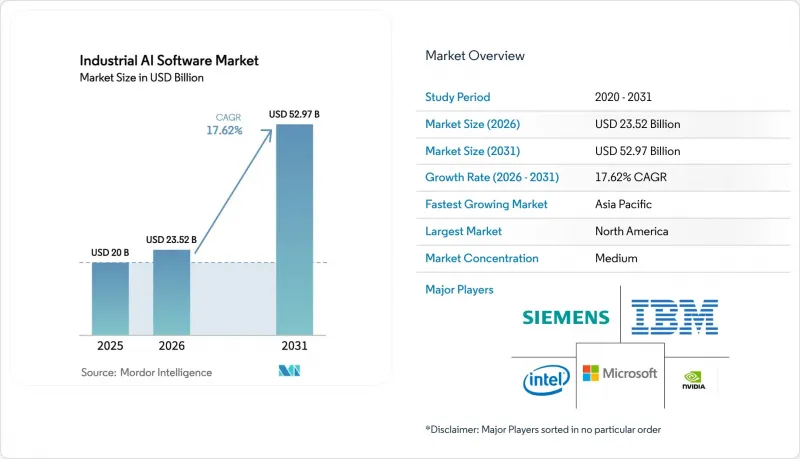
本報告按部署類型(雲端和本地部署)、最終用戶產業(汽車和運輸、零售和消費品、醫療保健和生命科學、航太和國防等)、應用(預測性維護、品質檢測和影像處理、流程最佳化等)和地區進行分類。
全球工業人工智慧軟體市場趨勢與洞察
預測性維護的引入減少了意外停機時間。
目前,工廠正從基於日曆的維護轉向人工智慧主導的例行維護,從而將維護預算降低25-30%,並將故障率降低70-75%。田納西河谷管理局 (TVA) 已證明,即使是資本密集型公共產業,透過實施人工智慧驅動的電網控制也能顯著降低成本,該方案在兩個月內避免了4萬戶用戶的停電。博世安斯巴赫工廠已將缺陷檢測轉移到基於邊緣的視覺人工智慧,最大限度地減少了延遲,使檢測人員能夠專注於更高價值的任務。具有前瞻性的營運商高度重視這些優勢,因為每意外停機一小時都可能造成超過5萬美元的損失。
不斷成長的工業巨量資料流
目前,即使是單一工廠每天也能產生Terabyte的感測器數據,這為機器學習模型提供了豐富的素材。一家公司每天在122家工廠產生1億個資料點,這也解釋了為什麼數據基礎設施正在向雲端原生數據湖轉型,以支援人工智慧管道的運作。然而,命名規則不一致和孤立的歷史資料庫仍然是瓶頸,迫使資訊長投資語義層,以提高模型精度並縮短訓練週期。
對資料主權和智慧財產權保護的擔憂
歐盟人工智慧法規將許多工廠車間演算法歸類為高風險,要求在工廠內資料保存並建立審計追蹤。因此,跨國製造商正在推出主權雲,以便在滿足居住要求的同時,繼續利用超大規模人工智慧服務(aws.amazon.com)。 AWS 已為這些歐洲區域撥款 78 億歐元。雖然單獨部署會增加成本,但企業正在權衡違規。
細分市場分析
到2025年,基於雲端的解決方案將佔據工業人工智慧軟體市場60.58%的佔有率。隨著企業將工作負載整合到可擴展的按需收費平台上,雲端解決方案實現了最強勁的成長,到2031年複合年成長率將達到19.65%。預計到2031年,採用雲端技術的工業人工智慧軟體市場規模將達到355.4億美元,反映出人們對多租戶安全模型的信心日益增強。混合架構透過將敏感資料集隔離在區域節點上,同時將匿名化特徵提供給中央模型訓練中心,進一步緩解了資料主權方面的擔憂。
在對延遲精度和資產管理要求極高的監管行業中,本地部署仍然至關重要。財富 2000 強製造商通常會維護本地叢集,以避免雲端使用激增帶來的不可預測的出站流量,但他們擴大使用與雲端相同的容器化技術堆疊來管理這些叢集。因此,這兩種部署模式正從競爭關係轉變為互補關係,從而推動了工業人工智慧軟體市場的持續成長。
區域分析
北美擁有強大的供應商和客戶生態系統以及深厚的雲端滲透率,預計2025年將佔據工業人工智慧軟體市場規模的36.45%。隨著製造商將認知功能升級置於傳統IT更新周期之上,預計僅IBM一家公司在2025年與生成式人工智慧相關的訂單就將達到60億美元。微軟透過將AI Copilot整合到其軟體堆疊中,並為工業開發人員提供預訓練模型,預計其營收將超過2,450億美元。
亞太地區引領成長,預計到2031年將以20.55%的複合年成長率持續成長。日本工廠正在試行應用人工智慧增強機器人,將停機時間降至幾乎為零;同時,中國的國家計畫正在加強對智慧製造群的補貼力度。預計到2025年,該地區的人工智慧投資將達到34億美元,幾乎是2024年的三倍。僅中國就實現了160%的成長,這充分錶明了政策主導的迫切性。
歐洲在數據主權問題上採取了嚴格的立場,引領產業發展。該地區的工業人工智慧軟體市場以GAIA-X等安全數據空間為核心,這些空間允許供應商共用遙測數據,而無需將控制權拱手讓給平台營運商。中東、非洲和南美洲的發展趨勢不一,但人工智慧的應用正在不斷成長。石油資源豐富的海灣國家正在利用人工智慧最佳化煉油廠的加工能力,而拉丁美洲的生產商則直接部署雲端原生人工智慧套件,跳過傳統的製造執行系統(MES)層,從而避免在成熟經濟體中面臨的技術債。
其他好處:
- Excel格式的市場預測(ME)表
- 3個月的分析師支持
目錄
第1章:引言
- 研究假設和市場定義
- 調查範圍
第2章:調查方法
第3章執行摘要
第4章 市場狀況
- 市場概覽
- 市場促進因素
- 預測性維護的引入減少了意外停機時間。
- 工業巨量資料流的總量正在增加。
- 各國工業4.0激勵計劃
- 人工智慧輔助駕駛將緩解工程領域的人手不足。
- 對範圍 3 排放進行強制性碳計量
- 市場限制因素
- 對資料主權和智慧財產權保護的擔憂
- 人員短缺,無法處理OT和AI的整合工作
- 由於傳統自動化基礎設施而導致的鎖定
- GPU硬體供應波動
- 價值鏈分析
- 監理情勢
- 技術展望
- 波特五力分析
第5章 市場規模與成長預測
- 依部署類型
- 基於雲端的
- 現場
- 按最終用戶行業分類
- 汽車和運輸業
- 零售和消費品
- 醫療保健和生命科學
- 航太/國防
- 能源公用事業
- 其他行業
- 透過使用
- 預測性保護
- 品質檢驗和視覺
- 流程最佳化
- 供應鏈和資產追蹤
- 安全與合規性分析
- 按地區
- 北美洲
- 南美洲
- 歐洲
- 亞太地區
- 中東和非洲
第6章 競爭情勢
- 市場集中度
- 策略趨勢
- 市佔率分析
- 公司簡介
- IBM Corporation
- Intel Corporation
- NVIDIA Corporation
- Microsoft Corporation
- Siemens AG
- Oracle Corporation
- Cisco Systems Inc.
- Veritone Inc.
- Advanced Micro Devices
- Google LLC
- GE Vernova
- Honeywell International
- ABB Ltd.
- Schneider Electric SE
- Rockwell Automation
- Bosch Rexroth AG
- Amazon Web Services
- Hitachi Ltd.
- PTC Inc.
- AspenTech
第7章 市場機會與未來展望
According to Mordor Intelligence, industrial AI software market size in 2026 is estimated at USD 23.52 billion, growing from 2025 value of USD 20 billion with 2031 projections showing USD 52.97 billion, growing at 17.62% CAGR over 2026-2031.
This report is Segmented by Deployment Type (Cloud-Based and On-Premise), End-User Industry (Automotive and Transportation, Retail and CPG, Healthcare and Life Sciences, Aerospace and Defense, and More), Application (Predictive Maintenance, Quality Inspection and Vision, Process Optimization, and More), and Geography.
Global Industrial AI Software Market Trends and Insights
Predictive-maintenance adoption cuts unplanned downtime
Plants now slash maintenance budgets by 25-30% and breakdowns by 70-75% after switching from calendar-based to AI-led routines. Tennessee Valley Authority spared 40,000 customer outages in two months by using AI-driven grid controls, proving that cost avoidance scales well in capital-intensive utilities. Bosch's Ansbach site moved defect detection to edge-based vision AI, keeping latency low and inspectors focused on higher-value tasks. Forward-looking operators view these gains as vital because every hour of unplanned stoppage can cost USD 50,000 or more.
Growing volumes of industrial big-data streams
Single factories now generate terabytes of sensor output per day, creating fertile ground for machine-learning models. Ndustrial processes 100 million data points daily across 122 plants, illustrating why data infrastructure is edging toward cloud-native lakes that feed AI pipelines. Yet inconsistent naming conventions and siloed historians remain bottlenecks, urging CIOs to invest in semantic layers that boost model accuracy and shorten training cycles.
Data-sovereignty and IP-protection concerns
The EU AI Act categorizes many factory-floor algorithms as high-risk, mandating local data retention and audit trails. Multinational manufacturers, therefore, spin up sovereign clouds, AWS earmarked EUR 7.8 billion for such European zones, to meet residency rules while still tapping hyperscale AI services aws.amazon.com. Separate deployments inflate costs, but firms weigh them against the penalties of non-compliance.
Other drivers and restraints analyzed in the detailed report include:
- National Industry 4.0 incentive programs
- Generative-AI copilots ease engineering labor shortages
- Scarcity of OT-AI integration talent
For complete list of drivers and restraints, kindly check the Table Of Contents.
Segment Analysis
Cloud-based solutions accounted for 60.58% of the Industrial AI Software market share in 2025 and posted the strongest trajectory at 19.65% CAGR through 2031 as firms consolidate workloads on scalable, pay-as-you-grow platforms. The Industrial AI Software market size for cloud deployments is forecast to reach USD 35.54 billion by 2031, reflecting rising confidence in multi-tenant security models. Hybrid architectures further alleviate sovereignty fears by isolating sensitive datasets on regional nodes while feeding anonymized features to central model training hubs.
On-premise installations remain critical in regulated verticals that demand deterministic latency and strict asset control. Fortune 2000 manufacturers often retain on-site clusters to dodge unpredictable egress fees from cloud activity spikes, yet they increasingly orchestrate these clusters through the same containerized stacks used in the cloud. Consequently, both deployment archetypes now complement rather than cannibalize each other, stimulating continual spending across the Industrial AI Software market.
Complete Report Scope:
- By Deployment Type
- Cloud-based
- On-premise
- By End-user Industry
- Automotive and Transportation
- Retail and CPG
- Healthcare and Life Sciences
- Aerospace and Defense
- Energy and Utilities
- Other Industries
- By Application
- Predictive Maintenance
- Quality Inspection and Vision
- Process Optimization
- Supply-chain and Asset Tracking
- Safety and Compliance Analytics
- By Geography
- North America
- South America
- Europe
- Asia-Pacific
- Middle East and Africa
Geography Analysis
North America contributed 36.45% of the Industrial AI Software market size in 2025, thanks to strong vendor-customer ecosystems and deep cloud penetration. IBM alone booked USD 6 billion in generative-AI orders in 2025 as manufacturers prioritized cognitive upgrades over traditional IT refresh cycles. Microsoft surpassed USD 245 billion in revenue by integrating AI copilots into its software stack, supporting industrial developers with pre-trained models.
Asia-Pacific is the speed leader, expanding at 20.55% CAGR to 2031. Japan's factories pilot AI-augmented robotics that showcase near-zero downtime, while Chinese state programs funnel subsidies into smart manufacturing clusters. Regional AI investments are set to reach USD 3.4 billion in 2025, nearly triple 2024 outlays, and a 160% bump in China alone illustrates policy-driven urgency.
Europe follows close behind, shaped by rigor around data sovereignty. The Industrial AI Software market here pivots on secure data-spaces such as GAIA-X that let suppliers share telemetry without ceding control to platform operators. Middle East, Africa, and South America charts show mixed but rising adoption. Oil-rich Gulf nations adopt AI to optimize refinery throughput, whereas Latin American producers leapfrog legacy MES layers by directly adopting cloud-native AI suites, sidestepping the technical debt faced in mature economies.
- IBM Corporation
- Intel Corporation
- NVIDIA Corporation
- Microsoft Corporation
- Siemens AG
- Oracle Corporation
- Cisco Systems Inc.
- Veritone Inc.
- Advanced Micro Devices
- Google LLC
- GE Vernova
- Honeywell International
- ABB Ltd.
- Schneider Electric SE
- Rockwell Automation
- Bosch Rexroth AG
- Amazon Web Services
- Hitachi Ltd.
- PTC Inc.
- AspenTech
Additional Benefits:
- The market estimate (ME) sheet in Excel format
- 3 months of analyst support
TABLE OF CONTENTS
1 INTRODUCTION
- 1.1 Study Assumptions and Market Definition
- 1.2 Scope of the Study
2 RESEARCH METHODOLOGY
3 EXECUTIVE SUMMARY
4 MARKET LANDSCAPE
- 4.1 Market Overview
- 4.2 Market Drivers
- 4.2.1 Predictive-maintenance adoption cuts unplanned downtime
- 4.2.2 Growing volumes of industrial big-data streams
- 4.2.3 National Industry 4.0 incentive programs
- 4.2.4 Generative-AI copilots ease engineering labor shortages
- 4.2.5 Carbon-accounting mandates for Scope-3 emissions
- 4.3 Market Restraints
- 4.3.1 Data-sovereignty and IP-protection concerns
- 4.3.2 Scarcity of OT-AI integration talent
- 4.3.3 Legacy automation infrastructure lock-in
- 4.3.4 GPU-hardware supply volatility
- 4.4 Value Chain Analysis
- 4.5 Regulatory Landscape
- 4.6 Technological Outlook
- 4.7 Porter's Five Forces Analysis
- 4.7.1 Bargaining Power of Buyers
- 4.7.2 Bargaining Power of Suppliers
- 4.7.3 Threat of New Entrants
- 4.7.4 Threat of Substitutes
- 4.7.5 Intensity of Competitive Rivalry
5 MARKET SIZE AND GROWTH FORECASTS (VALUE)
- 5.1 By Deployment Type
- 5.1.1 Cloud-based
- 5.1.2 On-premise
- 5.2 By End-user Industry
- 5.2.1 Automotive and Transportation
- 5.2.2 Retail and CPG
- 5.2.3 Healthcare and Life Sciences
- 5.2.4 Aerospace and Defense
- 5.2.5 Energy and Utilities
- 5.2.6 Other Industries
- 5.3 By Application
- 5.3.1 Predictive Maintenance
- 5.3.2 Quality Inspection and Vision
- 5.3.3 Process Optimization
- 5.3.4 Supply-chain and Asset Tracking
- 5.3.5 Safety and Compliance Analytics
- 5.4 By Geography
- 5.4.1 North America
- 5.4.2 South America
- 5.4.3 Europe
- 5.4.4 Asia-Pacific
- 5.4.5 Middle East and Africa
6 COMPETITIVE LANDSCAPE
- 6.1 Market Concentration
- 6.2 Strategic Moves
- 6.3 Market Share Analysis
- 6.4 Company Profiles (includes Global level Overview, Market level overview, Core Segments, Financials as available, Strategic Information, Market Rank/Share for key companies, Products and Services, and Recent Developments)
- 6.4.1 IBM Corporation
- 6.4.2 Intel Corporation
- 6.4.3 NVIDIA Corporation
- 6.4.4 Microsoft Corporation
- 6.4.5 Siemens AG
- 6.4.6 Oracle Corporation
- 6.4.7 Cisco Systems Inc.
- 6.4.8 Veritone Inc.
- 6.4.9 Advanced Micro Devices
- 6.4.10 Google LLC
- 6.4.11 GE Vernova
- 6.4.12 Honeywell International
- 6.4.13 ABB Ltd.
- 6.4.14 Schneider Electric SE
- 6.4.15 Rockwell Automation
- 6.4.16 Bosch Rexroth AG
- 6.4.17 Amazon Web Services
- 6.4.18 Hitachi Ltd.
- 6.4.19 PTC Inc.
- 6.4.20 AspenTech
7 MARKET OPPORTUNITIES AND FUTURE OUTLOOK
- 7.1 White-space and Unmet-need Assessment

 行動遊戲品質保證測試市場:全球市場預測,2026-2032年
 2035年軟體開發領域生成式人工智慧的全球市場:機會與策略
 英國人工智慧能源管理軟體:市場佔有率分析、行業趨勢和統計數據以及成長預測(2026-2031 年)
 人工智慧內容生成市場:按內容類型、技術、應用、最終用戶和地區分類軟體開發生命週期中生成式人工智慧的全球市場:機會與策略展望(至2035年)基於代理的人工智慧框架:市場佔有率分析、行業趨勢和統計數據、成長預測(2026-2031 年)全球人工智慧(AI)內容生成市場:到2035年的機會與策略
 2026-2030年全球工業人工智慧軟體市場人工智慧驅動的軟體測試和品質保證:市場佔有率分析、行業趨勢和統計數據以及成長預測(2026-2031 年)
 2026-2034年全球基於代理的AI框架市場規模、佔有率、趨勢和成長分析報告