


 |
市場調查報告書
商品編碼
2063666
人工智慧驅動的軟體測試和品質保證:市場佔有率分析、行業趨勢和統計數據以及成長預測(2026-2031 年)AI-Powered Software Testing And QA - Market Share Analysis, Industry Trends & Statistics, Growth Forecasts (2026 - 2031) |
||||||

※ 本網頁內容可能與最新版本有所差異。詳細情況請與我們聯繫。
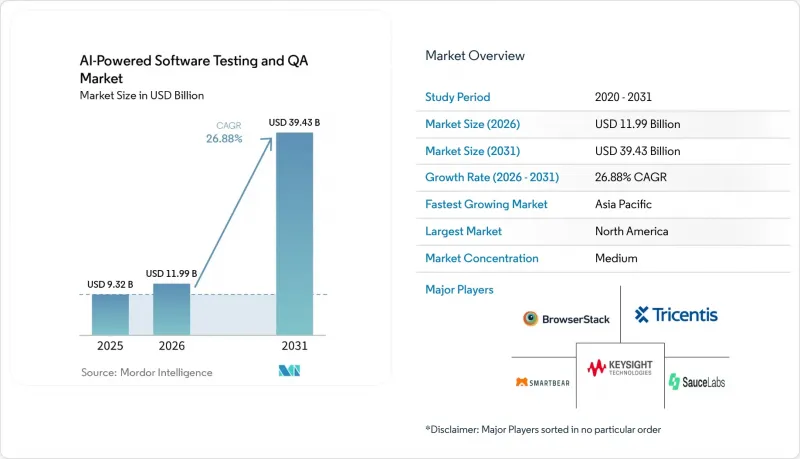
根據 Mordor Intelligence 預測,人工智慧驅動的軟體測試和品質保證市場預計將從 2025 年的 93.2 億美元成長到 2026 年的 119.9 億美元,然後在 2031 年達到 394.3 億美元,2026 年至 2031 年的複合成長率為 26.8%。
本報告按組件(軟體和服務)、部署模式(雲端和本地部署)、測試類型(功能測試、效能測試、安全測試、回歸測試等)、最終用戶產業(IT和電信、銀行、金融服務和保險、醫療保健和生命科學、零售和電子商務等)以及地區進行細分。市場預測以美元(USD)為單位。
全球人工智慧驅動的軟體測試及品質保證市場趨勢及洞察
將持續測試流程納入主流
為了確保程式碼、基礎設施和安全控制在一次操作中檢驗,各組織正在將品質門整合到其持續整合/持續交付 (CI/CD) 工作流程中。在發生一系列重大零時差攻擊後,61% 的公司現在在開發的每個階段都運作AI 測試引擎,將發布週期從數週縮短到數小時。歐盟 NIS2 指令順應了這一趨勢,透過強制關鍵服務提供者接受事件回應培訓,將持續測試作為合規的先決條件。自動化測試選擇演算法透過將計算資源分配給風險最高的程式碼路徑,進一步減少了重複執行。
微服務架構日益複雜化
單一雲端系統可以包含數百個鬆散耦合的服務。檢驗數千種 API 組合遠遠超出人工檢驗的能力。人工智慧驅動的合約測試工具可根據 OpenAPI 規格自動產生互動存根,從而在運作環境調查中將服務間的故障率降低 40%。部署 5G 核心網路的通訊業者認為這些工具對於滿足 10 毫秒以下的延遲閾值至關重要。服務網格路由進一步增加了系統的可變性,因此需要混沌工程平台來注入可控故障,並允許團隊即時觀察級聯效應。
測試資料湖中的資料隱私問題
將生產資料複製到非生產環境違反了 GDPR 第 25 條。在 2025 年的打擊行動中,此類違規行為平均被處以 210 萬歐元(約 224 萬美元)的罰款。諸如 Synthesized 之類的合成資料生成工具使用差分隱私演算法來創建統計資訊豐富但匿名化的資料集。然而,分佈漂移仍然是一個挑戰,尤其是在金融犯罪檢測領域,微妙的圖模式至關重要。機密運算區域會對使用中的資料進行加密,但其延遲開銷使其不適用於高吞吐量效能測試。
細分市場分析
到2025年,服務收入佔總收入的36.79%,預計將以27.28%的複合年成長率成長,並超越軟體訂閱。部署合作夥伴正擴大設計合成資料管道,並管理能夠監控漂移的自癒式測試機器人。製藥公司正將其臨床試驗平台的驗證工作外包給持有FDA Part 11和歐盟Annex 11認證的認證專家,這表明合規性正在推動服務的普及。相較之下,超大規模資料中心業者將基本功能整合到其平台中,通用測試自動化許可證正面臨商品化的壓力。儘管如此,用於混沌工程和邊緣設備驗證的細分軟體模組仍然保持著定價權。
在業界先進技術日益普及的推動下,軟體平台的AI驅動型軟體測試和品質保證市場依然龐大。嵌入式分析能夠為負責人提供模型行為的詳細解釋,透過確保透明度和合規性,在維持企業合約續約率方面發揮著至關重要的作用。然而,市場技能長期短缺迫使企業簽訂多年期託管測試契約,導致其預算的很大一部分被分配給服務供應商。這種情況凸顯了一種雙重趨勢:儘管自主代理和自動化技術不斷發展和成熟,但服務預計將持續成長。
預計到 2025 年,雲端平台將佔總收入的 72.48%,這反映了同時啟動數千個瀏覽器執行個體的經濟效益。彈性網格顯著降低了以往本地設備集群所需的資本投入,並透過基於使用量的收費,根據峰值需求調整成本。雖然面向雲端部署的 AI 軟體測試和品質保證市場正在穩步擴張,但對延遲敏感的汽車和航太工作負載仍然依賴空氣間隙的測試環境來滿足安全標準。因此,企業正在採用混合拓撲結構,在雲端運行功能測試套件,同時在符合資料主權法律的本地基礎架構上進行效能和安全性測試。
供應商藍圖如今優先考慮的是無縫的工件可移植性,這使得在雲端運行的失敗測試能夠在本地環境中復現,而不會丟失任何遙測資料。這項功能使企業能夠在不同的環境中保持測試流程的一致性和準確性。此外,計量收費模式的引入使得預算預測更加困難,促使採購團隊倡導設定每月支出上限以有效控制成本。因此,企業的採用策略發生了巨大變化。如今,企業不再需要在雲端解決方案和本地解決方案之間做出選擇;大多數大型企業正在採用混合方法,整合公有、私有和邊緣運算資源,以最佳化效能和柔軟性。
區域分析
北美仍然是重要的收入中心,這得益於其超大規模資料中心業者中心生態系統和軟體新創企業的密集聚集。在採購預算中,能夠與成熟的DevSecOps工具鏈無縫整合並提供可解釋儀錶板(這是企業管治委員會的關鍵要求)的供應商變得越來越重要。然而,儘管北美仍保持主導地位,但不斷上漲的基礎設施能源成本正促使企業將其人工智慧推理工作負載轉移到成本效益更高的地區。這種轉變為亞太地區的供應商提供了拓展市場佔有率和提升全球市場佔有率的機會。
亞太地區正以27.52%的驚人複合年成長率崛起為成長最快的地區,這主要得益於積極的數位化政府措施、半導體自給自足的努力以及人工智慧研究人才的快速成長。印度和新加坡等國政府正積極資助人工智慧測試平台建設以促進創新,而中國企業則大力投資硬體在環(HIL)設備,以支持國產晶片的研發。電信、銀行和公共部門等行業的成功案例正被推廣到其他領域,進一步加速了全部區域自主測試解決方案的普及應用。
在歐洲,在更嚴格的法規結構支援下,人工智慧產業持續穩定成長。歐盟人工智慧法案下的合規程序推動了對第三方認證和檢驗服務的需求,為本地顧問公司創造了蓬勃發展的利基市場。此外,歐洲嚴格的資料保護法使該地區成為合成資料平台的早期採用者,這些平台正在各個行業中廣泛應用。同時,中東和非洲正專注於智慧城市計畫和自動駕駛交通先導計畫,並經常依賴外部專家來解決這些領域的技能短缺問題。雖然南美洲的採用速度較慢,但巴西快速發展的金融科技產業表明,區域性法規,例如即時支付方案的合規性,可以刺激特定需求並推動特定細分市場的成長。
其他好處:
- Excel格式的市場預測(ME)表
- 3個月的分析師支持
目錄
第1章:引言
- 研究假設和市場定義
- 調查範圍
第2章:調查方法
第3章執行摘要
第4章 市場狀況
- 市場概覽
- 市場促進因素
- 將持續測試流程納入主流
- 微服務架構日益複雜化
- 擴大雲端原生應用程式的採用
- 監管機構日益重視軟體可靠性
- 向自主測試代理過渡
- 品質保證中合成資料產生的興起
- 市場限制因素
- 測試資料湖中的資料隱私問題
- 人工智慧測試專家短缺
- 不透明的黑箱人工智慧模型決策
- 人工智慧品質保證工具缺乏基準標準
- 宏觀經濟因素對市場的影響
- 產業價值鏈分析
- 監理情勢
- 技術展望
- 波特五力分析
第5章 市場規模與成長預測
- 按組件
- 軟體
- 服務
- 部署模式
- 雲
- 現場
- 按測試類型
- 功能測試
- 性能測試
- 安全測試
- 回歸測試
- 其他測試類型
- 按最終用戶行業分類
- 資訊科技/通訊
- BFSI
- 醫療保健和生命科學
- 零售與電子商務
- 製造業
- 其他終端用戶產業
- 按地區
- 北美洲
- 美國
- 加拿大
- 墨西哥
- 南美洲
- 巴西
- 阿根廷
- 其他南美國家
- 歐洲
- 英國
- 德國
- 法國
- 義大利
- 西班牙
- 其他歐洲國家
- 亞太地區
- 中國
- 日本
- 印度
- 韓國
- 其他亞太國家
- 中東和非洲
- 中東
- 阿拉伯聯合大公國
- 沙烏地阿拉伯
- 其他中東國家
- 非洲
- 南非
- 埃及
- 其他非洲國家
- 中東
- 北美洲
第6章 競爭情勢
- 市場集中度
- 策略趨勢
- 市佔率分析
- 公司簡介
- Tricentis GmbH
- SmartBear Software, Inc.
- Applitools Ltd.
- Sauce Labs, Inc.
- LambdaTest, Inc.
- Mabl Inc.
- Functionize, Inc.
- ACCELQ Inc.
- Parasoft Corporation
- Eggplant Software Ltd.
- Keysight Technologies, Inc.
- Cigniti Technologies Limited
- Qualitest Group Ltd.
- Mindful QA, LLC
- Test IO Inc.
- Rainforest QA Inc.
- Leapwork A/S
- Testsigma Technologies Inc.
- BrowserStack Limited
- Perfecto Mobile Ltd.
第7章 市場機會與未來展望
According to Mordor Intelligence, the aI-powered software testing and QA market size is expected to grow from USD 9.32 billion in 2025 to USD 11.99 billion in 2026 and is forecast to reach USD 39.43 billion by 2031 at a 26.88% CAGR over 2026-2031.
This report is Segmented by Component (Software, and Services), Deployment Mode (Cloud, and On-Premise), Testing Type (Functional Testing, Performance Testing, Security Testing, Regression Testing, and More), End-User Industry (IT and Telecom, BFSI, Healthcare and Life Sciences, Retail and E-Commerce, and More), and Geography. The Market Forecasts are Provided in Terms of Value (USD).
Global AI-Powered Software Testing And QA Market Trends and Insights
Mainstream Adoption of Continuous Testing Pipelines
Organizations embed quality gates inside CI/CD workflows so that code, infrastructure, and security controls are validated in a single transaction. After a series of critical zero-day exploits, 61% of enterprises now run AI test engines across every development stage, slashing release cycles from weeks to hours. Europe's NIS2 Directive builds on this momentum by requiring incident-response drills for essential service operators, making continuous testing a compliance prerequisite. Automated test-selection algorithms further reduce redundant executions by allocating compute budgets to the riskiest code paths.
Rising Complexity of Microservices Architectures
A single cloud system can contain hundreds of loosely coupled services; validating the thousands of possible API pairs is beyond the capacity of manual validation. AI-powered contract-testing tools auto-generate interaction stubs from OpenAPI specs, reducing inter-service defect rates by 40% in production studies. Telecommunications providers deploying 5G core networks view such tooling as essential to meet sub-10 ms latency thresholds. Service-mesh routing adds still more variability, forcing chaos-engineering platforms to inject controlled failures so teams can observe cascade effects in real time.
Data Privacy Concerns in Test-Data Lakes
Copying production data into non-production environments violates GDPR Article 25, a lapse that triggered average fines of EUR 2.1 million (USD 2.24 million) during a 2025 enforcement sweep. Synthetic-data generators like Synthesized use differential privacy algorithms to create statistically rich, yet anonymized, datasets. Yet distribution drift remains a hurdle, especially in financial crime detection, where subtle graph patterns matter. Confidential computing enclaves encrypt data in use, though the latency overhead makes them impractical for high-throughput performance testing.
Other drivers and restraints analyzed in the detailed report include:
- Growing Cloud-Native Application Deployments
- Increasing Regulatory Emphasis on Software Reliability
- Shortage of Skilled AI Testing Professionals
For complete list of drivers and restraints, kindly check the Table Of Contents.
Segment Analysis
Services accounted for 36.79% of 2025 revenue yet are projected to climb at a 27.28% CAGR, outpacing software subscriptions. Implementation partners increasingly design synthetic-data pipelines and monitor self-healing test bots for drift. Pharmaceutical firms outsource validation of clinical-trial platforms to certified specialists who maintain FDA Part 11 and EU Annex 11 credentials, illustrating how compliance drives services uptake. In contrast, commoditization pressure weighs on generic test-automation licenses as hyperscalers embed baseline capabilities into their platforms. Even so, niche software modules for chaos engineering or edge-device validation retain pricing power.
The AI-powered software testing and QA market size for software platforms remains significant, driven by the increasing adoption of advanced technologies across industries. Embedded analytics, which provide detailed explanations of model actions to auditors, play a crucial role in maintaining enterprise renewal rates by ensuring transparency and compliance. However, a persistent skills deficit in the market compels organizations to enter into multi-year managed-testing agreements, thereby shifting a significant portion of their budget toward service providers. This scenario highlights a dual trend, such as services are expected to gain momentum even as autonomous agents and automation technologies continue to evolve and mature.
Cloud platforms captured 72.48% of 2025 revenue, reflecting the economics of spinning up thousands of browser instances simultaneously. Elastic grids slash capital outlays once required for on-premise device farms, and usage-based billing aligns cost with demand peaks. The AI-powered software testing and QA market for cloud deployments is expanding steadily, but latency-sensitive automotive and aerospace workloads still rely on air-gapped rigs to meet safety standards. As a result, enterprises adopt hybrid topologies, running functional suites in the cloud while reserving performance and security testing for local infrastructure that complies with data-sovereignty laws.
Vendor roadmaps now prioritize seamless artifact portability, ensuring that a failing test executed in the cloud can be replayed on an on-premise bench without any loss of telemetry data. This capability allows organizations to maintain consistency and accuracy in their testing processes across different environments. Additionally, the adoption of consumption-based pricing models has introduced budget unpredictability, prompting procurement teams to advocate for monthly spending caps to manage costs effectively. As a result, organizations' deployment strategies have evolved significantly. It is no longer a binary choice between cloud and on-premises solutions; most large enterprises are adopting a hybrid approach that integrates public, private, and edge computing resources to optimize performance and flexibility.
Geography Analysis
North America remains the revenue epicenter, driven by hyperscaler ecosystems and a dense concentration of software start-ups. Procurement budgets increasingly favor vendors that seamlessly integrate with mature DevSecOps toolchains and offer explainability dashboards, which corporate governance committees highly seek after. However, despite maintaining its lead, rising infrastructure energy costs in North America are prompting enterprises to shift AI inference workloads to more cost-efficient regions. This shift is creating opportunities for Asia-Pacific providers to expand their market presence and capture a larger share of the global market.
Asia-Pacific is emerging as the fastest-growing region, with a remarkable 27.52% CAGR, driven by a combination of aggressive digital government initiatives, efforts to achieve semiconductor self-sufficiency, and a rapidly expanding pool of AI research talent. Governments in countries like India and Singapore are actively funding AI testbeds to foster innovation, while Chinese firms are heavily investing in hardware-in-the-loop rigs to support the development of home-grown chips. The replication of successful practices across industries such as telecommunications, banking, and the public sector is further accelerating the adoption of autonomous testing solutions throughout the region.
Europe continues to grow at a steady pace, supported by increasingly stringent regulatory frameworks. The EU AI Act's conformity procedures are driving demand for certified third-party validation services, creating a niche market where local consultancies are thriving. Additionally, the continent's strict data-protection laws have positioned Europe as an early adopter of synthetic-data platforms, which are gaining traction across various industries. Meanwhile, the Middle East and Africa are focusing on smart-city initiatives and autonomous-transit pilot projects, often relying on imported expertise to address skill shortages in these areas. In South America, adoption is progressing at a slower pace, but Brazil's burgeoning fintech sector demonstrates how localized regulations, such as compliance with instant-payment schemes, can stimulate targeted bursts of demand and drive growth in specific market segments.
- Tricentis GmbH
- SmartBear Software, Inc.
- Applitools Ltd.
- Sauce Labs, Inc.
- LambdaTest, Inc.
- Mabl Inc.
- Functionize, Inc.
- ACCELQ Inc.
- Parasoft Corporation
- Eggplant Software Ltd.
- Keysight Technologies, Inc.
- Cigniti Technologies Limited
- Qualitest Group Ltd.
- Mindful QA, LLC
- Test IO Inc.
- Rainforest QA Inc.
- Leapwork A/S
- Testsigma Technologies Inc.
- BrowserStack Limited
- Perfecto Mobile Ltd.
Additional Benefits:
- The market estimate (ME) sheet in Excel format
- 3 months of analyst support
TABLE OF CONTENTS
1 INTRODUCTION
- 1.1 Study Assumptions and Market Definition
- 1.2 Scope of the Study
2 RESEARCH METHODOLOGY
3 EXECUTIVE SUMMARY
4 MARKET LANDSCAPE
- 4.1 Market Overview
- 4.2 Market Drivers
- 4.2.1 Mainstream Adoption of Continuous Testing Pipelines
- 4.2.2 Rising Complexity of Microservices Architectures
- 4.2.3 Growing Cloud-Native Application Deployments
- 4.2.4 Increasing Regulatory Emphasis on Software Reliability
- 4.2.5 Shift Toward Autonomous Testing Agents
- 4.2.6 Emergence of Synthetic Data Generation for QA
- 4.3 Market Restraints
- 4.3.1 Data Privacy Concerns in Test-Data Lakes
- 4.3.2 Shortage of Skilled AI Testing Professionals
- 4.3.3 Opaque Black-Box AI Model Decisions
- 4.3.4 Limited Benchmarking Standards for AI QA Tools
- 4.4 Impact of Macroeconomic Factors on the Market
- 4.5 Industry Value Chain Analysis
- 4.6 Regulatory Landscape
- 4.7 Technological Outlook
- 4.8 Porter's Five Forces Analysis
- 4.8.1 Bargaining Power of Suppliers
- 4.8.2 Bargaining Power of Buyers
- 4.8.3 Threat of New Entrants
- 4.8.4 Threat of Substitutes
- 4.8.5 Intensity of Competitive Rivalry
5 MARKET SIZE AND GROWTH FORECASTS (VALUE)
- 5.1 By Component
- 5.1.1 Software
- 5.1.2 Services
- 5.2 By Deployment Mode
- 5.2.1 Cloud
- 5.2.2 On-Premise
- 5.3 By Testing Type
- 5.3.1 Functional Testing
- 5.3.2 Performance Testing
- 5.3.3 Security Testing
- 5.3.4 Regression Testing
- 5.3.5 Other Testing Types
- 5.4 By End-user Industry
- 5.4.1 IT and Telecom
- 5.4.2 BFSI
- 5.4.3 Healthcare and Life Sciences
- 5.4.4 Retail and E-commerce
- 5.4.5 Manufacturing
- 5.4.6 Other End-user Industries
- 5.5 By Geography
- 5.5.1 North America
- 5.5.1.1 United States
- 5.5.1.2 Canada
- 5.5.1.3 Mexico
- 5.5.2 South America
- 5.5.2.1 Brazil
- 5.5.2.2 Argentina
- 5.5.2.3 Rest of South America
- 5.5.3 Europe
- 5.5.3.1 United Kingdom
- 5.5.3.2 Germany
- 5.5.3.3 France
- 5.5.3.4 Italy
- 5.5.3.5 Spain
- 5.5.3.6 Rest of Europe
- 5.5.4 Asia-Pacific
- 5.5.4.1 China
- 5.5.4.2 Japan
- 5.5.4.3 India
- 5.5.4.4 South Korea
- 5.5.4.5 Rest of Asia-Pacific
- 5.5.5 Middle East and Africa
- 5.5.5.1 Middle East
- 5.5.5.1.1 United Arab Emirates
- 5.5.5.1.2 Saudi Arabia
- 5.5.5.1.3 Rest of Middle East
- 5.5.5.2 Africa
- 5.5.5.2.1 South Africa
- 5.5.5.2.2 Egypt
- 5.5.5.2.3 Rest of Africa
- 5.5.5.1 Middle East
- 5.5.1 North America
6 COMPETITIVE LANDSCAPE
- 6.1 Market Concentration
- 6.2 Strategic Moves
- 6.3 Market Share Analysis
- 6.4 Company Profiles (includes Global Level Overview, Market Level Overview, Core Segments, Financials as available, Strategic Information, Market Rank/Share, Products and Services, Recent Developments)
- 6.4.1 Tricentis GmbH
- 6.4.2 SmartBear Software, Inc.
- 6.4.3 Applitools Ltd.
- 6.4.4 Sauce Labs, Inc.
- 6.4.5 LambdaTest, Inc.
- 6.4.6 Mabl Inc.
- 6.4.7 Functionize, Inc.
- 6.4.8 ACCELQ Inc.
- 6.4.9 Parasoft Corporation
- 6.4.10 Eggplant Software Ltd.
- 6.4.11 Keysight Technologies, Inc.
- 6.4.12 Cigniti Technologies Limited
- 6.4.13 Qualitest Group Ltd.
- 6.4.14 Mindful QA, LLC
- 6.4.15 Test IO Inc.
- 6.4.16 Rainforest QA Inc.
- 6.4.17 Leapwork A/S
- 6.4.18 Testsigma Technologies Inc.
- 6.4.19 BrowserStack Limited
- 6.4.20 Perfecto Mobile Ltd.
7 MARKET OPPORTUNITIES AND FUTURE OUTLOOK
- 7.1 White-Space and Unmet-Need Assessment

 行動遊戲品質保證測試市場:全球市場預測,2026-2032年
 工業人工智慧軟體:市場佔有率分析、產業趨勢與統計、成長預測(2026-2031)
 2035年軟體開發領域生成式人工智慧的全球市場:機會與策略英國人工智慧能源管理軟體:市場佔有率分析、行業趨勢和統計數據以及成長預測(2026-2031 年)
 人工智慧內容生成市場:按內容類型、技術、應用、最終用戶和地區分類軟體開發生命週期中生成式人工智慧的全球市場:機會與策略展望(至2035年)基於代理的人工智慧框架:市場佔有率分析、行業趨勢和統計數據、成長預測(2026-2031 年)全球人工智慧(AI)內容生成市場:到2035年的機會與策略
 2026-2030年全球工業人工智慧軟體市場
 2026-2034年全球基於代理的AI框架市場規模、佔有率、趨勢和成長分析報告